
Quick answer
Sunapha, Anapha and Durudhara are Moon yogas. Sunapha forms when a planet other than the Sun sits in the 2nd house from the Moon, Anapha when one sits in the 12th, and Durudhara when both sides are occupied. They are the opposite of Kemadruma, and the tradition reads them as a supported mind, with each planet adding its own colour.
What are Sunapha, Anapha and Durudhara yoga?
Sunapha yoga is a Moon combination that forms when any planet other than the Sun occupies the 2nd house counted from the Moon. Anapha yoga is the mirror image, a planet in the 12th from the Moon, and Durudhara yoga forms when both the 2nd and the 12th from the Moon are occupied. Varahamihira's Brihat Jataka and later texts describe all three as yogas of a Moon that is accompanied rather than alone.
Most traditions leave Rahu and Ketu out, as they do for Kemadruma; some include them, and traditions differ. A full kundli reading names which rule is being used before naming the yoga.
Why are they the other side of Kemadruma?
Kemadruma is the yoga of a Moon with nothing in the 2nd or 12th from it, again leaving out the Sun and the nodes. Sunapha, Anapha and Durudhara are what you get when that condition fails. Before any cancellation rules are applied, every chart has exactly one of the four.
That is worth sitting with. If a report has worried you with Kemadruma, the same geometry tells you that most people have one of these three instead, and that Kemadruma itself is often cancelled; Kemadruma and its cancellations explains how.
| 2nd from the Moon | 12th from the Moon | Yoga | Traditional image |
|---|---|---|---|
| Occupied | Empty | Sunapha | A mind that builds and gathers |
| Empty | Occupied | Anapha | A mind that carries itself well and lets go |
| Occupied | Occupied | Durudhara | A mind held from both sides |
| Empty | Empty | Kemadruma (before cancellations) | A mind that must find its own company |
Why does the 2nd from the Moon mean gathering?
The 2nd house is family, savings, speech and food: what a person collects and keeps. A planet in the 2nd from the Moon is read as something the mind keeps reaching towards and building up. The texts link Sunapha to self-earned wealth, a good reputation and an intelligent, purposeful mind.
The emphasis on self-earned is the useful part. Sunapha is read as resources gathered by one's own effort rather than inherited, which fits many migrants who arrive with little and build steadily. The second house of family and savings gives the background.
Why does the 12th from the Moon mean bearing and release?
The 12th is expense, sleep, retreat and letting go. A planet there from the Moon is read as something the mind has already passed through and carries lightly. The texts link Anapha to good health, a pleasing manner, self-respect and, in later life, a readiness to give things up.
The 12th is also where settling abroad is traditionally read, so Anapha is sometimes discussed by readers far from where they were born. The twelfth house of release and foreign lands covers that side of the house.
What does each planet add?
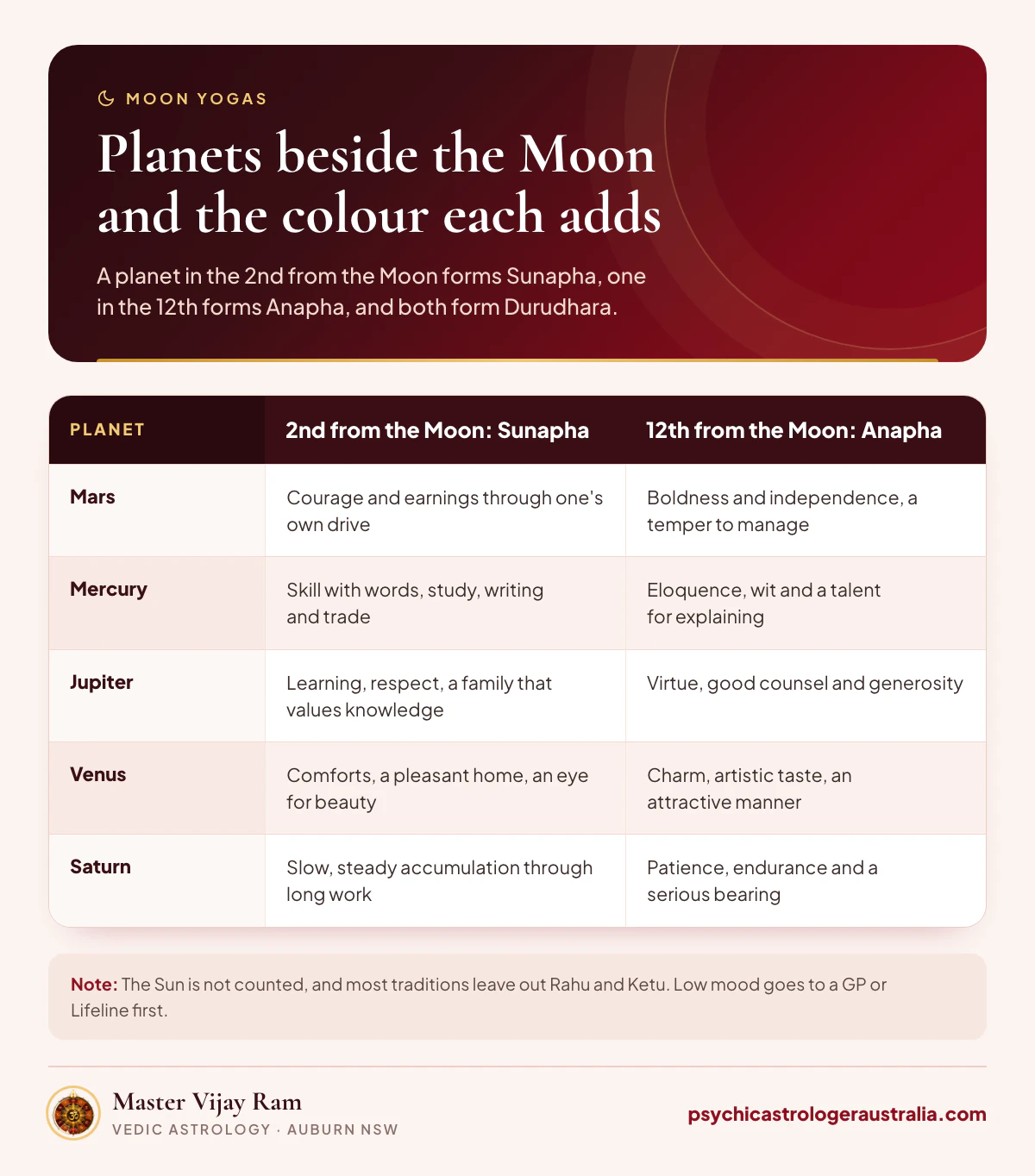
The yoga's name tells you which side is occupied; the planet tells you the colour. The texts give separate descriptions for each planet, and the summaries below follow their spirit rather than any one translation.
| Planet | In the 2nd from the Moon (Sunapha) | In the 12th from the Moon (Anapha) |
|---|---|---|
| Mars | Courage and earnings through one's own drive; property | Boldness, independence, a quick temper to manage |
| Mercury | Skill with words, study, writing and trade | Eloquence, wit, a talent for explaining |
| Jupiter | Learning, respect, a family that values knowledge | Virtue, good counsel, generosity |
| Venus | Comforts, a pleasant home, an eye for beauty | Charm, artistic taste, an attractive manner |
| Saturn | Slow, steady accumulation; land and long work | Patience, endurance, a modest and serious bearing |
Two planets on the same side blend their colours. A malefic on one side and a benefic on the other gives a mixed Durudhara, which is still a supported Moon.
What does Durudhara yoga add?
Durudhara combines the two, and the texts read it as a person with comforts, vehicles, good relations with family and generosity to others. The two flanking planets are read as two kinds of support, one gathering and one bearing, and the Moon between them as a mind that rarely feels alone.
The same geometry, planets on both sides of the Moon, can also be read as kartari: if both are benefics it is a protective embrace, if both malefics a squeeze. Shubha and papa kartari yoga explains that second reading, which asks about the planets' nature rather than their presence.
Why is the Sun left out?
The Sun is the source of the Moon's light, and in Jyotish a planet close to the Sun loses some independence. A Sun in the 2nd or 12th from the Moon also means a Moon within about two signs of the Sun, so close to the new Moon, when the Moon is weak in brightness. The texts therefore do not count the Sun as company for the Moon.
Rahu and Ketu are excluded for a different reason in most traditions: they are shadow points rather than bodies, and their association with the Moon is read separately as Grahan yoga.
A worked illustration: a Brisbane bus driver
An illustrative chart, not a client. The Moon is in Libra; Mars is in Scorpio, the 2nd from it; Mercury and Venus are in Virgo, the 12th; the Sun is in Leo, two signs further back. All three yogas could be named in turn: Sunapha through Mars, Anapha through Mercury and Venus, and so Durudhara.
The tradition would read a hard-working person who earns through their own push, speaks easily with passengers and carries themselves with some charm. The Moon in Libra, three signs from the Sun, is waxing but not yet bright, which tempers the reading a little. Brisbane clients book readings in Queensland time.
Does the distance in degrees matter?
The classical rule works by whole signs: any planet in the next sign or the previous sign counts, whether it is two degrees from the Moon or twenty-eight. Some modern astrologers also look at the actual distance and give more weight to a planet within the same thirty degrees as the Moon. Traditions differ, and the whole-sign rule is the one most widely used.
The Moon moves fast, crossing a sign in about two and a half days, so a planet in the 2nd from it is one the Moon is moving towards and one in the 12th is one it has just passed. Some teachers read Sunapha as a mind reaching forward and Anapha as a mind carrying what it has learned, an image that fits the gathering and bearing themes above.
How much weight do these yogas carry?
Less than the famous yogas, but they are quietly informative. Because almost every chart has one of the three, their value lies in the details: which planet, in what dignity, and whether it is a benefic or a malefic. A Sunapha formed by an exalted Jupiter means something; a Sunapha formed by a combust Mercury means rather less.
The Moon's own strength matters most. A bright, well-placed Moon makes any of these yogas more noticeable, and a weak Moon dims them. The flanking planets also bring the houses they rule from the lagna, which a reading weighs in the same breath.
When do Moon yogas show?
They are read most clearly in the Moon's own mahadasha and in the periods of the flanking planets. A Sunapha formed by Saturn, for instance, is felt in the steady building years of a Saturn mahadasha. Transits matter less here than for most yogas, because these combinations describe temperament more than events.
The houses facing the Moon, rather than beside it, form a different combination, described in Adhi yoga, benefics around the Moon.
What if worry, not curiosity, brought you here?
Many readers look up Moon yogas because they feel low, lonely or unsettled. If that is you, a GP, Beyond Blue on 1300 22 4636 or Lifeline on 13 11 14 should come before any chart. A Moon yoga can describe a temperament; it cannot treat anxiety or depression, and having or lacking one says nothing about your worth.
For the chart side, a reading on health and wellbeing looks at the Moon and its periods alongside the practical help already in place.
Are there remedies for a weak Moon?
The tradition's answers are gentle: Monday worship of Shiva, care and time for one's mother or elders, regular sleep, water offered to the Moon on Purnima, and the Moon beej mantra Om Shraam Shreem Shraum Sah Chandraya Namah in a family's own form. Where a consultation finds the Moon seriously afflicted, a Chandra shanti can be performed personally by Master Vijay Ram at his place of practice in Auburn, from $250, agreed before it is performed; how a puja on request works. A consultation is $50.
What these yogas cannot tell you
They cannot predict income, friendships or the success of a marriage on their own, and they cannot diagnose anything. They are small descriptions of how the mind meets the world, read with the rest of the chart and the running dashas. Vijay Ram ji reads them in English, Hindi or Punjabi, and says plainly when they matter little.
Read next
- Adhi Yoga: Benefics Around the MoonAdhi yoga explained: Jupiter, Venus and Mercury in the 6th, 7th and 8th from the Moon, full and partial forms, why it…
- Kemadruma Yoga: The Lonely Moon and Its CancellationsKemadruma yoga explained calmly: the lonely Moon, which planets count, the cancellations that undo it in most charts,…
- 11 Signs of Negative Energy in Your Life (and How to Clear It)Eleven signs of negative energy, the ordinary causes to rule out first, and the three-doors test that tells you wheth…
Frequently asked questions
How do I find Sunapha or Anapha yoga in my chart?
Find your Moon sign. Look at the next sign, the 2nd from the Moon, and the previous sign, the 12th from the Moon. If a planet other than the Sun sits in the next sign, you have Sunapha; in the previous sign, Anapha; in both, Durudhara. Most astrologers do not count Rahu or Ketu.
Are Sunapha, Anapha and Durudhara good yogas?
They are generally read as supportive, because the Moon has company. How good depends on the planets involved, their dignity and the Moon's strength. A benefic in good dignity beside a bright Moon is a pleasant yoga; a combust or debilitated planet beside a weak Moon is a faint one.
Is Durudhara stronger than Sunapha or Anapha?
Durudhara is usually read as the fullest of the three, because both sides of the Moon are supported. In practice the quality of the planets matters more than the count. A single exalted Jupiter forming Sunapha can outweigh a Durudhara formed by two afflicted planets.
Do Rahu and Ketu form these yogas?
Most traditions say no and leave the nodes out, as they do for Kemadruma. Some astrologers include them, and traditions differ. The Moon's link with Rahu or Ketu is usually read separately as Grahan yoga, which has its own interpretation and its own post on this site.
If I have Sunapha, can I still have Kemadruma?
Not by the basic definition. Kemadruma requires both the 2nd and 12th from the Moon to be empty of planets other than the Sun and the nodes, so a planet in either position means no Kemadruma. Each chart has one of the four conditions before any cancellation rules are applied.
Which planet gives the best Sunapha yoga?
The texts speak warmly of Jupiter, for learning and respect, and Venus, for comfort and good taste, in the 2nd from the Moon. Mercury is praised for skill with words and trade. Mars and Saturn give their own kinds of strength, earned through effort. Dignity and the houses the planet rules matter as much as which planet it is.
When will these Moon yogas give results?
They are read most clearly in the Moon's mahadasha and in the periods of the planets beside it. Because they describe temperament more than events, they tend to show steadily across a life rather than in sudden turns, and transits matter less than for many other yogas.
How much does a reading on Moon yogas cost?
A consultation with Master Vijay Ram is $50, by phone, video or WhatsApp in English, Hindi or Punjabi. If a Chandra shanti or other puja is recommended, it starts from $250, is agreed before it is performed, and is done personally at his place of practice in Auburn. Nothing is offered without a fee.
People also ask
What is the difference between Sunapha and Anapha yoga?
Sunapha has a planet in the 2nd house from the Moon and is read as gathering, self-earned resources and purpose. Anapha has a planet in the 12th from the Moon and is read as good bearing, health and the ability to let go. Both are supported-Moon yogas.
Is Durudhara yoga rare?
No. Durudhara only needs a planet on each side of the Moon, excluding the Sun and usually the nodes, and many charts meet that. Its value lies in which planets form it and how strong they are, rather than in rarity.
What is the opposite of Kemadruma yoga?
Sunapha, Anapha and Durudhara are its opposites. Kemadruma is a Moon with no planet in the 2nd or 12th from it; any planet other than the Sun and the nodes in either position forms one of these three instead. That is why Kemadruma is less common than its reputation.
Does the Sun count for Sunapha yoga?
No. The Sun is excluded because it is the source of the Moon's light, and a Sun beside the Moon means a Moon close to new, when it is faint. The texts therefore do not treat the Sun as company for the Moon in these yogas.
References & further reading
Serving clients across Australia
Confidential consultations by phone, video & WhatsApp — including: