
Quick answer
Palm reading interprets the lines and shape of your hand; Vedic astrology reads a chart computed from the date, time and place of your birth. The hand offers an impression a skilled observer can enlarge on; the chart offers positions anyone can check and a timing system. Master Vijay Ram reads charts, not palms, and will say so when you ask.
What palm reading is, and what Vedic astrology is
Palm reading, or palmistry, is a practice that reads character and fortune from the lines, mounts and shape of the hand. Vedic astrology, or jyotish, is a system that reads character and timing from a chart of the sky calculated for the minute and place you were born. People searching for a palm reading specialist in Australia often arrive at a Vedic astrologer instead, and the two are not the same thing at all.
This page sets out what each one claims, what each can honestly deliver, and why Master Vijay Ram, after more than forty years in jyotish, reads charts and not hands. It is written for someone deciding which to book, and it does not pretend the hand has nothing to say.
Is palmistry part of the Indian tradition?
Yes, and it would be dishonest to say otherwise. Hasta samudrika shastra, the reading of the hand, sits inside the larger samudrika tradition that reads marks and proportions of the whole body, and it is older than the Western palmistry sold in markets and festivals. Classical Indian manuals describe the lines of the palm, the mounts beneath the fingers and the marks on them, and a few pandits still practise it alongside the chart.
What the tradition never did was treat the hand as a replacement for the horoscope. The chart came first, because it carried the one thing the hand cannot: a calendar. The hand was read as a supplement, a second opinion on temperament, and most of all as something a learned man could do when no birth time existed, which in older India was often.
Western palmistry grew out of the same roots through Greek, Roman and later nineteenth-century European writers, who added the vocabulary most Australians know: the life line, the heart line, the head line and the fate line.
What does a palm reader claim to see?
A palm reader looks at three things. The shape of the hand and fingers is read for temperament. The major lines are read for the areas of life their names suggest: the heart line for affection, the head line for the mind, the life line for vitality and the fate line for career. The mounts, the fleshy pads below each finger and at the base of the thumb, are read for the planetary qualities the tradition assigns them.
Timing is the weak point. Palmists mark years along the life line and the fate line by dividing them into segments, and different schools divide them differently. A break, an island or a crossing line is then read as an event at the age that segment represents. Two trained palmists given the same hand will often agree on temperament and disagree on dates, and neither can show you where the dates came from.
None of that makes a palmist dishonest. It makes palmistry an art of observation, and observation is only as reliable as the observer.
Why a birth chart is a different kind of object
A birth chart, or kundli, is not an impression of you. It is a calculation. Given the date, the exact time and the place of your birth, the positions of the Sun, the Moon, the planets and the lunar nodes are fixed, and any astrologer in the world using the same ayanamsa will produce the same chart to the degree. The positions can be checked against an astronomical ephemeris by anyone who cares to.
That is why the chart is a different kind of object from a hand. Two palmists hold two opinions about one palm; two jyotishis hold one chart and argue only about what it means. The interpretation is a craft and can be done well or badly, but the thing being interpreted does not move.
The chart also carries time in a way the hand cannot. The Vimshottari dasha gives a sequence of planetary periods with fixed start and end dates; transits give the position of Saturn and Jupiter on any day you name. When a Vedic astrologer says a marriage window opens in a particular year, the year comes from arithmetic, not from a crease.
What a palm can tell you honestly
A hand is yours, and it changes. Calluses, scars, the thickness of the thumb and the set of the fingers record what you have done with your life, and a thoughtful reader can say sensible things about a person by looking at them closely. A palm reading is also intimate in a way a chart is not: someone holds your hand and looks at you. For many people that is the whole appeal.
- Temperament and energy, read from the shape and firmness of the hand, is where palmists do best.
- Lines do change across a lifetime, and the tradition reads that honestly as a record rather than a sentence.
- A reading that is mostly conversation can still be useful, in the way any attentive conversation is useful.
What you should know is that a skilled palmist is also a skilled observer of faces, clothes and reactions, and the same cold-reading habits that make psychic readings feel accurate operate here. That is not an accusation; it is how any reading that depends on a human in front of another human works, and the honest test of accuracy applies to palmistry as much as to anything else.
What a palm cannot tell you
A hand carries no dates. It cannot say which dasha you are running, when Saturn crosses your Moon, whether a Mercury retrograde touches your natal Mercury, or which month in the coming two years favours a wedding. It cannot be cast for a child born yesterday, a parent who has died, or a partner who is not in the room. It cannot be re-examined by a second practitioner without you travelling to them.
Most of all, it cannot be checked. If a palmist tells you that a break in the fate line means a change of career at thirty-two, there is nothing you or anyone else can test that against except your memory, which is a generous witness.
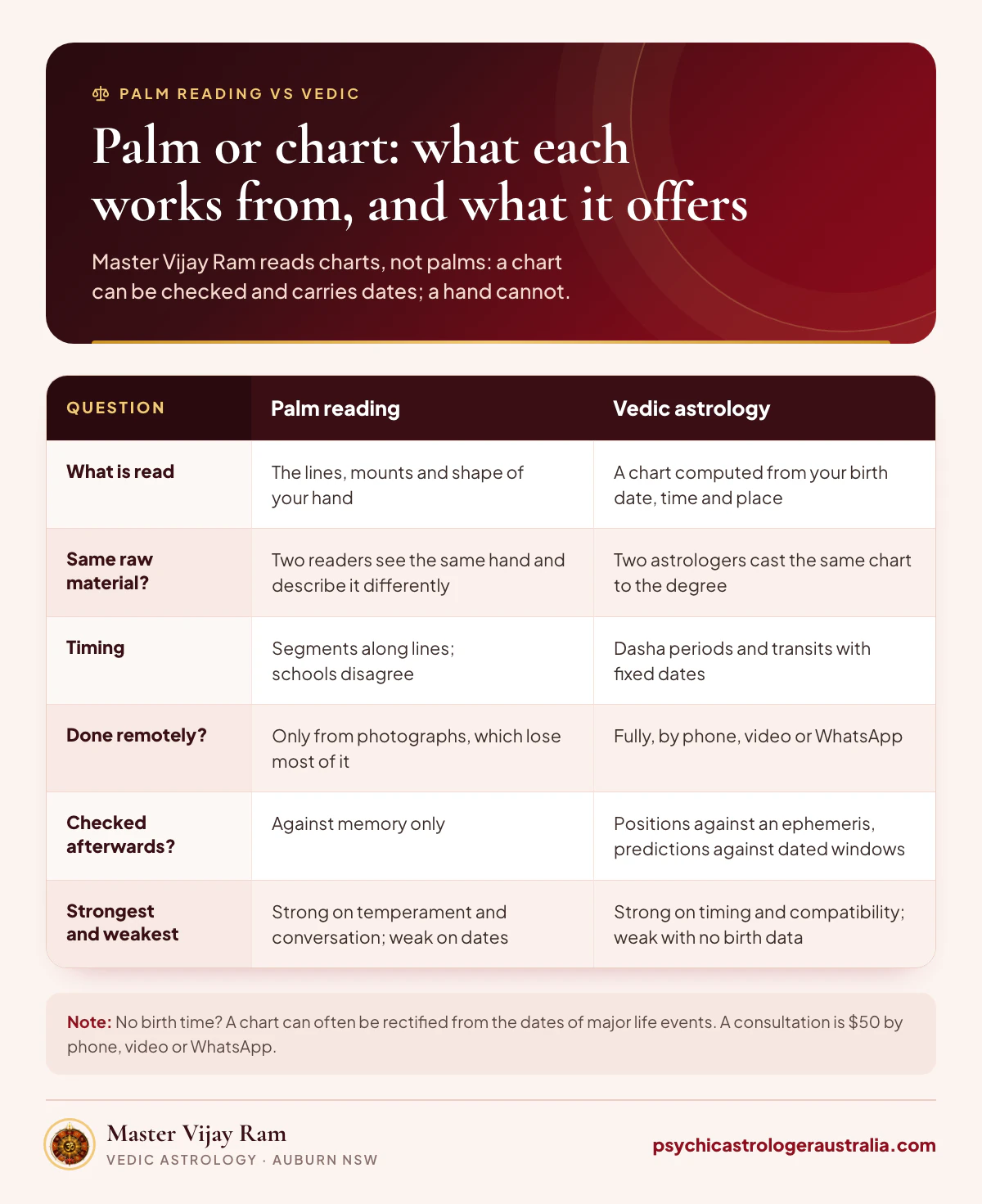
Side by side: palm reading and Vedic astrology
| Question | Palm reading | Vedic astrology |
|---|---|---|
| What is read | The lines, mounts and shape of your hand | A chart computed from your birth date, time and place |
| Can two practitioners get the same raw material? | They see the same hand and describe it differently | They cast the same chart to the degree |
| Timing | Segments along lines, schools disagree | Dasha periods and transits with fixed dates |
| Can it be done remotely? | Only from photographs, which lose most of it | Fully, by phone, video or WhatsApp |
| Can it be checked afterwards? | Against memory only | Positions against an ephemeris, predictions against dated windows |
| Needs a birth time? | No | Yes, or a rectification from life events |
| Strongest at | Temperament and conversation | Timing, compatibility, remedies chosen from the chart |
| Weakest at | Dates and anything checkable | People with no birth data at all |
Why Master Vijay Ram reads charts, not palms
His training is in jyotish, from a Himalayan lineage and an initiation at Rishikesh, and jyotish is what he has practised for more than forty years. He does not read palms, he does not claim samudrika as a skill, and he will tell you so in the first minute if you ask for it. A practitioner who says what he does not do is giving you the most useful information you will get on the call.
The reason is practical rather than doctrinal. Almost every question people bring him has a timing element: when, how long, whether this year or next. The chart answers timing questions with dates that can be written down and checked later; the hand does not. The chart can also be read for a daughter in Melbourne or a husband in Punjab from their birth details, which no palm reading can do.
The differences between an astrologer, a psychic and a medium follow the same line: he does the one thing that works from a checkable record, and sends people elsewhere for the rest.
What to do if you were searching for a palm reading specialist
Ask yourself what you wanted from it. Most people who search for a palm reader want a short, personal reading of who they are and what is coming, without homework. A Vedic consultation gives you that, with one difference: it needs your date, time and place of birth, and it takes about an hour by phone, video or WhatsApp rather than ten minutes across a table.
- Find your birth time. A birth certificate, a hospital record or a mother who remembers will do; if none exists, the chart can be rectified from the dates of major events.
- Bring one or two real questions rather than a request to be told everything.
- Expect windows and tendencies, not pronouncements, and write them down to check later.
If what you wanted was specifically a palm reader, book a palm reader. He will not read a photograph of your hand, and he will not pretend a chart reading is the same experience. How a reading by phone, video or WhatsApp runs is set out in full for anyone deciding.
Can the two be combined?
Some Indian practitioners read both, and in the classical tradition the hand was a legitimate supplement where it agreed with the chart. The difficulty is what happens when they disagree. A practitioner who holds two systems has two places to look for the answer the client wants, and the temptation to pick the flattering one is strong.
Vijay Ram ji keeps to one system for that reason. One chart, one set of positions, one line of reasoning you can follow from the planet to the statement. If a client brings a palm reading from someone else, he reads the chart as if it did not exist and lets the two be compared afterwards.
How to judge any reading afterwards
The test is the same for a hand or a chart: did the reading contain statements specific enough to be wrong? A reading that says you are sometimes outgoing and sometimes reserved has said nothing. A reading that says a particular stretch of next year favours a move, and the stretch after it does not, can be checked.
Keep the statements, date them, and look again in a year. Learning to read your own chart helps here, because you can see where a statement came from; a line on a palm offers no such trail.
What a consultation costs, and how to book
A consultation with Master Vijay Ram is $50, by phone, video or WhatsApp, in English, Hindi or Punjabi, from anywhere in Australia. For a question about your own nature or timing, that is the whole of it. Spell or prayer work, where the chart shows it is warranted, starts from $250 and is agreed with you before anything is performed; for most people who arrive looking for a palm reading, no such work is called for.
A full kundli reading is the usual starting point, and people from Brisbane to Perth book it the same way, since the chart does not care where the caller sits.
What neither a palm nor a chart can replace
Neither one is medical care, legal advice or counselling, and both are offered here as faith-based guidance. A reader who finds illness in a line, or an astrologer who finds it in the sixth house, has given you a reason to see a doctor, not a diagnosis. The hand and the chart can give a hard season a shape and an end point, and that is a real comfort; the work of the season is still yours.
Why a chart can reach Hobart or Darwin when a palm reading cannot
A palm reading needs the hand in front of the reader, which is why it lives at weekend markets, festival stalls and shopfronts in the larger cities. In Hobart, where the Hindu community is small, or in Darwin and Cairns, a reader from your own tradition who can sit across a table is harder to find. A Vedic birth chart has no such limit, because it is cast from details that travel by message.
Whether you were born in Darwin, Moonah or Mumbai, the birthplace fixes the chart and your present city fixes the clock its windows arrive on. Hobart astrology readings and readings for Darwin callers lose nothing by being held over the phone or on video. The table in Auburn, Master Vijay Ram's one place of practice, is there for anyone close enough to book it.
The same holds at the start of a life. A palm reading is not what families reach for when a baby arrives, but a child born at Westmead or in Cairns has a complete chart from the first minute, and the Moon's nakshatra gives the syllable many families use when naming a baby by nakshatra.
He reads charts only, never palms, and he will say so whether the call comes from Hobart, Darwin or Cairns.
Read next
- Permanent Residency Timing: What a Chart Can and Cannot SayPR astrology, honestly: what the 12th, 9th and 4th houses and Rahu show about settling abroad, why Home Affairs decid…
- A Difficult Boss or Workplace Conflict, and the ChartA difficult boss or workplace conflict: HR, union and bullying help first, then what the sixth house, the Sun and Sat…
- Black Magic vs Bad Luck: How to Tell the DifferenceBlack magic or a plain bad run? Use the three-S test of spread, start line and stall, and rule out the ordinary medic…
Frequently asked questions
Does Master Vijay Ram read palms?
No. His training and his forty-plus years of practice are in jyotish, the Vedic astrology of the birth chart. He does not practise hasta samudrika shastra, he will not read a photograph of your hand, and he will tell you so at once if you ask. If a palm reading is specifically what you want, he will say that a palmist is the person to book.
Is palm reading part of Vedic astrology?
They are related but separate. Hasta samudrika shastra, the Indian reading of the hand, belongs to the samudrika tradition that reads the marks of the whole body, and some pandits practised it alongside the chart. Jyotish itself works from the horoscope. The classical view treated the hand as a second opinion on temperament and the chart as the source of timing.
Which is more accurate, palm reading or astrology?
The honest answer separates two things. The raw material of a chart is accurate in a checkable way: any astrologer will cast the same positions, and they can be compared with an ephemeris. A palm is observed, not computed, and two readers describe it differently. Interpretation is a craft in both, and neither has shown predictive power above chance under controlled testing. Judge any reading by statements that could be wrong.
Can a palm reading give dates the way a chart does?
Not reliably. Palmists assign ages to segments of the life line and the fate line, but the schools divide the lines differently and there is no way to show where a date came from. A Vedic chart gives dates from the Vimshottari dasha and from transits, which are arithmetic and can be written down in advance and checked afterwards.
I do not know my birth time. Should I get a palm reading instead?
Not necessarily. A chart can often be rectified: Master Vijay Ram works back from the dates of major life events, a marriage, a migration, a bereavement, to narrow the birth time, and he will say plainly how confident the result is. Many people who assume they have no birth time find one on a hospital record or in a parent's memory. The palm is an option, but it is a different reading.
Can a palm reading be done over the phone or from a photo?
Palmists sometimes read from photographs, but the practice loses most of what it works from: the firmness of the hand, its temperature, the depth of a line, the way the fingers sit. A Vedic chart reading loses nothing over the phone, by video or on WhatsApp, because the chart is cast from your birth details rather than from anything in the room.
What does a Vedic consultation cost compared with a palm reading?
A consultation with Master Vijay Ram is $50, by phone, video or WhatsApp, and for a question about your nature or your timing that is the whole cost. Spell or prayer work, where the chart shows it is warranted, starts from $250 and is agreed before anything is done; it is rarely relevant to someone who came looking for a palm reading. Palmists set their own prices, usually per session or per minute.
Why do palm readings feel so accurate?
Partly because a skilled palmist is a skilled observer of people, and partly because of the way general statements feel personal, the same effect that makes psychic readings land. Neither of those is dishonesty; they are how any reading given by one person to another in the same room works. The protection is the same everywhere: ask for statements specific enough to be checked later.
Can I bring a palm reading to a Vedic consultation?
You can, and some people do. Master Vijay Ram reads the chart as if the palm reading did not exist, so that one system does not quietly borrow from the other, and you compare the two afterwards. Where they agree you have two opinions; where they disagree, the chart is the one whose reasoning can be followed from a planetary position to the statement.
Is there anything a hand shows that a chart does not?
Yes: a hand shows what you have done. Calluses, scars, the set of the fingers and the thickness of the thumb record a life as it has actually been lived, and an attentive reader can say sensible things from them. The chart shows what you were born into and when its periods fall. The two answer different questions, and only one of them carries dates.
People also ask
What can a palm reading tell you?
Temperament, energy and something of how you have lived, read from the shape, firmness and lines of the hand by a practitioner trained to observe. It is strongest as a reading of character and weakest at dates, because the ages palmists assign to the lines vary by school and cannot be checked against anything outside your own memory.
Is palmistry real?
Palmistry is a real and old practice, with an Indian branch called hasta samudrika shastra, and the hand it reads is real. Whether the lines predict events is a matter of belief rather than evidence; controlled testing has not supported it, and this site presents all such readings as faith-based guidance. What can be assessed is the quality of the reader, by the specificity of what they say.
What is the difference between a palm reader and an astrologer?
A palm reader works from your hand; an astrologer works from a chart calculated for the minute and place of your birth. The chart is the same whoever casts it and carries a timing system of planetary periods and transits; the hand is observed and described, and carries no calendar. Master Vijay Ram is an astrologer and does not read palms.
Do Indian astrologers read palms?
Some do, because hasta samudrika shastra is part of the wider Indian tradition, and a few pandits offer both. Many, including Master Vijay Ram, keep to the chart alone, on the view that one system with one line of reasoning is more honest than two that can be played against each other. Ask any practitioner which they do before you book.
Which should I book if I have never had a reading before?
Decide what you want. If you want a short, personal impression across a table, a palmist gives that experience. If you want timing, compatibility or a question about the year ahead answered with dates you can check later, a Vedic chart reading is the right tool, and it needs your birth date, time and place. A consultation with Master Vijay Ram is $50 by phone, video or WhatsApp.
References & further reading
Serving clients across Australia
Confidential consultations by phone, video & WhatsApp — including: