

Quick answer
An astrologer interprets a chart calculated from your birth date, time and place. A psychic claims direct intuitive perception with no chart, a clairvoyant is a psychic who reports what they see, a medium claims contact with people who have died, and a tarot reader interprets cards. Master Vijay Ram is a Vedic astrologer and healer, not a psychic or medium.
What do astrologer, psychic, medium, clairvoyant and tarot reader actually mean?
An astrologer is a practitioner who calculates a chart from the date, time and place of your birth and interprets the positions of the planets in it. A psychic is a person who claims to perceive information directly, by intuition, with no chart, cards or instrument in between. A medium is a psychic who claims specifically to receive messages from people who have died. That is the difference between astrology and a psychic reading in one line: one starts from a computed chart, the other from a claimed perception.
A clairvoyant is a psychic who describes what they perceive as images, the word meaning “clear seeing”; a clairaudient hears, a clairsentient feels. A tarot reader lays out cards and interprets the spread, drawing on the traditional meanings of the cards and on intuition.
In Australia the words are used loosely and often together. A single advertisement may offer “psychic astrologer, tarot and medium”, and the person answering the phone may be any one of those, or none. Knowing which is which is the first step to getting the reading you actually wanted.
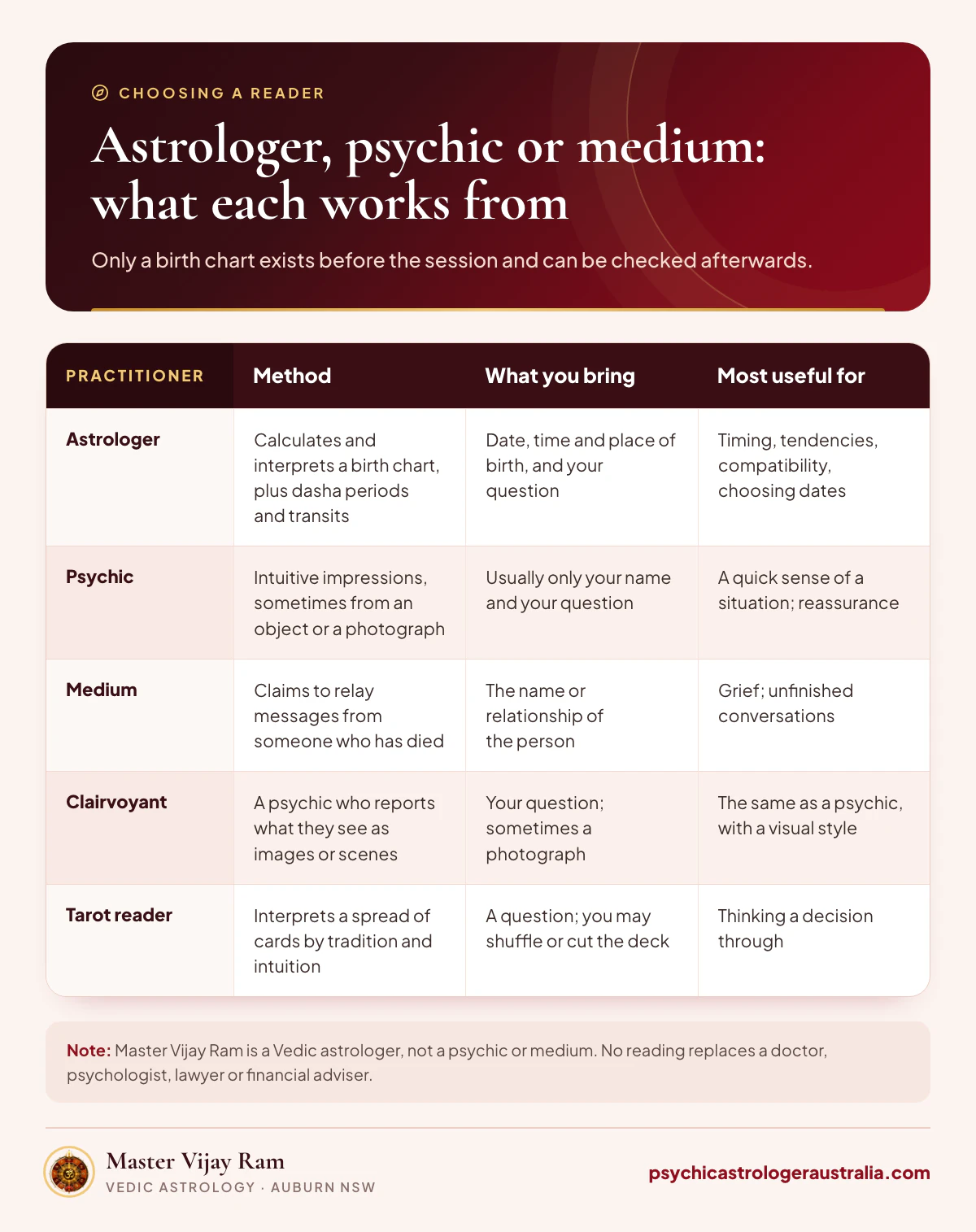
Side by side: method, what you bring, what you get back
The clearest way to separate the five is to ask where the information is supposed to come from and what you have to supply. The table puts them in one place.
| Practitioner | Method | What you bring | What you get back | Most useful for |
|---|---|---|---|---|
| Astrologer | Calculates and interprets a birth chart; in jyotish, also the dasha periods and the year's transits | Date, time and place of birth, and your question | A spoken or written reading tied to a chart you can keep and check | Timing, tendencies, compatibility, choosing dates |
| Psychic | Intuitive impressions, sometimes from an object or a photograph | Usually only your name and your question | Statements about you, your situation or the people around you | A quick sense of a situation; reassurance |
| Medium | Claims to relay messages from someone who has died | The name or relationship of the person | Messages and descriptions the sitter judges for themselves | Grief; unfinished conversations |
| Clairvoyant | A psychic who reports what they see as images or scenes | Your question; sometimes a photograph | Described scenes and symbols, interpreted for you | The same as a psychic, with a visual style |
| Tarot reader | Interprets a spread of cards by tradition and intuition | A question; you may shuffle or cut the deck | A narrative built from the cards drawn | Thinking a decision through; a structured conversation |
Only the first row works from a document that exists before the session and can be examined afterwards. Two astrologers given the same birth details will draw the same chart; whether they read it the same way is another matter, and how accurate any reading can be is a question of its own.
Where does the information come from?
This question separates the five more sharply than any label does. Astrology begins with astronomy. The positions of the Sun, Moon and planets at your birth are facts of the sky, computed to the minute, and the Vedic system adds the Moon's nakshatra, the running dasha and the transits of the year, every one of which is also a computed fact. The interpretation of those facts is where the astrologer's craft and tradition come in.
A psychic, a clairvoyant or a medium begins and ends with the practitioner's own perception. There is nothing to compute and nothing to show you afterwards except what was said. A tarot reading sits between the two: the cards are a physical system with traditional meanings, but which cards appear is chance, and the reading is the reader's interpretation of that chance.
None of this settles which is “right”. It does settle what you can check. A chart can be recalculated, a dasha date can be verified, and a Mercury station can be compared with an observatory table. An impression cannot.
What does the label on an Australian advertisement tell you?
Less than it should. There is no register of astrologers, psychics or mediums in Australia, so anyone may use any of the words, and many use all of them. A listing that offers “psychic, medium, clairvoyant, tarot, astrology, love spells” is describing a menu, not a training.
A more useful signal is what the practitioner asks you for. Someone who wants your date, time and place of birth before saying anything is working as an astrologer, whatever the sign on the door. Someone who wants only your first name and a question is working as a psychic. Someone who asks you to describe the problem at length before offering a single statement may be doing neither, and the section on cold reading below explains why that matters.
What do people searching for a psychic in Australia usually want?
In forty years of taking calls, Master Vijay Ram has found that the word people type is rarely the thing they need. Someone who searches for a psychic in Melbourne or Brisbane is usually carrying one of a small number of questions.
- Will this relationship survive, and will the person I love come back?
- When will I marry, and will my family accept the match?
- Should I take this job, move interstate, or start the business?
- Why has everything gone wrong at once, and is someone behind it?
- Is my mother, father or grandparent at peace, and did they forgive me?
- Will the baby come, and will the pregnancy be safe?
Each of those contains two questions. One is about timing and tendency, which a chart can take on. The other is about a specific person's mind, a medical outcome or a legal fact, which belongs to a counsellor, a doctor or a lawyer first. Separating the two honestly is most of the work of a first conversation.
Which of those needs can a Vedic chart meet, and which can it not?
A Vedic chart is strongest on timing and tendency. It can say which years of a life are marked for marriage, which months favour a move, where career strength sits and where health deserves attention. It can compare two charts for a marriage. It can show whether a difficult patch is a passing transit or a long dasha that needs patience and remedy, and a full kundli reading is built around exactly those questions.
A chart cannot tell you what a specific person is thinking today, cannot find a lost ring, and cannot deliver a message from someone who has died. Those are the requests that belong to a psychic or a medium, and a Vedic astrologer who takes them on is working outside his tradition.
The limitation runs the other way too. A psychic can tell you a story about your former partner; only a chart can tell you that your seventh house is under a Saturn transit until a particular month, and that the story will change when it lifts.
Why Master Vijay Ram will tell you he is not a psychic or medium
The address of this site contains the word psychic, because that is the word many Australians search for. Master Vijay Ram himself is a Vedic astrologer and spiritual healer from a Himalayan lineage, trained in jyotish, mantra and havan, and his background says so plainly. He does not do mediumship, does not read tarot and does not claim clairvoyance.
When a caller wants to hear from a parent who has died, he says so in the first minute and does not take the booking. When a caller wants to know whether a partner will return, he asks for both birth details and reads the charts, which is a different kind of answer from a psychic's impression and, in his view, a more honest one. That boundary is the same whether you ring from Melbourne or from Ludhiana.
How is a Vedic astrologer different from a Western astrologer?
Both calculate a chart for the same moment; they measure it against different zodiacs. Western astrology uses the tropical zodiac, anchored to the equinox. Vedic astrology, or jyotish, uses the sidereal zodiac, anchored to the fixed stars, which in the current decade sits about twenty-four degrees behind the tropical one. That is why your Vedic Sun sign is often the sign before your Western one.
Jyotish also leans on the Moon more than the Sun, divides the sky into twenty-seven nakshatras, and runs the dasha system, a timetable of planetary periods that gives Vedic readings their emphasis on when rather than only what. It carries a tradition of remedy as well: mantra, gemstone, puja and havan prescribed from the chart. A Western astrologer will more often stop at description.
Cold reading and the Barnum effect: the test that applies to everyone
Cold reading is a set of techniques, deliberate or unconscious, by which a reader produces statements that feel specific while being true of most people, then follows the sitter's reactions to refine them. The Barnum effect is the sitter's side of the same exchange: the tendency to accept a vague description as uniquely accurate. “You have a strong need to be liked, yet you can be hard on yourself” fits almost everyone and feels personal to almost everyone.
Honesty requires saying that astrology is exposed to the same effect. A reading that says you are “sometimes outgoing and sometimes reserved” has told you nothing, whoever drew the chart. The protection is the same in every case: ask for statements that could be wrong. A month, a year, a yes or a no. Vijay Ram ji's rule is that a reading which cannot be wrong is not a reading, and the checks that find a genuine practitioner are built on that rule.
One structural difference deserves a mention. Because a chart is read before you tell your story, a chart reading has a built-in defence against cold reading that an impression-based reading does not. It is not a complete defence, because the conversation still happens, but it is a real one.
Which kind of reading do you actually need?
A short test before you book anything.
- If your question has a “when” in it, you want an astrologer; timing is the thing a chart does that nothing else does.
- If your question is about a person who has died, you want a medium, and you should read about grief support first.
- If you want a structured conversation to think a decision through, tarot does that well, and so does a good counsellor.
- If you want someone to tell you what is going on without you saying much, you want a psychic, and you should keep the cold-reading test in mind.
- If your question is about a marriage match, a child, a career block or a run of misfortune in a family, a Vedic chart is the traditional tool, with remedies attached.
What no reading should ever replace
None of the five practitioners is a substitute for a doctor, a psychologist, a lawyer or a financial adviser. Chest pain, persistent low mood, a legal deadline and a debt are not questions for a chart or a card. Master Vijay Ram asks about health and safety early in any consultation and will send a caller to a GP or a crisis line before he opens a chart, and he regards that as part of the work rather than a failure of it.
What to expect if you book a Vedic reading instead of a psychic one
You will be asked for your date, time and place of birth, and for the question you are carrying. You will not be asked to describe your life in detail first; the chart is studied before the story is told. The reading itself is a conversation by phone, video or WhatsApp, and how an online reading runs is explained separately.
You will hear which planetary period you are in, what it tends to bring, when it changes, and what, if anything, is worth doing about it. You will not hear that your future is fixed, and you will not be sold a remedy on the first call.
Choosing between them in one afternoon
Write your question in one sentence. If it contains the word when, or the name of a person you may marry, or the word family, ring an astrologer. If it contains the name of someone who has died, ring a medium, or, better, someone who loved them too. If it is really “am I going to be all right”, ring whoever you trust, and remember that the honest answer from any of the five is the same: probably, and here is what the next stretch looks like.
After a death in India, why do Australian families look for a medium?
The request for a medium often reaches Master Vijay Ram from someone in Australia whose parent died in India before they could fly home. A daughter in Geelong or a son in Cairns watches the cremation on a phone screen, misses the days of mourning with the family, and months later searches for anyone who might say whether the parent is at peace. It is an understandable search, and it deserves a straight answer rather than a performance.
Vijay Ram ji is a Vedic astrologer, not a medium or a psychic, and he turns that booking down kindly. What the tradition itself offers the grieving is ritual rather than messages: the shraddha and the observances of Pitru Paksha, kept by the family with a priest of their own community.
Where that community gathers depends on the city. Geelong is still waiting for a permanent Hindu temple, with one approved by the council at Lara, so its nearest large temples include the Shri Shiva Vishnu Temple in Carrum Downs; in Cairns, where the Cairns Hindu Samaj is still raising money to build one, festivals gather in halls and parks. Geelong astrology consultations and Cairns readings by phone reach those families wherever they live, and meeting him face to face means a trip to his practice in Auburn, booked ahead.
What a chart can add is timing for the living: whether the coming months suit the eldest child's trip back for the first-year rites, and when the family is steady enough to settle what was left behind, with a lawyer handling any property. Grief that will not lift belongs with a GP or a counsellor first, and Lifeline is there day and night on 13 11 14. Grief also tends to be spoken in the parent's language, which is why many of these calls move into a Hindi or Punjabi consultation.
Read next
- Are Psychic and Astrology Readings Accurate? An Honest AnswerThe sky can be computed to the minute; reading it is a craft. What “accurate” can mean, what the 1985 double-blind te…
- How Much Does a Psychic or Astrology Reading Cost in Australia?What psychic lines, tarot readers and astrologers typically charge in Australia, what drives the price, what “free” m…
- Black Magic vs Bad Luck: How to Tell the DifferenceBlack magic or a plain bad run? Use the three-S test of spread, start line and stall, and rule out the ordinary medic…
Frequently asked questions
What is the difference between a psychic and an astrologer?
An astrologer calculates a chart from your birth date, time and place and interprets the planetary positions in it, so the reading rests on a document you can keep and recheck. A psychic claims to perceive information directly, by intuition, without a chart or any instrument. The astrologer needs your birth details before saying anything; the psychic usually needs only your name and a question.
What is the difference between a psychic and a medium?
A medium is a particular kind of psychic who claims to receive messages from people who have died. Every medium is, by definition, claiming psychic perception, but most psychics do not offer mediumship. If your question is about a parent or grandparent who has passed away, a medium is the practitioner being sought, and an astrologer, including Master Vijay Ram, will say plainly that this is outside his work.
Is a clairvoyant the same as a psychic?
A clairvoyant is a psychic who describes what they perceive as images or scenes, the word meaning clear seeing. Related terms are clairaudient, hearing, and clairsentient, feeling. In practice the words are used interchangeably in Australian advertising, and the method is the same: the practitioner's own perception, with nothing computed and nothing to examine after the session except what was said.
Is tarot a form of astrology?
No. Tarot is a deck of cards with traditional meanings, and a reading interprets whichever cards happen to be drawn, so chance is built into it. Astrology works from the actual positions of the planets at a fixed moment, which do not depend on chance and can be recalculated by anyone. Some tarot cards carry astrological symbols, but the two practices answer questions in different ways.
Is Master Vijay Ram a psychic?
No. He is a Vedic astrologer and spiritual healer from a Himalayan lineage, trained in jyotish, mantra and havan over more than forty years. He does not claim clairvoyance, does not read tarot and does not practise mediumship. The site carries the word psychic in its address because that is what many Australians search for, and the first conversation makes the distinction clear.
Which is more accurate, a psychic or an astrologer?
The astronomy behind an astrology reading is exact and can be checked; the interpretation, like a psychic's impression, is a human craft that controlled tests have not shown to predict above chance. The practical difference is that a chart reading can make dated, checkable statements about timing, while an impression usually cannot. Ask any practitioner for statements that could turn out to be wrong.
Can an astrologer tell me what my partner is thinking?
Not directly. A chart describes tendencies, timing and compatibility; it does not read a specific person's mind on a given day. What a Vedic astrologer can do, with both birth details, is compare the two charts, show which periods strain or support the relationship, and say when a transit affecting it is due to pass. The question about a person's current thoughts is one for the person.
Why do so many Australian listings combine psychic, medium and astrologer?
Because there is no licence or register for any of them, and because a wide menu draws more searches. A combined listing tells you what is offered, not how the practitioner was trained. The useful test is what you are asked for on the first call: birth details point to astrology, a name and a question point to psychic work, and a request to describe your whole situation first should make you cautious.
What is the difference between Vedic and Western astrology?
Both calculate a chart for the same moment, but Western astrology measures it against the tropical zodiac anchored to the equinox, while Vedic astrology uses the sidereal zodiac anchored to the fixed stars, currently about twenty-four degrees behind. Vedic astrology also emphasises the Moon and its nakshatra, runs the dasha timetable of planetary periods, and prescribes remedies such as mantra, gemstone and havan.
Should I see a psychic or an astrologer for a relationship question?
If the question is about timing, compatibility or whether a hard patch will pass, an astrologer, because those are things a chart addresses with dates attached. If you want an intuitive impression of what another person feels, that is the psychic's claim, and you should weigh it with the cold-reading test in mind. For a relationship in real difficulty, a counsellor belongs on the list before either.
What is cold reading?
Cold reading is a set of techniques by which a reader produces statements that feel specific while being true of almost anyone, then follows the sitter's reactions to refine them. It can be deliberate or unconscious. The Barnum effect is the sitter's tendency to accept such statements as uniquely accurate. Any kind of reading, including astrology, can fall into it, which is why specific, falsifiable statements matter.
People also ask
What does a psychic actually do?
A psychic claims to perceive information about you, your situation or other people directly, by intuition, without a chart, cards or any instrument. Sessions usually begin with your name and a question, and the reading consists of the practitioner's impressions. There is nothing to compute beforehand and nothing to examine afterwards except what was said, so the value depends entirely on the specificity of the statements.
Can a medium really talk to the dead?
That is the medium's claim, and it is a matter of belief rather than something a chart or a calculation can test. What can be said is that mediumship is a distinct practice from astrology, that it is the right request to make of a medium rather than an astrologer, and that anyone grieving is well served by reading about grief support alongside any sitting they book.
Do astrologers use intuition?
Interpretation always involves judgement, and experienced astrologers will say that reading a chart is a craft as much as a calculation. The difference from psychic work is the starting point: the planetary positions, the dasha periods and the transits are computed facts, and the astrologer's judgement is applied to them. A reading that drifts away from the chart into free impression has become something else.
Which kind of reading is best for a big decision?
For a decision with a when in it, a chart reading, because timing is what astrology addresses. For thinking a choice through in a structured way, tarot or a counsellor both work, and the counsellor will also help with the parts no reading covers. For a medical, legal or financial decision, the relevant professional comes first, and any reading is a supplement at most.
Is a Vedic astrologer the same as a jyotishi?
Yes. Jyotish is the Sanskrit name for Vedic astrology, the science of light, and a jyotishi is its practitioner. In Hindi and Punjabi conversations the words jyotishi or pandit ji are more common than astrologer. The practice uses the sidereal zodiac, the twenty-seven nakshatras and the dasha system, and traditionally includes prescribing remedies from the chart.
References & further reading
Serving clients across Australia
Confidential consultations by phone, video & WhatsApp — including: