
Quick answer
The astronomy behind a reading is exact: planetary positions, retrogrades and moon phases are computed to the minute and can be checked against observatory tables. The interpretation is a human craft, and controlled tests have not shown astrologers or psychics predicting personality or events above chance. A reading describes tendencies and timing, never a fixed fate, and never replaces a doctor.
What does “accurate” mean for a reading?
An accurate reading is a reading whose statements turn out to be true in a way that could have turned out false. That definition matters, because most of what passes for accuracy in readings is something else: a description so general it fits everyone, a prediction without a date, or a sitter's memory that quietly edits out the misses. Before asking whether psychic or astrology readings are accurate, it helps to separate the two things a reading contains.
The first is the sky, which in astrology is computed and can be exact. The second is the interpretation, which is a human craft in astrology and the whole of the work in psychic reading. They deserve different answers.
The part that is exact: the computed sky
The positions of the Sun, Moon and planets at any minute are not a matter of opinion. They are calculated from the same ephemeris astronomers use, and anyone can check them. Every 2027 date on this site, from the Mercury retrograde stations to the full moons and the festival timings, was computed with the Swiss Ephemeris and compared with the United States Naval Observatory's published tables; the moon phases agreed to within a minute and the moonrise times to the minute.
So when Vijay Ram ji says that Mercury turns retrograde at 4:36 am Sydney time on 10 February 2027, or that your Jupiter mahadasha ends in a particular month, that statement is accurate in the strictest sense. It is arithmetic on a known sky, and the 2027 Mercury retrograde dates are published here precisely so that they can be checked.
A psychic reading has no equivalent layer. There is no computed part to be right or wrong about, which is not a criticism, only a description.
The part that is a craft: interpretation
What a Saturn transit through your seventh house means for your marriage is not arithmetic. It is a judgement made from tradition, experience and the rest of the chart, and two trained astrologers can read the same placement differently. This is where accuracy becomes a matter of skill and honesty rather than calculation, and it is the part that scientific tests have examined.
Master Vijay Ram describes it this way: the chart is the weather map, drawn correctly; the forecast is still the forecaster's. A good forecaster is right more often than chance and says how confident she is. A poor one is vague enough never to be wrong.
What did the 1985 double-blind test find?
The most cited study is the double-blind test published in the journal Nature in 1985. Volunteer astrologers were given birth charts and asked to match each one to one of three personality profiles produced by a standard psychological inventory. They chose the correct profile about as often as chance would predict, roughly one time in three, and were no better when they expressed high confidence. The subjects themselves also could not pick out the interpretation of their own chart from others above chance.
The honest summary is that, under controlled conditions, interpretation of personality from a chart did not perform better than guessing. Later reviews of the wider literature reached the same conclusion for personality and for the prediction of events, and the general overview of astrology and science collects them.
Nothing in that study tests the astronomy, the dasha calendar or the experience of a consultation. It tests one specific claim, that a chart predicts a personality questionnaire, and it is fair to say that the claim failed.
How does Master Vijay Ram answer the test?
He does not argue with it. In his view the test examined astrology as a personality machine, which is not what a jyotishi is for. A Vedic reading describes tendencies and timing, says which periods will press on which areas of life, and suggests what to do in them. It is offered as guidance within a faith tradition, not as a measurement, and it is never a substitute for a doctor, a lawyer or a counsellor.
He also accepts the standard the test implies. A reading should make statements specific enough to be wrong, and the client should keep them and look back. In forty years that has been his own habit, and it is the reason his readings lean on dates, dasha changes and transit windows rather than on character sketches.
Checkable claims versus unfalsifiable claims
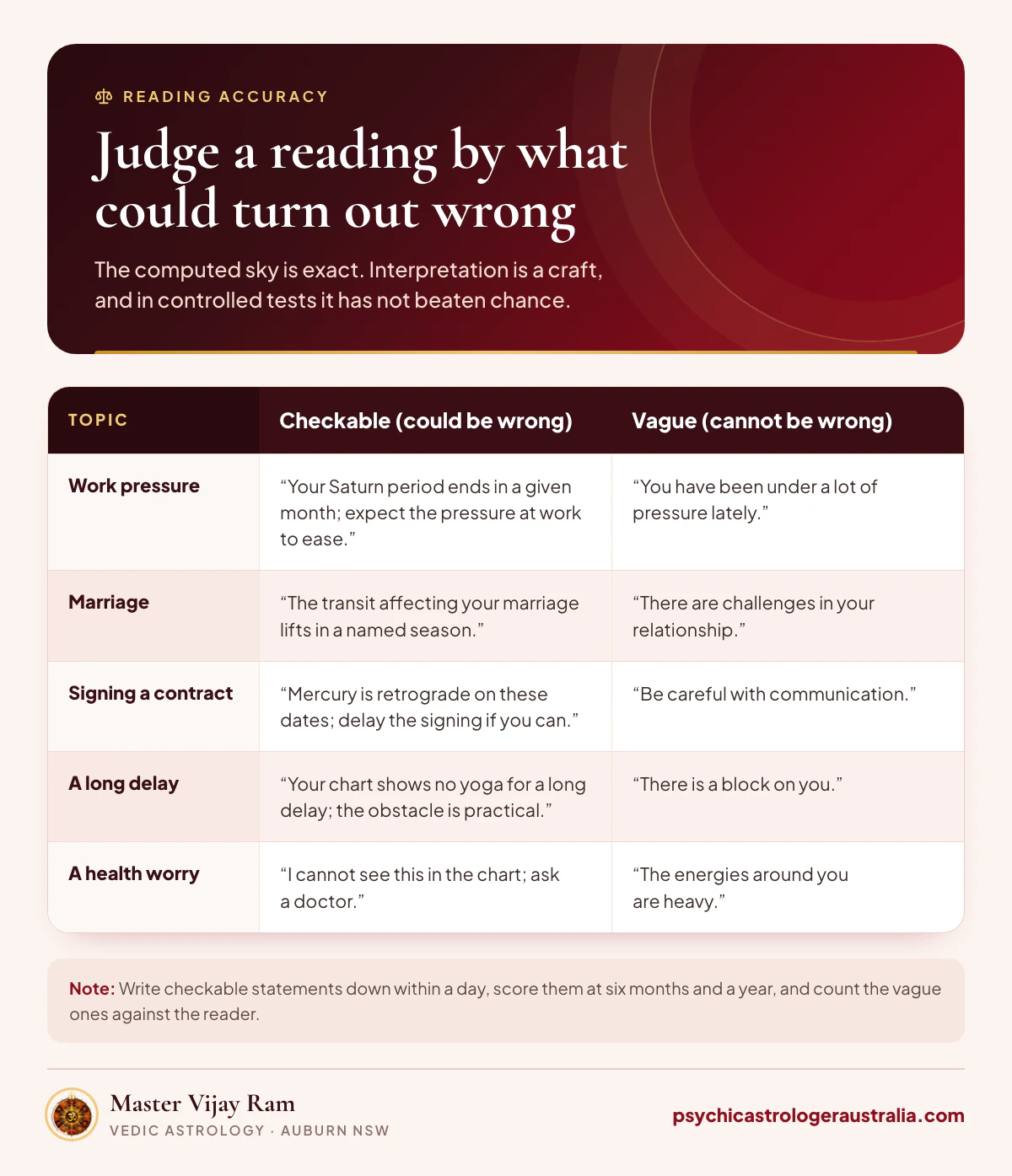
The quickest test of any reading, psychic or astrological, is to sort its statements into two columns.
| Checkable (could be wrong) | Unfalsifiable (cannot be wrong) |
|---|---|
| “Your Saturn period ends in a given month; expect the pressure at work to ease after it.” | “You have been under a lot of pressure lately.” |
| “The transit affecting your marriage lifts in a named season.” | “There are challenges in your relationship.” |
| “Mercury is retrograde on these dates; delay the signing if you can.” | “Be careful with communication.” |
| “Two charts show a strong seventh-house link; a match is likely within two years.” | “Someone important is coming into your life.” |
| “Your chart shows no yoga for a long delay; the obstacle is practical, not planetary.” | “There is a block on you.” |
| “I cannot see this in the chart; ask a doctor.” | “The energies around you are heavy.” |
A reading made entirely of the right-hand column has a perfect record and no content. A reading with several left-hand statements can be scored, and that is what you want from it.
Why can a reading feel accurate when it is vague?
The Barnum effect is the tendency to accept general statements as personally accurate; cold reading is the craft of producing them and adjusting to the sitter's reactions. Confirmation bias finishes the job: the hits are remembered and the misses forgotten. These effects do not require any dishonesty, and they apply to astrology as much as to psychic work.
The defences are mechanical. Write down what was said, with dates, before you leave the call. Ask for specifics when you are given generalities. And notice when you are supplying the information yourself: a reader who asks a question and then restates your answer as an insight has told you nothing. The differences between the kinds of reading include which ones are structurally more exposed to this.
Where does Vedic astrology make checkable statements?
Jyotish has an advantage here that it does not always use: its timing system produces dates. A mahadasha and its sub-periods change on calculable days. Saturn enters a sign, turns retrograde and turns direct on calculable days. Sade Sati begins and ends on calculable days. A reading that says “the heaviest stretch of this period runs until the Saturn station in late December, and it will feel different by February” has committed itself.
What it has not committed to is the event. Jyotish, read honestly, says that a period is marked for a kind of experience, not that a specific thing will happen on a specific Tuesday. A yearly forecast reading is built on these dated windows, which is why Vijay Ram ji prefers it to a general “what does the future hold” consultation: it can be checked month by month.
Are psychics more or less accurate than astrologers?
Under controlled testing, neither has shown predictive accuracy above chance for personality or events, and psychic claims have been tested more often and more harshly. The practical difference is not in the test results but in the structure of the work. An astrologer's reading sits on a computed chart and a dated calendar, so part of it is exactly right and the rest can be made specific. A psychic reading has no computed part and drifts toward the unfalsifiable column unless the reader chooses otherwise.
A fair conclusion is that the question “which is more accurate” is less useful than “which one will give me statements I can check”, and astrology is better placed to do so if the astrologer is willing.
What does accurate timing look like in practice?
Windows, not days. A Vedic reading will say a marriage is favoured in a span of a year or two, a career change in a particular dasha, a difficulty easing after a particular transit. It will not say the wedding is on the fourteenth. Anyone who gives you a day and a date for an event is guessing with confidence, whatever system they use.
The honest limitation is that a window can be right and still feel wrong. A favoured period for marriage does not produce a partner; it describes conditions. People who use readings well treat a window as a time to act, not a time to wait for delivery.
How to judge a reading afterwards
- Within a day of the reading, write down every statement that could be wrong, with its date or window.
- Set a reminder for six months and another for a year.
- Score each statement as right, wrong or too vague to score.
- Count the vague ones against the reader, not for them.
- Judge the reader on the dated statements only, and book again only if the record justifies it.
Applied to a kundli reading this is easy, because the dasha and transit dates are given to you; applied to a psychic reading it is often impossible, which is itself the answer.
What accuracy can never cover
No reading is accurate about a diagnosis, a court outcome or a debt, because none of those is written in a chart. Symptoms go to a doctor, charges go to a lawyer, and money trouble goes to a financial counsellor, before any astrologer and regardless of what the astrologer says. The same is true of remedies: whether black magic removal really works is a question this site answers with the same honesty, and the answer begins with ruling out ordinary causes.
The honest promise this site makes
That the sky quoted here is computed and checked. That a reading will contain statements specific enough to be wrong. That it describes tendencies and timing within a faith tradition, never a fixed fate and never medical, legal or financial advice. And that if the chart shows nothing, or shows that someone else should be helping you, Master Vijay Ram will say so. Readings are available by phone, video or WhatsApp; whether they are accurate, in the only sense that matters, is something you will be able to decide for yourself a year later.
Why your birth city's clock decides whether the chart is exact
The computed half of a reading is only exact if the birth time is converted on the right clock, and Australia keeps several. Brisbane and Gold Coast clocks stay on AEST all year, so a baby born there next January will show a clock time an hour behind a baby born in Sydney at the same instant; Gold Coast chart readings begin by checking that. Adelaide's clock trails Sydney's by thirty minutes in every season, and Perth's by two hours through the cooler months and three through the warmer ones.
That is why an accurate birth chart needs the city of birth as well as the time. The conversion uses the daylight-saving rule in force on the birth date, not this year's calendar. Cast a Darwin birth on Sydney time by mistake and the chart slips by thirty minutes in winter and ninety in summer, which can tip the lagna into the next sign; Darwin astrology consultations therefore begin with the zone.
Families who moved between countries carry a third clock. A janam patri from Punjab records the birth in Indian Standard Time, which sits 5½ hours behind a Sydney summer clock and 4½ behind its winter one, and Master Vijay Ram converts it before reading anything. When relatives in India join the call, each window is given on your clock first and on theirs second, so the statements you write down can be checked later without confusion.
None of this rescues a vague interpretation; it only keeps the exact half exact. Adelaide astrology readings and calls from every other zone are held on the phone, over a video link or through WhatsApp, while sitting with him in person means Auburn, by appointment.
Read next
- Astrologer vs Psychic vs Medium: What’s the Difference?Astrologer, psychic, medium, clairvoyant or tarot reader? What each actually does, what you bring, what you get back,…
- How Much Does a Psychic or Astrology Reading Cost in Australia?What psychic lines, tarot readers and astrologers typically charge in Australia, what drives the price, what “free” m…
- Do Love Spells Actually Work? An Honest Vedic AnswerDo love spells work? An honest Vedic answer on what a remedy can genuinely act on, what it cannot, and why most love …
Frequently asked questions
Are astrology readings accurate?
The computed part is: planetary positions, retrogrades, moon phases and dasha dates are arithmetic on a known sky and can be checked against observatory tables. The interpretive part is a craft, and controlled tests have not shown chart interpretation predicting personality or events above chance. A good reading gives you statements with dates or windows that could turn out wrong; a poor one gives you statements that cannot.
Are psychic readings accurate?
Under controlled testing, psychic claims have not shown predictive accuracy above chance, and they have been tested more often and more harshly than astrology. A psychic reading also has no computed layer, so there is nothing in it that is exact by construction. What you can do is apply the same test as to any reading: keep the statements that could be wrong, date them, and judge the reader on those alone.
What did the 1985 Nature study on astrology find?
In a double-blind test, astrologers were asked to match birth charts to one of three personality profiles from a standard psychological inventory. They chose correctly about one time in three, which is chance, and were no more accurate when confident. Subjects also could not pick the interpretation of their own chart above chance. The study tested personality prediction, not the astronomy or the timing calendar.
How does Master Vijay Ram respond to the scientific tests?
He does not dispute them. He reads jyotish as guidance within a faith tradition, describing tendencies and timing rather than measuring personality, and he accepts the standard the tests imply: a reading should contain statements specific enough to be wrong, kept by the client and checked later. His readings lean on dasha changes, transit dates and windows for that reason, and never replace medical, legal or financial advice.
Why does a vague reading feel so accurate?
Because of three ordinary effects: the Barnum effect, which makes general statements feel personal; cold reading, which produces such statements and adjusts to your reactions; and confirmation bias, which remembers the hits and forgets the misses. None requires dishonesty, and all apply to astrology as much as to psychic work. Writing statements down with dates before you leave the call defeats most of it.
Can an astrologer predict exact dates?
The sky, yes: a retrograde station, a sign change or a dasha boundary falls on a calculable day and can be quoted to the minute. Events, no. Honest Vedic astrology says a period is marked for a kind of experience and gives a window, such as a year or two favoured for marriage, not a day. Anyone who names the day of a future event is guessing with confidence.
How do I check whether my reading was accurate?
Within a day, write down every statement that could be wrong, with its date or window. Set reminders for six months and a year. Score each as right, wrong or too vague to score, and count the vague ones against the reader. Judge the practitioner on the dated statements only. This is easy with a Vedic reading, because the dates are part of it, and often impossible with a psychic one.
Is Vedic astrology more accurate than Western astrology?
Neither has outperformed chance in controlled tests of personality prediction, and the two systems describe the same sky from different starting points, about twenty-four degrees apart in the current decade. The practical difference is that Vedic astrology's dasha system produces dated periods, which makes it easier to state checkable windows. Whether a particular reading is accurate still depends on the astrologer's willingness to be specific.
Does accuracy matter if the reading helps me feel better?
Comfort is a real benefit, and many people consult a reader for exactly that. The risk is in decisions: postponing treatment, waiting on a reunion, or spending on remedies because of statements that could never have been wrong. Keep comfort and prediction separate. Take the reassurance, but act on medical, legal and financial matters through the right professionals, whatever the chart or the reader says.
Were the dates on this site really checked?
Yes. The 2027 planetary stations, moon phases, eclipses and festival timings were computed with the Swiss Ephemeris using the Lahiri ayanamsa for Vedic positions and compared with the United States Naval Observatory's published data. Moon phase times agreed to within a minute and moonrise and sunset times to the minute. That covers the astronomy; the interpretation on any page remains a matter of tradition and judgement.
People also ask
Has astrology ever been scientifically proven?
No. The best-known controlled test, published in Nature in 1985, found that astrologers could not match charts to personality profiles above chance, and later reviews of the research reached the same conclusion for personality and events. The astronomy astrology rests on is exact and fully established; the claim that the sky predicts personality or events has not been supported. This site presents readings as faith-based guidance for that reason.
What percentage of psychic predictions come true?
No reliable figure exists, because most psychic predictions are too vague to score, and the ones specific enough to check have not performed above chance in controlled tests. The useful measure is personal: write down the predictions you were given, with dates, and score them yourself after six months and a year. A reader with no scoreable statements has a perfect record and nothing to show for it.
Can astrology predict the future?
It can predict the sky with precision: where every planet will be, when Mercury turns retrograde, when a dasha changes. Whether those positions predict events in a life is a matter of belief, and controlled tests have not supported it. Honest Vedic astrology offers windows and tendencies within a faith tradition, not a fixed future, and treats a favourable period as a time to act rather than a promise.
Why do people believe their horoscope is accurate?
Mostly because of the Barnum effect, the tendency to read general statements as personal, reinforced by confirmation bias, which remembers hits and forgets misses. A newspaper horoscope is written to fit a twelfth of the population and usually does. A reading from an individual chart can be far more specific, but it is only more accurate if the astrologer makes statements that could actually be wrong.
How accurate are Vedic astrology predictions about marriage?
A Vedic reading can say which periods of a life are marked for marriage and which transits press on the seventh house, and those periods have dates. It cannot name a partner or a wedding day, and it cannot override anyone's free will. Treated as a window to act in, the timing is a useful and checkable thing; treated as a promise, it disappoints. Compatibility readings compare two charts on the same honest terms.
References & further reading
Serving clients across Australia
Confidential consultations by phone, video & WhatsApp — including: