
Quick answer
A mala has 108 beads, a number the tradition links to 27 nakshatras of four padas and to 12 signs times 9 planets. A lakh jaap is 100,000 repetitions and a sava lakh 125,000, usually counted in malas and spread over weeks or shared among several people. Steady daily counts matter more than size, and a full anushthan is agreed and planned before it starts.
What is a mantra jaap count, and why does it matter?
A mantra jaap count is the fixed number of repetitions a person or a priest undertakes for a mantra, from a single round of 108 to a vow of a lakh or more, and counting is what turns loose chanting into a discipline. The number gives the practice a shape: a beginning, a daily portion and an end. Without it, chanting tends to drift with mood.
The numbers themselves come from tradition rather than calculation, and families meet them most often when a reading recommends a planetary mantra. That is where a graha shanti puja and a jaap overlap, and where questions about “how many” begin. The mantras themselves are set out in the nine navagraha mantras; this page is about the counting.
Why 108?
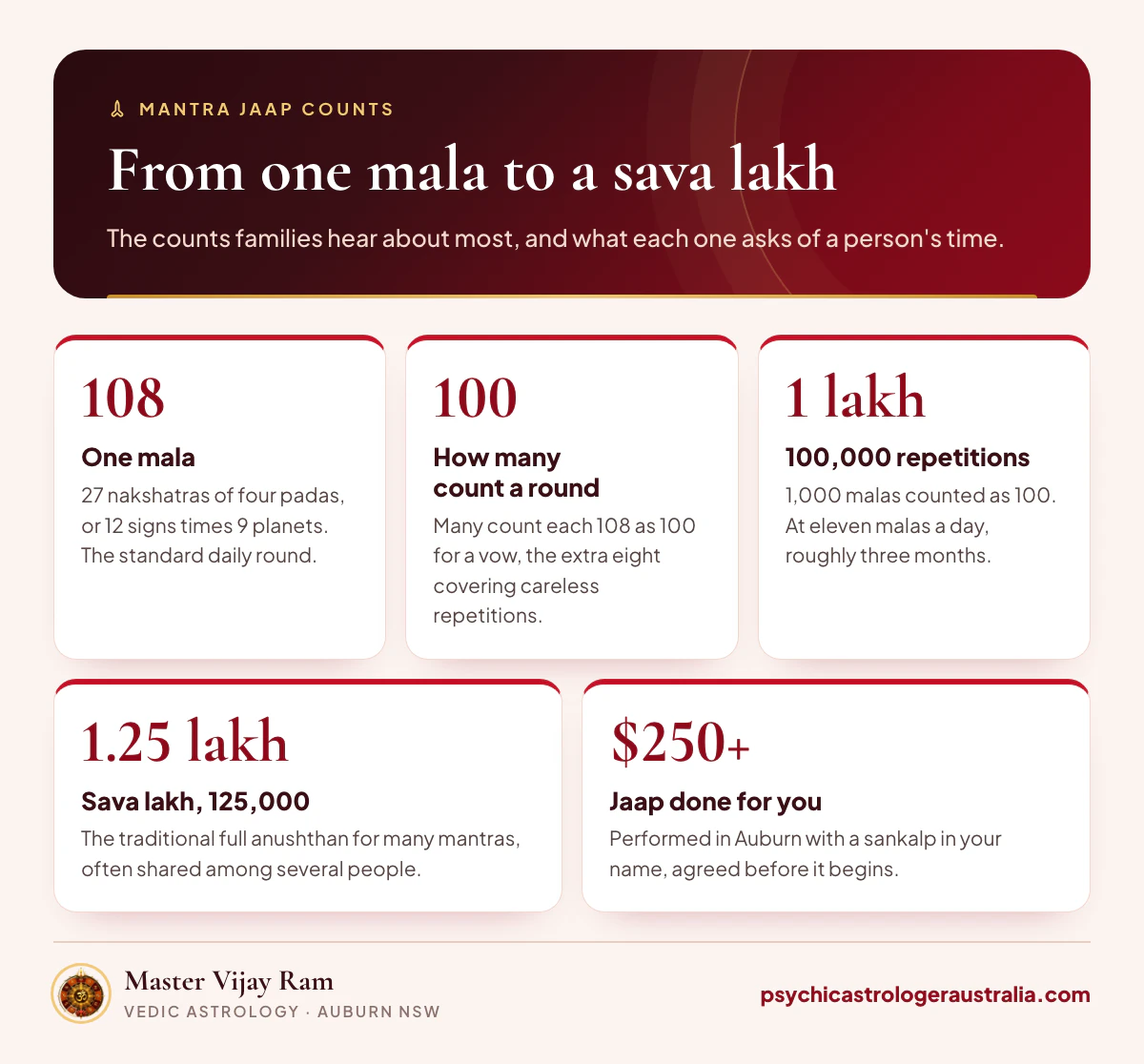
The tradition offers several explanations, and none of them is the single official reason. The two most often given are astrological: there are 27 nakshatras with four padas each, making 108, and there are 12 signs and 9 planets, and 12 × 9 is also 108. Both tie the mala to the whole sky, so a full round is said to touch every part of it.
Other explanations circulate too, some devotional, some numerical, and teachers differ in which they prefer. What matters in practice is that 108 has been the standard round for a very long time, so a mala, a teacher’s instruction and a family custom will all agree on it.
If a mala has 108 beads, why is a round sometimes counted as 100?
A widely kept custom counts each round of 108 as 100 for the purpose of a vow, treating the extra eight as cover for repetitions said carelessly or with a wandering mind. So a person who promises 1,000 repetitions completes ten full malas, not nine and a bit.
Not every family follows this, and some count every bead. Decide which rule you are using before you begin, write it down if the count is large, and keep to it.
What are the common counts, from 11 to a sava lakh?
The table sets out the counts people most often hear about, how they are usually done, and what they ask of a person’s time. The time column is a rough guide; a short beej mantra goes faster than a long verse.
| Count | Usually done as | What it asks |
|---|---|---|
| 11 or 21 | A short daily practice, or on a hard day | A minute or two |
| 108 | One mala, the standard daily round | Several minutes for a short mantra |
| 1,008 or 1,100 | Ten or eleven malas, often on a special day | Most of a morning for one person |
| 11,000 to 51,000 | A planet or deity anushthan over weeks | Several malas daily for a set period |
| 1 lakh (100,000) | A major vow, often shared or spread over months | Long, steady commitment or several people |
| Sava lakh (125,000) | The traditional full anushthan for many mantras | Usually shared among priests or family |
Texts and teachers give different totals for each planet’s full anushthan, and those differences are real. A reading should set any large count, not a website.
What does a lakh jaap actually involve?
A lakh jaap is one hundred thousand repetitions of a single mantra, completed under a vow. Counted in rounds of 100, that is 1,000 malas; counted bead by bead, a little more than 925 full rounds. Few people can do it alone quickly while working, which is why it is usually spread over weeks or months, or shared.
Imagine a Melbourne nurse who decides to keep eleven malas a day before a night shift. At that pace a lakh takes roughly three months, and missing days stretches it further. That is a realistic, admirable vow, but it needs planning, and it is better to promise a smaller count and finish it than a larger one and abandon it.
And a sava lakh, the 125,000 jaap?
Sava means one and a quarter, so a sava lakh is a 125000 jaap, the count many traditions give for a complete anushthan of a mantra such as the Maha Mrityunjaya. Counted in rounds of 100 it is 1,250 malas. At eleven malas a day, one person would need more than three and a half months.
That is why temples and priests often divide a sava lakh among several people chanting in parallel over a set number of days, with the total tallied each evening. The vow is kept by the group, on behalf of the person who asked for it, and finished with a havan.
What makes a jaap an anushthan?
A mantra anushthan is a jaap undertaken as a formal vow, with a sankalp at the start naming the person, the purpose and the count, a fixed daily portion, rules of conduct during the period, and a closing rite. Casual chanting has none of that structure, and it does not need it.
Many traditions close a large jaap with a five-part sequence: the jaap itself, then a havan of one-tenth the count, a tarpan of one-tenth of that, a marjan of one-tenth again, and feeding of one-tenth again. Traditions differ in how strictly they keep the fractions, and many families keep the havan and the feeding and simplify the rest.
How do you keep count without losing your place?
The mala is the oldest tool: one bead per repetition, moved with the thumb, with the larger guru bead marking the end of each round. For large counts, people keep a small notebook or a tally by the altar, adding the number of malas each day so the running total is never in doubt.
Counting on the finger joints with the thumb is the traditional method when no mala is at hand, and a simple click counter or a phone tally is now common for commuters. The tradition cares about the attention behind the count; the tool that keeps the count honest is the right one for you. Rudraksha beads and choosing a mala covers the beads themselves.
What if you miss a day or lose count?
Most teachers say simply to continue. If a day is missed in a formal anushthan, many add the missed portion to the following days; if the count is lost, they go back to the last number they are sure of. Nobody is punished for an honest gap.
Illness, a new baby, shift work and grief all interrupt practice, and the tradition makes room for that. A vow that becomes a source of guilt or exhaustion should be shortened, not forced; a smaller count completed with care is worth more.
Can someone else do the jaap for you?
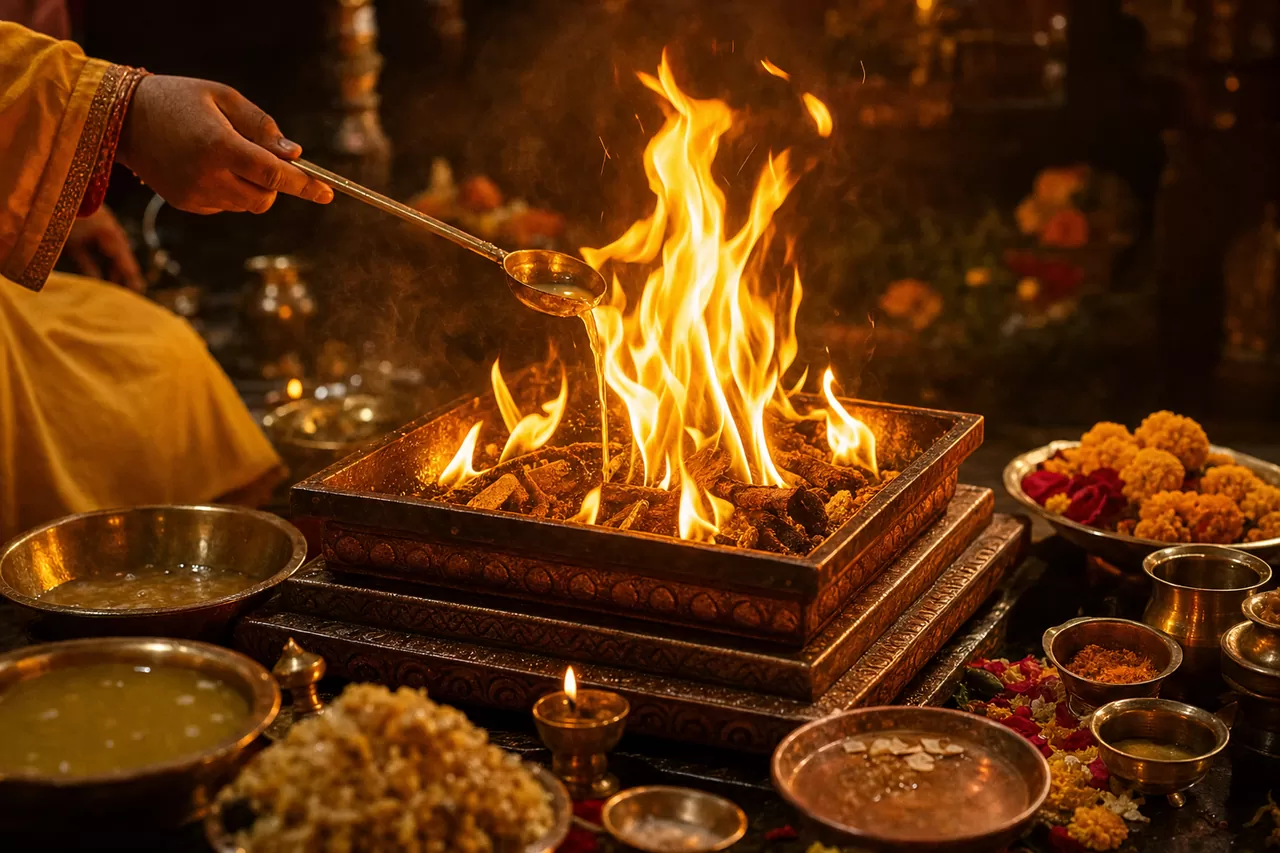
Yes. A jaap performed by a priest with a sankalp in your name is an old and accepted practice, especially for large counts, for people who are unwell, and for families who cannot keep a long vow. Many families do part of the count themselves and ask for the rest to be completed for them.
Master Vijay Ram performs jaap and anushthan personally at his place of practice in Auburn, with the sankalp in the client’s name and the family joining by video if they wish. The mantra, the count and the closing havan are discussed first, and the figure is agreed before anything begins; a jaap starts from $250. The online puja, havan and jaap page explains the process.
Does a bigger count mean a stronger remedy?
Not on its own. The tradition values sincerity, correct pronunciation and steadiness over volume, and a thousand distracted repetitions are not thought to equal a hundred attentive ones. A large count is a large commitment, and it suits people with the time and health to keep it.
For most people, eleven or one mala a day at the same time for a set period is the practice that lasts. The Maha Mrityunjaya mantra is one many families keep that way through an illness in the family, beside the doctors, never instead of them.
What can a jaap not do?
It cannot replace medical care, legal advice, financial counselling or therapy, and no count can promise a particular result. People sometimes turn to large vows in a crisis; if anxiety or low mood is overwhelming, talk to a GP or call Lifeline on 13 11 14, and keep the mantra as a comfort beside that help.
What a steady jaap often gives is a calmer mind, a daily anchor and a sense of having done something faithful during a hard period. That is a great deal, and it is honest.
How does Master Vijay Ram set a count?
He reads the chart and the running dasha, chooses the mantra, and suggests a count that fits your life: a daily mala for most people, a larger vow where the chart and the person’s circumstances support it, and a jaap performed for you where that is wiser. A consultation is $50, by phone, video or WhatsApp, in English, Hindi or Punjabi; clients in the west book through an astrologer for Perth clients at a time that suits their clock. Charity on the planet’s day often sits beside a jaap, as daan by planet explains.
Read next
- Lucky Numbers and Mobile Number Numerology: What Counts and What Does NotMobile number numerology and lucky numbers: how digits are reduced, what the tradition says, what is custom rather th…
- Mulank: Your Birth Number and What It Is Said to MeanMulank, the birth number of Indian numerology: how to work it out from the day you were born, what each of 1 to 9 is …
- Ex Love Spell vs Vashikaran: What Actually WorksEx love spell or vashikaran: what each word really means, what a Vedic reading can honestly do about an ex, and the p…
Frequently asked questions
Why does a japa mala have 108 beads?
The tradition gives several explanations. The two most common are astrological: 27 nakshatras with four padas each make 108, and 12 signs multiplied by 9 planets also make 108. Teachers differ on which they prefer. In practice 108 has been the standard round for so long that malas, teachers and family customs all agree on it.
How many malas make one lakh jaap?
If each round of 108 is counted as 100, as many families do for a vow, a lakh needs 1,000 malas. If every bead is counted, it needs a little more than 925 full rounds. Decide which rule you are using before you begin and keep a written tally so the running total is never in doubt.
What does sava lakh jaap mean?
Sava means one and a quarter, so a sava lakh jaap is 125,000 repetitions of one mantra. Many traditions give it as the full anushthan for mantras such as the Maha Mrityunjaya. It is usually spread over months or shared among several priests or family members chanting in parallel, and closed with a havan.
How many times should I chant a mantra daily?
For most people one mala of 108 at the same time each day is a sound practice, and eleven repetitions is a fair minimum on a hard day. Regularity matters more than volume. A larger daily count suits a formal anushthan with a set end date, which a reading can help you plan realistically.
What happens if I break a jaap anushthan?
Most teachers say to continue from where you left off, adding any missed portion to the following days, or going back to the last count you are sure of. Illness, work and family events interrupt practice, and the tradition allows for that. If a vow becomes exhausting, shorten it rather than force it.
Can a priest do jaap on my behalf?
Yes. A jaap performed by a priest with a sankalp in your name is an accepted practice, especially for large counts or when someone is unwell. Master Vijay Ram performs jaap personally at his place of practice in Auburn; the mantra, count and closing havan are agreed first, and a jaap starts from $250, agreed before it begins.
Is it fine to use a counter app instead of a mala?
Many people do, especially when commuting or at work. The mala is traditional and helps the hands stay with the practice, but the tradition cares most about attention and an honest count. Counting on the finger joints is the old method when no mala is at hand. Use whatever keeps your count accurate.
How much does a jaap or anushthan cost?
A consultation with Master Vijay Ram is $50, by phone, video or WhatsApp, in English, Hindi or Punjabi, and covers which mantra and count suit your chart. A jaap or anushthan performed for you starts from $250; the count, the closing havan and the figure are agreed before anything begins. Nothing is performed without that agreement.
People also ask
What is the significance of 108 in mantra chanting?
It is the standard number of repetitions in one round of a mala. The tradition links it to the 27 nakshatras with four padas each and to the 12 signs multiplied by 9 planets, so a full round is said to touch the whole sky. Other explanations exist, and teachers vary.
How long does it take to complete 1.25 lakh jaap?
It depends on the mantra and the daily count. At eleven malas a day, counted as 100 each, one person needs more than three and a half months. That is why sava lakh jaap is often shared among several people chanting in parallel over a set number of days.
What is a mantra anushthan?
It is a jaap taken as a formal vow, with a sankalp naming the person, purpose and count, a fixed daily portion, rules of conduct during the period, and a closing rite such as a havan. It differs from everyday chanting, which needs no vow or fixed total.
What is dashamsha havan after jaap?
Many traditions close a large jaap with a havan of one-tenth the count, followed by smaller tarpan, marjan and feeding portions, each a further tenth. Families and priests differ in how strictly they keep these fractions, and many keep the havan and the feeding and simplify the rest.
References & further reading
Serving clients across Australia
Confidential consultations by phone, video & WhatsApp — including: