

Quick answer
Mulank is your birth day of the month reduced to a single digit: born on the 28th, 2 + 8 = 10, 1 + 0 = 1, so your mulank is 1. Indian numerology pairs each digit with a planet, 1 the Sun through 9 Mars, and reads broad traits from it. It is a tradition and a talking point, not a substitute for the birth chart.
What is a mulank?
Mulank is a single-digit number that Indian numerology takes from the day of the month you were born, and that it treats as a sketch of your everyday temperament. The word means “root number”, and in English books on birth number numerology it is usually called the birth number or the psychic number. Of all the numbers numerology uses, it is the simplest to find and the one most people already know.
Master Vijay Ram uses it the way a good teacher uses a nickname: a friendly way in, never the whole person. The birth chart, cast from the date, time and place, is the document he actually reads, and the gemstone and numerology consultation sets numbers beside that chart rather than in its place.
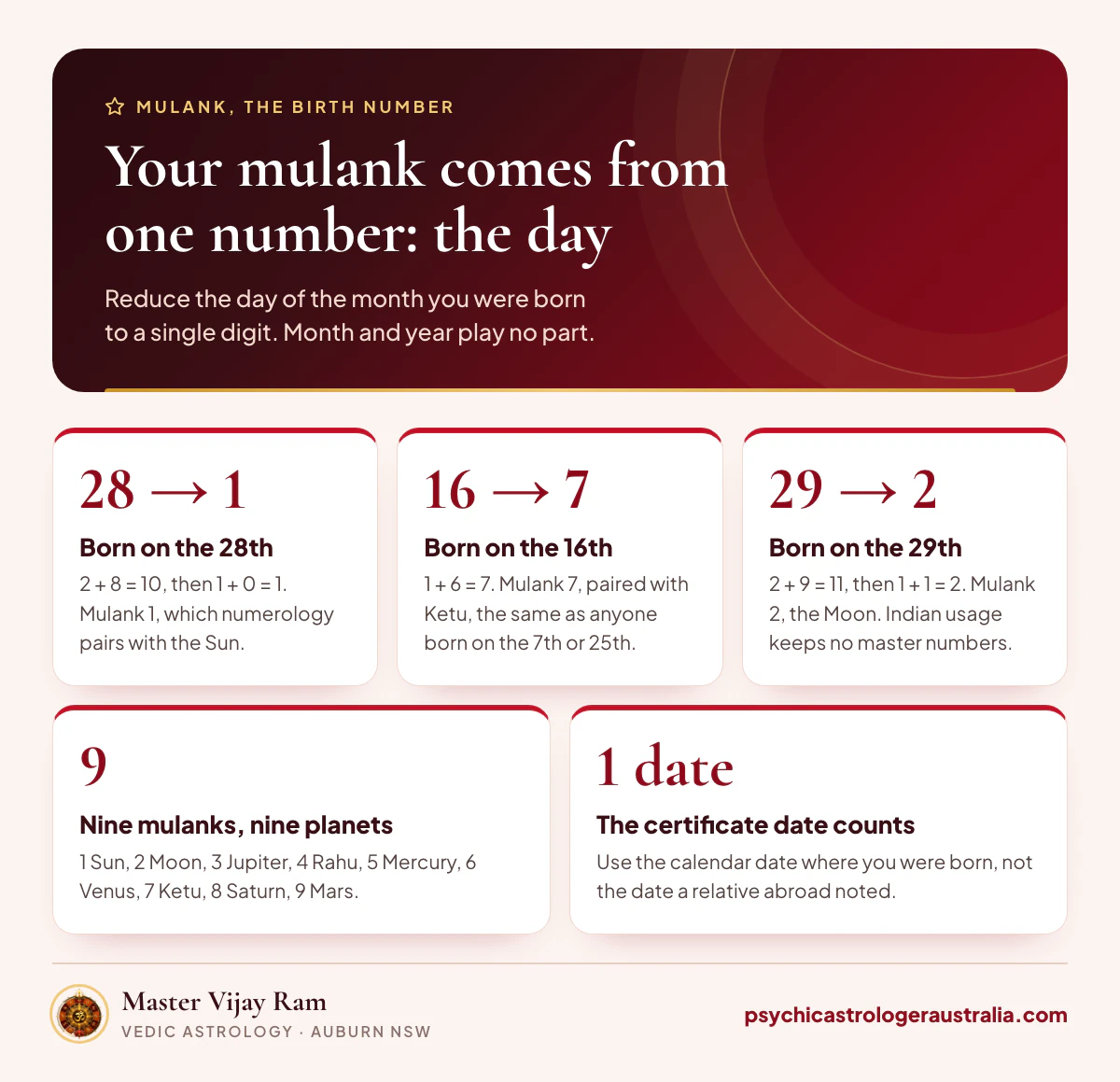
How do you calculate your mulank?
Take only the day of the month. If it is a single digit, that is your mulank. If it has two digits, add them, and if the answer still has two digits, add again.
- Born on the 7th: mulank 7.
- Born on the 16th: 1 + 6 = 7, so mulank 7 again.
- Born on the 28th: 2 + 8 = 10, then 1 + 0 = 1, so mulank 1.
- Born on the 29th: 2 + 9 = 11, then 1 + 1 = 2, so mulank 2.
The month and the year play no part. They belong to a different number, the full-date total, which bhagyank, the destiny number explains with its own worked example.
Which birth dates give which mulank?
Because only thirty-one days exist, every mulank is shared by three or four dates. The planet column follows the pairing that Indian numerology uses; the last column is the traditional reading, offered as tradition rather than measurement.
| Mulank | Born on | Planet | Traditionally said to suggest |
|---|---|---|---|
| 1 | 1, 10, 19, 28 | Sun | Initiative, pride, a wish to lead and to be seen |
| 2 | 2, 11, 20, 29 | Moon | Sensitivity, imagination, moods that follow people around them |
| 3 | 3, 12, 21, 30 | Jupiter | Teaching, advice-giving, a sense of duty and principle |
| 4 | 4, 13, 22, 31 | Rahu | Unconventional thinking, sudden turns, a pull toward the new |
| 5 | 5, 14, 23 | Mercury | Quick speech, trade, restlessness, a talent for numbers and deals |
| 6 | 6, 15, 24 | Venus | Comfort, beauty, hospitality, care about home and partner |
| 7 | 7, 16, 25 | Ketu | Inward thinking, research, a taste for solitude and the spiritual |
| 8 | 8, 17, 26 | Saturn | Patience, hard work, slow reward, a serious manner |
| 9 | 9, 18, 27 | Mars | Energy, courage, impatience, protectiveness of family |
Read the right-hand column, the traditional mulank meaning, as you would read a character sketch in an old almanac. Most people will recognise a little of themselves in several rows, which tells you more about how descriptions work than about the number.
Where do these meanings come from?
Indian numerology, often called ank jyotish, borrowed its planets from Jyotisha and its arithmetic from the Chaldean and Western numerology books that circulated in India in the twentieth century. Classical Sanskrit astrology texts do not teach a mulank. That does not make the practice worthless; it makes it a later, popular layer that sits beside astrology rather than inside it.
The traits are drawn from the planets’ older astrological reputations. The Sun is the king, so mulank 1 is the leader; Saturn is the servant and the slow teacher, so mulank 8 is the hard worker. If you know the planets, you can almost predict the reading without the number.
Born near midnight, or recorded in another country: which date counts?
Numerology uses the calendar date of your birth where you were born, as it appears on the birth certificate. A baby born at 11:50 pm in Perth has that Perth date, whatever the clock said in Sydney or Delhi at the same moment.
This matters more than it sounds for Indian-Australian families. A grandparent in India who hears the news the next morning sometimes notes the birth against the Indian date, and the family mulank quietly shifts by one. Check the certificate, and if the time is uncertain too, finding birth time records in Australia and India shows where to look.
Jyotisha, by contrast, counts the weekday from sunrise, so a pre-dawn birth may belong to the previous day’s vara in a panchang. Numerology does not follow that rule, and the two systems are simply answering different questions.
What about 11, 22 and the other “master numbers”?
Western numerology books sometimes stop the reduction at 11 or 22 and call them master numbers with special meanings. Indian usage generally does not: 11 becomes 2 and 22 becomes 4, and the paired planets are the Moon and Rahu as for anyone else with those mulanks.
If a reading you have been given talks about master numbers, it is following the Western school. Neither school is more correct than the other; they are simply different conventions, which is worth knowing before two numerologists give a person two different answers.
A family example: four people, four numbers
Picture an illustrative family in Newcastle. The father was born on the 19th, mulank 1; the mother on the 8th, mulank 8; their son on the 25th, mulank 7; their daughter on the 30th, mulank 3. A numerology book would cast the father as the leader, the mother as the patient worker, the boy as the quiet thinker and the girl as the teacher.
The family might laugh because some of it fits, and then notice that the daughter is the loudest person in the house and the son the most sociable. That is the honest experience of most families who try it: a few hits, a few misses, and a pleasant conversation over dinner. Nobody should be treated differently at home because of the date they arrived.
Does a mulank say anything a birth chart does not?
Very little. The mulank sorts every person on earth into nine groups by one fact; a birth chart places nine grahas in twelve signs and twelve houses for the exact minute and place. Two people born on the 19th share a mulank but may have opposite lagnas, different Moon signs and dashas running decades apart.
When a client’s mulank and chart agree, say a mulank 8 with a strong, well-placed Saturn, the agreement is pleasant and he mentions it. When they disagree, the chart wins, and a full kundli reading explains why the person is not the sketch their number suggests.
How do people use a mulank day to day?
Mostly in small, harmless ways. Some choose to begin something on a date that shares their mulank, or wear their planet’s colour on an interview day, as lucky colours and days by planet describes, or simply enjoy reading the description. Those habits take a moment and hurt nobody.
Problems begin when a number starts making decisions that belong elsewhere. A Hobart student who refuses an internship because its start date “clashes” with mulank 4, or a Wollongong couple who postpone a medical appointment to a “better” number, have let a pastime override practical judgement. Neither choice is supported by the tradition itself, which always put conduct and timing from the chart ahead of a single digit.
Which numbers are said to be friendly to each mulank?
Numerology books carry tables of friendly and unfriendly numbers, built from the friendships between the paired planets. The Sun, Moon, Mars and Jupiter are commonly grouped as friends, so 1, 2, 9 and 3 are treated as a harmonious family; Mercury, Venus and Saturn form another group, so 5, 6 and 8 are said to suit each other.
The books do not agree in detail, especially on 4 and 7, which take their nature from Rahu and Ketu. Treat any such table as one author’s opinion and never as a reason to avoid a person, a business partner or a marriage proposal.
Is there any evidence that a mulank describes character?
No controlled study has shown that people born on the 1st, 10th, 19th and 28th share a temperament different from anyone else’s. Character descriptions broad enough to fit most readers feel accurate to almost everyone, a pattern psychologists call the Barnum effect, and numerology relies on it as every character-reading system does.
Saying so is not hostility to the tradition. It is the reason a careful astrologer keeps numerology in the supporting role and does not let a digit decide anything important.
What can your mulank not tell you?
It cannot say when something will happen, because it has no timing in it; the dasha system and transits do that work. It cannot judge a marriage match, choose a career, diagnose an illness, predict a visa outcome or tell you whether to invest. Faith-based guidance never replaces a doctor, a migration agent, a financial adviser or a counsellor.
It also cannot be changed. A birth date is fixed, which is why the people who sell number corrections focus on names and phones; name numerology and luck covers that trade honestly.
How does Master Vijay Ram use your mulank in a reading?
Briefly. He notes it, says what the tradition associates with it, and then turns to the chart, where the planet behind the number is examined for its sign, house, strength and the period it is running. A mulank 9 client worried about anger hears about Mars in her actual chart, not about the number 9 in general.
A consultation is $50, by phone, video or WhatsApp, in English, Hindi or Punjabi; clients in the capital book through an astrologer for Canberra clients on the same terms. He sells no lucky charms, stones or number reports.
Read next
- Lucky Numbers and Mobile Number Numerology: What Counts and What Does NotMobile number numerology and lucky numbers: how digits are reduced, what the tradition says, what is custom rather th…
- Bhagyank: The Destiny Number and How It Is CalculatedBhagyank, the destiny number: how to add up the full birth date step by step, why both methods give the same digit, a…
- Kundli Reading Explained: What Your Birth Chart RevealsWhat a Kundli reading reveals about your life, personality, career and destiny. Master Vijay Ram explains Vedic astro…
Frequently asked questions
How do I find my mulank?
Take the day of the month you were born and reduce it to one digit. If you were born on the 5th, your mulank is 5. If you were born on the 23rd, add 2 and 3 to get 5. If you were born on the 19th, 1 and 9 make 10, and 1 and 0 make 1. The month and the year are not used for the mulank.
What is the difference between mulank and bhagyank?
Mulank comes from the day of birth only, while bhagyank adds every digit of the full date, day, month and year, and reduces the total to one digit. Numerology reads the mulank as everyday temperament and the bhagyank as the broader direction of life. Both are traditional readings rather than measured findings, and both are secondary to the birth chart.
Which planet rules my mulank?
Indian numerology pairs 1 with the Sun, 2 with the Moon, 3 with Jupiter, 4 with Rahu, 5 with Mercury, 6 with Venus, 7 with Ketu, 8 with Saturn and 9 with Mars. The pairing is a numerology convention. Whether that planet is strong or weak in your own life is shown by the birth chart, not by the number.
Is mulank 8 unlucky?
No number is unlucky in itself. Mulank 8 is paired with Saturn, which numerology books associate with patience, work and slow reward, and some popular writers turn that into fear. In astrology Saturn rewards steady effort, and plenty of people born on the 8th, 17th or 26th have entirely ordinary, happy lives. Your chart says far more than the date.
What if I was born just after midnight?
Numerology uses the calendar date on your birth certificate, so a birth at 12:10 am belongs to the new date. Jyotisha counts the weekday from sunrise, so in a panchang the same birth may sit in the previous day’s vara, but that rule is for astrology and does not change a numerology mulank. Use the certificate date for the number.
Can I change my mulank?
No. It comes from your date of birth, which is fixed. Some sellers offer to change a name or phone number to balance an unwelcome mulank, but there is no evidence that doing so changes anything. If a number worries you, a chart reading shows what the planet behind it is actually doing in your life.
Should I choose important dates by my mulank?
Using a date that shares your mulank for something small, like a first day at a new gym, is harmless. For anything important, choose by practical need first and by a proper muhurat second if you want one. Never delay medical care, legal deadlines or a good opportunity because a date has the wrong number.
How much does a numerology reading with Master Vijay Ram cost?
A consultation is $50, by phone, video or WhatsApp, in English, Hindi or Punjabi. He reads your mulank and other numbers alongside the birth chart, which remains the main document. He does not sell number reports, lucky charms or gemstones, and if a remedy such as a puja is ever suggested it starts from $250, agreed before it is performed.
People also ask
What does mulank 1 mean?
Mulank 1 belongs to people born on the 1st, 10th, 19th or 28th and is paired with the Sun. Numerology traditionally reads it as initiative, pride and a wish to lead. Treat it as a sketch: whether those traits show depends on the Sun and the rest of your birth chart, and on the choices you make.
Is mulank the same as psychic number?
Yes. English-language numerology books often call the birth-day number the psychic number, and Indian books call it the mulank. Both mean the day of birth reduced to one digit. The name psychic number has nothing to do with psychic ability; it refers to how a person is said to see themselves.
Which mulank is the luckiest?
None. Numerology books describe each number’s character, and every one has strengths and difficulties in those descriptions. Luck in the popular sense is not measured by a birth number. A birth chart reading, with the dasha and transits, is how Vedic astrology looks at favourable and difficult periods.
Does Vedic astrology use mulank?
Classical Jyotisha texts do not. Mulank belongs to Indian numerology, a later tradition that borrowed the planets from astrology. Many Vedic astrologers mention it alongside the chart because clients ask about it, but the chart, built from the exact date, time and place, is the primary tool.
References & further reading
Serving clients across Australia
Confidential consultations by phone, video & WhatsApp — including: