
Quick answer
A kalava or mauli is the red, yellow-streaked thread tied on the wrist at the end of a puja with the raksha mantra, commonly the right wrist for men and unmarried women and the left for married women. The black thread is worn against nazar on an ankle, wrist or a child’s waist. Both are reminders and promises, not shields.
What is a kalava, or mauli?
A kalava is a red cotton thread, usually streaked with yellow, that a priest or an elder ties round the wrist at the end of a puja, and the mauli thread is the same thing under its other name. It marks two things at once: that the wearer has just taken part in worship, and that they have been placed under the deity’s protection for the vow or the season ahead.
Families wear it without thinking much about it, which is how most customs survive, and then a child asks why, or a new nurse is told to take it off, and nobody quite knows the rules. This post sets them out, with the black thread for nazar beside it. Where a family wants something stronger than a thread, a kavach prepared for protection is the traditional next step, and it begins with a reading rather than a purchase.
What is said when the thread is tied?
The usual mantra is the raksha mantra: Yena baddho Bali raja danavendro mahabalah, tena tvam pratibadhnami rakshe ma chala ma chala. It says, roughly, I bind you with the thread that bound the mighty king Bali; protection, do not waver, do not waver. Wordings differ slightly between families and temples, and every version carries the same sense.
Bali was the generous asura king who gave Vishnu, in his dwarf form as Vamana, three steps of land and found himself bound by his own promise. The thread on the wrist is the household’s version of that binding: a promise held, and protection held with it.
Which wrist does the kalava go on?
Commonly the right wrist for men and unmarried women, and the left for married women. Many temples simply tie it on the right for everyone, and some families reverse the rule altogether; traditions differ, and the custom of the temple or the elder tying it is the right one at that moment.
The thread is usually wound round a few times, often an odd number, and knotted so it sits loose enough to slide a finger under. A thread that leaves a mark on the skin is too tight, and it can be loosened or retied without any disrespect.
What do the colours mean?
The red thread of the north is the colour of auspiciousness and of the Goddess, and the yellow that often runs through it is the colour of Vishnu and of Jupiter. In much of the south a turmeric-yellow thread is tied for a vow or a wedding instead, and kept until the vow is complete.
Black is the odd one out. It is not tied at a puja at all but chosen for nazar, the evil eye, on the old logic that a dark flaw draws an admiring glance away from what it admires.
When is a kalava changed, and how is it retired?
The honest answer to when to remove a kalava is when it frays, fades or starts to look grimy, or at the next puja, when a fresh one is tied. Many families change it on a Tuesday or a Saturday, or at a festival, and some keep it until it falls off by itself; traditions differ, and none of them asks you to wear a dirty thread for months.
Untie it or cut it with a moment’s thanks, then let it go back to the earth. A cotton kalava can go into the garden, a pot plant’s soil or the compost, and one with plastic beads or a metal charm can go to your temple’s collection. It never goes into a river, the sea or the bush, where in Australia it can count as littering.
What is the black thread for?
The kala dhaga for nazar is the black thread families tie against the evil eye: on an adult’s ankle, on a child’s wrist, or round a small child’s waist, where it is called the kamar dhaga in Hindi. Which ankle varies by family, and many women wear it on the left; some households also say the waist thread shows at a glance whether a child is gaining or losing weight.
A black thread on the ankle has also become simple fashion, and nobody needs to explain theirs. Where the worry about nazar is real and keeps returning, evil eye and nazar removal is where it is read, with the ordinary explanations named first.
Is a black thread safe for a baby or a small child?
Only with the safe-sleep rules ahead of the custom. Nothing goes round a baby’s neck, ever; a thread sits loose on the wrist or ankle, is checked every day, and comes off before the baby sleeps. A waist thread on a toddler should slide easily and be looked at during every bath.
The gentle customs for a newborn, the kala tikka behind the ear and the whispered prayer among them, are set out in nazar on newborns and gentle protection. The child health nurse comes before all of them.
Do some rashis have to avoid the black thread?
No. Lists online that forbid the black thread to people of certain rashis, usually the signs of Mars, have no basis in any classical text. The reasoning offered is that black belongs to Saturn and Saturn is unfriendly to the lord of those signs, which mixes up a colour with a planet’s placement.
A chart is read by its houses, aspects, strengths and running periods, not by the colour of a thread on the ankle. A gemstone is a different matter, because it is worn to strengthen a planet, and that choice does come from a full chart.
What if work asks you to keep your wrists bare?
Many Australian hospitals ask clinical staff to keep their forearms and wrists bare during patient care, for hand hygiene, and kitchens and some worksites have similar rules. The tradition bends easily here: the thread can move to an ankle, sit in a pocket or a wallet, or rest at the home altar until the shift ends.
A nurse on a Brisbane ward who unties her kalava before a shift has not broken anything. If a doctor needs to cut a thread before a procedure, it can be retied afterwards, and the protection in the tradition’s terms was never in the knot.
Which thread is which?
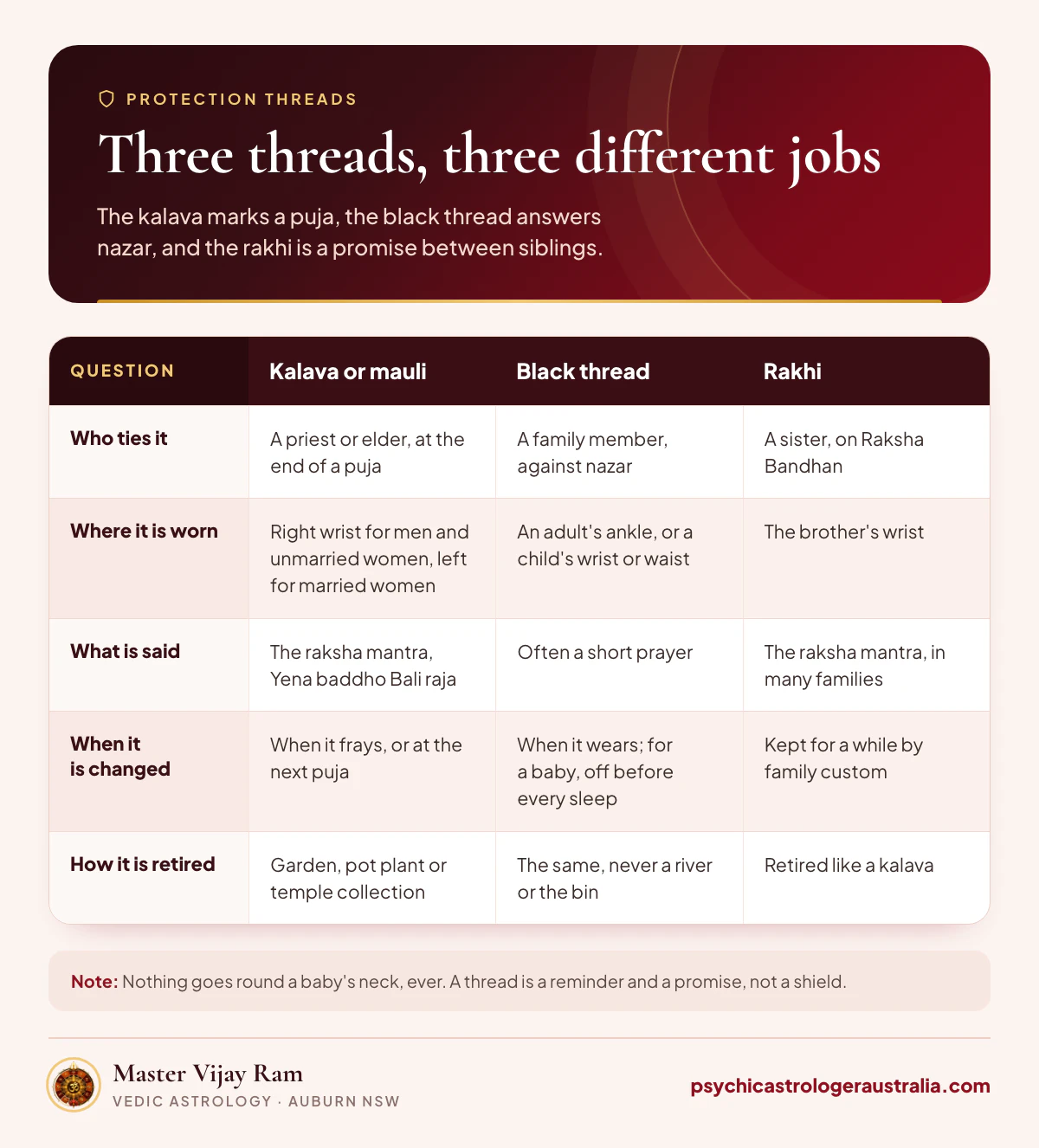
Four threads get confused, and the table sets them apart by who ties them, when, and what happens to them afterwards.
| Thread | Who ties it, and when | Where it is worn | Changed or retired |
|---|---|---|---|
| Kalava or mauli | A priest or elder, at the end of a puja, with the raksha mantra | Right wrist for men and unmarried women, left for married women; traditions differ | When it frays or at the next puja; to the garden or a temple collection |
| Black thread | A family member, against nazar, often with a short prayer | An adult’s ankle; a child’s wrist or waist | When it wears; for a baby, off before every sleep |
| Rakhi | A sister, on Raksha Bandhan, for her brother | The brother’s wrist | Kept for a while by family custom, then retired like a kalava |
| Janeu | Given at upanayana, the thread ceremony | Across the body, from the left shoulder | Renewed at set times by the wearer’s own tradition |
The rakhi shares the raksha mantra with the kalava in many families, but it is a promise between two people, not a mark of worship. In 2027 Raksha Bandhan falls on Tue 17 Aug 2027 in every Australian city and India, and Raksha Bandhan 2027 and the time to tie gives the hours.
What can a thread not do?
It cannot stop an accident, treat an illness, keep a person safe from someone who means them harm, or replace a seatbelt, a doctor or the police. A thread is a reminder and a promise, worn by people who also keep their own conduct, and that is the whole of its power in the tradition.
A thread sold online with a promise to block black magic or bring money is a product making claims, and Consumer Affairs Victoria or NSW Fair Trading will hear about a seller who promised more than cotton can carry. What a thread offers belongs to faith; it is not medical, legal or financial help.
When is a kavach prepared instead, and what does it cost?
When a reading of the chart finds a hard period that a thread will not steady on its own, Master Vijay Ram may suggest a kavach prepared for one named person, and taweez, kavach and yantra compared explains how that differs from a thread. A kavach is prepared only where a consultation finds it will help, and most consultations end with a thread, a mantra and nothing more.
Consultations cost $50 and run by phone, video or WhatsApp. Preparing a kavach is jaap and puja work, so it starts from $250, agreed before it is performed; he does it with his own hands at his Auburn practice, the wearer welcome to watch on video, and online puja and havan explains the arrangement. He sells no threads, beads or kits.
Clients reached through astrology readings for Brisbane families are read on Queensland time; in-person sessions are held in Auburn alone, by appointment. The thread is one small part of the household’s care for body and mind that the Vedic idea of body cleansing describes.
Read next
- How to Protect Yourself from Black Magic: Daily RemediesPractical daily protection from black magic: the three-doorway habit, what is safe to do at home, what needs guidance…
- Aura Reading: What a Vedic Astrologer Means by Your AuraAura reading from the Vedic side: what people expect from aura colours, what the birth chart really shows about your …
- Psychic Attack: What the Term Means, and the Vedic ViewPsychic attack: where the term comes from, what people mean by it, the Vedic words for related ideas, the overlap wit…
Frequently asked questions
What is the meaning of a kalava?
A kalava, also called mauli, is a red cotton thread, usually streaked with yellow, tied on the wrist at the end of a puja with the raksha mantra. It marks that the wearer has taken part in worship and has been placed under the deity’s protection for the vow or season ahead. It is a reminder and a promise, not a charm with powers of its own.
Which hand should the kalava be tied on?
Commonly the right wrist for men and unmarried women and the left wrist for married women. Many temples tie it on the right for everyone, and some families follow other rules, so the custom of the temple or elder tying it is the one to follow. It should sit loose enough to slide a finger under, wound round a few times and knotted.
When should a kalava be removed?
When it frays, fades or looks grimy, or at the next puja, when a fresh one is tied. Many families change it on a Tuesday or Saturday or at a festival, and some wait until it falls off by itself. Traditions differ, and none asks anyone to keep wearing a dirty thread. Untie or cut it with a moment’s thanks and retire it respectfully.
What do you do with an old kalava or black thread?
Let it go back to the earth. A cotton thread can go into the garden, a pot plant’s soil or the compost, and one with plastic beads or a metal charm can go to a temple’s collection. It never goes into a river, the sea or the bush, where in Australia it can count as littering, and it is not thrown carelessly in the bin.
Why do people wear a black thread on the ankle?
Against nazar, the evil eye: the old logic is that a dark flaw draws an admiring or envious glance away from the person. Many women wear it on the left ankle, though which ankle varies by family, and for many it is now simple fashion too. It is a custom of reassurance, and a worry about nazar that keeps returning is better read than answered with more thread.
Is a black thread safe for a baby?
Only with safe sleep first. Nothing goes round a baby’s neck, ever. A thread sits loose on the wrist or ankle, is checked every day for tightness and skin marks, and comes off before every sleep, day or night. A waist thread on a toddler should slide easily and be looked at during each bath. The child health nurse comes before any custom.
Can people of some rashis not wear a black thread?
No classical text says so. Online lists that bar certain rashis, usually the signs of Mars, argue that black belongs to Saturn and Saturn dislikes those signs’ lord, which confuses a colour with a planet’s placement in a chart. A thread is a nazar custom, not a gemstone; a gemstone is chosen only from a full chart reading, a thread needs no such check.
Can I wear a kalava at work in a hospital?
Many Australian hospitals ask clinical staff to keep forearms and wrists bare during patient care for hand hygiene, so the thread usually comes off for the shift. Move it to an ankle, keep it in a pocket or wallet, or leave it at the home altar. The tradition treats that as no loss, and a thread cut before a procedure can be retied afterwards.
Does Master Vijay Ram sell protection threads?
No. He sells no threads, beads, stones or kits. A family’s kalava comes from its own temple or puja, and a black thread from its own household. Where a reading finds a hard period that a thread will not steady, a kavach is prepared for one named person from $250, agreed before it is performed, after a $50 reading of the chart.
People also ask
What does a red thread on the wrist mean in Hinduism?
It is usually a kalava or mauli, tied by a priest or elder at the end of a puja with the raksha mantra, marking that the wearer took part in worship and is under the deity’s protection. The red stands for auspiciousness and the Goddess, and the yellow often spun with it for Vishnu and Jupiter. It is changed when it frays or at the next puja.
Which leg should a black thread be tied on?
Many women tie it on the left ankle, but customs vary by family and region, and no classical rule fixes the leg. What matters more is that it is loose, kept clean and changed when it wears, and for a baby that it sits on the wrist or ankle, never the neck, and comes off before sleep.
What mantra is said when tying a kalava?
The raksha mantra: Yena baddho Bali raja danavendro mahabalah, tena tvam pratibadhnami rakshe ma chala ma chala. It means, roughly, I bind you with the thread that bound the mighty king Bali; protection, do not waver. Wordings differ slightly between families and temples, and many also say it when a sister ties a rakhi.
Can a kalava and a black thread be worn together?
Yes. Nothing in the tradition forbids it, and many people wear a kalava on the wrist and a black thread on the ankle at the same time. They do different jobs: the kalava marks a puja and a vow, the black thread is a custom against nazar. Keep both loose and clean, and change each when it wears.
When should a black thread be changed?
When it frays, loosens, gets grimy or starts to mark the skin, and at once for a child if it seems tight. Some families renew it on a Saturday, the day of Saturn, whose colour is black, but there is no fixed rule. Retire the old one to the garden or a temple collection rather than the bin or a waterway.
References & further reading
Serving clients across Australia
Confidential consultations by phone, video & WhatsApp — including: