
Quick answer
Jadu-tona is the Fiji Hindi phrase for a spell or charm someone is thought to have worked against a person, carried from India by the girmitiyas and kept alive in elders' stories. Most of what elders describe has ordinary roots, from grief to illness. Respect their practices, see the GP first and consult in Hindi; a havan is rarely needed.
What does jadu-tona mean in a Fiji Indian family?
Jadu-tona is a Fiji Hindi phrase for a spell or charm that someone is thought to have worked against a person, and in a Fiji Indian family it usually reaches the younger generation through an elder: a nani, a nana, an aunt who remembers the old settlement. The words are shared with north India, but the stories around them have their own history, shaped by more than a century in Fiji and a second migration to Australia.
Master Vijay Ram hears Fiji Indian jadu-tona fears from families in Sydney, Brisbane, Melbourne, the Gold Coast, Canberra and Adelaide, often from a grandchild who wants to help an elder without dismissing her. This page is for that grandchild: where the beliefs come from, what elders describe, what helps, and how black magic removal works in the Vedic frame when it is warranted. The words themselves are unpacked in jadu tona explained.
Where do these beliefs come from?
From the girmitiyas, the indentured labourers brought to Fiji between 1879 and 1916, most of them from the Hindi-speaking villages of the north, with later recruits from the south. They came under an agreement, the girmit, to work the cane fields, and they carried their village faith with them, fears included.
On the plantations and in the settlements that followed, the Awadhi and Bhojpuri of those villages grew into Fiji Hindi, and the beliefs settled into a shape of their own. Girmit beliefs about spirits, charms and the evil eye are therefore far older than any family's years in Australia, and younger relatives often hear them for the first time only when something goes wrong.
Which traditions travelled with the girmitiyas?
The Ramayan travelled best. Many families kept a weekly Ramayan mandali, neighbours gathering to sing Tulsidas's Ramcharitmanas together, and that singing still sits at the heart of Fiji Hindu traditions in Australia, a protection against fear long before anyone called it cleansing.
Holding a Sundarkand path at home describes the reading of Hanuman's chapter that such families often turn to in a hard season. Hanuman travelled too: many Fiji Hindu households raise a red flag for him after a puja, and his is the name an elder says at night.
So did the village healer, the man or woman who blew a mantra over water, swept a sick child with neem leaves or tied a thread at the wrist. Many elders still remember one by name from the old settlement, with affection more often than fear.
What do elders describe when they say jadu-tona?
The stories have a settlement's texture. Something put in the food at a wedding, a quarrel over a lease or a house in Fiji that soured two branches of the family, a bhoot at the creek or under an old tree, a child who fell ill after a visitor praised her, a family that has not prospered since a particular funeral: they are told as memory rather than theory, and they deserve to be heard that way.
The table sets some of them beside what often sits underneath and a gentle first step. None of the first steps asks anyone to tell an elder she is wrong.
| What an elder describes | What often sits underneath | A gentle first step |
|---|---|---|
| Someone did jadu-tona on the family after a quarrel back in Fiji | A real loss, a land or house dispute, grief that never had a place to go | Ask what happened and when, not who; write the dates down together |
| A spirit in the house at night, or a late husband seen at the door | Grief, a new medicine, an infection, poor sleep, failing eyes or ears | A GP visit with every medicine listed; Griefline for the loss itself |
| Najar on a grandchild after a visitor's praise | An ordinary childhood bug, teething, a missed nap | The GP if the child is unwell; nani's salt and chillies can stay |
| The family has not prospered since a funeral | Migration costs, debts, the loss of the elder who held things together | A plain look at money and work; a reading of the family's timing |
| Something was put in the food at a function | Food poisoning, an allergy, a stomach complaint | The GP; if a substance is suspected, Poisons Information on 13 11 26 |
Is it jadu-tona, or is nani unwell?
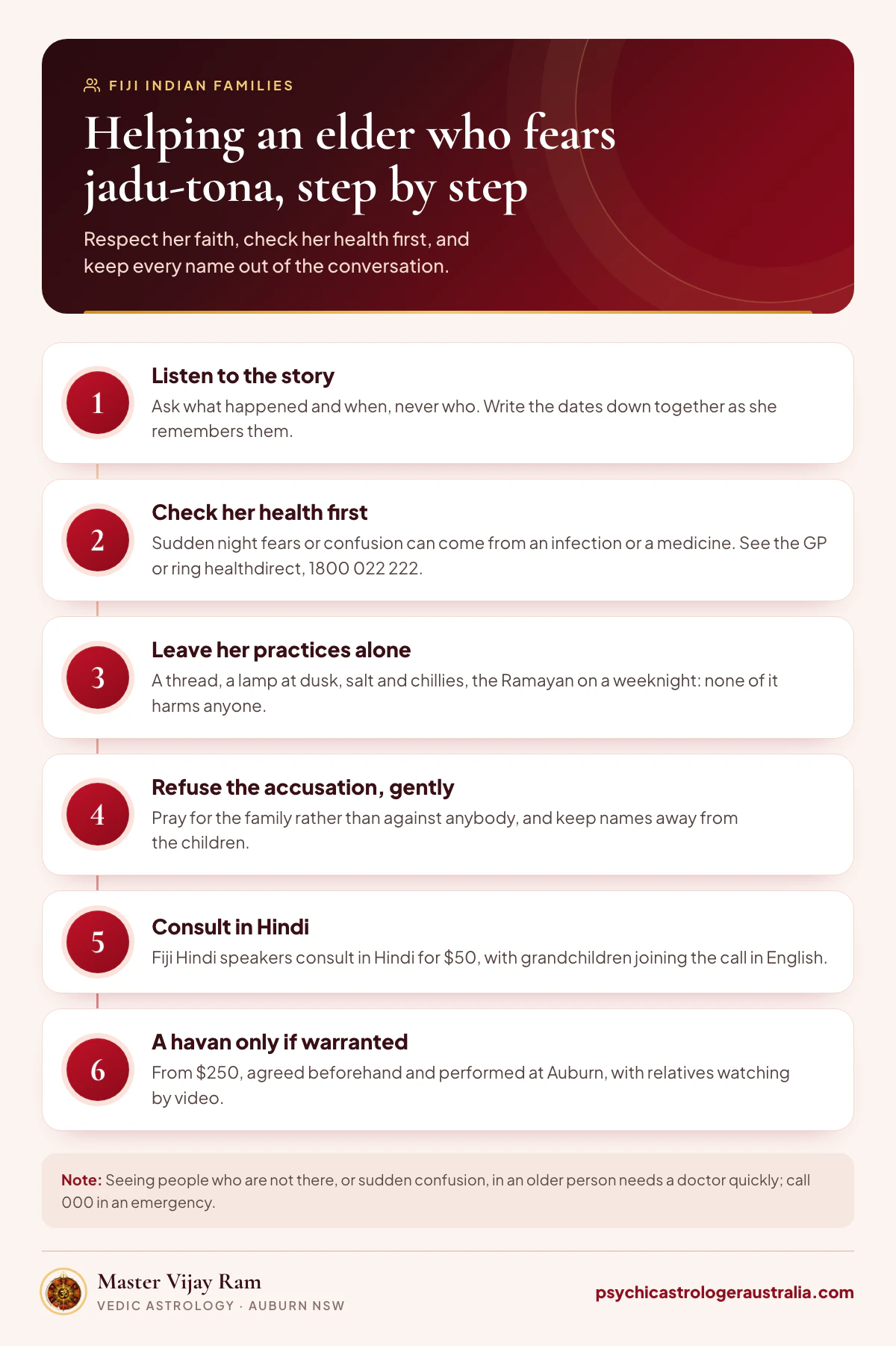
Both can be true at once, and the illness comes first. A sudden change in an older person, with new fears at night, seeing people who are not there or confusion that comes and goes, can be delirium from an infection or a reaction to a medicine, and it needs a doctor quickly. healthdirect on 1800 022 222 can advise at any hour, and 000 is for an emergency.
Slower changes, such as a narrowing world or repeated stories of someone taking her things, can be early signs of a memory problem and are worth a GP appointment with a family member present. Whoever looks after an elder at home carries a heavy load too, and Carers Australia, listed below, exists for them.
How can a family respect an elder's practice without feeding the fear?
Leave her practices alone. A thread on the wrist, a lamp at dusk, salt and chillies circled over a grandchild, the Ramayan on a weeknight: none of it harms anyone, and taking it away tells an elder that her whole world is wrong.
What a family can gently refuse is the accusation. A grandchild can suggest praying for the family rather than against anybody, and keep every name out of the conversation, above all in front of the children, because fear moves through a household faster than any charm.
Where should a village healer's methods stop?
The gentle methods, a mantra blown over water, a sweep with neem leaves, a thread tied with a prayer, sit comfortably beside medical care. The harmful ones do not: beating someone to drive a thing out, burning, starving, keeping a person from a doctor, or naming a neighbour as a witch.
Jhaad-phoonk and where it must stop draws that line in detail. In Australia, anyone offering to discover who did it, or to send something back, is offering the most harmful thing of all, because accusations of witchcraft still cost lives.
What does a second migration do to these fears?
Many Fiji Indian families have migrated twice: once from India under girmit, and again from Fiji to Australia or New Zealand. The second move left houses, graves and quarrels behind and spread families across three countries, so a sister in Auckland, a brother in Lautoka and a mother in Brisbane may each hold a piece of the story.
For an elder, a move to an Australian suburb can also mean losing the mandali, the neighbours and the language of every day. Loneliness of that kind is real, and it often speaks in the old vocabulary of spirits and jadu-tona because those are the words the elder has; black magic fears in diaspora families looks at the same pressure across the wider diaspora.
Can Fiji Hindi speakers consult in Hindi?
Yes. Fiji Hindi speakers consult in Hindi, and most elders follow a reading in standard Hindi with ease, since the Ramayan, the prayers and the words of the chart are shared. Consultations in Hindi and Punjabi explains how a call runs, with grandchildren joining in English if they prefer.
Let the elder speak in her own Fiji Hindi; where a word differs, he asks. One grandchild on the call to note the dates as she remembers them makes the reading far easier.
What does the Vedic reading add?
A sense of timing. He casts the chart of whoever is most troubled, looks at the planetary period now running and at this year's slow-moving planets, and compares them with the family's account of when things changed, so that a hard stretch can be named for what it is.
That is usually where the reading stops: a season given its name, an idea of how long it lasts, and a few practices the elder already knows. A chart cannot point at a person, so he never reads a suspected relative's chart or guesses at one, however certain the story.
When is a havan the answer, and what does it cost?
Only when the chart and the dates together suggest deliberate work. He then performs a shanti havan with Hanuman or Durga mantra himself, at his Auburn place of practice and at a muhurat picked for the family, with relatives watching by video from Brisbane, Canberra or Suva if they wish, and online puja and havan at Auburn describes the day.
A $50 consultation is all most families ever need. A havan starts from $250 and is agreed before it is performed; where an elder's fear is of a restless spirit rather than of jadu-tona, spirit and ghost removal explains how that reading differs.
Can a Fiji Indian puja be done in Sydney?
A Fiji Indian puja in Sydney, whether a Hanuman puja or a Satyanarayan katha after a hard year, can be arranged at Auburn, where families attend in person by appointment; it is the only place he performs any rite or sees anyone. Families from the Gold Coast to Adelaide join the same puja by video.
For their own worship, families have the Sri Venkateswara Temple at Helensburgh and the Sydney Murugan Temple at Mays Hill in Sydney, the Shree Laxmi Narayan Mandir at Burbank in Brisbane, the Shri Shiva Vishnu Temple at Carrum Downs and the Shri Ganesha Temple at Oaklands Park. No temple is confirmed on the Gold Coast, so Brisbane's southside temples are the nearest, and readings for Brisbane and Queensland families covers the time difference across the border.
What will a reading never replace?
It will never replace the GP, the memory clinic, a grief counsellor or a family's patience with an elder, and it cannot prove that jadu-tona was done or mend a quarrel in Fiji. This is guidance from faith and the Vedic tradition, never medical or legal advice, and no outcome is guaranteed.
What it can offer is a calm, respectful second view that honours the elder's faith and keeps the doctor in front. That is what any honest Indo-Fijian spiritual healer should offer as well, whoever the family chooses to see.
Read next
- Kala Jadu, Sihr and Voodoo: Which Tradition Is Your Family Describing?Kala jadu, sihr, voodoo, hooniyam and the evil eye: what each tradition means by harm, what undoes it, and how a Vedi…
- Black Magic Removal for NRIs & the Indian DiasporaBlack magic removal for NRIs and Indian diaspora families: how remote assessment works, what usually explains the tro…
- Black Magic Removal in Australia: Cost, Process & ResultsBlack magic removal in Australia explained honestly: how fees are built, what should never be charged, how the work i…
Frequently asked questions
What is jadu-tona in Fiji Hindi?
Jadu-tona is the Fiji Hindi phrase, shared with north India, for a spell or charm that someone is thought to have worked against a person. Fiji Indian families usually hear it from an elder after a run of trouble. It names a fear rather than a fact, and most of what it is used for turns out to have ordinary roots such as grief, illness or a family quarrel.
Where did Fiji Indian beliefs about jadu-tona come from?
From the villages of India the girmitiyas left behind. Indentured labourers were brought to Fiji between 1879 and 1916, most from the Hindi-speaking north, and they carried their faith, their Ramayan and their fears with them. Over generations the language became Fiji Hindi and the beliefs took a shape of their own, which many families brought on to Australia.
My nani says someone did jadu-tona on the family. How should I respond?
Listen first, and ask what happened and when rather than who did it. Leave her practices alone, from the thread to the evening lamp, but gently keep names out of the conversation, especially near the children. If anything about her has changed suddenly, take her to the GP. A reading can then look at the family's timing calmly, without anyone being accused.
My nana says he sees my late grandmother at night. Is it a spirit?
Many grieving people sense or glimpse the person they have lost, and in an older person new night-time visions can also come from an infection, a medicine or failing sight, so a GP visit is the first step. Griefline supports people through loss. If he finds comfort in prayer, a lamp lit for her and a Ramayan reading honour her memory without feeding fear.
Can I consult Master Vijay Ram in Fiji Hindi?
He consults in Hindi, English and Punjabi, and Fiji Hindi speakers follow a reading in Hindi comfortably because the prayers, the Ramayan and the words of the chart are shared. Elders can speak in their own Fiji Hindi and he asks whenever a word differs. Grandchildren can join the same call in English and note the dates as the elder remembers them.
Is it safe to take an elder to a healer who does jhaad-phoonk?
The gentle forms, a mantra blown over water, a sweep with neem leaves, a thread tied with a prayer, are harmless beside medical care. Walk away from anyone who beats, burns or starves a person, keeps them from a doctor, or names someone as a witch. Anyone who offers to discover who did it or to send harm back is offering something dangerous.
Does the Ramayan or the Hanuman Chalisa help with jadu-tona fears?
In the family's own faith, yes: the Ramayan mandali and Hanuman worship have been Fiji Hindu households' protection against fear for generations, and a Sundarkand path is often held in a hard season. Master Vijay Ram is glad when families hold on to them. They are a comfort and a discipline, and they sit beside medical care rather than replacing it.
How much does a havan for jadu-tona cost?
A $50 consultation, held by phone, video or WhatsApp, is all most Fiji Indian families need. If the chart and the family's dates together suggest deliberate work, he performs a shanti havan at Auburn; it starts from $250, and the amount is settled with the family before the day. Relatives can watch by video from anywhere, and the figure does not rise afterwards.
Can relatives in Fiji or New Zealand take part in the puja?
Yes. The puja is performed at Auburn on a chosen muhurat, and relatives in Suva, Lautoka, Auckland or anywhere else can join by video or simply keep the hour with a lamp at home. Their names can be spoken in the sankalp. Families split across three countries often find that sharing one puja brings them together more than any argument about the past.
People also ask
What is girmit?
Girmit is the Fiji Hindi word, taken from the English agreement, for the indenture contract under which Indian labourers were brought to Fiji between 1879 and 1916. The labourers are remembered as girmitiyas, and their descendants are the Indo-Fijians, many of whom have since moved on to Australia and New Zealand, carrying Fiji Hindi and their traditions with them.
Do Fiji Indians believe in black magic?
Some Fiji Indian families hold beliefs about jadu-tona, the evil eye and spirits, as families from many traditions do, and many hold none. Where the beliefs are present they usually come through elders and sit alongside the Ramayan and Hanuman worship. Belief varies from household to household, and no community should be described as one thing.
What language do Fiji Indians speak?
Fiji Hindi, which grew from the Awadhi and Bhojpuri spoken by the girmitiyas, alongside English and, for many, standard Hindi used in prayer and the Ramayan. That is why Fiji Hindi speakers can consult Master Vijay Ram in Hindi, with grandchildren joining in English, and why elders usually follow the reading without difficulty.
How do you help an elder who believes the family has been cursed?
Listen without arguing, leave their prayers and customs alone, and check their health first, because sudden fears in older people can come from infection, medicines or memory problems. Keep names and accusations out of the conversation. A calm reading of the family's timing, in the elder's own language where possible, often settles more than any argument would.
References & further reading
Serving clients across Australia
Confidential consultations by phone, video & WhatsApp — including: