
Quick answer
Hasta is the thirteenth nakshatra, 10° to 23°20′ of sidereal Virgo. Its symbol is a hand, its deity Savitar, the Sun as the power that sets things moving, and its lord the Moon, so a Hasta Moon begins life in the Moon's dasha. Tradition reads skill, wit and practical help, and picks the star for beginnings.
What is Hasta nakshatra?
Hasta nakshatra is the thirteenth lunar mansion, running from 10° to 23°20′ of sidereal Virgo, and its name simply means hand. The star group usually given for it is the five bright stars of Corvus, the Crow, which tradition reads as the five fingers of an open palm. Tamil calendars call it Hastham, and in Kerala it is Atham, the day on which the ten days of Onam begin in the month of Chingam.
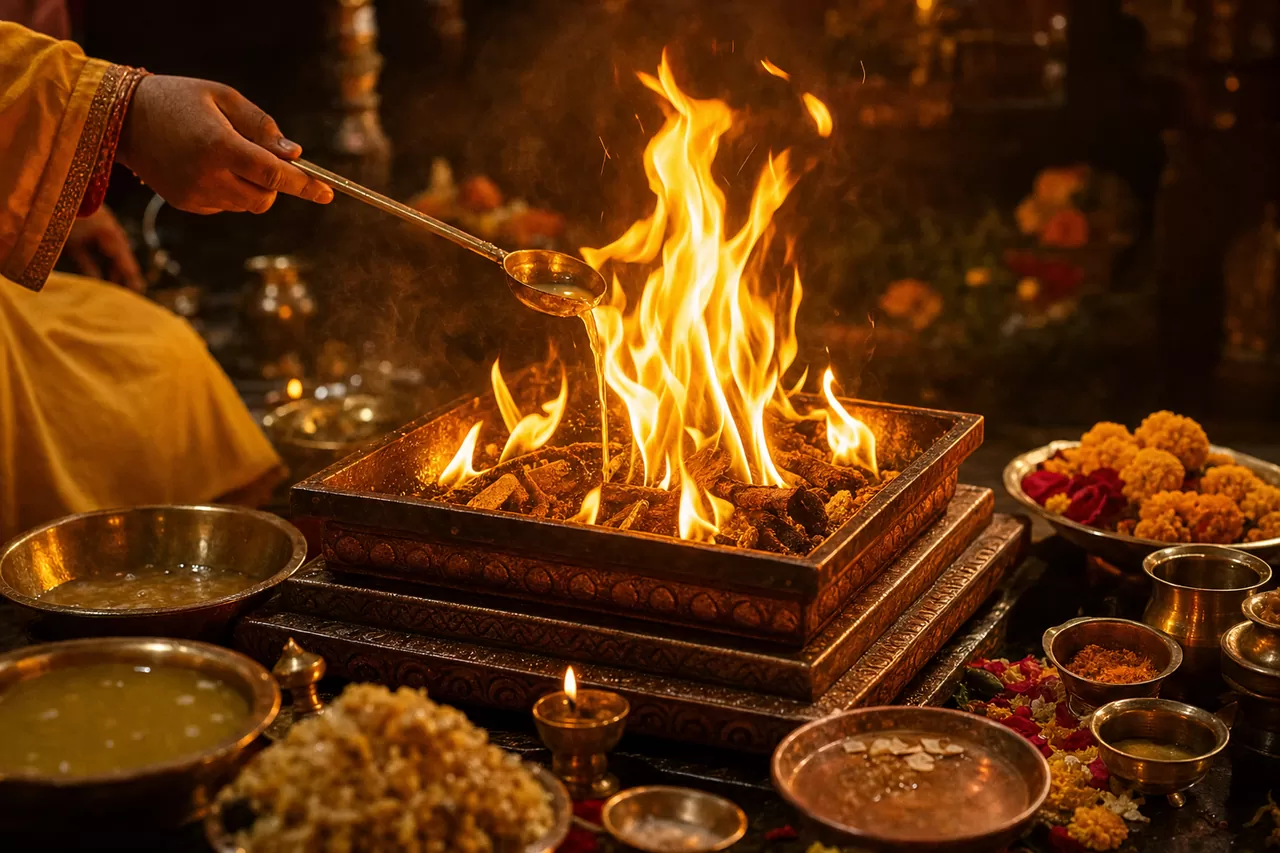
Its presiding deity is Savitar, the Sun in his role as the one who stirs the world into action, and its ruling planet is the Moon. Hasta is the hinge of the three Moon-ruled stars, with Rohini before it and Shravana after, and it sits wholly inside Virgo, Mercury's sign. A detailed kundli reading reads the star with the Moon's condition, Mercury and the lagna, because a single nakshatra describes a texture, not a whole person.
Who is Savitar, and why is he called golden-handed?
Savitar is a Vedic form of the Sun: not the disc itself so much as the impulse that wakes people, animals and crops each morning and sends them to their work. The Gayatri mantra, recited daily in countless Hindu homes, is addressed to him, asking that he stir and brighten the mind. The Rig Veda calls him golden-handed, raising his arms to bless and to set things in motion.
That gives the star its tone. Hasta stands for the point at which intention turns into action, the moment an idea leaves the head and becomes something made, fixed, cooked, written or healed, and its people are traditionally happiest when their hands are busy with something useful.
Why is the symbol a hand?
A hand gives, takes, holds, shapes and heals, and Indian tradition reads all of those meanings into the symbol. The raised palm of the abhaya mudra offers protection; the hand of the craftsman shapes; the hand of the trader closes the deal. The star's five fingers suggest dexterity, but also the five senses gathered into one act of attention.
The same symbol carries a caution. A hand that grasps can hold on too tightly, and the tradition reads a Hasta Moon under strain as someone who tries to control every outcome by doing everything personally, then wonders why they are exhausted.
Why does the Moon rule a star of craft?
The Moon signifies the mind, and in Hasta the mind lives in the hands: a person who thinks by making, calms down by cooking and solves problems by taking the thing apart. Because the Moon sits in Mercury's sign here, the tradition adds precision, a good memory for method, and a fondness for lists and routines.
The Moon also starts the dasha. A Hasta child is born into the Moon's ten-year mahadasha, with as many of those years left as the Moon still had to travel in the star, and the order then runs as below.
- Born with the Moon at Hasta's first degree: the Moon until about ten, Mars until seventeen, Rahu until thirty-five, Jupiter until fifty-one, then Saturn.
- Born at the star's midpoint: the Moon until about five, Mars until twelve, Rahu until thirty, Jupiter until forty-six, then Saturn until sixty-five.
- Born near 23°20′ Virgo: Mars almost at once, Rahu from about seven to twenty-five, Jupiter until forty-one, Saturn until sixty.
So for most Hasta people Rahu's eighteen years cover the teens and twenties, the years of study, first jobs and often a move, and Jupiter's sixteen follow into the thirties and forties. The tradition reads that as an unsettled youth and a steadier, more generous middle life, with the chart deciding how much of either applies.
How does the tradition describe a Hasta Moon?
The modern reading of Hasta nakshatra traits is consistent: dexterity, practicality, a quick wit and often a dry sense of humour, resourcefulness under pressure, and a habit of helping by doing rather than by talking. Hasta people are often the ones who can fix the tap, plait the hair, balance the books and make everyone laugh while they do it. They tend to learn by watching and copying, and they remember method better than theory.
Some older lists are blunt to the point of unkindness and call the Hasta-born cunning; modern readers take this as quickness of hand and mind that needs a conscience to steer it. The shadow side is restlessness, worry, a need to control, and cleverness used to get around a rule rather than through it. All of these are tendencies, coloured by the lagna, Mercury and whatever aspects the Moon receives.
Which work suits a Hasta Moon?
Work that joins skill of hand to judgement suits the star: nursing, surgery, physiotherapy, dentistry, massage, the electrical, carpentry and plumbing trades, mechanics, tailoring, jewellery, pottery, cooking, laboratory work, IT hardware and repair, and any craft with a long apprenticeship. Writing, design and accounting suit it too, because they are precise work done by hand. The tradition reads Hasta nakshatra career success as mastery built one repetition at a time.
A physiotherapist in Townsville, working from a clinic near the university hospital in Douglas, might ask whether to open a practice of her own. That is a question for the tenth and eleventh houses and the running dasha, the sort of thing a business and career reading answers, and readings for Townsville clients handle it over the phone or on video, in a city that keeps no daylight saving.
What are Hasta's padas and name sounds?
Hasta's quarters fall in the Aries, Taurus, Gemini and Cancer navamsas, the same four as Magha's, one full round of the zodiac later. Their traditional starting sounds are Pu, Sha, Na and Tha.
| Pada | Degrees of Virgo | Navamsa | Sound | Example names | Usually read as |
|---|---|---|---|---|---|
| 1 | 10° to 13°20′ | Aries | Pu | Puneet, Pushpa, Purva | energetic, quick to start |
| 2 | 13°20′ to 16°40′ | Taurus | Sha | Shalini, Sharad, Shaurya | steady, good with materials |
| 3 | 16°40′ to 20° | Gemini | Na | Naina, Naveen, Navya | talkative, curious, good with words |
| 4 | 20° to 23°20′ | Cancer | Tha | rarely begins a name | caring, protective |
In the Hindi lists the second, third and fourth sounds are the hard, tongue-curled forms that seldom open a name, so families commonly use the everyday Sha and Na, or keep the strict sound for the name spoken at the temple. Naming a baby by nakshatra works through these choices with the family.
What kind of partner does a Hasta Moon make?
The tradition reads Hasta nakshatra marriage as attentive and practical: love shown by doing things, remembering the details, and keeping the household running. The difficulty is the controlling hand, a partner who reorganises the kitchen without asking or treats advice as a repair job.
Hasta's matching profile is a Deva gana, an Adi nadi and a female buffalo yoni. Its yoni partner is the male buffalo of Swati, two stars on; the horse stars, Ashwini and Shatabhisha, are its traditional yoni opposites; Deva gana sits easily with Deva and Manushya partners and less easily with Rakshasa ones; and another Adi star, such as Uttara Phalguni or Jyeshtha, creates Nadi dosha, which several exceptions can cancel. How nakshatra compatibility works explains how much each of these weighs.
Why is Hasta a favourite star for beginnings?
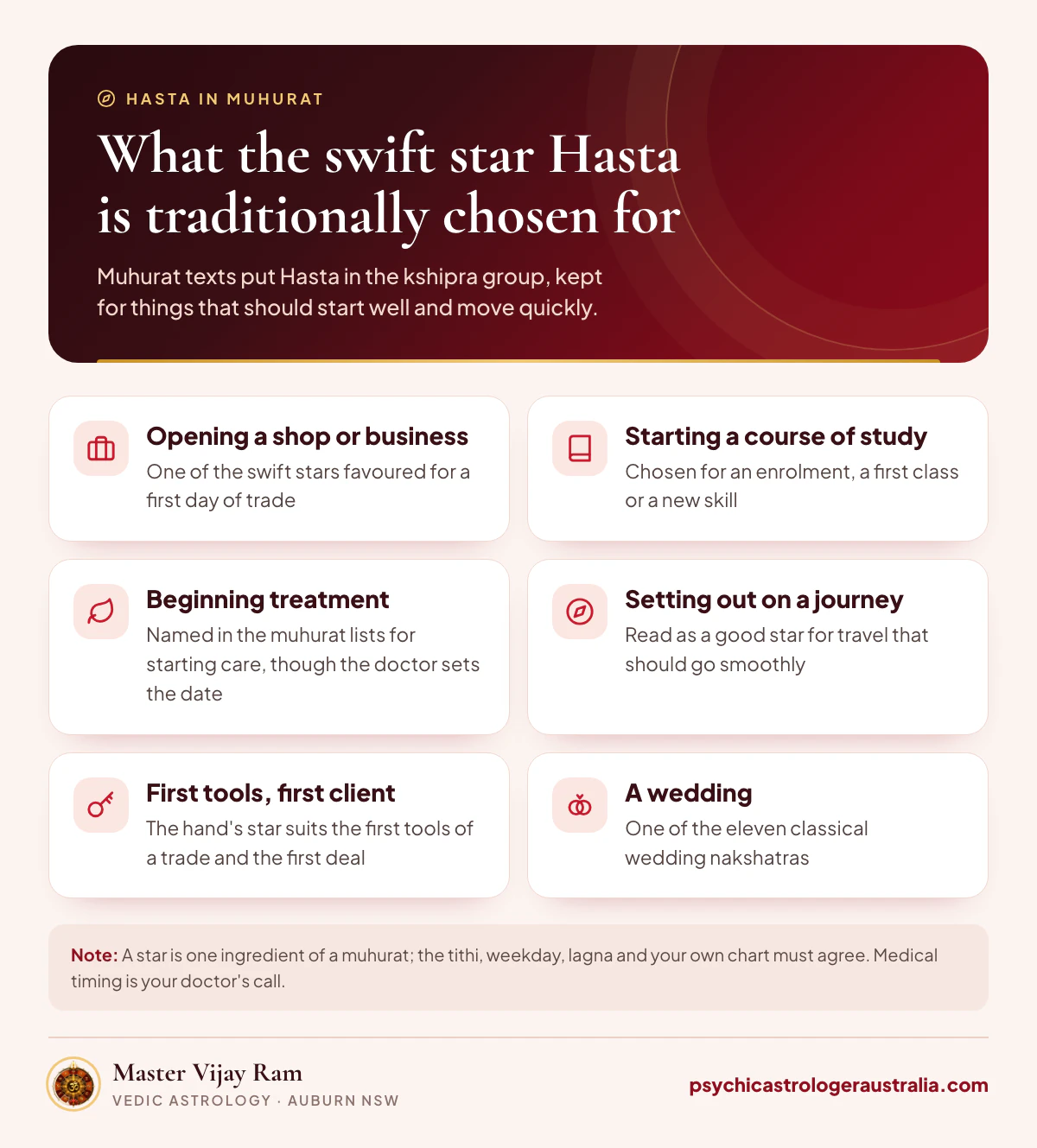
Muhurat texts place Hasta in the kshipra, or swift, group with Ashwini and Pushya, stars traditionally chosen for things that should start well and move quickly: opening a shop, starting a course, beginning treatment, setting out on a journey, buying tools or signing up a first client. It also appears among the eleven classical wedding stars, which makes it one of the busiest stars in a family priest's diary.
The star is never the whole answer. A good muhurat also needs a clean tithi, a suitable weekday and lagna, and the horoscopes of whoever is acting, which is why an auspicious date and hour is chosen for a person rather than taken from a list.
Is Hasta the same as palm reading?
No, though the shared word causes confusion. Hasta samudrika shastra, the Indian art of reading the hand, is a separate tradition from the nakshatra, and Master Vijay Ram does not practise it; a Hasta Moon is a position in the sky at birth, not a pattern on the palm. Palm reading against Vedic astrology sets out the difference honestly.
Which health habits are traditionally read for Hasta?
Busy hands bring the habits of busy hands: wrists, fingers and shoulders worked hard for years, posture forgotten at a bench or a keyboard, and meals eaten standing up. Virgo is traditionally linked with digestion and the nerves, and a Hasta Moon under pressure is often read as worry that settles in the stomach.
These are tendencies to look after, not predictions. Pain, numbness or tingling in the hands, or a stomach that stays unsettled, should be seen by a GP or a physiotherapist first, and no mantra replaces that.
What does the tradition offer for a strained Moon?
The Moon's own practice comes first: Monday observances, worship of Shiva, the Gayatri itself given its link to Savitar, and the Moon's beej mantra, Om Shraam Shreem Shraum Sah Chandraya Namah, in your family's preferred spelling. A pearl is a later question, weighed only once the whole chart has been read and never because of the birth star, and Master Vijay Ram does not sell pearls or any other gem.
Now and then a Chandra shanti is suggested, when the Moon is badly hurt in the chart and its period weighs heavily. If so, Vijay Ram ji does the rite in person at Auburn for a fee from $250 that you agree to before the day, and only after a $50 consultation; how online puja and havan work covers taking part from interstate.
Where does a Hasta reading stop?
A reading can describe how a mind works and when its periods turn. It cannot choose a trade for you, guarantee that a business will succeed or tell you whether a contract is fair; a financial adviser, a lawyer and your own judgement do that work. Treat it as faith-based guidance; it does not replace medical, legal, financial or psychological advice.
Consultations happen over the phone, on video or through WhatsApp from anywhere in the country, in Hindi, Punjabi or English, and face to face only in Auburn, booked ahead. The star that sits after Hasta is Chitra, the craftsman's bright jewel, where the hand's skill becomes design, and the star before it is Uttara Phalguni, the star of promises.
Read next
- Rohini Nakshatra: The Moon’s Favourite Star of GrowthRohini nakshatra: why it is the Moon’s favourite, Brahma and the ox cart, the 10-year Moon dasha, padas and name soun…
- Shravana Nakshatra: The Star of Listening and LearningShravana nakshatra explained: Vishnu and the three footprints, the Moon as lord, padas and name sounds, traits, caree…
- Online Istikhara Service in Australia for Marriage & DecisionsHow online istikhara for marriage and other decisions works in Australia, what a genuine practitioner asks for, and t…
Frequently asked questions
Does a Hasta Moon mean I will be good with my hands?
It is a tendency, not a promise. The tradition reads a Hasta Moon as someone who thinks by doing and enjoys skilled practical work, and many people with this Moon are handy, precise or quick-witted. The lagna, Mercury, Mars and the tenth house decide how that shows up, so one Hasta person becomes a surgeon and another a writer whose skill is in the editing.
Is Hasta nakshatra good for starting a business?
Traditionally yes. Hasta belongs to the kshipra, or swift, group that muhurat texts favour for openings, trade, study, treatment and travel, and it appears in the usual lists for starting a business. A good opening also needs a suitable tithi, weekday and lagna and the owner's own chart, so the star is a strong ingredient rather than the whole muhurat.
Why is the symbol of Hasta a hand?
Because the star group is usually given as the five bright stars of Corvus, read as the five fingers of an open palm, and because its deity, Savitar, is the golden-handed Sun who sets the world to work. The hand stands for skill, giving, blessing and craft, and also for the grasping, controlling side that the tradition warns about.
Is Hasta nakshatra connected with palmistry?
Only by the word. Hasta means hand, and hasta samudrika shastra is the Indian tradition of reading the palm, but a Hasta Moon is a position of the Moon at birth, calculated from the date, time and place. Master Vijay Ram does not read palms; his work is the birth chart, and he says so plainly if a palm reading is what someone wants.
What letters are used for names in Hasta nakshatra?
Pu, Sha, Na and Tha, a sound for each quarter, for example Puneet, Shalini or Naina. In the Hindi lists the last three are hard, tongue-curled sounds that seldom begin a name, so many families use the everyday Sha or Na, or keep the strict sound for the temple name and pick another name for daily life. The quarter has to be confirmed from the hospital's recorded time.
How long is the Moon dasha at birth for Hasta?
Anything up to ten years, which is the whole Moon mahadasha, depending on how much of the star the Moon still had to cross at birth. At Hasta's first degree almost ten years remain; at its midpoint about five; near its end very little. Mars's seven years come next, then Rahu's eighteen, which for most Hasta people cover the teens and twenties.
Which nakshatras match well with Hasta?
On yoni, Swati's male buffalo pairs fully with Hasta's female buffalo. Deva gana sits comfortably with Deva and Manushya partners, while another Adi-nadi star such as Uttara Phalguni or Jyeshtha creates Nadi dosha that only a recognised exception can lift, and the horse stars, Ashwini and Shatabhisha, score lowest on yoni. A full kundli match, read as a whole, decides the question.
Which rashi is Hasta nakshatra?
Virgo, Kanya rashi, for all four padas, since the whole star lies between 10° and 23°20′ of sidereal Virgo. A Hasta Moon is therefore a Moon in Mercury's sign, and Sade Sati, Dhaiya and Jupiter's yearly movement are all measured from Virgo. Each pada has its own navamsa, Aries for the first quarter through to Cancer for the fourth.
People also ask
Who is the deity of Hasta nakshatra?
Savitar, a Vedic form of the Sun as the power that wakes the world and sets it to work each morning. The Gayatri mantra is addressed to him, and the Rig Veda calls him golden-handed. His presence is why the star is read for turning intention into action, the moment an idea becomes something made, mended or healed.
What is Hasta called in Malayalam?
Atham. In Kerala the ten days of Onam begin on Atham in the month of Chingam and end on Thiruvonam, the Malayalam name for Shravana, so Malayali families often know this star best as the start of the festival. Tamil calendars call it Hastham, and Hindi and Telugu calendars Hasta.
What is the animal of Hasta nakshatra?
The female buffalo, in the yoni scheme that compares two charts for marriage. Swati carries the male buffalo and scores fully with it, and the horse yoni of Ashwini and Shatabhisha is its traditional opposite. Yoni is one strand of eight in the match, read for physical temperament between partners; it does not judge anyone's character.
Is Hasta a good nakshatra for a wedding?
Yes, traditionally: the classical list of eleven wedding stars includes Hasta, alongside Rohini, Uttara Phalguni, Swati and Anuradha, and its swift nature makes it popular for beginnings in general. A wedding muhurat still needs the right tithi, weekday and lagna and both partners' charts, and the family's priest or panchang has the final word on the date.
Which planet rules Hasta nakshatra?
The Moon, which also rules Rohini and Shravana. Hasta is the middle of the Moon's three stars, and because Vimshottari opens each life with the period of the birth star's ruler, a Hasta Moon begins in the Moon's ten-year mahadasha. The Moon's condition in the chart, its sign, aspects and phase, colours how the star is read.
References & further reading
Serving clients across Australia
Confidential consultations by phone, video & WhatsApp — including: