
Quick answer
The Moon–Rahu antardasha is Rahu's sub-period inside the ten-year Moon mahadasha, lasting 1 year and 6 months from about seventeen months into it. The tradition links it with a restless, easily stirred mind, poor sleep and worry about home and mother. It is a tendency, not a diagnosis: a GP or Lifeline on 13 11 14 comes first for anxiety or low mood.
What is the Moon–Rahu antardasha?
The Moon mahadasha Rahu antardasha is the sub-period in which Rahu takes charge inside the Moon's ten-year mahadasha, and it is the one the tradition most closely associates with an unsettled mind. In Hindi it is the Chandra Rahu antardasha. The Moon is manas, the feeling mind, and Rahu is the shadow that in the old story swallows it at an eclipse.
That story is a picture, not a diagnosis. Many people pass through these months with nothing more than a busier head than usual, and Master Vijay Ram's graha shanti guidance for the Moon and Rahu begins with the ordinary supports before anything ritual.
If you are struggling right now, who comes first?
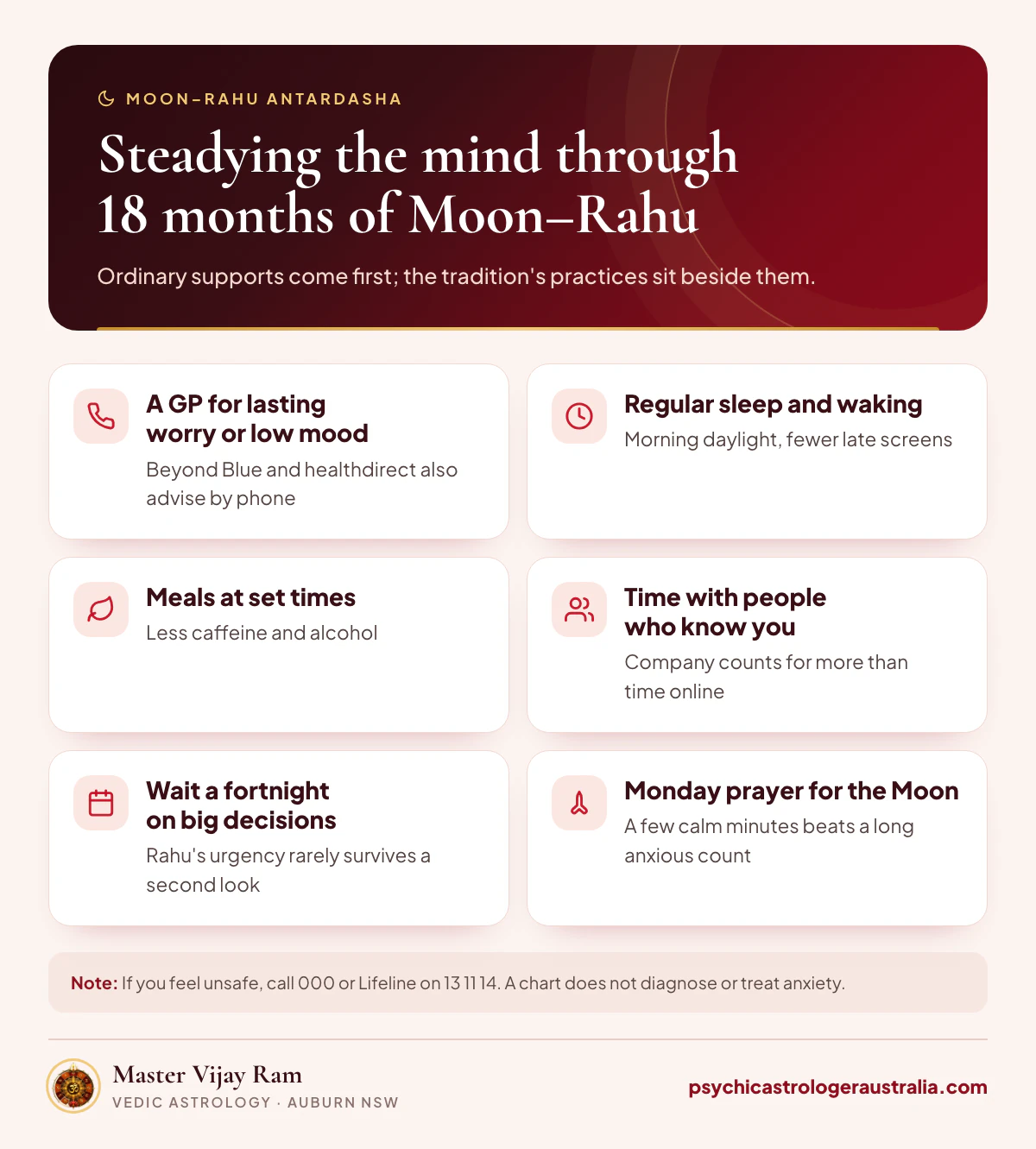
Before any astrology: if you feel unsafe or are thinking about ending your life, call 000 or Lifeline on 13 11 14, any hour. For anxiety or low mood that has lasted more than a couple of weeks, see a GP, who can arrange a mental health plan and referrals; Beyond Blue (1300 22 4636) and healthdirect (1800 022 222) also give advice by phone.
A chart reading can sit beside that care and help you understand the timing of a hard stretch. It does not treat anxiety or depression, and no remedy replaces a doctor. The guide to astrology and mental health explains where the line sits and why Vijay Ram ji holds to it.
How long does Moon–Rahu last, and when does it come?
It lasts 1 year and 6 months in 360-day years: the Moon's ten years multiplied by Rahu's eighteen, divided by 120. It is the third sub-period of the Moon mahadasha, after the Moon's own ten months and Mars's seven, so it begins about a year and five months into the ten years. Jupiter's sub-period follows.
Eighteen months is long enough to feel like a season, short enough to see the end of. Many people find that knowing the date it finishes is, by itself, a real comfort. The guide to the Moon mahadasha shows the whole ten-year sequence.
Why does the tradition link these months with a restless mind?
The Moon governs mood, sleep, memory, appetite, the mother and the sense of being at home. Rahu magnifies, distorts and craves, and it has no body of its own to settle into. When Rahu runs a sub-period inside the Moon's years, the tradition reads the mind as easily stirred and slow to settle.
In the eclipse story Rahu swallows the Moon and the Moon reappears, because Rahu has no throat to hold it. Astrologers have long used that image as encouragement: the darkening is real, but it is temporary, and the light comes back by its own nature.
What do people commonly describe?
The table lists the Moon Rahu anxiety patterns clients in this sub-period often describe, beside the ordinary explanations that should be checked first. A chart can describe a tendency; it cannot rule out a thyroid problem, burnout or grief.
| What people describe | Ordinary causes worth checking | Who helps first |
|---|---|---|
| Racing thoughts at night, poor sleep | Stress, caffeine, screens, shift work | GP; a sleep routine |
| Worry that will not switch off | Anxiety, a life change, money pressure | GP, Beyond Blue |
| Feeling far from home or family | Migration, a move, a parent's illness | Friends, community, a counsellor |
| Unusual fears or suspicion | Exhaustion, substances, an illness | GP promptly; 000 if anyone is unsafe |
| Comfort eating or skipping meals | Mood, routine, a medical cause | GP, a dietitian |
| Heavy screen use, scrolling | Loneliness, avoidance, habit | Limits, company, daylight |
Does a Moon–Rahu conjunction at birth make it stronger?
A Moon in the same sign as Rahu at birth gives one version of the pairing people call Grahan dosha, and these eighteen months put both of its planets in charge together. The explanation of Grahan dosha covers why it is a later label and what changes its weight. The closer the two are in degrees, the more astrologers watch it.
No natal pairing, no Grahan question: a dasha is a calendar, and a calendar cannot add a conjunction that was not there when you were born.
How do the Moon's phase and sign change the reading?
A bright, waxing Moon well away from the Sun is read as resilient, and carries the sub-period more easily. A Moon close to the Sun at birth, within about 12°, or in the dark half of the month, is read as more sensitive. The Moon is exalted in Taurus and debilitated in Scorpio, and that dignity matters too.
Position from the Moon to Rahu is the next layer. Rahu in the 4th, 8th or 12th from the natal Moon tends to make the sub-period more inward and restless; Rahu in the 3rd, 6th or 11th from the Moon, the growth houses, often lets the same restlessness drive effort and ambition instead. For some, the very months others find unsettling turn out to be inventive and productive.
Why is Moon–Rahu different from Rahu–Moon?
The order of the lords changes the reading. Rahu–Moon, the Moon Rahu bhukti in reverse, sits near the end of Rahu's eighteen years: Rahu's ambition and restlessness are the background, and the Moon's sub-period brings the feelings those years stirred up to the surface. Here it is the other way round.
In Moon–Rahu the background is the Moon's own decade of home, family, care and feeling, and Rahu arrives early in it as a disturbance. People often describe a settled domestic life suddenly feeling too small, or a calm mind suddenly busy. The same two planets, but the question is different: not what all that striving cost, but what this new restlessness wants.
Is there a link with Saturn and the Moon?
People who already have Saturn with the Moon at birth sometimes ask whether this sub-period adds to that heaviness. The two pairings are read differently: Saturn with the Moon tends toward weight and seriousness, Rahu with the Moon toward agitation and craving. The post on Vish yoga, Saturn with the Moon covers the first.
If Saturn's Sade Sati is also running over the Moon sign, the reading looks at all three together. An overlap is a reason for gentler plans, not for alarm.
What does the sub-period mean for mother and home?
In the tradition the Moon stands for the mother and Rahu for distance and the foreign. For Indian-Australian families the sub-period often coincides with worry about a mother far away, a long visit, or a decision about whether a parent should move here. These are real pressures, and talking them through with family and, if needed, a counsellor helps.
The 4th house of home and property is the Moon's natural house, so moving house, renovating or renting out a property are common topics too. Practical advice from an agent, a conveyancer or a builder comes first; the chart adds which months look steadier.
Should big decisions wait until it passes?
Where a decision can wait a few months without harm, many astrologers suggest it does, especially if it is irreversible and being made in a hurry: resigning without another job, ending a long relationship in one argument, a large purchase to lift a low mood. That is ordinary good sense as much as astrology. Life does not stop for eighteen months, though, and decisions that are needed should be made with good advice.
A useful habit is to write a decision down and look at it again in two weeks. Rahu's urgency rarely survives a fortnight; a sound choice usually does.
What steadies the mind in these months?
The plain supports come first: regular sleep and waking times, daylight in the morning, meals at set hours, movement, and less caffeine and alcohol. Time with people who know you well matters more than time online. None of these is mystical, and all of them are what the Moon is traditionally said to need.
Many families keep Monday for the Moon: a simple prayer to Shiva, the mantra Om Shraam Shreem Shraum Sah Chandraya Namah, and a gift of rice, milk or white cloth. For Rahu, Durga worship and a gift of blankets are traditional. Your own family's version of any mantra is fine, and a few calm minutes count for more than a long count done anxiously.
A pearl is never suggested from a dasha alone; he sells no stones. When the Moon is badly placed and a shanti seems right, Vijay Ram ji does it himself in Auburn, and the figure, from $250, is settled with you beforehand; details are on the Chandra and Rahu puja page. The health and wellbeing reading that decides whether one is wanted costs $50.
What can a Moon–Rahu reading not do?
It cannot diagnose anxiety, depression or any other condition, and it cannot replace medication, therapy or a doctor's care. It can explain why a period feels the way it does, show roughly when it eases, and suggest calm practices to add to proper care. If anything in this post has stirred up worry, Lifeline on 13 11 14 is there.
Someone in Logan or Toowoomba can talk to Vijay Ram ji on a video call as easily as someone round the corner from Auburn; the readings for Brisbane clients explain the time-zone side, and the conversation can be in Punjabi, Hindi or English.
Read next
- Chandra Mahadasha: Ten Years of the Moon and the MindChandra mahadasha explained: the ten-year Moon period, its nine antardashas, the mind, mother and home, why the Moon’…
- Grahan Dosha: Sun or Moon with Rahu or Ketu in the Birth ChartGrahan dosha, the Sun or Moon with Rahu or Ketu, explained calmly: the four forms, what each colours, what changes it…
- Kundli Reading Explained: What Your Birth Chart RevealsWhat a Kundli reading reveals about your life, personality, career and destiny. Master Vijay Ram explains Vedic astro…
Frequently asked questions
How long is Moon mahadasha Rahu antardasha?
Eighteen months, or 1 year and 6 months, counted in traditional 360-day years. Ten Moon years times eighteen Rahu years over 120 gives one and a half. The Moon's own ten months and Mars's seven come before it, so it opens roughly seventeen months after the Moon mahadasha begins, and Jupiter takes over when it ends.
Does Moon–Rahu antardasha cause anxiety?
The tradition associates it with a restless, easily stirred mind, but a chart does not cause or diagnose anxiety. Ordinary causes such as stress, sleep loss, a life change or a medical problem should be checked by a GP. Beyond Blue and Lifeline on 13 11 14 are there for support.
What is the link between Moon–Rahu and Grahan dosha?
Grahan dosha is a popular label for the Sun or Moon in the same sign as Rahu or Ketu at birth. If your chart has the Moon with Rahu, this sub-period runs both lords of that pairing and is when its themes are most noticed. Without the natal conjunction, the label does not apply.
Is Chandra Rahu antardasha bad?
Not necessarily. A strong, waxing Moon and Rahu in the 3rd, 6th or 11th from the Moon can turn the same restlessness into ambition and inventiveness. It is heavier when the Moon is weak, close to the Sun, or debilitated in Scorpio, or when Rahu sits in the 4th, 8th or 12th from it.
Should I make big decisions during Moon–Rahu?
Decisions that can safely wait a few months are often better left, especially irreversible ones made in a hurry. Decisions that are needed should be made with good advice. Writing a choice down and revisiting it after two weeks is a simple test against Rahu's sense of urgency.
What remedies help in Moon Rahu dasha?
Regular sleep, daylight, meals at set times and time with trusted people come first. Many families add Monday prayers to Shiva with the Moon beej mantra, a gift of rice, milk or white cloth, and Durga worship or blankets for Rahu. None of these replaces medical care.
Should I wear a pearl in Moon–Rahu antardasha?
Not on the strength of the dasha. A gemstone is considered only after the whole chart is read, because the Moon rules different houses for different lagnas. Master Vijay Ram sells no stones, and buying advice belongs to a qualified gemmologist under Australian Consumer Law.
What does a Moon–Rahu consultation cost?
Fifty dollars for the reading itself, which can be held over the phone, on video or through WhatsApp. Only if the chart calls for it would a Chandra or Rahu shanti follow; those begin at $250, the amount is fixed with you before anything is done, and Master Vijay Ram performs it himself in Auburn. Most people in this sub-period need only the conversation.
People also ask
What happens in Rahu antardasha of Moon mahadasha?
The tradition reads a mind that is easily stirred: busier thoughts, lighter sleep, worry about home or mother, and a pull toward distraction. For some it brings restless ambition instead. The detail depends on the Moon's strength and phase and on where Rahu sits from it in the birth chart.
Why is Rahu considered hard on the Moon?
In the eclipse story Rahu swallows the Moon, and astrology borrows that image for Rahu's effect on the mind. The same story has the Moon reappearing, because Rahu cannot hold it, which is why the tradition reads the effect as temporary. The image is symbolic, not medical.
What comes after Moon–Rahu antardasha?
Moon–Jupiter follows, lasting 1 year and 4 months. Inside the Moon mahadasha the order is Moon, Mars, Rahu, Jupiter, Saturn, Mercury, Ketu, Venus and the Sun. Jupiter's sub-period is often read as steadier, bringing counsel and a calmer sense of direction.
Can astrology help with anxiety?
A reading can help some people understand the timing of a hard stretch and feel less alone in it, but it does not treat anxiety. A GP, Beyond Blue on 1300 22 4636 or Lifeline on 13 11 14 should come first, with any spiritual practice added beside proper care.
References & further reading
Serving clients across Australia
Confidential consultations by phone, video & WhatsApp — including: