

Quick answer
Gochar is the Vedic method of reading transits by counting the house each moving planet occupies from your natal Moon sign. Each planet has houses where its transit is traditionally favourable, such as the 3rd, 6th and 11th for Saturn, and vedha points where another planet can block the good result. Transits colour the period the dasha has already set.
What is gochar?
Gochar is the Vedic method of reading transits, the current movement of the planets, against a person's birth chart by counting where each planet now stands from the natal Moon. The word means moving, or the path of movement. It is the part of astrology behind every headline about Saturn changing sign or Jupiter entering a new rashi.
The method is old and simple at its core: find your Moon sign, count from it to the sign a planet is passing through, and read what the tradition says about that planet in that house. What makes it useful rather than a horoscope column is the detail that follows: vedha, the strength of the sign for this chart, and the dasha the person is running.
Gochar is one layer of a personal kundli reading, never a substitute for it.
Why are transits counted from the Moon?
The Moon stands for the mind, the body's daily rhythm and how life is felt from the inside. Classical texts on transits in Vedic astrology therefore count gochar from the Moon sign, the janma rashi, so that the reading describes how a period is experienced. This is also why Sade Sati is defined by Saturn's distance from the Moon.
Many astrologers also count from the lagna as a second view, and some check the Sun for questions of status and health. When the Moon count and the lagna count agree the reading is firmer. If you do not know your Moon sign, how to find your Moon sign walks through it.
How do you count the house a planet is transiting?
Your Moon sign is house one. The next sign is house two, and so on round the zodiac. If your Moon is in Leo and Saturn is moving through Aries, count Leo one, Virgo two, Libra three, Scorpio four, Sagittarius five, Capricorn six, Aquarius seven, Pisces eight, Aries nine: Saturn is in your ninth from the Moon.
Sidereal signs are used throughout, so the dates differ from Western astrology's. The table below shows when the slow planets change sidereal sign in the period ahead.
| Planet | Moves | Date (Sydney) | Date in India |
|---|---|---|---|
| Jupiter | Gemini → Cancer (Karka) | Tue 2 Jun 2026 | 2 Jun 2026 |
| Jupiter | Cancer → Leo (Simha) | Sat 31 Oct 2026 | 31 Oct 2026 |
| Jupiter | Leo → Cancer (Karka) retrograde | Mon 25 Jan 2027 | 25 Jan 2027 |
| Jupiter | Cancer → Leo (Simha) | Sat 26 Jun 2027 | 26 Jun 2027 |
| Jupiter | Leo → Virgo (Kanya) | Sat 27 Nov 2027 | 26 Nov 2027 |
| Jupiter | Virgo → Leo (Simha) retrograde | Tue 29 Feb 2028 | 28 Feb 2028 |
| Jupiter | Leo → Virgo (Kanya) | Mon 24 Jul 2028 | 24 Jul 2028 |
| Jupiter | Virgo → Libra (Tula) | Tue 26 Dec 2028 | 26 Dec 2028 |
| Saturn | Pisces → Aries (Mesha) | Thu 3 Jun 2027 | 3 Jun 2027 |
| Saturn | Aries → Pisces (Meena) retrograde | Wed 20 Oct 2027 | 20 Oct 2027 |
| Saturn | Pisces → Aries (Mesha) | Thu 24 Feb 2028 | 23 Feb 2028 |
| Rahu | Aquarius → Capricorn (Makara) retrograde | Sun 6 Dec 2026 | 5 Dec 2026 |
| Rahu | Capricorn → Sagittarius (Dhanu) retrograde | Sat 24 Jun 2028 | 24 Jun 2028 |
| Ketu | Leo → Cancer (Karka) retrograde | Sun 6 Dec 2026 | 5 Dec 2026 |
| Ketu | Cancer → Gemini (Mithuna) retrograde | Sat 24 Jun 2028 | 24 Jun 2028 |
Rahu and Ketu use the mean node, the usual Vedic default. Computed with the Swiss Ephemeris (Lahiri ayanamsa for Vedic positions) and checked against US Naval Observatory data. Times are rounded to the minute.
Which houses are favourable for each planet?
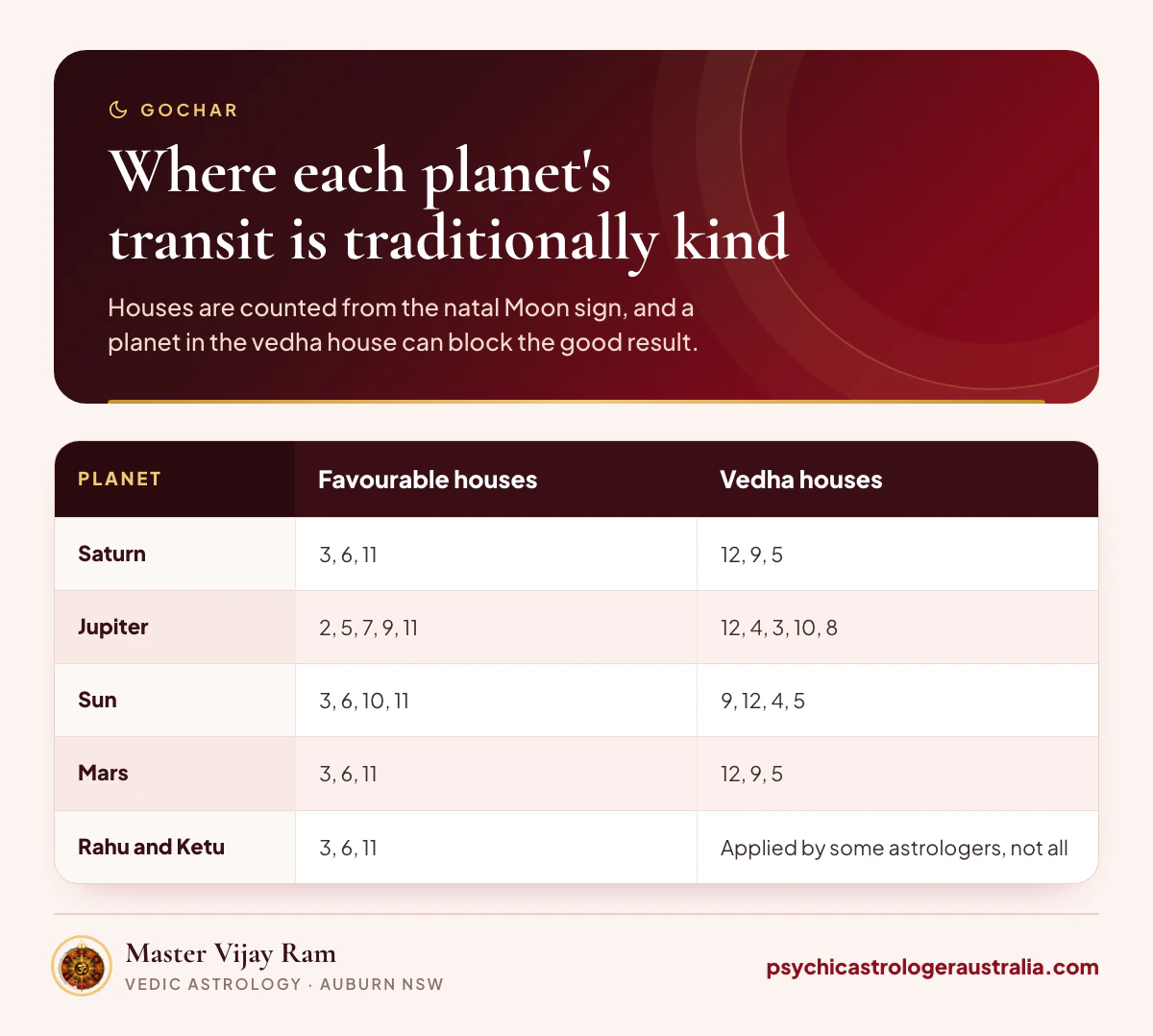
The classical rule is that each planet gives its better transit results from certain houses counted from the Moon, and its harder ones from the rest. The houses differ by planet because each planet's nature differs: a slow, heavy planet does best where effort and competition are rewarded, a benefic where growth and comfort are.
| Planet | Favourable houses from the Moon | Vedha (blocking) house for each |
|---|---|---|
| Sun | 3, 6, 10, 11 | 9, 12, 4, 5 |
| Moon | 1, 3, 6, 7, 10, 11 | 5, 9, 12, 2, 4, 8 |
| Mars | 3, 6, 11 | 12, 9, 5 |
| Mercury | 2, 4, 6, 8, 10, 11 | 5, 3, 9, 1, 8, 12 |
| Jupiter | 2, 5, 7, 9, 11 | 12, 4, 3, 10, 8 |
| Venus | 1, 2, 3, 4, 5, 8, 9, 11, 12 | Varies between texts |
| Saturn | 3, 6, 11 | 12, 9, 5 |
| Rahu and Ketu | 3, 6, 11 | Applied by some astrologers, not all |
Notice that the 11th, the house of gains, is favourable for every planet, and that the malefics share the upachaya houses 3, 6 and 11, where struggle turns into progress. Jupiter is the planet most people watch, and Jupiter's transit through 2027 applies the rule sign by sign.
What is vedha, and why does it matter?
Vedha in transits means obstruction. For every favourable house there is a paired house, and if another planet is transiting that paired house at the same time, the good result is said to be blocked or reduced. The reverse also applies in some texts: a planet in a difficult house can have its harm softened by a planet in the matching vedha point.
Two exceptions are commonly given: the Sun and Saturn do not obstruct each other, and nor do the Moon and Mercury, because each pair is related as father and child in the myths. Whether Rahu and Ketu cause vedha is a point on which astrologers disagree.
Can you show vedha with a real transit?
Take a Leo Moon in 2027. From the 2027 Moon-sign tables, Jupiter is in the first house from that Moon from late June to late November, and moves into the second from 27 November in Sydney time. The second is one of Jupiter's favourable houses, so the year ends on a traditionally helpful note for money and family.
Its vedha point, though, is the twelfth from the Moon, which for a Leo Moon is Cancer, and Ketu sits in Cancer for all of 2027. An astrologer who counts the nodes for vedha would say the Jupiter benefit arrives muted; one who does not would read it as clear. That difference is real, and a good reading names it rather than hiding it.
The same Leo Moon has Saturn in the eighth from the Moon until 2 Jun 2027, a Dhaiya, in the ninth after Saturn enters Aries on 3 Jun 2027, and in the eighth again once Saturn slips back into Pisces on 20 Oct 2027. Neither is among Saturn's favourable houses, but the ninth is gentler in practice than the eighth for most charts.
How do Saturn transits read from the Moon?
Because Saturn spends about two and a half years in each sign, its transits shape long stretches of life. The twelfth, first and second from the Moon make up Sade Sati; the fourth and eighth are the two Dhaiyas; the third, sixth and eleventh are the houses where Saturn's transit is traditionally productive. The full 2027 picture by rashi is in Saturn's transit into Aries for every rashi.
Even a difficult Saturn transit is read as a time of tightening and patience rather than disaster. Many people find their most solid work, savings and habits are built in exactly these years.
Do the fast planets matter in gochar?
The Sun changes sign roughly once a month, Mercury and Venus about as often, Mars every month and a half or so, and the Moon every two and a half days. Their transits are too quick to describe a chapter of life, so astrologers use them to fine-tune timing inside a period the slow planets and the dasha have already marked out.
A common example is the Sun's transit through the tenth or eleventh from the Moon, traditionally a good month to ask for recognition at work, or the Moon's daily position, which the panchang uses for choosing hours. Mars over the third or sixth is read as a month when effort and competition go well; over the eighth or twelfth, a month for care on the road and with tempers.
Some texts add a further layer, the murti or paya of a transit, judged from where the Moon stands at the moment a slow planet changes sign. Counted from the natal Moon, the 1st, 6th and 11th are called gold, the 2nd, 5th and 9th silver, the 3rd, 7th and 10th copper and the 4th, 8th and 12th iron, from kindest to hardest. Traditions differ on how much weight to give it, and Vijay Ram ji treats it as a footnote rather than a verdict.
Why must transits follow the dasha?
This is the principle most online transit forecasts ignore. The birth chart shows what a life can contain, the dasha shows which part of it is active now, and the transit shows how the weather feels within that season. A transit cannot give what the chart and the running period do not promise.
So a fine Jupiter transit through the eleventh does little for someone in a hard dasha whose lord is weak and badly placed, while a modest transit can coincide with a big year if the dasha is strong. Master Vijay Ram reads the dasha first and the gochar second for exactly this reason.
How do the bindus refine a transit?
Two people with the same Moon sign have the same gochar, but they do not live the same year. One reason is the dasha; another is the ashtakavarga, which scores how well each sign supports each planet in a particular chart. A Saturn transit through a sign with a high score is traditionally read as much lighter than one through a low-scoring sign.
The method is explained in ashtakavarga and transit scores. Used with gochar, it turns a generic forecast for twelve Moon signs into something closer to a personal one.
What can a transit reading not tell you?
A transit cannot see your workplace, your health results, your visa file or the property market, and it never fixes an event to a date. It describes tendencies and timing, and its plainest limitation is that the same transit is shared by roughly one in twelve people, which is why it must be read through the individual chart.
Practical help comes first for practical problems: a GP for health, a financial counsellor or the National Debt Helpline for money stress, Home Affairs or a registered migration agent for visas, and Lifeline on 13 11 14 for anyone who feels overwhelmed.
What helps during a hard transit?
The traditional answers are modest: mantra for the transiting planet, steady routines, charity suited to the planet, and patience with what is slow. For Saturn that means honest work, care for elders and service to people who labour; the Sade Sati and Shani remedies page sets this out.
Where a shanti is warranted it is performed personally by Vijay Ram ji at his place of practice in Auburn, starting from $250 and agreed before it is performed; arranging a shanti puja explains the steps. A $50 consultation by phone, video or WhatsApp, in English, Hindi or Punjabi, covers the reading, and clients in the national capital can book through readings for Canberra clients.
Read next
- 2027 Vedic Horoscope: Forecast for All 12 Moon Signs2027 Vedic horoscope for all 12 Moon signs: Saturn into Aries on 3 June, Sade Sati for Aquarius, Pisces, Aries and Ta…
- Karka Rashi 2027: Ketu on the Moon and Jupiter’s Brief ReturnKarka rashi 2027 for the Cancer Moon: Ketu on the Moon and Rahu in the 7th all year, Jupiter back in Cancer from 25 J…
- Sihr Removal in Australia: Signs of Sihr and How Ruqyah HelpsSihr removal in Australia explained: the signs worth taking seriously, what to rule out first, how ruqyah actually wo…
Frequently asked questions
What does gochar mean in astrology?
Gochar means the movement of the planets, and in Vedic astrology it refers to reading transits against the birth chart. The house each moving planet occupies is counted from the natal Moon sign, and the tradition describes what that planet tends to bring from each house. It is combined with the dasha and the birth chart, never read alone.
Why are transits read from the Moon sign and not the lagna?
The Moon represents the mind and how life is experienced, so classical gochar rules count from the Moon sign. Many astrologers also count from the lagna for a second view, especially for events and health. When both counts point the same way the reading is firmer; when they differ, the dasha usually decides which is more relevant.
Which houses are good for a Saturn transit?
Saturn's transit is traditionally favourable in the 3rd, 6th and 11th houses from the Moon, the upachaya houses where effort turns into progress. Its passage over the 12th, 1st and 2nd is Sade Sati, and over the 4th and 8th the Dhaiya. Other houses are mixed, and the ashtakavarga and dasha change the weight of every one.
What is vedha in gochar?
Vedha is obstruction. Each favourable transit house has a paired vedha house, and if another planet is moving through that paired house at the same time, the good result is said to be reduced or blocked. The Sun and Saturn do not obstruct each other, and nor do the Moon and Mercury. Traditions differ on whether Rahu and Ketu cause vedha.
Is a Jupiter transit in the 1st house good?
The 1st from the Moon is not among Jupiter's classical favourable houses, which are the 2nd, 5th, 7th, 9th and 11th. In practice many people find Jupiter over the Moon a time of reflection, health attention or responsibility rather than obvious gain. The dasha, the ashtakavarga score and Jupiter's role in the chart decide how it actually feels.
Why do two people with the same Moon sign have different years?
Because gochar is only one layer. Each person runs a different dasha, has a different lagna and has different ashtakavarga scores, so the same transit lands on different ground. The transit is shared by everyone with that Moon sign; the experience of it is not.
Can a transit predict an exact event?
No. A transit describes a tendency and a period, such as a stretch when effort at work is rewarded or when family needs more attention. Exact events depend on the chart, the dasha, choices and circumstances that no transit can see. Readings that give a fixed date from a transit alone claim more than the method supports.
Should I do a remedy during a difficult transit?
Usually the first suggestions are mantra, steady routines and charity suited to the planet. A shanti is considered only where the transit coincides with a difficult dasha and the reading finds it worthwhile. It is performed personally in Auburn, starts from $250 and is agreed beforehand, after a $50 consultation. Many hard transits need only patience.
People also ask
How do I find which house a planet is transiting?
Take your sidereal Moon sign as house one and count forward sign by sign to the sign the planet is currently in. The number you reach is the house from the Moon. Use a sidereal (Lahiri) ephemeris, not Western sun-sign dates.
Which planet's transit matters most?
Saturn and Jupiter matter most because they stay in a sign long enough, about two and a half years and about a year respectively, to shape a period of life. Rahu and Ketu, which stay about eighteen months, come next. Fast planets are used for short-term timing.
What is the difference between gochar and dasha?
The dasha is a personal timing cycle fixed at birth that decides which planet's themes are active. Gochar is the real movement of the planets now, read against the chart. The dasha sets the season and the transit sets the weather within it.
Are transits counted in sidereal or tropical signs?
Vedic gochar uses sidereal signs, usually with the Lahiri ayanamsa, so a planet's sign change falls on a different date than in Western astrology. Saturn, for instance, enters sidereal Aries on 3 Jun 2027 Sydney time.
References & further reading
Serving clients across Australia
Confidential consultations by phone, video & WhatsApp — including: