
Quick answer
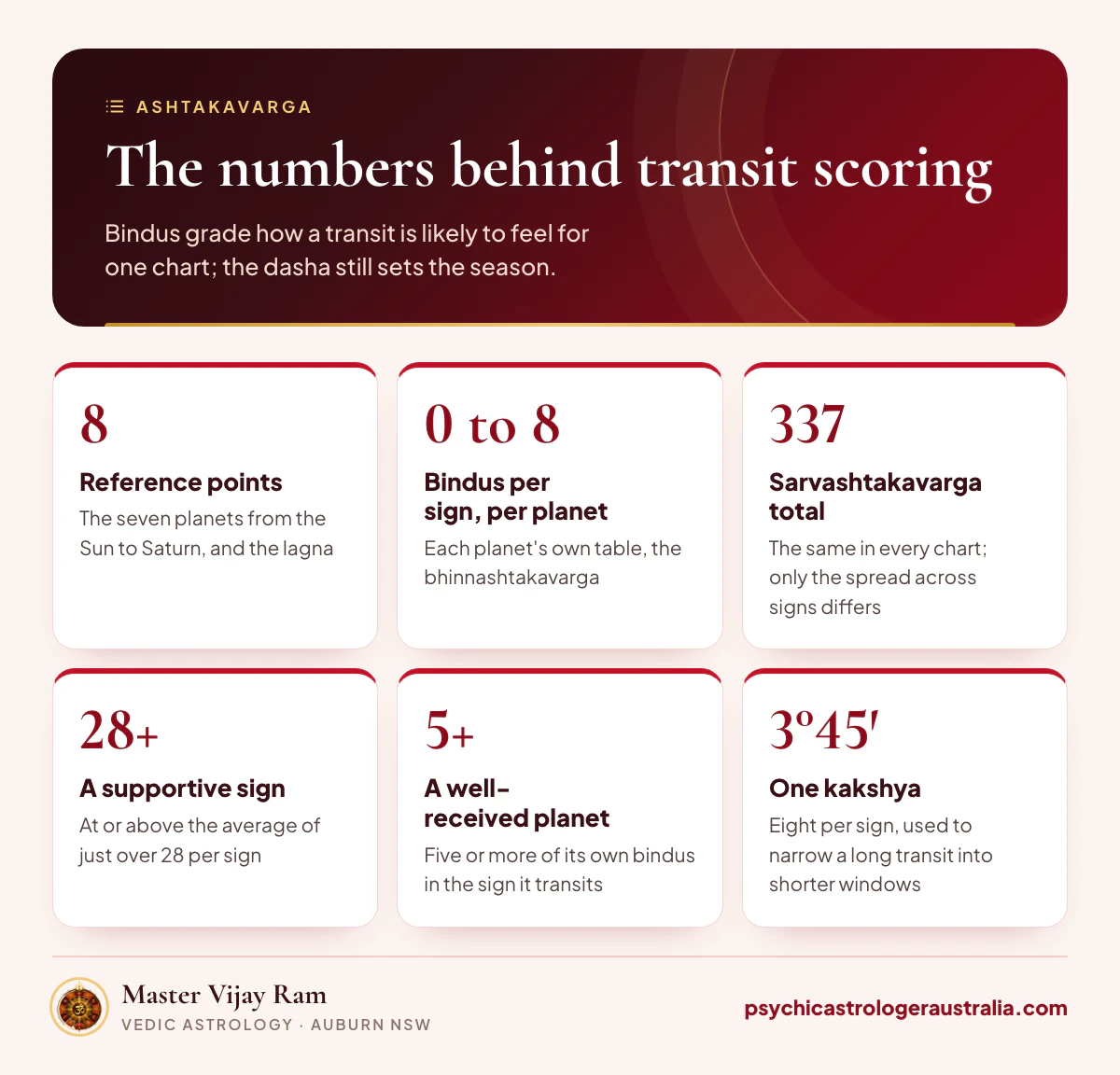
Ashtakavarga is a Vedic scoring system in which each planet gives every sign between 0 and 8 bindus, or points. The planet-by-planet tables add up to a sarvashtakavarga of 337, and a sign holding 28 or more is traditionally read as supportive for transits through it. It grades how a transit is likely to feel for one chart, rather than predicting events.
What is ashtakavarga?
Ashtakavarga is a scoring method that counts how much support each sign of the zodiac receives from eight reference points in a birth chart: the seven visible planets from the Sun to Saturn, and the lagna. The name means eight divisions. Every sign is given a small number of points, called bindus, and those numbers are then used to judge how a planet moving through that sign is likely to feel for this particular person.
It is one of the oldest tools in Jyotish, set out in the Brihat Parashara Hora Shastra, and it answers a question every astrologer meets: why does the same Saturn transit sit lightly on one person and heavily on another with the same Moon sign? The bindus are part of the answer. They are worked out once, from the birth chart, and stay fixed for life.
Like the dashas and the divisional charts, it belongs inside a careful kundli reading rather than on its own.
Where do the bindus come from?
For each planet, the texts list which houses, counted from each of the eight reference points, receive a benefic point. Jupiter, for instance, gives a point to certain houses counted from the Sun, certain houses from the Moon, and so on through the lagna. Because there are eight contributors, any one sign can receive anywhere from 0 to 8 bindus from a given planet.
The planet-by-planet grid is called the bhinnashtakavarga. A planet's table always adds up to the same total whatever the chart, because the rules give it a fixed number of points to distribute; only where those points land changes from person to person.
| Planet | Total bindus in its own table | Highest possible in one sign |
|---|---|---|
| Sun | 48 | 8 |
| Moon | 49 | 8 |
| Mars | 39 | 8 |
| Mercury | 54 | 8 |
| Jupiter | 56 | 8 |
| Venus | 52 | 8 |
| Saturn | 39 | 8 |
| All seven together (sarvashtakavarga) | 337 | 56 |
What is the sarvashtakavarga, and why 337?
Add the seven planets' tables sign by sign and you get the sarvashtakavarga, the combined score. Whatever the chart, its twelve signs together hold 337 bindus, the sum of the seven fixed totals above. Divide by twelve and the average sign holds a little over 28.
That is where the commonly quoted rule comes from: a sign with 28 or more bindus in the sarvashtakavarga is read as supportive for planets transiting it, and a sign well below 28 as asking more effort. Some astrologers soften the line, treating 25 to 28 as ordinary and only the low twenties and below as demanding; traditions differ on the exact cut.
How are bindus used to judge a transit?
Two numbers are read together when a slow planet enters a new sign. The first is the sarvashtakavarga of that sign, which shows how well the area of life it represents is supported overall. The second is the transiting planet's own bindus in that sign, from its bhinnashtakavarga, which shows how well that particular planet is received there.
On a planet's own table, 4 is the midpoint. A transit through a sign where the planet holds 5 or more of its own bindus is traditionally read as giving that planet's good results more easily; 3 or fewer suggests its harder side shows more. When both numbers are high the transit is read as kind, when both are low as heavy, and mixed scores as a transit with some help and some strain.
The method sits on top of ordinary transit reading from the Moon, which is described in how gochar reads transits from the Moon. Ashtakavarga does not replace that count; it grades it.
What does a worked example look like?
The table below is an invented sarvashtakavarga for an imaginary chart, laid out by house from the lagna. The twelve figures add to 337 as every real one must. It belongs to nobody and is here only to show how the numbers are read.
| House from lagna | Bindus | How it is read |
|---|---|---|
| 1st | 30 | Supportive |
| 2nd | 26 | Ordinary |
| 3rd | 29 | Supportive |
| 4th | 24 | Asks more effort |
| 5th | 31 | Supportive |
| 6th | 27 | Ordinary |
| 7th | 33 | Strongly supportive |
| 8th | 22 | Asks more effort |
| 9th | 28 | Supportive |
| 10th | 32 | Strongly supportive |
| 11th | 35 | Strongly supportive |
| 12th | 20 | Asks more effort |
Suppose Saturn is about to move into this person's fourth house, with 24 bindus, and Saturn's own table gives that sign only 2. A reader would expect the home and family side of life to ask patience while Saturn stays there, perhaps renovations that drag or a parent who needs more care. If Saturn's next sign were the tenth, with 32 overall and 5 of its own, the same planet would be read as steadier and more productive at work.
How does ashtakavarga soften or sharpen Sade Sati?
This is where most people meet the method. Sade Sati is Saturn's passage over the twelfth, first and second signs from the Moon, and it is the same for everyone with that Moon sign. Ashtakavarga is one of the tools that separates a mild Sade Sati from a demanding one.
If the three signs involved carry high sarvashtakavarga scores, and Saturn holds 4 or more of its own bindus in them, the period is traditionally read as lighter than its reputation. Low scores in all three suggest the classic weight. Readers whose Moon sign is affected in 2027 can see which signs are involved in Sade Sati 2027 by Moon sign.
What are kakshyas, and do they matter?
Some astrologers refine the method further by cutting each sign into eight kakshyas of 3°45′, each ruled in turn by Saturn, Jupiter, Mars, the Sun, Venus, Mercury, the Moon and the lagna. When a transiting planet crosses a kakshya whose ruler gave a bindu to that sign, that stretch of the transit is read as kinder; when it crosses one whose ruler gave none, as harder.
This narrows a two-and-a-half-year Saturn transit into shorter windows of a few months. It is a fine-grained tool, useful for confirming a timing the dasha already suggests, and easy to over-read when used alone.
How do you read the ashtakavarga page of a software printout?
Most kundli software prints the method as a set of small grids. There is usually one grid per planet, each with a number from 0 to 8 in every sign, and one larger grid with the combined figure for each sign. Some programs lay these out as North Indian diamonds and others as South Indian squares, but the numbers mean the same thing.
Start with the combined grid. Check that the twelve figures add up to 337; if they do not, the software is using a variant rule or the grid has been misread. Then note which signs sit well above 28 and which fall into the low twenties, and count from your Moon sign and your lagna to see which houses those signs are.
Only after that look at the single-planet grids for Saturn and Jupiter, because those two planets stay in a sign long enough for their scores to matter over months rather than days. A fast planet such as the Moon crosses a sign in about two and a half days, so its bindus are used for short-term timing, if at all. Bring the printout to a consultation if you have one, so the figures can be checked against the chart itself.
Why can a high score still feel hard?
Because transits follow the dasha. A Jupiter transit over a sign with 34 bindus is welcome, but if the running mahadasha lord is badly placed and rules the eighth, the year can still be difficult. The dasha sets the season and the transit, graded by ashtakavarga, adjusts the weather inside it.
The bindus also say nothing about what a planet signifies for this chart. A strong score for Saturn in the seventh may describe a steady time with a partner or a patient business deal, depending on what Saturn rules. Numbers without the chart behind them are just arithmetic.
What are the limits of the method?
Ashtakavarga is a traditional system, not a measurement, and it has never been shown to predict events in controlled testing. It also inherits every weakness of the birth chart: the lagna's own contribution depends on an accurate time, and software can differ slightly in the rules it applies.
It is a way of describing tendencies and timing. A low-scoring transit is not a forecast of loss, a high one is not a promise of luck, and nobody should delay medical care, legal advice or a financial decision on the strength of a bindu count.
How does Master Vijay Ram use the scores?
He reads the birth chart and the running dasha first, then counts the big transits from the Moon, and only then checks the bindus to judge how heavy or light those transits are likely to feel. Where a strained transit coincides with a difficult period, a Saturn or Jupiter mantra and steady conduct are usually all he suggests; occasionally a shanti is warranted, performed personally in Auburn and agreed beforehand, as set out under how a puja or havan is booked.
A $50 consultation by phone, video or WhatsApp, in English, Hindi or Punjabi, covers the reading. The yearly forecast service uses the same tools across a whole year, families on Corio Bay can book through readings for Geelong clients, and the companion piece on shadbala and planetary strength explains the other great numerical method. For the transit of 2027 itself, see Saturn's 2027 transit into Aries.
Read next
- Lagna Explained: Your Rising Sign the Vedic WayLagna, the Vedic rising sign: why it outranks the sun sign, how fast it changes, the twelve lagnas and their lords, a…
- Gochar: Reading Transits From the MoonHow gochar works in Vedic astrology: counting transits from the Moon sign, the favourable houses for each planet, ved…
- 11 Signs of Negative Energy in Your Life (and How to Clear It)Eleven signs of negative energy, the ordinary causes to rule out first, and the three-doors test that tells you wheth…
Frequently asked questions
What are bindus in ashtakavarga?
Bindus are the benefic points each planet gives to each sign under the ashtakavarga rules. There are eight contributors, the seven visible planets and the lagna, so a planet can give any sign between 0 and 8 bindus. More bindus mean the sign is read as better able to support that planet when it transits there.
Why does the sarvashtakavarga always total 337?
Each planet's own table has a fixed total under the classical rules: Sun 48, Moon 49, Mars 39, Mercury 54, Jupiter 56, Venus 52 and Saturn 39. Those seven totals add up to 337 in every chart. What changes from person to person is how the points are spread across the twelve signs, which is what the reading is about.
What does 28 bindus mean?
Because 337 divided by twelve signs is just over 28, a sign holding 28 or more sarvashtakavarga bindus is read as above average and supportive for transits through it. Signs well below 28 are read as asking more effort. Some astrologers treat the mid twenties as ordinary rather than weak, so the line is a guide, not a rule.
What is the difference between bhinnashtakavarga and sarvashtakavarga?
The bhinnashtakavarga is a single planet's table, showing the 0 to 8 bindus it gives each sign. The sarvashtakavarga adds all seven planets' tables together for a combined score per sign. Transit readings usually check both: the overall support of the sign and the transiting planet's own score there.
Can ashtakavarga make Sade Sati easier?
It can show that a particular Sade Sati is likely to be lighter or heavier, but it cannot change it. If the signs Saturn crosses carry high scores and Saturn holds four or more of its own bindus there, the period is traditionally read as milder. The scores come from the birth chart and are fixed for life.
Do I need an exact birth time for ashtakavarga?
The planets' contributions are steady, but the lagna is one of the eight reference points, so its share depends on the rising sign. A time that is out by enough to change the lagna will change some scores. An approximate time still gives useful planet-based figures, and the astrologer should say which parts rest on the lagna.
Is ashtakavarga used to predict events?
It is used to grade transits, not to predict particular events. A high score suggests a transit tends to bring that planet's better results, a low score its harder side, but what those results are depends on the houses the planet rules and the dasha running. It describes tendencies and timing, never certainties.
Does a low score call for a remedy?
Not by itself. A low-scoring transit during a supportive dasha may pass quietly. Where a strained transit and a difficult period coincide, mantra and steady conduct are usually suggested first, and occasionally a shanti performed personally in Auburn from $250, agreed beforehand after a $50 consultation. Many readings recommend nothing beyond patience.
People also ask
What is a good ashtakavarga score?
In the sarvashtakavarga, 28 or more bindus in a sign is commonly read as good for transits, and above 30 as strongly supportive. In a single planet's table, 5 or more bindus out of 8 is read as favourable for that planet's transit. Lower figures suggest more effort rather than misfortune.
How many bindus are there in total?
The sarvashtakavarga always totals 337 bindus across the twelve signs. That figure is the sum of the seven planets' fixed totals, so it is the same for every chart; only the distribution differs.
Which house should have the most bindus?
There is no single required pattern, but many astrologers are pleased to see the eleventh house, read for gains, scoring well and the twelfth, read for expenses, scoring lower. Any one figure is read beside the house lords and the dasha.
Is ashtakavarga better than Moon-sign transits?
It is not a replacement but a refinement. Transits are first counted from the Moon, and ashtakavarga then grades how supportive each sign is for this particular chart. Used together they explain why people with the same Moon sign have different experiences of the same transit.
References & further reading
Serving clients across Australia
Confidential consultations by phone, video & WhatsApp — including: