
Quick answer
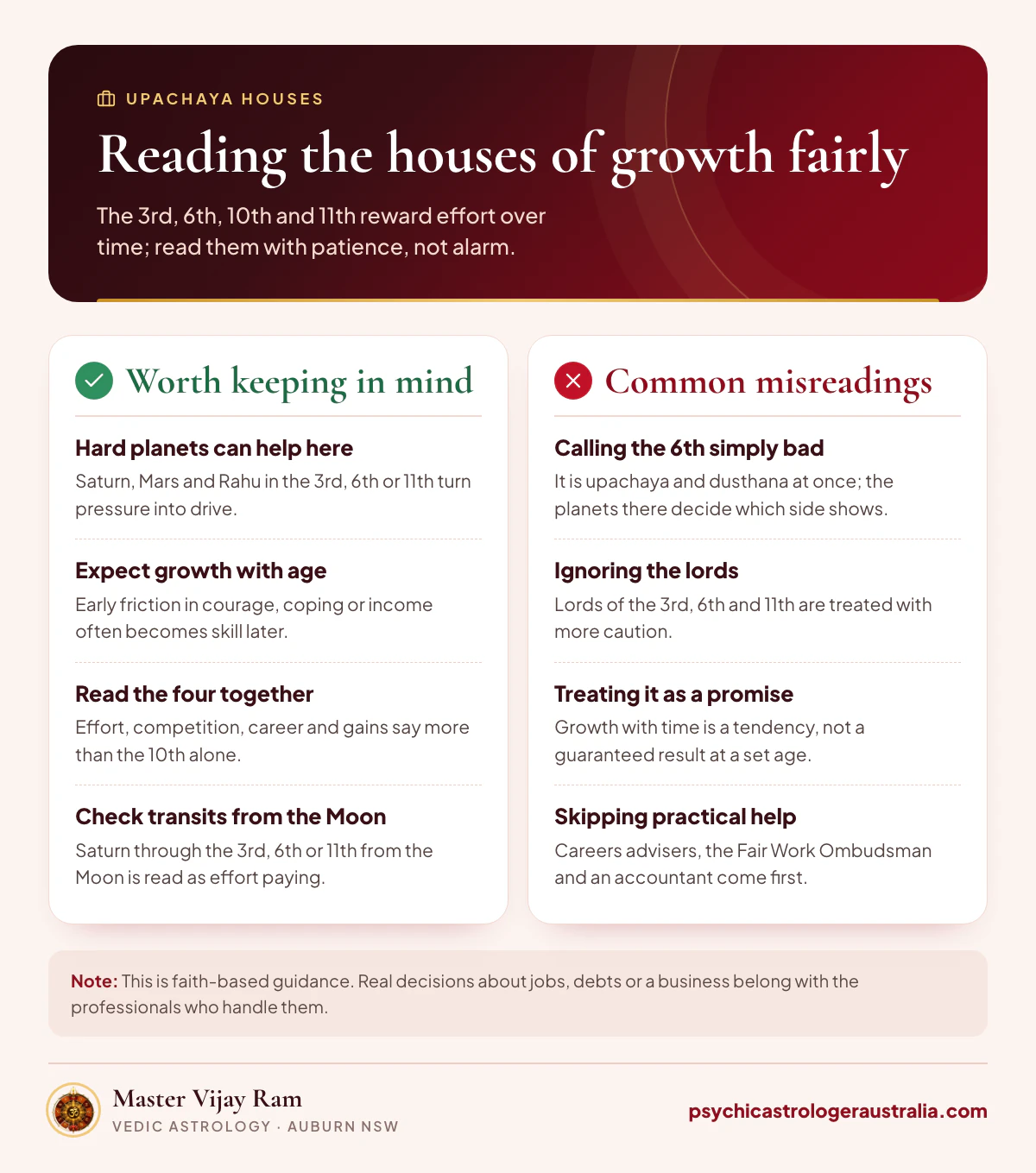
The upachaya houses are the 3rd, 6th, 10th and 11th, the houses of effort, competition, work and gains. Upachaya means growth, and the tradition holds that these houses improve with time and practice. Hard planets such as Saturn, Mars and Rahu are read as useful there, turning pressure into drive, while their lords are treated with more caution.
What are the upachaya houses?
An upachaya house is a house of the Vedic chart that the tradition says grows stronger over time and through effort, and there are four of them: the 3rd, 6th, 10th and 11th. Upachaya means increase or accumulation, which is why the upachaya houses are often called the houses of growth. Where most houses describe something you are given, these four describe something you build: courage through practice, resilience through competition, standing through work and income through networks.
The idea changes how a chart is read in a very practical way. A hard planet that would trouble a house of comfort or family is often welcomed in an upachaya house, because its pressure becomes fuel. This page explains why, using the houses as a group; the individual houses have their own guides, and a kundli reading with Master Vijay Ram puts the pattern into your own chart.
Why these four houses and not others?
Each of the four is a house of doing. The 3rd is the house of your own effort, courage, skills of the hand and voice, and younger siblings; its guide, the third house of courage and effort, covers it in depth. The 6th is the house of competition, service, debts and daily work. The 10th is career, status and public action. The 11th is gains, income, elder siblings, friends and networks.
What makes them houses of growth is that they respond to repetition. Courage grows by being used, a rival makes you sharper, a career is a ladder climbed one rung at a time and income compounds. The other eight houses, called anupachaya, describe things that are more given than earned: the body, family, home, children, partner, inheritance, fortune and loss.
| House | What grows | Saturn, Mars, Rahu or the Sun there tend to | What time and effort change |
|---|---|---|---|
| 3rd | Courage, skill, initiative, communication | Give nerve, stamina and persistence | Early shyness or rivalry with siblings gives way to confidence |
| 6th | Resilience, service, the ability to win disputes | Help defeat rivals and handle pressure | Debts and conflicts become problems the person knows how to solve |
| 10th | Career, authority, reputation | Bring hard work, responsibility, slow but solid rise | Recognition tends to arrive later and last longer |
| 11th | Income, gains, networks, fulfilled aims | Bring gains through persistence and unusual channels | Earnings build in steps rather than all at once |
Why do malefics do well in upachaya houses?
The natural malefics, Saturn, Mars, Rahu and to a degree the Sun, carry qualities that are uncomfortable in a home or a marriage: severity, aggression, ambition, impatience. In a house that is about effort and competition, those same qualities become assets. A soldier is a problem at the dinner table and exactly who you want on the front line.
So the classical rule runs: malefics in upachaya houses, especially the 3rd, 6th and 11th, are read as giving good results. Mars in the 3rd gives the nerve to start things; Saturn in the 6th gives the patience to outlast opponents; Rahu in the 11th gives an appetite for gains through networks and unusual paths. None of this is automatic, but it is the starting point of the reading.
Gentle planets are not unwelcome in these houses. Jupiter in the 11th, for instance, is often read as generous gains through good counsel. The point is only that the softer planets do not gain as much from being there as the hard ones do.
What does growth with time actually look like?
The tradition describes upachaya matters as improving with age, and many people recognise the pattern. Someone who was afraid to speak up at school may, with Saturn in the 3rd, become the steady voice in a meeting by their forties. The early years carry the friction; the later years carry the skill the friction built.
An illustration: a tradesman in Townsville with Mars in his 3rd house argued his way through an apprenticeship, changed bosses twice and then started his own business in his thirties. The chart did not make those choices; it described someone whose courage was raw early and useful later. The same Mars in his 4th house would have been read very differently, as restlessness at home.
This is the most encouraging feature of the upachaya idea. It treats certain difficulties as the early stage of a strength rather than as a fixed fault.
How do the upachaya houses work in a career?
The 10th and 11th are directly about work and money, and the 3rd and 6th describe the effort and competition that feed them. Reading the four together gives a better picture of career growth houses than the 10th alone. A strong 6th suggests someone who copes well with targets, rosters and pressure; a strong 3rd, someone who sells, writes, trains or builds; a strong 11th, someone whose income grows through people.
A Geelong software developer, again as an illustration, might have Saturn in the 11th: early pay that felt slow compared with friends, followed by a steady climb as experience counted. For the business and career readings Master Vijay Ram gives, this is often the most useful part of the chart, because it shows where effort pays and roughly when.
For practical work questions, a careers adviser, a union, the Fair Work Ombudsman for pay and entitlements, and an accountant for a business come first. The chart describes tendencies and timing; it does not replace any of them.
Is the 6th house good or bad, then?
Both, and that is no contradiction. The 6th is an upachaya house, where hard planets help you overcome, and a dusthana house, one of the three the tradition treats as difficult, because it also governs illness, debt and conflict. The question is always which side of the house a particular planet brings forward.
Saturn or Mars in the 6th tends to emphasise the fighting, coping side, while the 6th lord's condition shows how the house's troubles arise. The companion guide on dusthana houses 6, 8 and 12 explains the difficult side calmly.
Why are the lords of these houses treated with caution?
Here is a paradox worth knowing. While hard planets are welcome in the 3rd, 6th and 11th, the planets that rule those houses are treated warily in Parashari astrology. The 3rd, 6th and 11th together are sometimes called the trishadaya houses, and their lords can bring the restless, competitive or acquisitive themes of those houses into whatever they touch.
The 11th lord in particular is often described as bringing desire along with gain. This does not make it harmful; it means that a period of the 11th lord may bring income together with a busier, more demanding life. A reading weighs which houses each planet rules before calling its period easy or hard, and the eleventh house of gains and friends shows the same balance from the house's side.
Do the upachaya houses matter in transits?
Yes. In gochar, the reading of transits, houses are counted from the Moon sign, and the classical texts treat the 3rd, 6th and 11th from the Moon as favourable for the slow malefics. Saturn moving through the 3rd, 6th or 11th from your Moon is usually read as a time when effort pays, in sharp contrast to Saturn over the Moon or the 12th from it.
That is why a person can be in a hard dasha and still feel a lift when Saturn reaches the 11th from their Moon. The method is explained in gochar transits read from the Moon; a transit confirms a promise in the birth chart, it does not create one.
Are upachaya houses also counted from the Moon at birth?
Many astrologers check them from both the lagna and the natal Moon. A planet in an upachaya house from both is read as doubly placed for growth, while one that is upachaya from the lagna but in a difficult house from the Moon gives a mixed picture: the outer life may improve while the inner experience feels harder. Traditions differ on how much weight the Moon count deserves.
Do these houses need remedies?
Usually not. A strong upachaya house needs effort rather than ritual, and the most traditional advice for the 3rd, 6th, 10th and 11th is conduct: keep practising, serve well, deal fairly with competitors, and give a share of gains away. Daan, giving in proportion to what comes in, is the classic practice tied to the 11th.
When a reading finds that one of these houses is under real strain in a running period, the first suggestions are the relevant planet's weekday prayer and mantra. A graha shanti is chosen only where the whole chart calls for it, and Master Vijay Ram performs it personally at his place of practice in Auburn; it starts from $250, with the amount agreed before anything is done, as explained on the online puja and havan page. The consultation itself is $50.
What the upachaya idea cannot tell you
It cannot promise that effort will be rewarded by a certain age or in a certain amount. It describes a tendency for these areas to improve with practice, which is a hopeful frame and not a guarantee. This is faith-based guidance, not financial, legal or career advice, and real decisions about jobs, debts or a business belong with the professionals who handle them.
Consultations run by phone, video or WhatsApp in English, Hindi or Punjabi, or in person at Auburn by appointment. Clients in Victoria's second city can read about astrology readings for Geelong.
Read next
- Dasamsa (D10): The Career Chart ExplainedHow the dasamsa (D10) chart is built from 3° slices, what an astrologer reads in it for work and status, and why it d…
- Maraka Planets and the Fear of Death in a ChartMaraka planets and houses 2 and 7 explained honestly: what the term means, why every chart has them, and why no readi…
- Black Magic at Work: Signs Your Career Is Being BlockedCareer stuck for no clear reason? Learn which signs point to something spiritual, what is safe to do at home, and whe…
Frequently asked questions
Which houses are upachaya in Vedic astrology?
The 3rd, 6th, 10th and 11th houses are the upachaya houses. They cover effort and courage, competition and service, career and status, and gains and networks. The word means growth, and the tradition holds that what these houses describe improves with age, practice and persistence, unlike the other eight houses.
Why is Saturn good in the 3rd, 6th or 11th house?
Saturn's patience, severity and endurance are uncomfortable in houses of home, family or partnership, but they suit houses that reward persistence. In the 3rd it gives staying power, in the 6th the ability to outlast rivals, and in the 11th gains that build slowly. Its dignity, the houses it rules and the running dasha still decide the final reading.
Is Rahu in the 11th house good?
It is traditionally read as one of Rahu's better placements, giving a strong appetite for gains, ambition and income through networks, technology or unusual paths. The other side is desire that keeps growing, so the reading also looks at the 11th lord and Rahu's dispositor. Like any placement, it describes tendencies rather than a guaranteed result.
Do benefics do badly in upachaya houses?
No. Jupiter, Venus, Mercury and a strong Moon can do well in upachaya houses, and Jupiter in the 11th is often read as generous gains through good counsel. The rule is simply that the hard planets gain more from being in these houses than the soft ones do, because their harsh qualities become useful there.
What does it mean that upachaya houses improve with time?
It means the tradition reads the matters of these houses, such as courage, coping, career and income, as getting stronger the more they are exercised. Many people notice early friction in these areas giving way to skill later. It is a hopeful pattern, not a promise of a particular result at a particular age.
Is the 6th house an upachaya or a dusthana?
It is both. As an upachaya house, the 6th rewards effort and helps a person overcome competition. As a dusthana, it also governs illness, debt and conflict. Hard planets placed there tend to bring out the coping side, while the 6th lord's condition shows how the house's troubles may arise.
What are the trishadaya houses?
Trishadaya is a name sometimes given to the 3rd, 6th and 11th houses together. In Parashari astrology the lords of these houses are treated with some caution, because they can carry restless, competitive or acquisitive themes into the matters they touch. That is separate from the placement rule, under which hard planets are welcome in these houses.
Can a reading tell me when my career will improve?
It can describe periods when the career houses and their lords are active, through the dasha and the transits, and those periods are often when effort shows results. It cannot promise a promotion or a figure. For practical decisions, a careers adviser, the Fair Work Ombudsman for entitlements and an accountant for business questions come first.
People also ask
What does upachaya mean?
Upachaya is a Sanskrit word meaning growth, increase or accumulation. In Vedic astrology it names the 3rd, 6th, 10th and 11th houses, which the tradition holds will improve over a lifetime with effort. The other eight houses are called anupachaya, describing matters that are more given than built.
Which planets are good in upachaya houses?
Natural malefics, Saturn, Mars, Rahu and the Sun, are classically read as giving good results in upachaya houses, especially the 3rd, 6th and 11th, because their pressure turns into drive and resilience. Benefics can also do well there, but they do not gain as much from the placement.
Is the 10th house an upachaya house?
Yes. The 10th is both an upachaya house and a kendra. As an upachaya, it is read as improving with effort and time, so career and reputation tend to build gradually. Saturn in the 10th, for example, is often read as a slow rise to lasting responsibility.
What is the opposite of upachaya?
The houses that are not upachaya, the 1st, 2nd, 4th, 5th, 7th, 8th, 9th and 12th, are called anupachaya. They describe matters such as the body, family, home, children, partner, inheritance, fortune and loss, which the tradition reads as less dependent on repeated effort.
References & further reading
Serving clients across Australia
Confidential consultations by phone, video & WhatsApp — including: