
Quick answer
Cord cutting is a modern energy-healing practice of imagining ties to another person and cutting them. The Vedic tradition frames attachment as raga and moha, sees some bonds as karmic debts that loosen once settled, and prefers release to severing, like ripe fruit leaving the vine. Grief work, counselling and, where abuse is involved, 1800RESPECT come first.
What is cord cutting?
Cord cutting is a modern energy-healing practice in which a person pictures the ties, or cords, that seem to bind them to someone else, and then cuts them, usually in a guided visualisation or a small ritual with string, scissors and a candle. It comes from Western energy healing rather than from any Indian tradition, and it has spread widely through wellness sites and social media.
People who ask Master Vijay Ram about it are rarely interested in the technique. They want to stop feeling pulled towards someone, and they want to know whether the Vedic tradition has its own way of doing that. It does, and Vedic aura cleansing is the nearest service to what cord cutting promises; this page sets out the tradition's view of attachment first, because the view matters more than any rite.
Why do people want to cut a cord?
Usually because something has ended and the feeling has not. A former partner who still occupies every quiet moment, a parent whose disapproval follows a grown child across an ocean, a friendship that soured, a manager whose voice is still in the head on Sunday nights: each feels less like a memory than a line still attached.
A cord cutting ritual gives that feeling a shape and an ending, and that is a real need. The question is whether cutting is the right picture of what the mind needs to do, and whether the tie is the kind that a visualisation can loosen.
Does cord cutting actually work?
As a symbol, it can help. Marking a decision with a small act, saying out loud that you are finished and choosing to stop feeding a connection, is something people of every culture do, and many find it steadies them.
There is no evidence that literal cords exist, though, and the pull people feel is made of things a pair of scissors cannot reach: memory, habit, hope, unfinished business and grief. Cutting energetic cords in a visualisation can begin a letting go; it cannot do the slower work that letting go involves, and it should never be sold as a substitute for it.
How does the Vedic tradition understand attachment?
With two old words. Raga is clinging to what once gave pleasure, and Patanjali's Yoga Sutras count it, with its twin dvesha, aversion to what gave pain, among the afflictions that cloud the mind. Moha is the confusion that attachment breeds; in the Bhagavad Gita it is Arjuna's paralysis on the battlefield, and the dialogue ends with him saying it has gone.
Notice what that frame implies. The tie is not a cord running out to the other person but a grip inside your own mind, and resentment binds as tightly as longing does. Attachment in Hinduism is therefore loosened from within, by practice and understanding, rather than cut from outside, and love can remain while the clinging eases.
The Yoga Sutras pair two remedies for a restless mind: abhyasa, steady practice, and vairagya, dispassion. Neither is dramatic, and both take time, which is the honest answer to anyone who wants a tie gone by the weekend.
What are karmic bonds, or rinanubandhan?
Many families speak of rinanubandhan, the bond of debt: the belief that people come together to settle accounts carried from earlier lives, and that the bond loosens of its own accord once the account is settled. A relationship that ends, in this view, has often completed rather than failed.
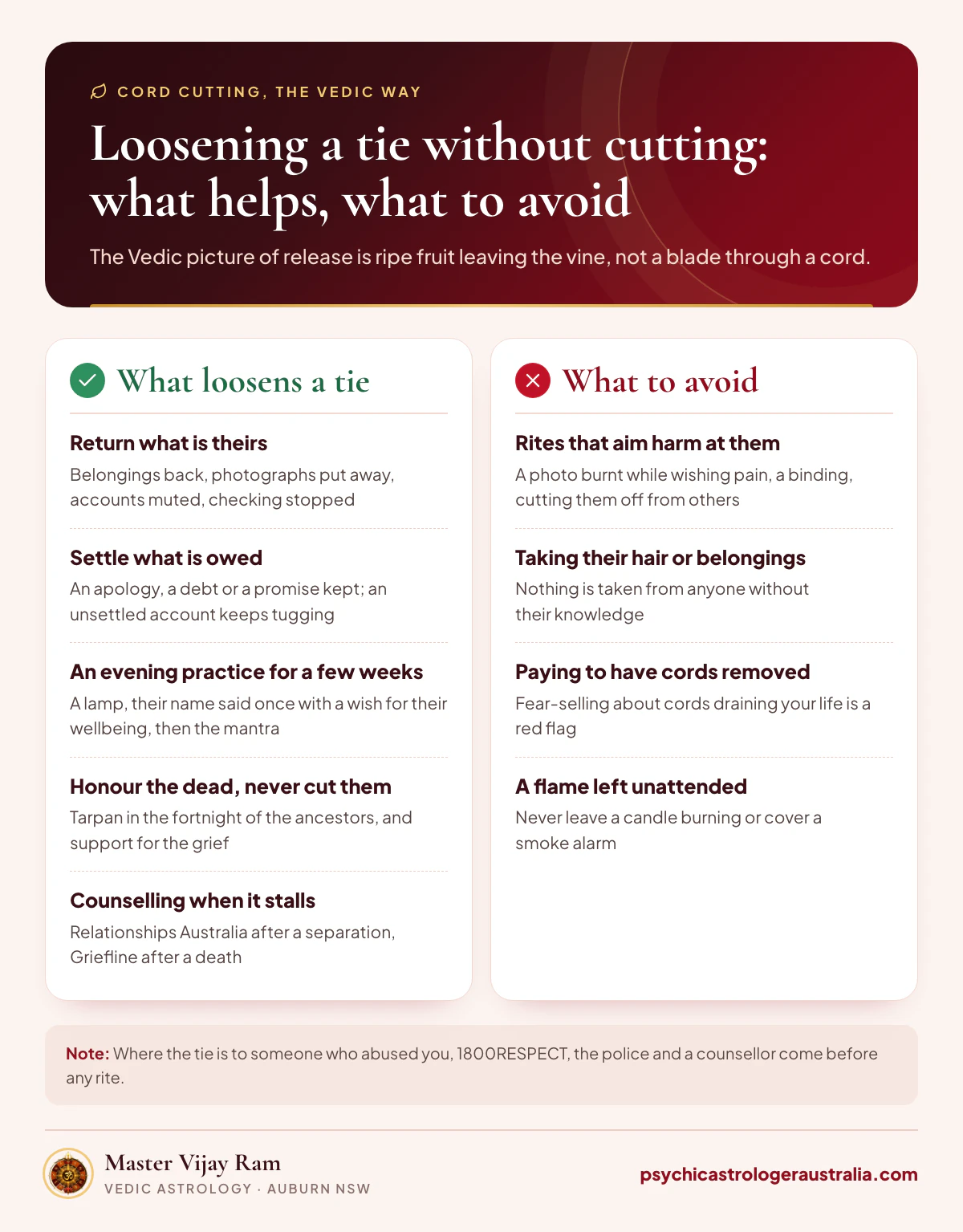
The idea carries a caution too. If something is genuinely owed, an apology, money, a promise kept, a child's welfare arranged, the tradition would say the tie will keep tugging until that is done. Settling what can be settled is often the most effective cord cutting there is.
Where does Ketu come in?
Ketu, the south lunar node, is the planet of detachment and severance in the chart. Its periods tend to bring endings that later look like clearings, and people living through one often describe interest draining out of things and people that once held them, sometimes before they are ready to let go.
Ketu Mahadasha and its remedies explains the period in detail, including Ganesha worship as the classical practice. The Ketu mantra, Om Sraam Sreem Sraum Sah Ketave Namah (transliterations differ, and the version your family uses is just as good), is said by many people when an ending needs accepting rather than fighting.
Cutting, or letting the fruit ripen?
The Maha Mrityunjaya mantra holds the tradition's own picture of release. Urvarukamiva bandhanan, it says: like the cucumber freed from its stalk. The ripe fruit is not hacked from the vine; it comes away when it is ready, and the vine is not harmed.
That is a gentler and more truthful image than a blade, and it is why many families say this mantra through a hard ending. The Maha Mrityunjaya mantra, line by line explains its meaning and how to chant it.
Is there a Vedic alternative to a cord cutting meditation?
A simple one, kept for a few weeks rather than done once. At dusk, light a lamp on a metal plate and sit quietly; say the person's name once and wish them well, in your own words; then chant the Maha Mrityunjaya mantra or Om Namah Shivaya slowly for a few minutes, letting the ripening image do its work.
Alongside it, the practical acts that any cord cutting meditation leaves out: return what belongs to them, put away the photographs, mute the accounts, and stop the small rituals of checking. Cleansing your space and aura after a breakup sets out a week of those steps room by room.
An ex, a parent, a friend: is every tie the same?
No, and the tradition treats them very differently. The table sets out the common ties, what the energy-healing approach suggests, the Vedic view and what helps first.
| The tie | Energy-healing approach | The Vedic view | What helps first |
|---|---|---|---|
| A former partner | Cut the cord and move on | A bond whose account may be settled; Venus and Ketu periods colour it | No contact, belongings returned, a prayer for their wellbeing, time |
| A living parent | Cut cords to stop old patterns draining you | Gratitude and duty remain, and boundaries are allowed | Boundaries, counselling, repair where it is safe |
| A parent or grandparent who has died | Release them | Honoured rather than cut, through shraddha and tarpan | Tarpan in the fortnight of the ancestors; grief support |
| A friend or colleague who drains you | Cut to protect your energy | Give with discernment, without contempt | Distance and polite limits |
| An abusive partner or relative | Cut the cord | Safety comes before any rite | 1800RESPECT, the police where needed, counselling |
What does the tradition say about ties to family and the dead?
It does not cut them; it honours them, and that difference matters to Hindu families who feel uneasy about a ritual that severs a parent. A living parent may be loved at a distance, with boundaries, and the tradition sees no contradiction in that; a parent who has died is remembered through shraddha and tarpan, water and black sesame offered with the names of the ancestors spoken aloud.
Tarpan is traditionally offered in Pitru Paksha, the dark fortnight that ends just before Sharad Navratri, on the days your temple's panchang gives, and pitra dosh and ancestral remedies explains where it fits in a chart. Grief for a parent is not a cord to be cut, and Griefline supports anyone carrying it.
Forgiveness, kshama, sits underneath all of this. The Gita counts it among the divine qualities, and the tradition treats it as a release for the one who forgives at least as much as for the one forgiven, without requiring anyone to return to a relationship that harmed them.
When is a cord really an abusive relationship?
When the person you cannot let go of frightened you, controlled you, or was cruel and kind by turns. The strong pull back towards someone like that is sometimes called a trauma bond, and it is not a spell, a curse or an energetic cord; it is a recognised pattern that a counsellor understands well.
No ritual should keep anyone in contact with a person who harms them, and no practice replaces safety. 1800RESPECT supports anyone affected by family or relationship violence, the police come first where there is danger, and Relationships Australia offers counselling once you are safe.
Which cord-cutting rituals should you avoid?
Anything that aims harm at the other person, however it is dressed: a photograph burnt while wishing them pain, a binding, a ritual to cut them off from a new partner or a job. The tradition refuses all of these, and the wish behind them binds the person making it more tightly than any cord.
Avoid too anything that needs their hair, clothing or belongings taken without their knowledge, anyone who tells you your cords are draining your life and charges to remove them, and candle rituals left burning; never leave a flame unattended or cover a smoke alarm. A practice that leaves you more frightened than before is not cleansing anything.
When does a consultation help, and what does it cost?
When a tie keeps pulling after months of time, no contact and counselling, and you want to know what the chart says about the season you are in. Master Vijay Ram reads the Moon, Venus and Ketu and the period running, and says plainly whether a practice at home is enough or whether an aura cleansing is warranted.
The consultation is $50 and can happen on the phone, over video or on WhatsApp, in English, Hindi or Punjabi. If a cleansing puja or havan is warranted, he carries it out at Auburn on a muhurat suited to your chart, with the cost starting at $250 and agreed before it is performed; families can watch by video, as puja and havan on request describes. Adelaide keeps a clock half an hour behind Sydney's, which readings for Adelaide clients takes into account.
If the tie is really an obsession you cannot shake, limerence and attachment explained may describe it better than any talk of cords.
What can no ritual do?
No ritual can make you stop loving someone, shorten grief, settle a debt you have not paid, or make an unsafe person safe. Nothing here comes with a promised result, and it is faith-based guidance, not psychological, medical or legal advice; trauma, grief and abuse belong first with counsellors, doctors and support services.
What the tradition offers is a truer picture than a severed cord: a grip that loosens with practice, a debt that can be settled, a fruit that falls when it is ripe. Many people find that once they stop trying to cut, the letting go begins.
Read next
- 15 Signs of Jinn Possession (and What to Do Next)Fifteen signs people connect with jinn possession, the ordinary causes to rule out first, and a plain test for decidi…
- Energy Cleansing for a Car, a Shop and a Rental PropertyEnergy cleansing for a new car, a shop and a rental property: what the customs do, what a tenant may and may not do, …
- Why Hindus Bathe After a Funeral, and What to Do in AustraliaWhy Hindus bathe after a funeral: the custom at the door, the reasons tradition gives, children and elders, going bac…
Frequently asked questions
What is a cord cutting ritual?
A modern energy-healing practice in which a person pictures the ties binding them to someone else and cuts them, usually in a guided visualisation or with string, scissors and a candle. It comes from Western energy healing, not from Indian tradition. As a symbol of a decision it can help; it cannot replace the slower work of grief, practice and settling what is owed.
Does cord cutting actually work?
As a way of marking a decision, it can steady people, and many find that helpful. There is no evidence of literal cords, though, and the pull people feel is made of memory, habit, hope and unfinished business, which a single ritual cannot remove. Treat it as a first step at most, alongside time, distance, counselling and a daily practice.
Is cord cutting part of Hinduism?
No. It belongs to modern Western energy healing. The Vedic tradition has its own frame: attachment as raga and moha, a grip within the mind rather than a cord to another person; relationships as karmic debts that loosen once settled; and release pictured as ripening, in the Maha Mrityunjaya mantra's image of the cucumber freed from its stalk.
How do I cut cords with an ex?
Begin with the practical acts: return their belongings, put photographs away, mute their accounts and stop checking. Then a short evening practice for a few weeks: a lamp, their name said once with a wish for their wellbeing, and a few minutes of the Maha Mrityunjaya mantra or Om Namah Shivaya. Time and no contact do the rest; counselling helps if it stalls.
Can I cut cords with a parent?
The tradition would not use that language about a parent. A living parent may be loved at a distance, with boundaries and, where it is safe, repair; a parent who has died is honoured through shraddha and tarpan rather than cut away. Where a parent was abusive, safety and counselling come first, and nothing obliges you to stay in contact with someone who harms you.
How does the Vedic tradition see attachment?
It names it raga, clinging to what gave pleasure, and pairs it with dvesha, aversion to what gave pain; both cloud the mind. Moha is the confusion attachment breeds, as in Arjuna's paralysis in the Bhagavad Gita. The remedies are steady practice and dispassion, which loosen the grip from within while love itself can remain.
What is rinanubandhan?
A belief many Hindu families hold that people come together to settle debts carried from earlier lives, and that the bond loosens of its own accord once the account is settled. It reframes an ending as completion rather than failure, and it carries a caution: where something is genuinely owed, an apology, money or a promise, the tie tends to tug until that is done.
Can a cord cutting be used to hurt the other person?
Some rituals sold under that name are designed to, and they should be refused: a photograph burnt while wishing pain, a binding, a rite to cut someone off from a new partner. The tradition rejects any work aimed at harming another person, and the wish behind such a rite binds the person making it more tightly than before. Release is about you, not about them.
Why do I keep going back to someone who hurts me?
That pull is common after a relationship that mixed cruelty and kindness, and it is sometimes called a trauma bond. It is not a spell or an energetic cord, and it responds to counselling. If you are in danger, call the police; 1800RESPECT supports anyone affected by family or relationship violence. No ritual should keep you in contact with someone who harms you.
People also ask
What does cord cutting mean spiritually?
In modern energy healing it means imagining the energetic ties to another person and cutting them, to stop feeling drained or pulled. The Vedic tradition describes the same experience as attachment, raga and moha, held in one's own mind, and prefers release to severing: practice, settling what is owed, and prayer that lets a tie loosen like ripe fruit from a vine.
How do you do a cord cutting meditation?
The usual version is a visualisation of cords being cut. A Vedic alternative is kept for a few weeks: at dusk, light a lamp, say the person's name once and wish them well, then chant the Maha Mrityunjaya mantra slowly for a few minutes. Pair it with the practical acts: belongings returned, photographs put away, accounts muted and checking stopped.
What is attachment in Hinduism?
Attachment is described as raga, clinging to what once gave pleasure, and moha, the confusion that clinging breeds. The Yoga Sutras count raga among the afflictions of the mind, alongside dvesha, aversion. The answer is not to stop loving but to loosen the grip through steady practice and dispassion, so that love can remain without the clinging.
Is cord cutting safe?
As a quiet visualisation, it is usually harmless. The risks are elsewhere: candle rituals left burning, rites designed to harm the other person, practitioners who charge to remove cords they say are draining you, and using a ritual to avoid grief, counselling or safety steps. If the tie is to someone who abused you, 1800RESPECT and a counsellor come first.
References & further reading
Serving clients across Australia
Confidential consultations by phone, video & WhatsApp — including: