

Quick answer
If you can't stop thinking about someone, limerence or attachment is far more likely than a spell. Limerence, a term coined by the psychologist Dorothy Tennov, is intense, involuntary longing fed by uncertainty. Distance, routine and counselling help; compulsive checking may be OCD, which a GP can treat. A Vedic reading shows the season you are in.
Am I under a spell, or is something else going on?
Limerence is a state of involuntary, intrusive longing for one particular person, a term coined by the psychologist Dorothy Tennov, and it explains much of what people mean when they type am I under a spell into a search bar late at night. The thoughts arrive uninvited, crowd out work and sleep, and feel so unlike your usual self that an outside cause seems the only explanation left.
Master Vijay Ram hears the question often, sometimes from people whose families have already decided that someone did vashikaran. Vashikaran removal is real work for a narrow situation; this page helps you work out whether you are in it, or in one of the far more common states that feel exactly the same from the inside.
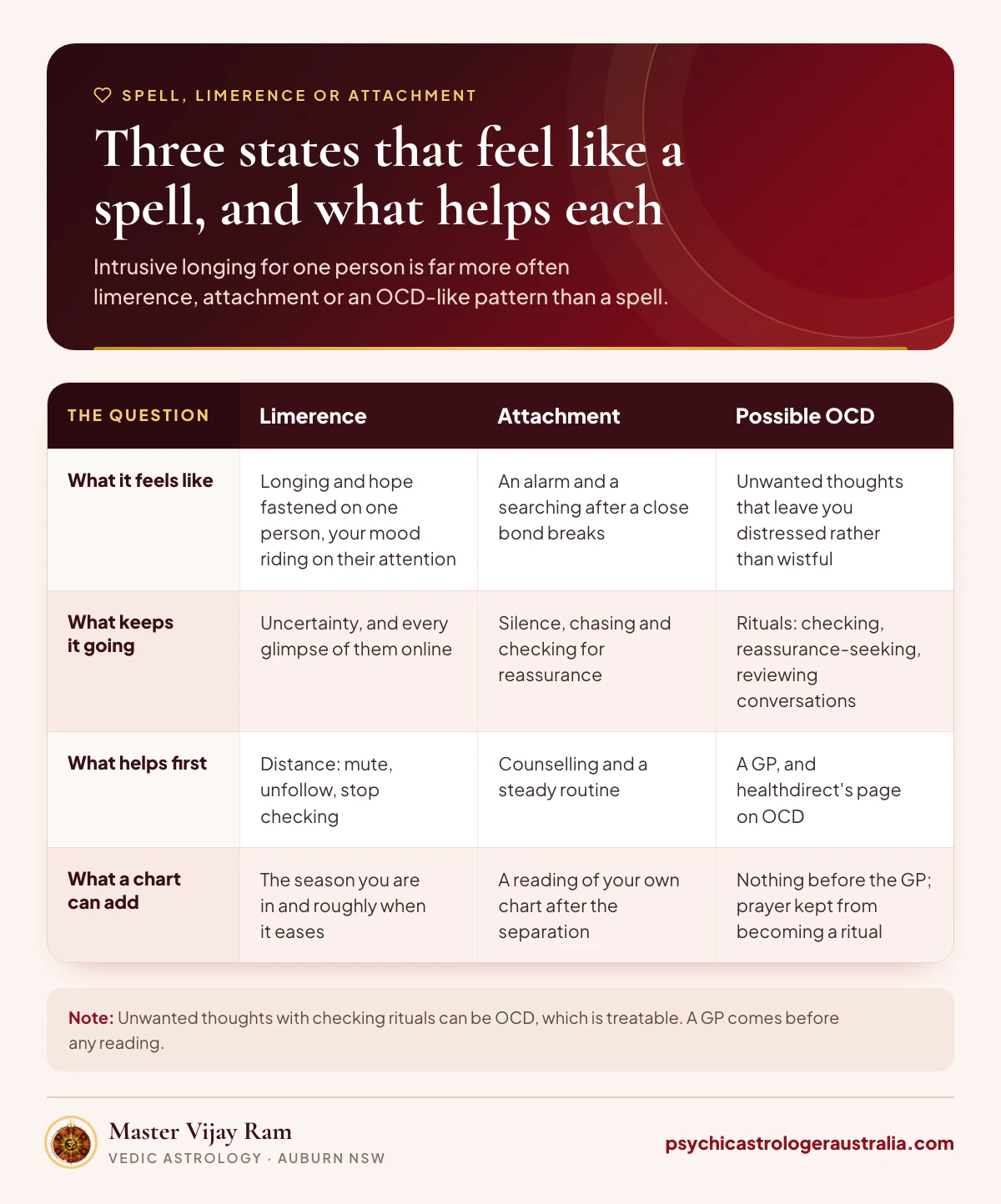
What does it feel like when you can't stop thinking about someone?
The person is there when you wake and when you try to sleep. You replay a conversation for the fortieth time, rehearse the next one, check whether they have posted or been online, and feel your mood rise or fall with a single message or its absence.
The body joins in: a racing heart when their name appears, a lost appetite, broken sleep, an odd mix of elation and dread. When you can't stop thinking about someone in this way, it can feel like something done to you, because it so plainly is not something you chose.
What is limerence?
Limerence is the name for that state when it fastens on one person: intrusive thoughts about them, an aching wish for the feeling to be returned, close reading of every sign, and a picture of them that is brighter than the person really is. It can attach to someone you barely know as easily as to a former partner.
Uncertainty feeds it. A reply that is warm one day and cool the next, an ex who neither returns nor fully leaves, a crush who might or might not be interested: each keeps hope alive, and hope is the fuel. Limerence tends to fade when the hope stops being fed, which is why distance helps more than any charm.
How is attachment different?
Attachment is the older and deeper system, the bond that forms with a partner over months and years of closeness. When that bond breaks, the mind keeps searching for the missing person as it would for anyone it depends on, and the searching shows up as the same intrusive thoughts.
People whose early closeness was unreliable often feel a breakup or a silence as an alarm rather than a sadness, and they chase, check and seek reassurance to switch the alarm off. Psychology calls that pattern anxious attachment, and a counsellor can help with it in a way no ritual can.
There is also the bond that forms in a relationship that hurt you, warm and cruel by turns. If the person you cannot stop thinking about frightened or controlled you, 1800RESPECT supports anyone whose relationship was abusive, and cord cutting and the Vedic view of attachment looks at how such ties are loosened without harm to anyone.
Why does it feel like a spell?
Because the experience is involuntary, and the mind prefers an outside cause to the idea that it is doing this to itself. Many Indian families also have a ready phrase for it, kiya karaya, something has been done, and a relative may supply the explanation before you have had time to think.
Advertisements make it worse. Lists of obsession spell signs describe ordinary longing, thinking about them all day, dreaming of them, feeling drawn to wherever they are, so closely that almost anyone in love or heartbreak will match. A list that fits everyone is a sales tool, not a diagnosis.
Which signs point to the mind, and which would a reading look at?
The table sets common experiences beside what they usually point to and what helps first. Only one row describes the narrow case where the tradition would want to read a chart, and even there the doctor comes before the astrologer.
| What you notice | What it usually points to | What helps first |
|---|---|---|
| Thoughts that spike whenever they post or reply | Limerence, fed by uncertainty | Mute or unfollow; stop checking |
| Panic when a message goes unanswered | Anxious attachment | Counselling; one trusted friend to talk to |
| Hours of checking, reassurance-seeking or mental reviewing | A pattern that can be OCD | A GP, and healthdirect's page on OCD |
| Longing that grew sharply during one stretch of months | A demanding planetary period, in the tradition's terms | Routine now; a reading of the timing if you wish |
| Missing an ex who has blocked you | Grief, with nowhere to go | Time, no contact and support |
| A pull towards someone you dislike, from a datable day, with changes others noticed | The narrow case the tradition takes seriously, once medical causes are checked | A GP first, then a reading of your chart against the timeline |
What does Vedic astrology say about longing?
The tradition reads longing through three planets. Venus is attraction and the wish for pleasure and partnership, the Moon is the mind and its moods, and Rahu is craving, the hunger that fixes on one thing and magnifies it.
A period of one of these, or a transit that touches them, is traditionally said to intensify longing for a time. The Moon's mahadasha with a Rahu antardasha, which runs a year and a half in the classical tables, is one stretch in which the mind can grip harder than usual; the Moon placed with Rahu, which some astrologers call grahan, is a later popular label rather than a classical yoga, and its weight depends on sign, house and aspects.
These are tendencies, not verdicts, and none of them is a spell. A chart can tell you that you are in a season when the mind holds on tightly, and roughly when that season eases; it cannot tell you that anyone has done anything to you.
When does it look like OCD?
When the thoughts are unwanted rather than longed for, when they come with rituals such as checking, seeking reassurance or reviewing every conversation in your head, and when the whole thing takes hours of the day and leaves you distressed rather than wistful. That pattern can be obsessive-compulsive disorder, which is common, real and treatable.
Some people experience it as doubt about a relationship, checking over and over whether they love a partner or are loved; others as images they hate but cannot stop. The healthdirect page on OCD explains it plainly, and a GP is the first stop. A prayer repeated until it feels right can become part of the pattern rather than a way out of it.
What actually helps?
Distance first. Mute or unfollow, archive the chat, stop visiting their profile, and if you share a workplace or a class, keep contact polite and brief; every glimpse is a small dose of hope, and hope keeps the thoughts alive.
Then routine: regular sleep, meals, exercise and time with people who have nothing to do with the person. Many people find it helps to name the state when it arrives, telling themselves that this is limerence, not destiny, and to write down what they actually know about the person beside what they have imagined.
Counselling helps with both limerence and attachment, and Relationships Australia and headspace are good places to start. None of this is quick, and none of it needs a spell.
What can the tradition offer alongside?
Steadiness for the mind, which is the Moon's territory. A short Moon mantra said at night, Om Shraam Shreem Shraum Sah Chandraya Namah (spellings vary, and a family's own version is fine), a lamp at dusk and a prayer for the other person's happiness, whoever it is with, are simple practices that many people find loosen the grip.
Some keep a Monday observance for the Moon and Shiva, which can be as light as one simple meal; anyone whose appetite has already gone, or who is pregnant, diabetic or on medication, should skip fasting and speak to a GP. The aim is a steadier mind, not a rite that makes the thoughts stop on command.
What if you believe someone did vashikaran on you?
Then the question is narrower than the advertisements suggest. The tradition takes it seriously when a pull towards someone you would not otherwise choose began on a datable day, came with other changes that people around you noticed, and has outlasted the ordinary explanations and a GP's check.
Master Vijay Ram reads your own chart against that timeline in a $50 consultation by phone, video or WhatsApp, and says plainly whether the timing fits a hard period or something more; nobody is named, and nobody else's chart is read without their knowledge. The signs a love spell was cast sets out what is worth noticing and what usually explains it.
Where a removal is warranted, it is a shanti puja or havan he performs himself in Auburn on a chosen muhurat, starting from $250 and agreed before it is performed; puja and havan on request describes how you can take part by video. Callers in the Hunter are read exactly as anyone in Sydney, and readings for Newcastle clients explains the booking.
What if it is an ex who has blocked you?
Then the longing is grief with nowhere to go, and the block is a boundary to respect, not a problem to solve. When an ex has blocked you everywhere explains why no other door is acceptable and what a reading of your own chart can offer instead.
People in this state are sometimes told by a seller that the ex was turned against them, or that they themselves are bound, and offered an attraction spell to fix it. Neither story helps anyone heal, and both cost money; the honest work is on your side of the silence, which is what a love problem consultation reads for.
Is this normal for a teenager or a uni student?
Completely. A first intense crush can feel like the most important thing that has ever happened, and the intensity says more about the age and the newness than about any spell; talking helps, whether to a parent, a school or uni counsellor, Kids Helpline or headspace.
If you have already tried a love spell from a video and now regret it, undoing DIY spell work safely explains how to close it calmly. Do not pay anyone online who offers to remove a spell from you or to cast one; they are selling fear to someone who is already hurting.
What can a reading not do?
It cannot make the thoughts stop, make the other person feel anything, or shorten grief by decree, and no reading can be guaranteed. This is faith-based guidance; limerence, attachment and OCD are matters for counsellors and doctors, and they respond well to that care.
What a reading can add is perspective on timing: the season you are in, when it is likely to ease, and whether anything beyond your own mind and heart needs attention. For most people nothing does, and hearing that from someone who takes the fear seriously is often where letting go begins.
Read next
- Signs a Love Spell Was Cast on Your RelationshipHow to tell whether a love spell was cast on your relationship: the signs, the ordinary causes to rule out first, and…
- Signs Someone Used Vashikaran on You — and How to Reverse ItSigns someone used vashikaran on you, the ordinary explanations to rule out first, and what a careful reversal involv…
- Signs Someone Is Doing Vashikaran to Break Your MarriageWorried someone is doing vashikaran to break your marriage? The signs people report, the ordinary causes to rule out …
Frequently asked questions
Am I under a spell if I can't stop thinking about someone?
Almost certainly not. Intrusive longing for one person is a well-known human state, often called limerence, and it is fed by uncertainty and contact rather than by anything done to you. Attachment after a breakup and, sometimes, an OCD-like pattern feel the same from the inside. The tradition considers a spell only in a narrow case, after the ordinary explanations and a GP's check.
What is limerence?
Limerence is a term coined by the psychologist Dorothy Tennov for an involuntary, intense longing for one particular person: intrusive thoughts about them, an aching wish for the feeling to be returned, and a mood that rises and falls with their attention. It can attach to a near-stranger or a former partner, and it tends to fade when hope stops being fed.
How long does limerence last?
There is no fixed length. It tends to ease once the hope that feeds it stops, which is why distance, muting and no contact help so much, and it tends to flare whenever contact or uncertainty returns. If it has dominated your days for months and is affecting sleep, work or study, a counsellor or GP can help it loosen sooner.
Can someone make me obsessed with them through vashikaran?
In the Vedic tradition another person's choices stay theirs, and vashikaran in its classical sense is not a lever on someone else's mind. The fear is taken seriously in a narrow case: a pull towards someone you would not choose, starting on a datable day, with changes others noticed, outlasting the ordinary explanations. Even then your chart is read first, and nobody is named.
What are the signs of an obsession spell?
The lists sold online describe ordinary longing so closely that almost anyone in love or heartbreak matches them, which is what they are designed to do. What the tradition looks for is narrower: a sudden, datable change that feels foreign, noticed by others, with no ordinary cause and a medical check already done. Most people who ask find a simpler answer in limerence or grief.
Is obsessive thinking about an ex a sign of OCD?
Sometimes. If the thoughts are unwanted, come with rituals such as checking their profile, seeking reassurance or reviewing conversations for hours, and leave you distressed rather than wistful, that pattern can be obsessive-compulsive disorder, which is treatable. The healthdirect page on OCD explains the signs and a GP is the right first step. Prayer that turns into a compulsion can become part of the pattern.
Which planets are linked with obsessive love in a chart?
The tradition reads longing through Venus, the planet of attraction, the Moon, which governs the mind, and Rahu, which is craving and fixation. A period of one of them, or a transit touching them, is traditionally said to intensify longing for a time. These are tendencies, not verdicts: a chart can show a season when the mind holds on tightly, never a spell.
Does no contact really help?
For limerence and attachment it is the most useful single step, because every glimpse of the person, a post, a reply, a story view, renews the hope that keeps the thoughts going. Mute or unfollow, archive the chat and keep any unavoidable contact brief and polite. The first weeks are the hardest, and the thoughts usually lose their grip as the gaps lengthen.
Can a mantra help me stop thinking about someone?
It can steady the mind, which is not the same as switching the thoughts off. Many people say a short Moon mantra at night, light a lamp at dusk and pray for the other person's happiness, whoever it is with, and find the grip loosens. If repeating a mantra starts to feel compulsive, needing to be said until it feels right, stop and talk to a GP.
People also ask
Why can't I stop thinking about someone?
Usually because hope and uncertainty are keeping the thoughts alive: a person who might return, might reply or might feel the same. That state is often called limerence. After a breakup, the attachment system also keeps searching for the missing person. Distance, routine, sleep and someone to talk to help most; if the thoughts come with compulsions such as constant checking, see a GP.
How do I know if I'm under a love spell?
You are very unlikely to be. Ordinary longing, grief and anxious attachment produce every feeling the online lists describe. The tradition considers a spell only when a pull towards someone began on a datable day, feels foreign, was noticed by others, and has outlasted the ordinary explanations and a medical check. Then a reading of your own chart against the timeline is a sensible next step.
What is the difference between limerence and love?
Limerence is mostly about the longing: intrusive thoughts, hope for the feeling to be returned and a brighter picture of the person than the facts support. Love, as most people describe it after the early months, is about knowing the actual person and caring for their wellbeing whether or not it serves you. The two can overlap at the start, and limerence tends to fade either way.
What helps with limerence?
Reducing contact and checking so the hope stops being fed; a steady routine of sleep, meals, exercise and other company; writing down what you actually know about the person beside what you imagine; and counselling if it persists. Many people also find that a simple evening practice, a lamp and a short prayer, steadies the mind. If it looks compulsive, see a GP.
References & further reading
Serving clients across Australia
Confidential consultations by phone, video & WhatsApp — including: