

Quick answer
Sleep is usually the first thing to shift, then the atmosphere at home, and only later the practical circumstances. No honest practitioner promises a date, and if nothing at all has shifted after several weeks, that is a reason to question the original diagnosis.
Why no honest practitioner will give you a date
People ring and ask for a number. Two days. Two weeks. Something firm to hold while they wait, because waiting without a shape to it is the hardest part of all.
It is a fair question and it deserves a fair answer. Master Vijay Ram has spent more than forty years watching how these situations move, and the pattern is real even though the calendar is not. Some people notice something within the first few nights. Others feel nothing for a fortnight, then realise a problem they had stopped mentioning has quietly gone. A few find nothing shifts at all, which is useful in its own way, because it usually means the reading was wrong and something ordinary was behind the trouble.
Anyone naming a guaranteed date is guessing, or selling. What follows is the shape of the arc, and what makes it longer or shorter.
What people actually mean when they ask about results
The word covers three different things, and they run on three different clocks.
The first is relief in the body: sleeping through, eating properly, the pressure behind the eyes easing. The second is circumstance: the interview that finally lands, the argument that stops repeating itself, the money that comes through. The third is certainty, the settled feeling that whatever was sitting over the house has gone.
Relief usually arrives first. Circumstance follows. Certainty comes last, and often so quietly that people cannot say when it arrived. Most people who ask about the clearing work itself are hoping for all three at once, and are disheartened when only the first turns up. That is not failure. It is the ordinary order, and knowing the order stops you reading a flat week as proof that nothing happened.
The three-seven-forty window
Over the years Vijay Ram ji has come to describe the arc with one rule of thumb: the three-seven-forty window. It is a way of describing what to look at, not a schedule and not a promise. It tells you when to look, not what you will find.
- Three nights. Watch sleep and nothing else. Sleep changes before the mind will admit anything has.
- Seven days. Watch the household. Tone of voice, appetite, whether the same argument still starts at the same hour.
- Forty days. Watch circumstance. Work, money, appointments, the things that need other people to move.
The window says nothing about whether the work is genuine. That is a separate question, taken up in Does Black Magic Removal Really Work? Honest Answers & Reviews. Used properly, it turns an anxious open-ended wait into three calm checkpoints.
A realistic timeline at a glance
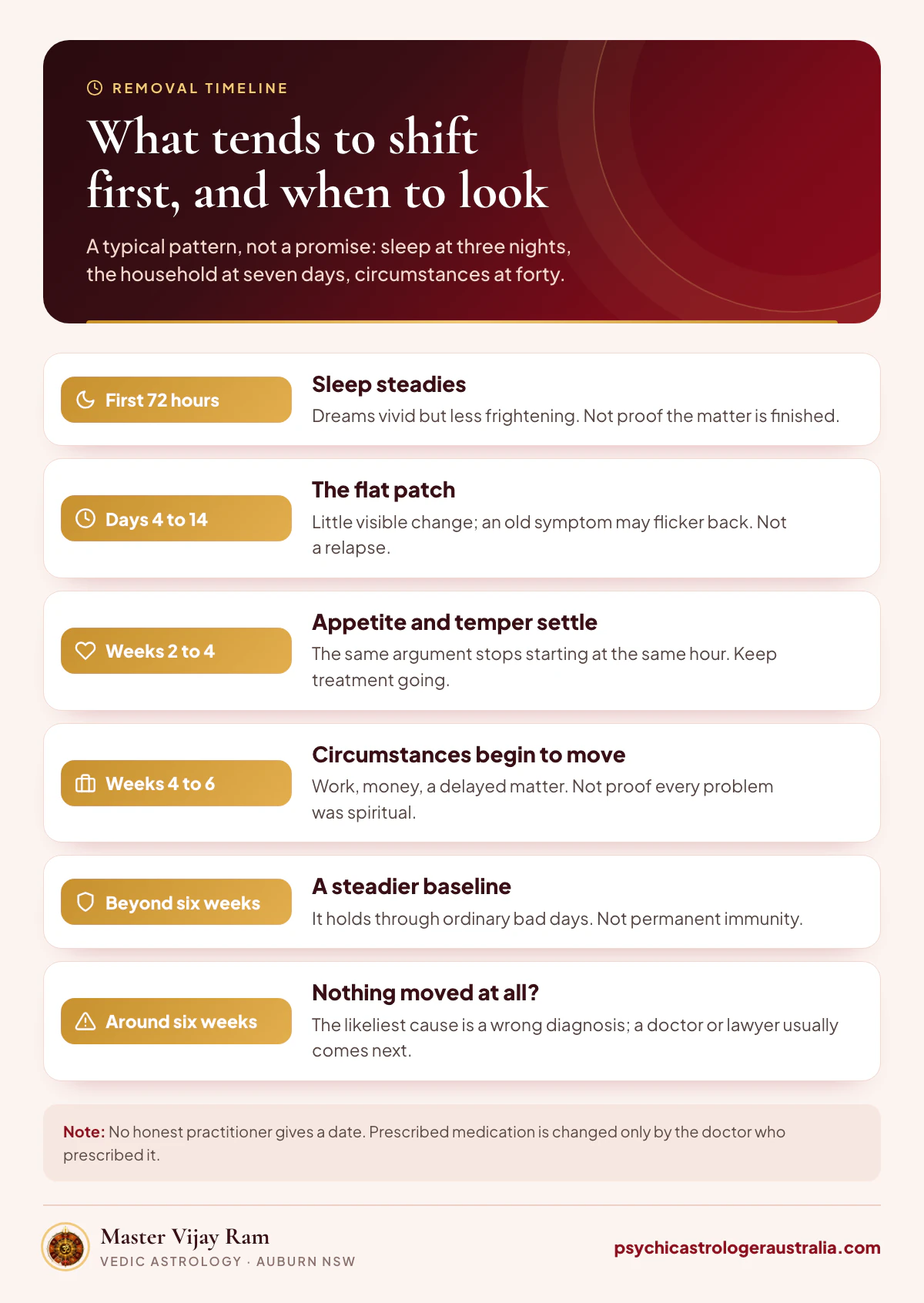
The pattern below is drawn from ordinary casework in black magic and in shrap-nivaran and hex clearing. It is a pattern, not a schedule, and the right-hand column matters as much as the middle one.
| Period | What is typically noticed | What it does not mean |
|---|---|---|
| First 72 hours | Sleep steadies; dreams vivid but less frightening; the house feels less crowded | Not proof the matter is finished. Relief at having finally spoken to someone does this too |
| Days 4 to 14 | Little visible change; an old symptom may flicker back for a day or two | Not a relapse, and not a sign the remedy has failed |
| Weeks 2 to 4 | Appetite and temper settle; the same argument stops starting at the same hour | Not a reason to stop medical treatment or legal advice already under way |
| Weeks 4 to 6 | Circumstances begin to move: work, money, a delayed matter unblocking | Not evidence that every problem you had was spiritual in origin |
| Beyond six weeks | A steadier baseline that holds through ordinary bad days | Not permanent immunity, and not a guarantee against future trouble |
The first three nights: sleep usually moves first
Sleep is the most sensitive instrument most people own. It registers change before the mind is willing to concede any.
In the first three nights after remedial work the common reports are these: falling asleep without the long wait, waking once instead of four times, dreams that are vivid but no longer menacing, and an odd sense that the room is less occupied. Some people instead sleep very heavily and wake groggy for a day. That is normal and usually passes.
It is the most frequent first report in the clearing work done for households in Melbourne's south-east, and that is what this looks like for people near Dandenong too. On its own it proves nothing, because rest improves for many reasons. But it is the first honest marker, and worth writing down.
Days four to fourteen: the flat patch nobody warns you about
Almost everybody hits this, and almost nobody is warned. The lift of the first few nights levels off. An old symptom flickers back. Nothing obviously good happens for a week or more, and the mind fills the gap with the worst reading available to it.
This is the point at which people go looking for someone else: a temple, a relative overseas, another astrologer in Newcastle found in a late-night search. It is understandable and it is usually a mistake, because stacking a second remedy on an unfinished one muddies what you can learn from either.
The flat patch is not evidence of failure. It is what the middle of most arcs looks like. Hold the line to day fourteen before concluding anything.
What tends to stretch the arc
Some situations take longer, and the reasons are usually visible from the start.
- Work in place for years rather than months, and reinforced more than once.
- Several people in one household affected, each on a slightly different clock.
- Continuing contact with whoever is behind it: shared property, shared business, a custody arrangement.
- An underlying medical or money problem running alongside, which does not lift because a remedy was done.
Work of the kind covered by sihr and the healing for it often runs longer than average, because that kind of work is frequently layered rather than single, and each layer has to be lifted in order. Being told your case will take longer is not bad news. It is a practitioner refusing to flatter you with a date he cannot honour.
What tends to shorten it
The opposite list is shorter and less glamorous, and most of it is within your control.
Recent work lifts faster than old work. One person affected clears faster than a whole household. Honest and complete information at the first call saves days otherwise spent correcting a wrong assumption. Keeping ordinary routine steady, with meals, sleep, walking and going to work, gives change something to settle into.
Families who arrange black magic removal in Frankston and then hold their household routine steady through the first fortnight tend to describe a cleaner, shorter arc than families who spend that fortnight ringing three practitioners. Doing less, consistently, works better than doing more, frantically. That is unglamorous advice and it is the truest sentence here.
Why two people with the same remedy see different timing
Two people can have a remedy performed in the same week and describe completely different arcs. The reason sits in the diagnosis, not the ritual.
What is actually present, whether nazar, tona-totka, sihr, a family shrap or nothing spiritual at all, determines how it lifts. So does when it began, how it reached you, and what else in your chart is running at the time. A remedy matched to the wrong diagnosis can produce one pleasant week and then nothing, which is the most confusing outcome of all.
That is why the reading matters more than the ritual, and the way a practitioner arrives at it is set out in How a Black Magic Specialist Diagnoses and Breaks a Spell. Ask what was found before asking how long it takes.
Why your location does not change the timing
People ask whether living far from the practitioner slows things down. It does not.
Consultations happen by phone, video or WhatsApp, and the remedy is carried out personally by Vijay Ram ji at his own place of practice. Nothing in the work requires him to stand in your kitchen, and nothing about your postcode changes the arc. Someone in Wollongong and someone in Dubai are on the same clock.
What does differ is the practical business of talking. Shift rosters, fly-in fly-out swings and overseas time zones make follow-up calls harder to arrange, and follow-up is where the timeline is actually read. If speaking is difficult for you, say so at the first call so the checkpoints sit inside your week rather than against it.
When another person is involved, the clock belongs to two people
Timing gets slipperier the moment the outcome depends on somebody else's behaviour. A husband who has withdrawn, a partner who has stopped calling, a relative who will not speak: none of them move on your schedule.
What remedial work can address is the obstruction, meaning the heaviness, the suspicion, the atmosphere that makes an ordinary conversation impossible. What it cannot do is override an adult's free will, and any practitioner offering that is offering something he should not.
The same caution applies to relationship work, and to anyone looking for a love spell specialist across Melbourne's south-east, because the pace there belongs to two people rather than one. Expect movement in the atmosphere first and in the other person's behaviour later, if at all. Nobody can honestly promise the second.
When this is not the answer
A slow timeline is sometimes a message. If weeks pass and nothing moves, the likeliest explanation is not a weak remedy but a wrong diagnosis.
Ordinary causes sit behind a great many of the symptoms people bring. Thyroid disease, anaemia, sleep apnoea, undiagnosed diabetes, perimenopause and vitamin B12 deficiency all produce exhaustion and fog. Depression and anxiety disorders produce exactly the flatness, dread and broken sleep that get read as a curse. Psychosis, mania and severe trauma responses need a doctor urgently, not a ritual. Debt spirals, visa trouble and family-law disputes need a lawyer or a financial counsellor.
Those come first. Spiritual work sits alongside medical and legal care and never in place of it. Most enquiries turn out not to need a remedy at all, and being told so plainly is a good outcome.
Keeping a plain record, and when to ask for a review
Memory is a poor witness during a hard period. It flattens good days and magnifies bad ones. Three lines a night in a notebook, covering how you slept, one thing that went right and one thing that did not, will tell you more at week four than any amount of recollection.
Record what is observable rather than what you feel about it. "Slept through, woke at six" is useful. "Something still feels off" is not.
If you are unsure what counts as worth logging, Black Magic Symptoms in the Body: Physical Warning Signs sets out the physical ones plainly. Ask for a review at the seven-day and forty-day marks rather than every second day. Someone reading your notes at the right interval can tell you something useful.
What to do once the arc closes
When the forty-day mark passes and the ground feels steady, the temptation is either to forget the whole business or to keep paying for more work. Neither is right.
What follows is not more remedy. It is ordinary spiritual protection and cleansing kept up quietly: a small daily practice, a clean house, restraint about who you invite into your affairs, and a habit of not narrating your good fortune to people who resent it.
Watch for the difference between an ordinary bad week and a return of the original pattern, meaning the same symptom, at the same hour, in the same person. That is worth a phone call. A bad fortnight after a redundancy is not. You will be told plainly when nothing further is needed, and if no remedy is called for, the $50 consultation is the only charge.
Read next
- Black Magic Removal Near Me: What “Near” Actually Buys YouBlack magic removal near me: what a visit genuinely adds, what it does not, how the work reaches every suburb from Au…
- Black Magic Removal in Australia: Cost, Process & ResultsBlack magic removal in Australia explained honestly: how fees are built, what should never be charged, how the work i…
- Black Magic on Marriage: Signs Your Relationship Is TargetedSigns that black magic may be affecting a marriage, how the drift unfolds week by week, and the ordinary causes to ru…
Frequently asked questions
What should I write down in the first week so I can tell whether anything is really changing?
Keep it short and factual. Each night note how you slept, one thing that went right and one thing that did not. Add anything physical: headaches, appetite, chest tightness. Avoid writing how you feel about the day, because mood colours memory badly. Three lines a night for four weeks gives a practitioner something real to read at review.
Is a strong reaction on the first night a good sign or a bad one?
Neither on its own. Heavy sleep, vivid dreams, a day of tiredness or a brief return of an old ache are all commonly reported in the first night or two and usually settle. A strong reaction is not a measure of how much was present. If anything alarms you physically, ring your doctor first and mention it at review afterwards.
Nothing has shifted by day ten. Should I assume the remedy has failed?
Day ten sits in the middle of the flat patch, which almost everyone passes through and almost nobody is warned about. The early lift levels off, an old symptom flickers, and the mind reads that as failure. Wait until day fourteen before drawing conclusions, then raise it at review rather than starting a second remedy on top.
My sleep improved but my money troubles have not. Does that mean only part of the work took?
Not usually. Relief in the body arrives first because it needs nobody's cooperation. Circumstance moves later because it involves employers, banks, courts and other people's decisions. A gap between the two is the normal order rather than a half-finished job. If six weeks pass with no movement at all in circumstance, that is worth reviewing properly.
Should I keep taking prescribed medication while the remedy is under way?
Yes. Nothing in this work replaces medical treatment, and stopping medication because you feel better for a week is how people get badly hurt. Antidepressants, thyroid medication, blood pressure tablets and psychiatric prescriptions are changed by the doctor who prescribed them and by nobody else. Master Vijay Ram will tell you the same thing plainly.
Is it a problem that I keep re-reading old messages from the person I suspect?
It will not undo the work, but it keeps the wound open and makes your own reading of the timeline unreliable. Every re-read renews the anger, and then you record a bad night that had an ordinary cause. If you cannot stop, put the messages somewhere awkward to reach for a fortnight and see what your notes look like then.
Can I have a second practitioner working at the same time to move things along faster?
You can, but you lose the ability to learn anything from either. Two remedies running together means no way to tell what worked, what did nothing and what made things worse. It also tends to double the cost and the anxiety. Finish one arc, review it honestly, and only then decide whether anything further is warranted.
My mother wants the remedy repeated every week until something happens. Is that wise?
Repetition driven by fear is not the same as repetition driven by a reading. Weekly remedies feed the anxiety they are meant to settle, and they make the timeline impossible to interpret. If the diagnosis was right, the arc needs time rather than volume. If it was wrong, repeating it changes nothing except what you spend.
Why do children in a household often settle before the adults do?
Children carry less commentary. They have not spent months rehearsing the story, checking symptoms or reading about curses at two in the morning, so when the household atmosphere lifts they simply respond to it. Adults keep scanning for proof. That is also why a child settling is often the earliest honest signal that something in the home has genuinely changed.
What is the difference between a flat patch and a genuine relapse?
A flat patch is an absence of progress: nothing much improves, nothing much worsens, and it sits in the second week. A relapse is a return of the specific original pattern, usually the same symptom, at the same hour, in the same person, after a stretch of real improvement. The first needs patience. The second needs a phone call.
Does talking about the work with friends slow anything down?
It does not interfere with the remedy, but it reliably interferes with you. Every retelling invites an opinion, a rival theory and a story about somebody's cousin, and by week two you are managing other people's anxiety alongside your own. Keep it to one trusted person if you need one. Everything you share in consultation stays strictly confidential.
If symptoms come back in week five, does everything start again from zero?
Rarely. A return in week five is more often an ordinary bad stretch, an untreated medical issue surfacing, or renewed contact with the original situation. Vijay Ram ji would look at what changed in the days before it returned rather than assume the work undid itself. Repeating the whole process is the last option considered, not the first.
Does the type of work involved change how quickly things move?
Yes, noticeably. Nazar is generally the lightest and lifts soonest. Tona-totka and hex work sit in the middle. Sihr and layered kala jadu that has been reinforced over years take longest, because each layer is lifted in turn. This is why the diagnosis is worth more than any promised date, and why the reading comes before the remedy.
What would make Master Vijay Ram say the timeline is not the real issue?
A pattern that matches something ordinary. Symptoms that track a night-shift roster, a chart showing nothing unusual, exhaustion that began with a new baby or a bereavement, or medical tests that were never actually completed. In those cases he says so plainly and sends you back to a doctor, a counsellor or a lawyer instead.
Is there any point starting if I am about to move house or travel overseas?
There is. The remedy is performed at his own place of practice, so your address does not govern it and a move does not interrupt it. What a move does affect is the follow-up conversation, which is where the arc is actually read. Say the dates at the first call so the review points can be set around them.
People also ask
Do black magic removal results appear all at once or gradually?
Gradually, and in a fairly consistent order. Relief in the body tends to come first, usually showing up in sleep within the first few nights. The household atmosphere settles next, across the following fortnight. Changes in circumstance, which depend on other people and institutions, come later again. Expecting all three together is the most common reason people wrongly conclude nothing happened.
Can black magic removal results be felt on the very first night?
Some people do report a change in the first night, most often deeper sleep or dreams that are vivid but no longer frightening. It is a genuine marker but not proof on its own, because relief at having finally spoken to someone produces much the same effect. Note it, keep watching, and judge the pattern over the first three nights rather than one.
Why do some people notice nothing for two weeks after a cleansing?
Because the middle of the arc is usually flat. The early lift levels off around day four, an old symptom may flicker back, and nothing obviously good happens for a week or more. Almost everybody passes through this and almost nobody is warned about it. It is not evidence of failure, and it is the worst moment to start a second remedy.
Is there a point at which you should stop waiting and get a second opinion?
Around six weeks is a reasonable threshold. If sleep, household atmosphere and circumstance have all stayed exactly where they were through that period, the likeliest explanation is that the original diagnosis was wrong rather than that the remedy was weak. At that point the honest next step is usually a doctor or a lawyer, not another practitioner.
What does the forty-day mark mean in black magic removal?
It is a traditional review point rather than a deadline. Forty days is long enough for circumstance to have had a chance to move, since work, money and other people's decisions do not turn on a week's notice. It is used as a checkpoint for an honest conversation about what changed and what did not, not as a promised finish line.
References & further reading
Serving clients across Australia
Confidential consultations by phone, video & WhatsApp — including: