

Quick answer
The bhava chalit chart is a version of the birth chart in which houses are drawn around midpoints, the bhava madhya, rather than whole signs. A planet near a sign edge can therefore appear one house earlier or later than in the rashi chart, but its sign never changes. Many astrologers read signs from the rashi chart and house results from the chalit.
What is a bhava chalit chart?
A bhava chalit chart is a house chart that draws the twelve houses around calculated midpoints instead of treating each whole sign as one house. In Hindi software it is often labelled simply chalit, or chalit kundli, and it usually appears on the page right after the rashi chart. Families who compare the two are often alarmed to see that a planet has moved, sometimes from the seventh house into the eighth.
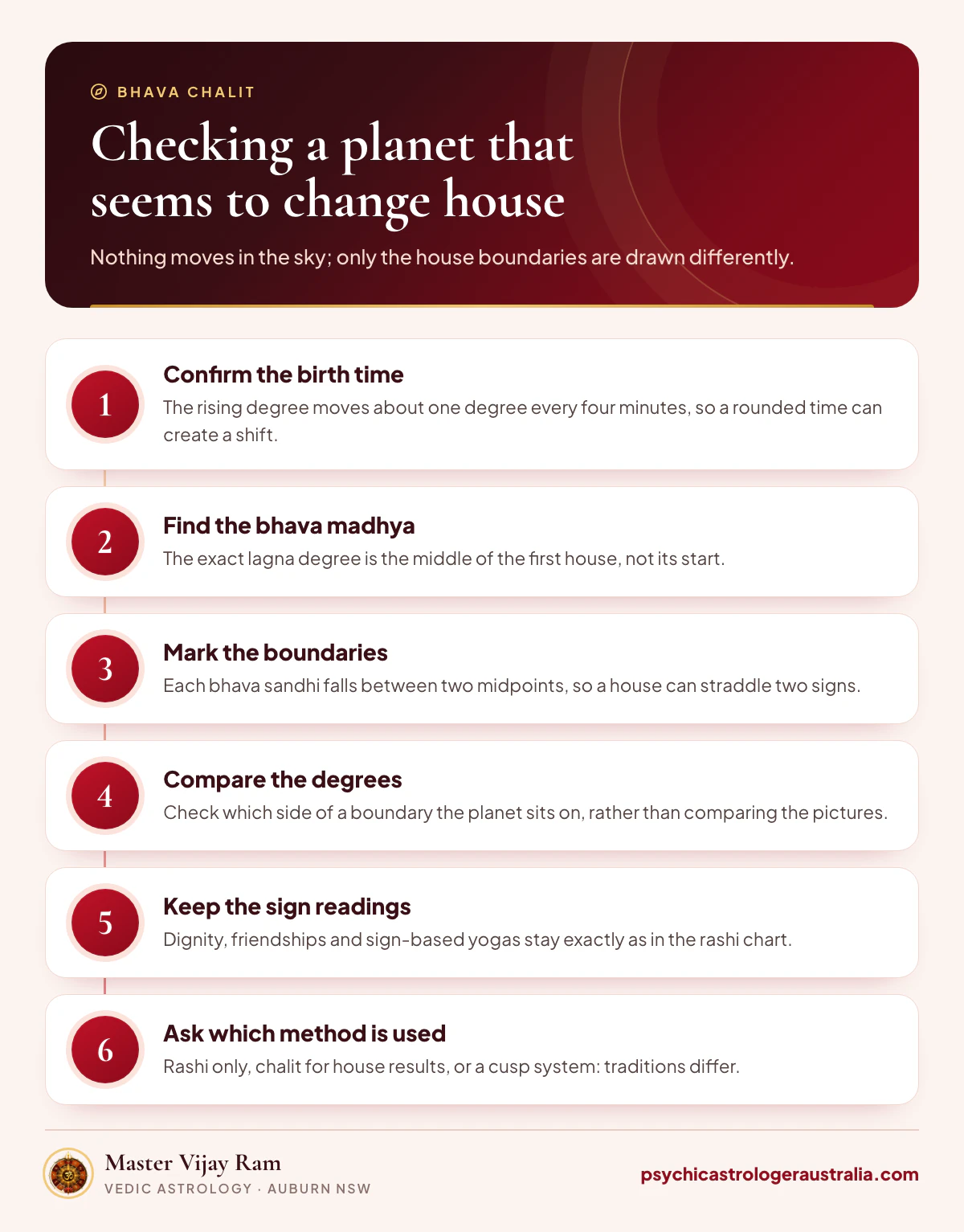
Nothing has moved in the sky. The planet is in the same sign at the same degree in both diagrams; what has changed is where the boundaries of the houses are drawn. Understanding that one point removes most of the confusion.
It is also a question that comes up often in a detailed kundli consultation, usually when an old printout from India and a new app disagree.
What is the difference between whole-sign and bhava houses?
In the rashi chart, the D1 most Vedic astrologers read first, houses are whole signs. Whatever sign is rising, explained in the lagna or rising sign, is the first house from 0° to 30°, the next sign is the second house, and so on. A planet anywhere in the second sign is in the second house, whether it sits at 1° or 29°.
In a bhava chart the houses are measured from the exact rising degree. That degree is treated as the middle of the first house, its bhava madhya, rather than the start of it. The boundary between two houses, the bhava sandhi, then falls roughly halfway between two midpoints, and a house can straddle two signs.
| Question | Rashi chart (D1) | Bhava chalit chart |
|---|---|---|
| What is a house? | One whole sign | A span around a calculated midpoint |
| Where does the first house start? | At 0° of the rising sign | About halfway back to the previous midpoint |
| Can a planet's sign change? | No | No |
| Can a planet's house change? | Not applicable | Yes, if it sits near a sign edge |
| Usually read for | Signs, dignity, yogas, aspects | Which house's affairs a planet delivers |
Why does a planet seem to change house?
Take a simple equal-house version to see how a planet shifts house in the chalit. Suppose the lagna is at 25° Taurus. If that degree is the middle of the first house and each house is 30°, the first house runs from 10° Taurus to 10° Gemini. The second house runs from 10° Gemini to 10° Cancer, and so on.
Now place Venus at 5° Taurus. In the rashi chart it is in Taurus, the first house. In the chalit it falls before 10° Taurus, so it is in the twelfth house. Place Mercury at 8° Gemini: second house by sign, but inside the first bhava because it lies before 10° Gemini. Both planets keep their signs, their dignity and their friendships; only the house they are counted in has shifted.
These positions are invented to show the mechanics. In an equal-house chalit every boundary sits 15° from the matching point of the lagna degree, so the planets that shift are the ones lying between a sign's edge and that boundary. With a lagna near the middle of its sign, very few planets move at all.
Why are the houses sometimes unequal?
The equal-house version is the easiest to picture, but many Indian programs use the Sripati method, which places the midpoint of the first house at the lagna degree and the midpoint of the tenth at the meridian, then divides the spaces between. Because the angle between the rising degree and the meridian varies with the time of day and the latitude, the houses come out unequal.
The further from the equator a birth takes place, the more uneven quadrant-based houses tend to become. A child born in Darwin will usually have more even chalit houses than one born in Hobart, which is one reason a chalit chart can look surprising for a southern Australian birth. Krishnamurti Paddhati, a modern Indian school, goes further and uses Placidus cusps with its own rules.
Which chart should be read, rashi or chalit?
Traditions differ, and honestly so. One widely used approach reads a planet's sign, dignity, yogas and aspects from the rashi chart, and the house whose affairs it delivers from the chalit. In that view the Venus at 5° Taurus in the example is still a Venus in its own sign, strong, but it gives twelfth-house results: spending, rest, distance, foreign links.
Other astrologers, especially those who follow a strict whole-sign reading of Parashara, set the chalit aside and use the rashi chart for everything. Still others give the chalit priority only for timing, judging which house a dasha lord activates. None of these is a mistake; what matters is that the astrologer is consistent and tells you which method is being used.
The house meanings themselves are the same in either system. For the seventh house, often the one people worry about, see the seventh house explained.
Does the chalit change yogas and doshas?
It can change the ones that depend on houses. Mangal dosha, for example, is defined by Mars's house; a Mars at 2° of the sign in the seventh house of the rashi chart may fall into the sixth bhava in the chalit, and some astrologers then treat the dosha as weakened. Kemadruma and kartari yogas, which depend on neighbouring houses, can be affected the same way.
Yogas defined by signs, such as a planet in its exaltation sign, do not change at all. This is why a careful reading states whether a dosha holds in the rashi chart, the chalit, or both, rather than announcing it from one diagram.
How do North and South Indian printouts show the chalit?
North Indian software draws the chalit in the same diamond layout as the rashi chart, with the house numbers fixed and the planets moved to their bhava. South Indian software, where signs are fixed in place, often prints the bhava cusps as a table of degrees instead of a second chart, or draws the chalit with planets shifted into the neighbouring box.
The layouts themselves are compared in North and South Indian chart styles. Whatever the style, the test is the same: find the cusp degrees and see on which side of them a planet falls.
Why does the birth time matter so much here?
The chalit is built from the exact rising degree, which moves about a degree every four minutes on average. A planet sitting within a few degrees of a bhava sandhi can cross from one house to the next with a birth-time error of a quarter of an hour. Planets in the middle of a sign almost never shift.
So when a reading leans heavily on a chalit shift, the first question should be how sure the birth time is. If it is a rounded family memory, the shift may be an artefact of the rounding rather than a feature of the chart, and birth time rectification may need to come first.
A worked illustration: a Townsville family's two charts
Picture a mother in Townsville who brings her daughter's chart from a Delhi astrologer, showing Saturn in the seventh house, and an app chart showing Saturn in the eighth. In this illustration Saturn is at 1° of the seventh sign, with the lagna at 22° of its sign.
A reader would explain that Saturn is in the seventh sign in both charts, so its sign-based qualities, its dignity and its aspects are unchanged. In the chalit it sits before the seventh bhava begins, so for house results it is read with the sixth. With this lagna no chalit could put a planet in the seventh sign into the eighth bhava, so the app's eighth points to a wrong time, place or setting. Checking the degrees, rather than the pictures, settles which program has made an error. Families in North Queensland can bring such questions to readings for Townsville clients.
What can the chalit not do?
The chalit cannot turn a chart into a different chart. It refines which house a borderline planet speaks for, and it is only as good as the birth time behind it. Its plainest limitation is that two respectable traditions disagree about how much weight it should carry, so no reading should hang a major life decision on a single chalit shift.
It also cannot settle questions that belong to practical life. A worrying placement is a reason for a careful reading, not for panic, and health, legal and financial matters belong with a GP, a lawyer or a financial counsellor first.
Should a remedy or gemstone depend on the chalit?
Not on a chalit shift alone. A gemstone is considered only after a full reading of sign, house, dignity and the running dasha in both views, which is the approach behind gemstone guidance from the full chart; Master Vijay Ram sells no stones. Where a puja is warranted for a planet under strain, it is performed personally at his place of practice in Auburn, starts from $250 and is agreed before it is performed; how a graha puja is arranged sets out the steps.
A $50 consultation by phone, video or WhatsApp, in English, Hindi or Punjabi, is enough to have both charts compared and explained in plain words.
Read next
- The Eighth House in Vedic Astrology: Sudden Change, Inheritance and Hidden MattersThe eighth house in Vedic astrology: sudden change, inheritance, in-laws’ wealth and hidden matters, the eighth lord …
- Maraka Planets and the Fear of Death in a ChartMaraka planets and houses 2 and 7 explained honestly: what the term means, why every chart has them, and why no readi…
- Kundli Reading Explained: What Your Birth Chart RevealsWhat a Kundli reading reveals about your life, personality, career and destiny. Master Vijay Ram explains Vedic astro…
Frequently asked questions
Why does my planet change house in the chalit chart?
Because the chalit draws house boundaries around the exact rising degree instead of using whole signs. A planet near the start or end of a sign can fall on the other side of a boundary and be counted in the neighbouring house. The planet's sign and degree are identical in both charts; only the house it is counted in changes.
Which is correct, the rashi chart or the bhava chalit?
Both are correct for what they measure. Many astrologers read sign, dignity, aspects and yogas from the rashi chart and the house whose affairs a planet delivers from the chalit. Strict whole-sign practitioners use only the rashi chart. Traditions differ, and a good astrologer tells you which approach is being used and why.
What is bhava madhya?
Bhava madhya is the midpoint of a house in the chalit system. The exact rising degree is taken as the midpoint of the first house, and in the Sripati method the meridian degree is the midpoint of the tenth. House boundaries, called bhava sandhi, fall between the midpoints, so a house usually includes parts of two signs.
Does Mangal dosha change in the chalit chart?
It can. Mangal dosha depends on the house Mars occupies, and a Mars near a sign edge may move into a different bhava in the chalit. Some astrologers then treat the dosha as weakened or absent; others judge it from the rashi chart only. A careful reading states which chart the dosha holds in rather than announcing it from one diagram.
Why do two kundli apps show different chalit charts?
They may use different house methods, such as equal houses from the lagna degree or the Sripati method, or different ayanamsas and time-zone entries. A small difference in birth time also moves the cusps. Compare the printed cusp degrees, not the pictures, to see which method each program uses.
Is the chalit chart used for predictions?
It is used mainly to decide which house a planet's period will activate, which affects timing. Sign-based judgements such as dignity and most yogas still come from the rashi chart. Predictions in Vedic astrology describe tendencies and timing, and the chalit refines rather than replaces the main reading.
Should I worry if a planet moves into the 8th or 12th in the chalit?
No. The planet keeps its sign, dignity and nature, and the eighth and twelfth houses carry useful themes such as research, inheritance, rest and foreign links as well as difficulties. A shift is a reason to read more carefully, not to fear. Check the birth time too, because a small error can create the shift.
Does a chalit shift change which gemstone I should wear?
It can change the reading of which houses a planet rules and influences, which is one reason gemstones are never suggested from a single diagram. A stone is considered only after the full chart, both house views and the running dasha are read. Master Vijay Ram sells no stones and does not recommend one from a chalit shift alone.
People also ask
What is the difference between lagna chart and chalit chart?
The lagna or rashi chart treats each whole sign as one house, starting from the rising sign. The chalit chart draws houses around the exact rising degree, so houses can straddle two signs and a planet near a sign edge may be counted in the next or previous house.
What is bhava sandhi?
Bhava sandhi is the junction between two houses in the chalit system. A planet very close to a sandhi is traditionally said to give mixed or weaker results for both houses, and it is the planet most sensitive to birth-time errors.
Do planets change sign in the chalit chart?
No. A planet's sign and degree are the same in the rashi and chalit charts. Only the house in which the planet is counted can differ, and only for planets near the edge of a sign.
Which house system does Vedic astrology use?
Classical Parashari practice uses whole-sign houses in the rashi chart, often with a bhava chalit chart as a second view. Krishnamurti Paddhati uses Placidus cusps. Practice varies between families of astrologers, and traditions differ on how much weight to give each.
References & further reading
Serving clients across Australia
Confidential consultations by phone, video & WhatsApp — including: