
Quick answer
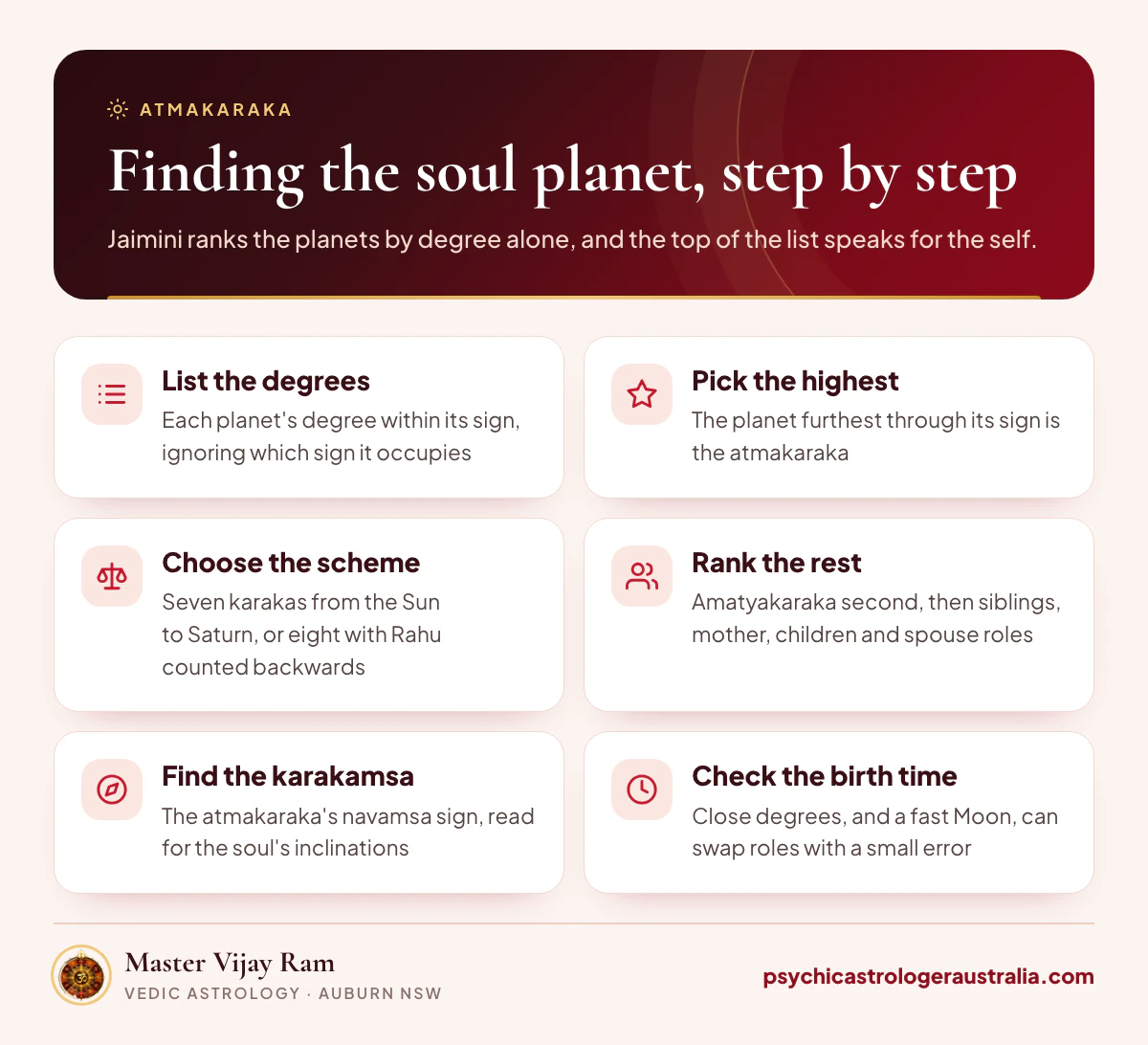
The atmakaraka is the planet with the highest degree within its sign in a birth chart, and Jaimini astrology treats it as the significator of the soul. It heads a list of chara karakas ranked by degree, in a seven-planet or eight-planet scheme that includes Rahu. Its navamsa sign, the karakamsa, is read for a person's deeper inclinations and spiritual path.
What is the atmakaraka?
The atmakaraka is the planet that has travelled furthest through its sign in a birth chart, and Jaimini astrology treats it as the karaka, or significator, of the self at its deepest. Atma means soul. Where most of Vedic astrology reads the lagna as the body and the Moon as the mind, this system adds a planet that speaks for the person's central lesson and longing.
It is not a fixed planet. In one chart it is Saturn, in another the Moon, in a third Venus, depending only on degrees. That makes it personal in a way the natural significators, the same in every chart, are not.
The atmakaraka is usually discussed as a refinement within a full kundli reading rather than as a reading on its own.
What is Jaimini astrology, and how does it differ from Parashara?
Jaimini astrology takes its name from the Jaimini Sutras, a terse text in short aphorisms traditionally attributed to the sage Jaimini. It shares the zodiac, the planets and the houses with the Parashari system most Indian astrologers use, but it adds tools of its own: variable significators, sign-based aspects, arudha padas and chara dasha, a timing system that runs by signs rather than planets.
The best way to think of it is as a parallel system that can be laid over a Parashari reading. Most astrologers in India, Vijay Ram ji included, read the chart in the Parashari way first and use Jaimini ideas, the atmakaraka above all, to confirm or deepen what they see. Traditions differ on how far to mix the two.
How is the atmakaraka found?
Ignore the signs and look only at each planet's degree within its sign. The planet with the highest degree is the atmakaraka. A Saturn at 27° of any sign outranks a Jupiter at 24°, whichever signs they occupy.
The other planets then take the remaining chara karaka roles in descending order of degree. Chara means moveable: the roles move from chart to chart, unlike the fixed, or naisargika, karakas such as Jupiter for children or Venus for marriage.
Seven karakas or eight?
Here the tradition splits. One scheme uses the seven visible planets from the Sun to Saturn. The other adds Rahu as an eighth, and because Rahu always moves backwards, its degree is counted backwards too: a Rahu at 4° is treated as having travelled 26° through its sign.
| Rank by degree | Seven-karaka scheme | Eight-karaka scheme | Traditionally signifies |
|---|---|---|---|
| 1 (highest) | Atmakaraka | Atmakaraka | The self, the soul's lesson |
| 2 | Amatyakaraka | Amatyakaraka | Career, counsel, the minister to the self |
| 3 | Bhratrikaraka | Bhratrikaraka | Siblings, and in some readings the guru |
| 4 | Matrikaraka | Matrikaraka | Mother |
| 5 | Putrakaraka | Pitrikaraka | Children (seven) or father (eight) |
| 6 | Gnatikaraka | Putrakaraka | Rivals and relatives (seven) or children (eight) |
| 7 | Darakaraka | Gnatikaraka | Spouse (seven) or rivals and relatives (eight) |
| 8 (lowest) | Not used | Darakaraka | Spouse |
Both schemes have serious followers, and many astrologers check both. In most charts the atmakaraka is the same in either; the difference usually shows lower down the list, which is why the darakaraka and amatyakaraka are the roles most often argued about.
What does a worked example look like?
Take an invented chart with these degrees: Moon 27°, Jupiter 24°, Mercury 19°, Saturn 15°, Sun 12°, Venus 8°, Mars 3°, and Rahu at 4°. In the seven-planet scheme the Moon is atmakaraka, Jupiter amatyakaraka, Mercury bhratrikaraka, Saturn matrikaraka, the Sun putrakaraka, Venus gnatikaraka and Mars darakaraka.
In the eight-planet scheme Rahu's 4° counts as 26°, so Rahu slips in second as amatyakaraka and everything below moves down a place: Jupiter becomes bhratrikaraka, Mercury matrikaraka, Saturn pitrikaraka, the Sun putrakaraka, Venus gnatikaraka and Mars darakaraka. The atmakaraka, the Moon, is unchanged. This example belongs to no real person.
Because the ranking depends on degrees and sometimes on minutes, a planet close behind another can swap places with a small error in the birth time, especially when the Moon, which moves about half a degree an hour, is involved.
What does each planet mean as atmakaraka?
The tradition reads the atmakaraka as the area where the soul has most to learn, often through the planet's harder side before its gifts. The short readings below are traditional tendencies, never a description of any one person.
- Sun: lessons around pride, authority and the father; growth through humility and service to a larger purpose.
- Moon: lessons around feeling, care and dependence; growth through compassion that includes oneself.
- Mars: lessons around anger, courage and conflict; growth through disciplined effort and protection of others.
- Mercury: lessons around speech, cleverness and restlessness; growth through truthful words and study.
- Jupiter: lessons around teaching, belief and the guru; growth through living what one teaches.
- Venus: lessons around desire, beauty and relationships; growth through devotion and refined love.
- Saturn: lessons around sorrow, duty and limitation; growth through patience, service and detachment.
- Rahu (eight-karaka scheme): lessons around ambition, the foreign and illusion; growth through discernment.
What is the karakamsa?
The karakamsa is the navamsa sign occupied by the atmakaraka. If the atmakaraka falls in Sagittarius in the navamsa, Sagittarius is the karakamsa. Jaimini then reads that sign, the planets in it and the planets aspecting it as a picture of the soul's tendencies and the work that suits it. The construction of the navamsa itself is set out in the navamsa D9 chart.
Some astrologers also mark the karakamsa sign in the birth chart and count houses from it, a method called the karakamsa lagna. The houses counted from it are read for particular matters; the twelfth from it, for instance, is one traditional pointer to the ishta devata, the personal deity, which is explored in finding the ishta devata in the chart.
A worked illustration: a teacher in Hobart
Picture a secondary school teacher in Hobart, in his forties, who rings because he keeps being offered leadership roles and keeps turning them down. In this illustration his atmakaraka is Jupiter at 28°, his karakamsa is Sagittarius, Jupiter's own sign, and the Sun sits with it in the navamsa.
A reader would describe a soul lesson around teaching and belief, a person most at ease when what he teaches matches how he lives, with the Sun adding a pull toward responsibility he may not feel ready for. That reading does not tell him to take the job. It offers language for a tension he already feels, and a sense of which periods tend to bring it forward.
The decision itself rests on his workload, his family and his health, and those are better discussed with the people around him than settled by a planet's degree.
What if the atmakaraka is debilitated or afflicted?
An atmakaraka in its debilitation sign, or joined by Rahu or Ketu in the navamsa, is often read as a soul lesson that arrives early and insistently. It is not read as a damaged soul. The tradition often reads a strained atmakaraka as the chart of a seeker, because the lesson is hard to ignore.
Is the atmakaraka the same as the lagna lord?
No, and the two are often confused. The lagna lord is fixed by the rising sign and describes the body, the temperament and the direction of life in the Parashari way. The atmakaraka is fixed by degrees and describes what the person is, at a deeper level, trying to learn. In some charts they are the same planet, which is read as a strong alignment between outer life and inner purpose.
A related confusion is with the Moon sign. The Moon describes the mind's daily weather; the atmakaraka, even when it is the Moon, is read for something slower.
How is the atmakaraka used in timing?
In Parashari practice, the atmakaraka's own dasha and antardasha are often noted as periods when the soul's lesson comes to the front, sometimes uncomfortably. In Jaimini practice the chara dasha, which runs through signs, is read alongside the karakas, and periods of signs linked with the atmakaraka or karakamsa are given extra weight.
These are refinements on the main dasha reading described in the Vimshottari dasha system. They describe tendencies and timing and never fix an event to a date.
What can the atmakaraka not tell you?
It cannot tell you your worth, your fate or whether your choices are right. A planet that tops a list by a few minutes of arc is a traditional pointer for reflection, and its plainest limitation is that a small birth-time error, or a different karaka scheme, can hand the role to another planet.
It is also not a diagnosis of anything. Low mood, anxiety or a crisis of meaning deserve real support: a GP, a counsellor, Beyond Blue, or Lifeline on 13 11 14 at any hour.
How does Master Vijay Ram use the atmakaraka?
He reads the Parashari chart first, then notes the atmakaraka in both schemes and the karakamsa, and mentions them where they add something, often in questions of vocation, faith or why the same lesson keeps returning. He says plainly when the karakas are too close in degree to rank with confidence.
Practice, where the atmakaraka is under strain, is simple: the planet's mantra, the deity traditionally linked with it, and conduct suited to its lesson. A shanti through graha shanti puja is rarely needed; where it is, it is performed personally in Auburn, starting from $250 and agreed beforehand, as described under puja and havan bookings. A $50 consultation by phone, video or WhatsApp covers the reading, and Queensland clients can book through astrology readings for Brisbane.
Read next
- Maraka Planets and the Fear of Death in a ChartMaraka planets and houses 2 and 7 explained honestly: what the term means, why every chart has them, and why no readi…
- Retrograde Planets in a Birth Chart: What Vakri Really MeansVakri graha in a kundli: why a planet looks to move backwards, the three schools on its strength, the stationary plan…
- 11 Signs of Negative Energy in Your Life (and How to Clear It)Eleven signs of negative energy, the ordinary causes to rule out first, and the three-doors test that tells you wheth…
Frequently asked questions
How do I find my atmakaraka?
List each planet's degree within its sign, ignoring which sign it is in. The planet with the highest degree is the atmakaraka. In the eight-karaka scheme, Rahu is included with its degree subtracted from 30, because it moves backwards. Most kundli software shows the chara karakas, but check which scheme it uses before relying on the list.
What is the difference between the 7 and 8 karaka schemes?
The seven-karaka scheme ranks the Sun, Moon, Mars, Mercury, Jupiter, Venus and Saturn by degree. The eight-karaka scheme adds Rahu, counted backwards, and inserts a pitrikaraka for the father. Both are traditional and both have followers. The atmakaraka usually stays the same, but roles further down the list often change between the schemes.
Can Rahu be the atmakaraka?
Only in the eight-karaka scheme. There Rahu's degree is counted from the end of its sign, so a Rahu at 2° is treated as having travelled 28° and may outrank every other planet. In the seven-karaka scheme Rahu is never a chara karaka. Astrologers who use both schemes note when they disagree.
What is the karakamsa in Jaimini astrology?
The karakamsa is the navamsa sign occupied by the atmakaraka. Jaimini reads that sign, the planets in it and those aspecting it for the soul's inclinations and the kind of work and devotion that suit the person. Some astrologers also mark that sign in the birth chart and count houses from it.
Is the atmakaraka a good or bad planet?
Neither. It is read as the area of life where the soul has most to learn, which often means meeting the planet's harder side before its gifts. A Saturn atmakaraka may bring lessons in patience and duty, a Venus atmakaraka lessons in desire and devotion. The reading describes tendencies, not a verdict on a person.
Does the atmakaraka change during life?
No. It is fixed by the degrees of the planets at birth. What changes is which periods bring it forward: its own dasha and antardasha, and in Jaimini practice the chara dasha periods of signs linked with it. Those periods are often described as times when the soul's lesson is more noticeable.
What is the amatyakaraka?
The amatyakaraka is the planet with the second-highest degree. Its name means the minister, and it is read for career, counsel and the support that helps the atmakaraka do its work. Because it sits just below the top of the list, it is the role most likely to change between the seven- and eight-karaka schemes.
Should I worship my atmakaraka planet?
Many families chant the mantra of the atmakaraka planet or honour the deity traditionally linked with it, and some find that steadying. It is a devotional choice rather than an obligation. The family deity and the ishta devata usually come first, and no practice should replace medical or psychological support where it is needed.
People also ask
Which planet is the soul planet in astrology?
In Jaimini astrology the soul planet is the atmakaraka, the planet with the highest degree within its sign in the birth chart. It differs from chart to chart. In Parashari astrology the Sun is the natural significator of the soul, the same in every chart.
What is chara karaka?
Chara karakas are the variable significators of Jaimini astrology. The planets are ranked by degree within their signs and assigned roles such as self, career, siblings, mother, children and spouse. Because the ranking changes from chart to chart, so do the roles.
What does darakaraka mean?
The darakaraka is the planet with the lowest degree among the chara karakas and is read as the significator of the spouse. Its sign and placement, especially in the navamsa, are used in Jaimini marriage readings alongside the seventh house.
Is Jaimini astrology different from Vedic astrology?
Jaimini astrology is a branch of Vedic astrology. It shares the signs, planets and houses but adds its own tools, such as chara karakas, sign aspects and chara dasha. Most astrologers read the Parashari chart first and use Jaimini ideas to confirm it.
References & further reading
Serving clients across Australia
Confidential consultations by phone, video & WhatsApp — including: