

Quick answer
The sixth house in Vedic astrology, ripu bhava, is the house of debts, disputes, illness, service, competition and daily work, with Mars and Saturn as its karakas. It is both a difficult house and a house of growth, so it describes trouble that effort can overcome, and a financial counsellor, Legal Aid or a GP comes before any reading of it.
What is the sixth house in Vedic astrology?
The sixth house in Vedic astrology is an arena, the place in the chart where the daily contest is fought: debts, disputes, illness, service, competition and the routine work that fills most of a life. Its Sanskrit name, ripu bhava, means the house of the enemy, and astrologers often sum it up in three words, rina, ripu and roga, meaning debt, opponent and illness. It sounds grim, yet the tradition reads it as the place where problems are met and beaten, which is why a strong sixth is so prized.
This guide explains the territory of the house, how its lord and its planets are weighed, and how its themes show up in Australian working lives, from credit-card debt and workplace disputes to rotating rosters and stubborn health habits, naming the professional who comes first at each step. A thorough kundli reading puts all of this into the context of your own chart.
Why is the sixth both a difficult house and a house of growth?
The tradition files the twelve houses under several headings, and the sixth is the only house that sits under two which seem to contradict each other. It is a dusthana, one of the three difficult houses with the eighth and twelfth, because it holds conflict, debt and illness; and it also counts among the upachayas, the houses of growth, alongside the third, tenth and eleventh, because those troubles are the kind effort can overcome.
Put together, the two labels describe something true of ordinary life: the sixth is trouble you can work on. A debt can be paid down, a rival outlasted and a habit changed, and the house describes the stamina a person brings to that work as much as the trouble itself.
Why does the sixth house have two karakas?
Mars and Saturn share it. Mars is the karaka of fights and competition, the energy to stand up to an opponent and win; Saturn is the karaka of service, labour and the long, chronic matters that only patience resolves. A sixth house is read with both in view, and their dignity says a great deal about how a person handles conflict and hard work.
A strong Mars with a weak Saturn tends to win the argument and lose the long game, while a strong Saturn with a weak Mars outlasts everyone but avoids confrontations it should have had. The practices the tradition attaches to them, Hanuman's prayers on Tuesdays and Saturdays and Shani's mantra on Saturdays, are aimed at that balance.
Why do malefics do well in the sixth house?
Because the sixth is an arena, and arenas reward fighters. The tradition holds that Saturn, Mars, Rahu and the Sun, the natural malefics, tend to defeat opponents, clear debts and outwork rivals from here, while gentle benefics can be too kind for the house: Jupiter in the sixth is sometimes read as generosity that others take advantage of, and Venus here, in a house whose natural sign is Virgo, its sign of debilitation, as comfort that costs more than it should.
Mercury in the sixth gives an analytical, problem-solving mind suited to audit, law, medicine and IT support; the Moon there is read as a worrier whose health follows mood; the Sun as success in government service and against rivals; Ketu as quiet victories over opposition that never quite shows its face. The planets in the sixth house still answer to their sign and aspects, so a debilitated Mars here fights hard but not always wisely.
What does the sixth house lord show?
The sixth sign from your lagna is your sixth house, and its ruler is your sixth house lord: Mercury for an Aries lagna through Virgo, Venus for a Taurus lagna through Libra, Mars for a Scorpio lagna through Aries. Wherever it sits it brings the house's contests with it: in the first, a life shaped by work, health and discipline; in the seventh, disputes that involve partners; in the tenth, a career in service such as nursing, law, policing or medicine.
The best-known placement is the sixth lord in the sixth, eighth or twelfth, which the tradition calls Harsha yoga, one of the three vipreet raja yogas: difficulty turned into success, the problem that ends up making the person. Vipreet raja yoga, explained plainly covers it and its two companions, Sarala and Vimala.
Who should you see first? A sixth-house guide
Every sixth-house matter has a professional who comes before the chart. The table pairs the commonest questions with what a reading looks at and who to call first.
| Sixth-house matter | What the chart is read for | Who comes first |
|---|---|---|
| Debt and borrowing | The sixth lord, its links with the second and eleventh houses, and the dasha running | A financial counsellor; the National Debt Helpline can put you in touch with one |
| A dispute at work | Mars, Saturn and the sixth lord, with the tenth house beside them | Your manager or HR, your union, or the Fair Work Ombudsman |
| A legal dispute or a court date | The sixth for the contest, the seventh for the open opponent | Legal Aid in your state, a community legal centre or a lawyer |
| Rosters, shift work and fatigue | Saturn, the sixth lord and the Moon's condition | A GP, and your employer about the roster itself |
| A chronic health habit | The sixth lord and its occupants, read as tendencies | A GP, and any specialist the GP refers you to |
| Competition: exams, interviews, tenders | Malefics in the sixth and the sixth lord's strength | Preparation, practice and a mentor who has done it |
The chart's job in each row is timing and temperament: which months suit a hard conversation, a negotiation or a fresh start, and what a person's own patterns add to the problem.
What does the sixth house say about debt?
Rina, debt, is the first of the sixth house's three words. The tradition reads borrowing through the sixth lord and its links with the second house of savings and the eleventh of income: a sixth lord tied to the second can describe loans inside the family, and one tied to the twelfth, spending that outruns the pay.
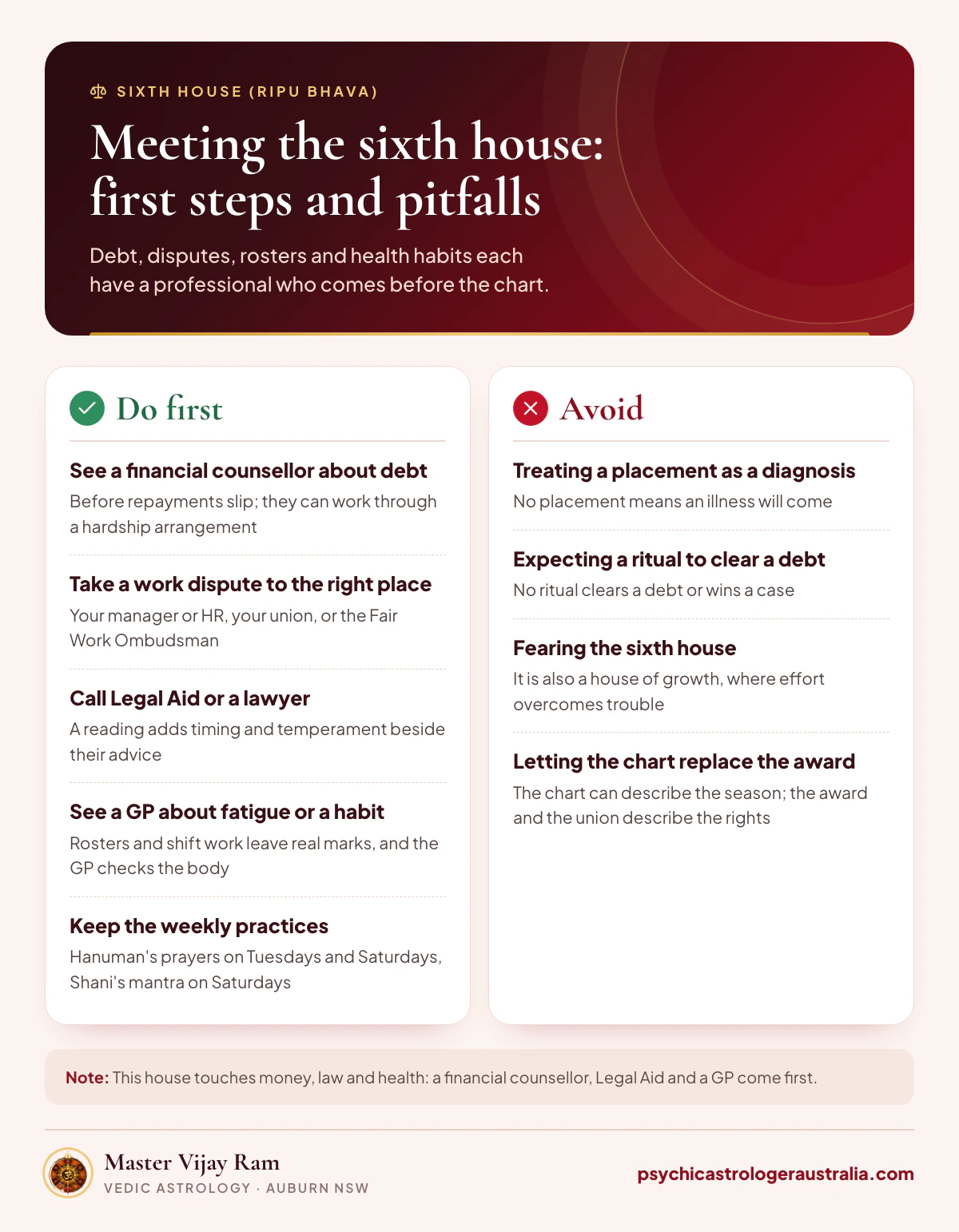
Credit cards, buy-now-pay-later accounts and car loans are its modern face, and a chart can describe a person's pattern with debt and the periods when it eases. It cannot negotiate with a lender, and a financial counsellor, who can work through a hardship arrangement with you, is the first call when repayments start to slip.
Workplace disputes, rivals and court cases
Ripu, the opponent, covers the colleague who takes the credit, the manager who will not listen, the competitor for the same promotion and the other side of a legal matter. Open opponents and partners belong to the seventh house, as the seventh house of partners and open rivals explains, while the sixth holds the day-to-day contest and a person's capacity to win it.
Workplace rights belong with your union, HR or the Fair Work Ombudsman, and legal disputes with Legal Aid or a lawyer; enemy and court-case guidance reads the chart alongside that advice, usually for timing and for the temper a person brings into the room. A nurse on rotating rosters in Melbourne, in a running dispute with a ward manager, might ask whether to push now or wait, and the chart can describe the season, but the award and the union describe the rights.
Rosters, service and the daily round
Seva, service, is the sixth house at its best: daily work done for others, from nursing and aged care to hospitality, warehousing and cleaning. The tenth house is the career and its standing; the sixth is the shift itself, the routine, the colleagues and the body that has to turn up.
Saturn's link with the sixth makes it the house of rosters, and night shifts, rotating rosters and fly-in fly-out swings all leave marks the tradition reads here. A warehouse worker in Brisbane on a rotating roster might ask why every third month feels worse, and the honest answer often combines a Saturn period with an ordinary sleep debt; the GP comes first for the second.
Health habits: what the sixth shows and never diagnoses
Roga, illness, is the third of the house's words, and the tradition reads here the body's chronic tendencies and the habits that feed them: sleep, diet, stress and the things people know they should change. The first house is the constitution; the sixth is what daily life does to it.
No placement diagnoses anything. Symptoms, results and medication belong with a GP and with whichever specialist the GP sends you to, and when to see a doctor before an astrologer is useful for anyone unsure which comes first; health guidance that works beside your GP describes what a reading can add once care is in place.
2027: Saturn and Jupiter in the sixth from the Moon
Saturn in the sixth from the Moon is traditionally one of its best transits, a season for clearing debts, outlasting rivals and settling into disciplined work. In 2027 (Sydney dates) Tula (Libra) Moons have it twice, while Saturn is in Pisces before 3 June and again once it returns there on 20 October, and Vrishchika (Scorpio) Moons have it in between, during Saturn's stay in Aries.
Jupiter in the sixth from the Moon is read more cautiously, as a time when generosity, lending and health habits need watching: Meena (Pisces) Moons have it for most of January and again for five months from 26 June, Kumbha (Aquarius) Moons from late January to late June, and Mesha (Aries) Moons from 27 November. Rahu spends the whole year in the sixth from a Simha (Leo) Moon, traditionally a strong placement for beating competition, and Ketu in the sixth from a Kumbha Moon.
Reading the sixth house's strength: what counts?
A strong sixth is not a quiet one. The reader wants a sixth lord with enough dignity to fight, Mars and Saturn in reasonable condition, malefics in or aspecting the sixth rather than gentle planets alone, and the sixth from the Moon free of heavy affliction.
For the sixth house in a kundli the divisional charts are a matter of school: some astrologers use the sixth (D6) and others the thirtieth (D30) for health and misfortune, traditions differ, and none of them replaces a medical test. The dasha decides when the contest comes, since periods of the sixth lord, of a planet in the sixth, or of Mars and Saturn bring its matters forward.
After the fifth, before the seventh: where the sixth sits
The sixth follows the fifth house of study and merit, and the order makes sense: learning is tested in the contest, the exam after the study. Counted from the seventh it falls twelfth, the position of loss, which is why it is watched in marriage questions, since disputes and debts are what most often wear a partnership down.
It also belongs with the eighth and twelfth, the other two dusthanas, and the three are read together when a chart shows a long run of difficulty, because their lords can cancel one another's troubles in the vipreet pattern described above.
Where the chart stops and the professionals start
The sixth house cannot clear a debt, win a case, fix a roster or diagnose an illness, and anyone who says a ritual will do those things is overselling the tradition. It can describe a person's pattern with conflict and work, the periods that favour a hard push and those that favour patience, and the habits that would make the contest easier.
Everything in a reading sits on the faith side of the line. It is not financial, legal or medical advice, and a financial counsellor, Legal Aid and a GP are the first calls for the matters in this house.
Reading the sixth house with Master Vijay Ram
He looks at the sixth from the lagna and the Moon, weighs its lord, Mars and Saturn, notes whether Harsha yoga or another vipreet pattern is present, and checks what the current dasha and the year's transits are switching on, so you leave knowing which matters are likely to press and which months suit action. The consultation costs $50 and can be held by phone, video or WhatsApp, in English, Hindi or Punjabi; Melbourne and Victorian clients share Sydney time, and the only in-person appointments are at Auburn.
Most sixth-house readings end with a practice from the Tuesday and Saturday traditions and a plan made with the right professional. Where a shanti for an afflicted sixth lord is warranted, he performs it himself, in person at Auburn, from $250, with the figure fixed with you beforehand; a havan or puja performed in Auburn describes how clients take part by video.
Read next
- The Tenth House in Vedic Astrology: Career, Reputation and KarmaThe tenth house in Vedic astrology: career, reputation and karma, its four karakas, the tenth lord in each house, pla…
- The First House in Vedic Astrology: Body, Vitality and SelfThe first house in Vedic astrology (tanu bhava): body, vitality and temperament, the Sun as karaka, planets in the fi…
- Signs of Jinn Disturbance at Home and How Ruqyah HelpsJinn disturbance at home: which signs matter, which have ordinary causes, what ruqyah really is, and how a settled ho…
Frequently asked questions
What does the sixth house represent in a kundli?
The sixth house, ripu bhava, represents debts, disputes and opponents, illness and health habits, service and daily work, and competition. Mars and Saturn are its karakas. It is both a dusthana, a house of difficulty, and an upachaya, where results grow with effort, which is why it describes the troubles that effort can overcome and the stamina a person brings to overcoming them.
Is the sixth house bad in astrology?
Not simply. It is a dusthana because it holds debt, conflict and illness, but it is also an upachaya, where results improve with effort, and malefics placed there are traditionally strong. The tradition links a busy sixth house with service careers such as nursing, law and policing, and with people who win by outworking the competition. The question is how a person meets difficulty.
What does Saturn in the sixth house mean?
Saturn in the sixth is traditionally one of its better placements: endurance in service, patience with chronic matters, and a slow, steady victory over opponents and debts. It suits disciplined work such as nursing, aged care or compliance. Health habits need steady attention rather than bursts of effort, and Saturn's sign and dasha decide how the placement shows in a particular life.
What is Harsha yoga?
Harsha yoga is the vipreet raja yoga formed when the sixth lord sits in the sixth, eighth or twelfth house. The tradition reads it as difficulty turned into success: the debt, illness or rival that ends up strengthening the person. Its companions are Sarala yoga, for the eighth lord, and Vimala yoga, for the twelfth. Like any yoga, it depends on dignity and on the dasha that activates it.
Can the sixth house show court cases?
It shows the contest and a person's capacity to win it, while the seventh shows the open opponent, and the tradition reads both, with the dasha, when a legal matter is pending. It cannot predict a verdict or replace a lawyer. Legal Aid, a community legal centre or a solicitor comes first, and a reading adds timing and temperament beside their advice.
Does the sixth house show illness?
It shows the tradition's view of chronic tendencies, the habits that feed them, and the periods in which health needs more attention. It cannot diagnose anything, and no placement means an illness will come. Symptoms belong with a GP before anyone else. After that, a reading can offer help with routine, patience and the timing of the effort recovery asks for.
Who is my sixth house lord?
Find the sixth sign counting from your lagna; its ruler is your sixth lord. For Aries rising that means Mercury through Virgo, for Taurus rising Venus through Libra, for Gemini rising Mars through Scorpio, for Cancer rising Jupiter through Sagittarius, for Leo or Virgo rising Saturn, and for Scorpio rising Mars through Aries. Its placement shows where the contests of your life tend to arise.
What does Rahu in the sixth house mean?
Rahu in the sixth is traditionally counted among its best placements: a fighter's instinct, success against competition and an ability to handle opponents others fear. It can also bring unusual health habits or worries that need ordinary medical checking. How it shows depends on the ruler of its sign, the aspects it receives and when its dasha runs.
Can a remedy help with debts or enemies?
The tradition offers practice first: Hanuman's prayers on Tuesdays and Saturdays, Shani's mantra on Saturdays, steady routines and fair dealing. Where the chart shows an afflicted sixth lord in a pressing period, Master Vijay Ram may suggest a shanti, which he performs in Auburn from $250 with the cost agreed first. No ritual clears a debt or wins a case, he sells no gemstones or beads, and a financial counsellor and Legal Aid do that work.
People also ask
What does the 6th house rule in Vedic astrology?
The 6th house rules debts, disputes and opponents, illness and health habits, service, competition and daily work. Its Sanskrit name is ripu bhava and its karakas are Mars and Saturn. It is both a dusthana and an upachaya, so the tradition reads it as the house where problems are met and, with effort, overcome.
Which planet is good in the 6th house?
Natural malefics are traditionally strongest there: Saturn, Mars, Rahu and the Sun help a person defeat rivals, clear debts and outwork the competition. Mercury is also useful, giving an analytical, problem-solving mind. Gentle benefics such as Jupiter and Venus can be too kind for the house, though their sign and aspects have the final word.
What if the 6th house is empty?
That is common and harmless. Debts, disputes and health habits are then read from the sixth lord, any aspects falling on the house, and Mars and Saturn as karakas. An empty sixth with a well-placed lord often describes someone who meets problems calmly and without much drama, so there is nothing to fear in it.
What is ripu bhava?
Ripu bhava, the house of the enemy or opponent, is what the Sanskrit texts call the sixth house. It covers debts, disputes, illness, service, competition and daily work, often summed up as rina, ripu and roga: debt, opponent and illness. The tradition reads it as the house where problems are met and overcome, not merely suffered.
Is the sixth house a dusthana or an upachaya?
Both. It is a dusthana, a house of difficulty, with the eighth and twelfth, and an upachaya, a house of growth, with the third, tenth and eleventh. It is the only house in both groups, which is why the tradition reads it as trouble that effort can overcome rather than trouble simply to be feared.
References & further reading
Serving clients across Australia
Confidential consultations by phone, video & WhatsApp — including: