
Quick answer
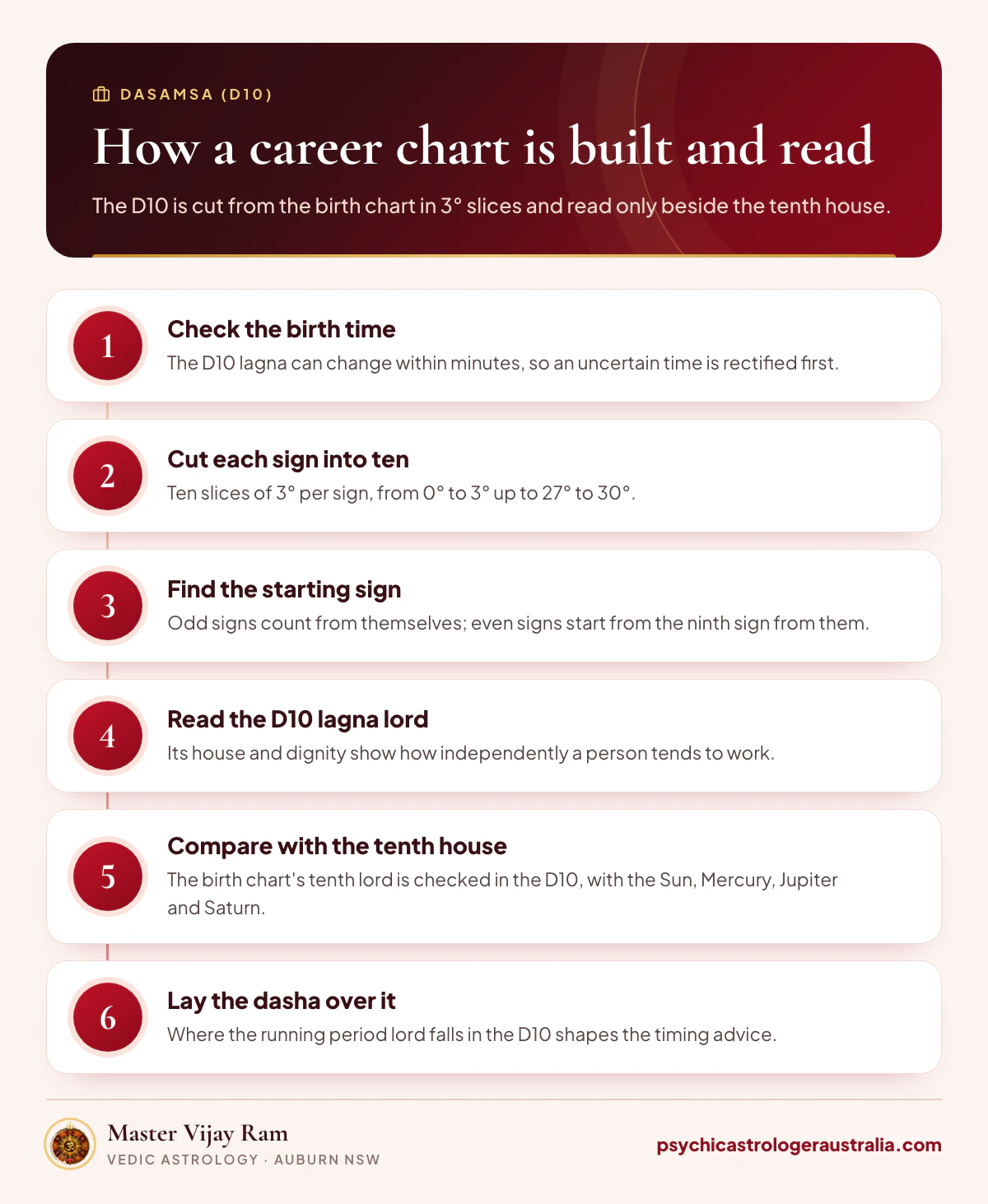
The dasamsa, or D10, is the divisional chart Vedic astrologers use for career. Each sign is cut into ten slices of 3°, odd signs counting from themselves and even signs from the ninth, and the result is read beside the tenth house of the birth chart. Because the D10 lagna shifts every few minutes, it is only as reliable as the birth time behind it.
What is the dasamsa chart?
The dasamsa chart is a divisional chart that cuts every sign of the zodiac into ten equal slices and rebuilds the horoscope from the slice each planet falls in. Astrologers also write it as dashamsha or simply the D10 chart, and Parashara lists it among the sixteen vargas he describes. Its subject is the work a person does in the world: the shape of a career, the standing it brings and the kind of authority a person grows into.
The main birth chart, the D1 or rashi chart, already has a career house, the tenth. The D10 is a magnifying glass held over that house. It does not replace the rashi chart and nothing in it should be read alone; it confirms, sharpens or questions what the tenth house has already suggested.
For readers who want the whole method rather than one slice of it, a full kundli reading with Master Vijay Ram always begins with the D1 and moves to the D10 only when a work question is on the table.
How is a D10 chart built, step by step?
Each sign spans 30°, so ten slices of 3° each fill it. The first slice runs from 0° to 3°, the second from 3° to 6°, and so on to the tenth, from 27° to 30°. The only question is which sign the first slice is given, and here the rule splits by sign.
For the odd signs (Aries, Gemini, Leo, Libra, Sagittarius and Aquarius) the count starts from the sign itself. For the even signs (Taurus, Cancer, Virgo, Scorpio, Capricorn and Pisces) it starts from the ninth sign counted from that sign. From the starting sign the count simply runs forward through the zodiac, one sign per slice.
| Sign in the birth chart | Odd or even | First D10 slice starts from |
|---|---|---|
| Aries | Odd | Aries |
| Taurus | Even | Capricorn (9th from Taurus) |
| Gemini | Odd | Gemini |
| Cancer | Even | Pisces (9th from Cancer) |
| Leo | Odd | Leo |
| Virgo | Even | Taurus (9th from Virgo) |
| Libra | Odd | Libra |
| Scorpio | Even | Cancer (9th from Scorpio) |
| Sagittarius | Odd | Sagittarius |
| Capricorn | Even | Virgo (9th from Capricorn) |
| Aquarius | Odd | Aquarius |
| Pisces | Even | Scorpio (9th from Pisces) |
Can you show the arithmetic with real degrees?
Take a Sun at 14° Leo. Leo is odd, so the count begins at Leo. Fourteen degrees falls in the fifth slice (12° to 15°), and the fifth sign counted from Leo is Sagittarius, so the Sun sits in Sagittarius in the D10.
Now take a Saturn at 17° Taurus. Taurus is even, so the count begins at Capricorn, the ninth from Taurus. Seventeen degrees falls in the sixth slice (15° to 18°); counting six signs from Capricorn gives Capricorn, Aquarius, Pisces, Aries, Taurus, Gemini, so Saturn lands in Gemini. The D10 lagna is worked out the same way from the rising degree, and the houses of the D10 are then counted whole-sign from it.
These two placements are illustrations of the method, not anyone's chart. Software does the sums instantly; what matters is knowing which inputs the software needs and how sensitive the answer is to them.
Why does the birth time matter so much for the D10?
A 3° slice is small. The rising degree moves through a whole sign in roughly two hours on average, faster for some signs and slower for others, so the D10 lagna can change in well under a quarter of an hour. That is quicker even than the navamsa lagna, which the tradition reckons at about twelve minutes per change.
A birth time rounded to the nearest half hour, which is common on older Indian certificates and in family memory, can therefore give the wrong D10 lagna altogether. The planets themselves move slowly enough that their D10 signs are usually safe, but the houses they occupy are not. When the time is uncertain, birth time rectification comes before any D10 judgement, and an honest astrologer says how much of the reading rests on it.
What does an astrologer actually read in the D10?
The first thing is the D10 lagna and where its lord sits. A lagna lord in a kendra or trikona of the D10, in a friendly or own sign, is traditionally read as a person who can stand on their own feet at work. A lagna lord in the sixth, eighth or twelfth of the D10 points to more effort, more service under others, or work that happens behind the scenes.
Next comes the tenth house of the D10 and its lord, then the D10 placement of the tenth lord from the birth chart. When the birth chart's tenth lord is strong in the D10 too, the career promise is read as firm; when it is strong in one and weak in the other, the promise is real but uneven. The four career karakas, the Sun, Mercury, Jupiter and Saturn, are checked last for their dignity in the dasamsa.
- Dignity: a planet exalted or in its own sign in the D10 is read as delivering its career themes more easily.
- Repetition: a planet in the same sign in D1 and D10 is often given extra weight, in the spirit of vargottama in the navamsa.
- The dasha lord: the period running now is judged by where its lord falls in the D10, which is how timing enters the picture.
How do the D1 tenth house and the D10 work together?
Think of the birth chart as the job description and the dasamsa as the way the job is actually done. A strong Mercury ruling the tenth in the D1 points toward work with words, numbers or trade; the D10 then shows whether that Mercury is supported or strained, and whether the person is more likely to run something or serve within it.
The fuller story of which planets suit which fields is in career astrology and suitable fields, and the tenth house itself is covered in the tenth house explained. The D10 adds a second opinion to both rather than a new set of meanings.
How does the D10 compare with the navamsa?
The navamsa (D9) is the most used divisional chart because it speaks to marriage and to the inner strength of every planet. The dasamsa is narrower: it is consulted when the question is about work. Many astrologers check a planet's navamsa strength first and then its dasamsa placement, so that a planet weak in both is not mistaken for a career signature.
The method for the ninth divisional chart is set out in the navamsa D9 chart. Both charts share the same weakness, the birth time, and the D10 suffers from it slightly more.
A worked illustration: a planner in Newcastle
Picture an engineer in her thirties who has moved from a big Sydney firm to a council planning role in Newcastle and wonders whether to go out on her own. Her birth chart shows Saturn ruling the tenth from a Taurus lagna, well placed. In this illustration the D10 lagna is Capricorn with Saturn in it, and the Sun, often read as authority, sits in the D10 tenth.
A reader would say the chart supports long, steady building of standing and that independent consulting suits it, especially in a Saturn period. It would not say when to resign, how much to charge or whether the local market needs another consultant. Those are questions for her accountant and her professional network, and readings for Newcastle clients are framed that way.
What can the D10 not tell you?
A divisional chart cannot see the economy, an employer's restructure, a visa condition or a qualification that has not been recognised in Australia. It describes tendencies and timing inside a person's own working life, and the plainest limitation is that a wrong birth time produces a confident reading of the wrong chart.
Practical help comes first for practical problems. A careers adviser, your professional association, the Fair Work Ombudsman for workplace rights, and Home Affairs or a registered migration agent for anything tied to a visa will answer questions no chart can.
Do remedies change a weak dasamsa?
No ritual moves a planet from one slice to another. What the tradition offers, where a reading finds a career karaka under strain in the running period, is mantra for that planet, conduct that matches its nature (Saturn's patience and honest labour, for instance) and, occasionally, a shanti.
Where a puja is warranted it is performed personally by Vijay Ram ji at his place of practice in Auburn; it starts from $250 and is agreed before anything is done, and how a puja or havan is arranged explains the process. Most D10 questions end with timing advice and no remedy at all.
How does Master Vijay Ram use the dasamsa in a career reading?
He casts the D1 first, judges the tenth house, its lord and the career karakas, and only then opens the D10 to test what he has seen. If the birth time is shaky he says so before he reads the dasamsa, and he may set it aside entirely.
The period running now is then laid over both charts, because timing is what most people ring about: a promotion, a change of field, a business launch. A $50 consultation by phone, video or WhatsApp, in English, Hindi or Punjabi, covers the reading; the career and business astrology service describes how such questions are approached.
Read next
- Saptamsa (D7): The Chart of ChildrenWhat the saptamsa (D7) chart is, how its seven slices of each sign are counted, what astrologers read in it about chi…
- Dhanu Lagna (Sagittarius Ascendant): The Seeker’s ChartDhanu lagna, the Sagittarius ascendant: Jupiter ruling self and home, the Sun on fortune, Mercury on both marriage an…
- Kundli Reading Explained: What Your Birth Chart RevealsWhat a Kundli reading reveals about your life, personality, career and destiny. Master Vijay Ram explains Vedic astro…
Frequently asked questions
What does D10 stand for in astrology?
D10 is shorthand for the tenth divisional chart, the dasamsa or dashamsha. The D stands for division: every sign of the zodiac is split into ten equal parts of 3°, and the planets are placed in new signs according to which part they occupy. Vedic astrologers use it mainly for questions about career, professional standing and the kind of work a person is suited to.
How do I calculate my D10 chart?
Divide the degree of each planet and the lagna by three to find which of the ten slices it sits in. For an odd sign count that many signs forward from the sign itself; for an even sign start from the ninth sign from it. Most chart software does this automatically, but it needs the correct birth time and the same ayanamsa your astrologer uses.
Is the D10 more important than the tenth house?
No. The tenth house of the birth chart and its lord carry the main career promise, and the D10 is read to confirm or refine it. A strong D10 under a weak tenth house suggests ability that needs the right period to show itself, while a weak D10 under a strong tenth house suggests a good start that needs steadier effort. Neither chart is read alone.
Why does my D10 lagna differ between apps?
The usual reasons are a slightly different birth time, a different ayanamsa setting or a different time-zone entry for the birthplace. Because each D10 slice is only 3° wide, the rising degree can cross into the next slice within minutes. Check that the time, place and ayanamsa are identical in both apps before deciding which chart is right.
Can the D10 show government jobs or business?
Astrologers often read the Sun's strength in the D10 for government and authority roles and the seventh and eleventh houses of the D10 for trade and business, but these are traditional tendencies, not rules. The birth chart's tenth lord, the running dasha and the person's real circumstances all weigh more than a single D10 placement. Selection processes and markets decide the actual outcome.
Does the D10 show promotion timing?
It helps. The usual approach is to see where the current mahadasha and antardasha lords fall in the D10, then check transits over the tenth house of the birth chart. A period lord well placed in the dasamsa is read as a better window for a step up. It indicates a favourable season, never a fixed date or a promised promotion.
What if I do not know my exact birth time?
Then the D10 lagna and houses should be treated with caution, and many astrologers set the dasamsa aside until the time is rectified. Hospital records and state birth registries sometimes hold the time. The planets' D10 signs usually remain usable even when the lagna is uncertain, because planets other than the Moon move slowly.
Can a remedy improve my career chart?
No remedy changes where a planet sits in the D10. The tradition offers mantra, steady conduct and occasionally a shanti for a strained career karaka during its period. If a puja is warranted, it is performed personally in Auburn, starts from $250 and is agreed beforehand, after a $50 consultation. Most career readings recommend timing and effort rather than a ritual.
People also ask
Which divisional chart is used for career?
The dasamsa, also called the D10 or dashamsha, is the divisional chart traditionally used for career, status and professional reputation. It is read alongside the tenth house of the main birth chart and the running dasha. Some astrologers also glance at the D9 to judge a planet's underlying strength before trusting its D10 placement.
How is the dasamsa calculated for even signs?
For even signs, Taurus, Cancer, Virgo, Scorpio, Capricorn and Pisces, the first 3° slice is given to the ninth sign counted from that sign, and each following slice moves one sign forward. So the first slice of Taurus belongs to Capricorn, and the first slice of Cancer belongs to Pisces.
What does the tenth house of the D10 show?
The tenth house of the dasamsa is read as the core of public work: the role a person tends to occupy, how visible it is and how much authority it carries. Its lord's dignity and the planets in it are compared with the tenth house of the birth chart to see whether both point the same way.
Is the D10 chart accurate?
It is only as accurate as the birth time behind it. Because the D10 lagna can change within minutes, a rounded time can give a completely different chart. Even with a precise time it describes tendencies and timing, not certainties, and it cannot see outside factors such as the job market or visa conditions.
References & further reading
Serving clients across Australia
Confidential consultations by phone, video & WhatsApp — including: