
Quick answer
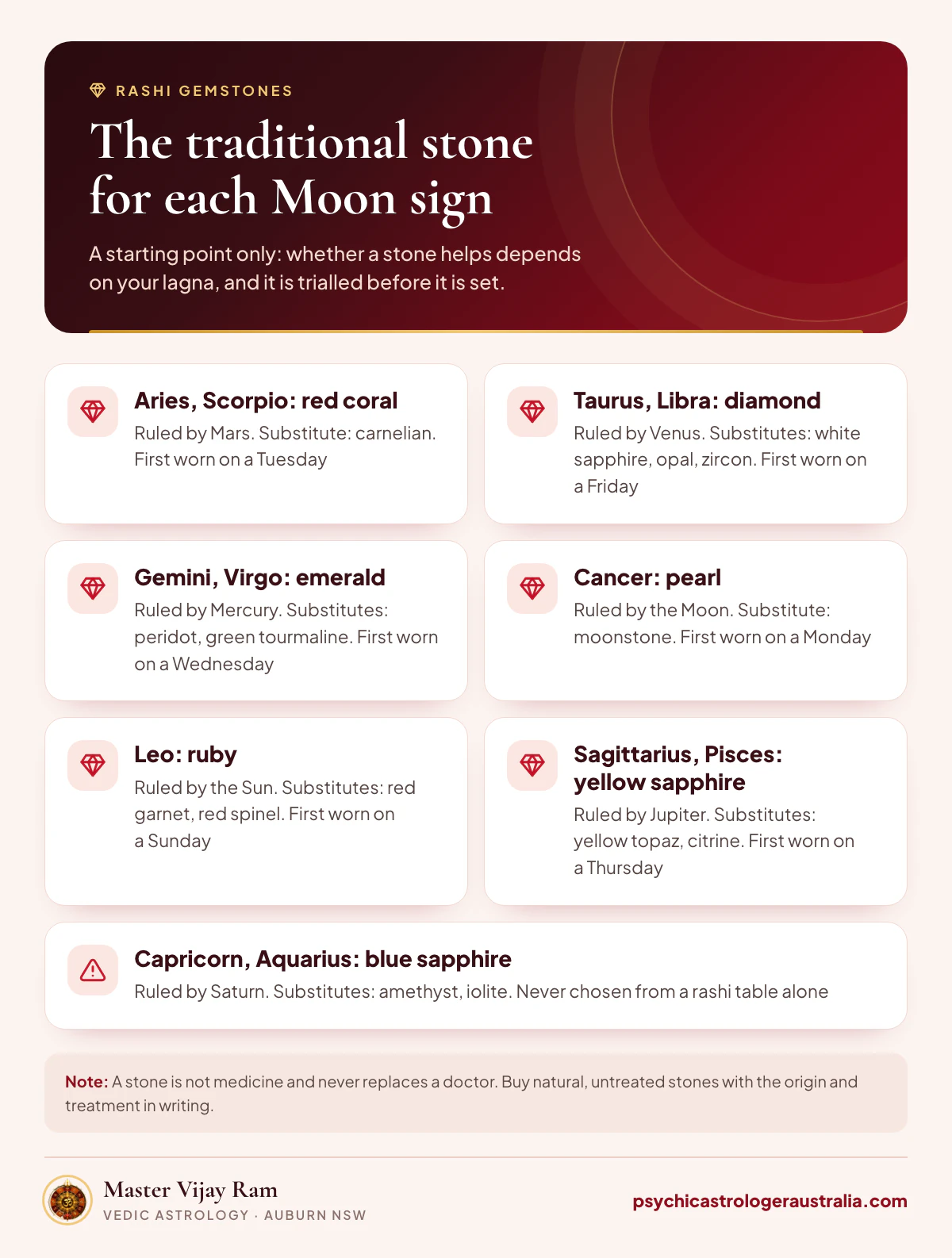
A rashi ratna is the gemstone of the planet that rules your Moon sign: coral for Aries and Scorpio, diamond for Taurus and Libra, emerald for Gemini and Virgo, pearl for Cancer, ruby for Leo, yellow sapphire for Sagittarius and Pisces, blue sapphire for Capricorn and Aquarius. It is a starting point; the stone that actually helps is chosen from the whole chart.
What is a rashi ratna?
A rashi ratna is the gemstone of the planet that rules your rashi, your Moon sign in the Vedic chart, and the gemstone for rashi tables that circulate online are lists of those twelve rulers and their stones. The idea behind them is sound: in the tradition a gemstone strengthens the planet it belongs to, and the lord of the Moon sign is a planet most people want strong. The problem is that the table stops where the real reading begins, because a planet that is good for one person's chart is harmful for another's.
This page gives the rashi table, the navaratna table of all nine planets and their stones, and then the part that matters: how a stone is actually chosen, trialled, bought and worn, and what it cannot do. A gemstone and numerology consultation does the choosing from your own chart; a kundli reading is where the chart comes from.
Rashi, sun sign and lagna: three different signs
Three things get called 'your sign', and only one of them is the rashi. The Western sun sign is the sign the Sun occupied, in the tropical zodiac, on your birthday; the Vedic rashi is the sign the Moon occupied, in the sidereal zodiac, at the hour you were born; the lagna is the sign rising on the eastern horizon at that hour. A person can be a Leo by sun sign, a Cancer by rashi and a Scorpio by lagna, and the gemstone advice differs for each.
Most online tables quietly use the sun sign while calling it the rashi, which is how so many people end up wearing the wrong stone. How to find your Moon sign explains the difference and why the birth time settles it.
The gemstone for each rashi
The table below is the traditional lucky stone by rashi: the stone of each sign's ruling planet, with the common substitute, the upratna, that the tradition accepts where the primary stone is unsuitable or out of reach.
| Rashi (Moon sign) | Ruling planet | Primary stone | Substitute |
|---|---|---|---|
| Mesha (Aries) | Mars | Red coral (moonga) | Carnelian |
| Vrishabha (Taurus) | Venus | Diamond (heera) | White sapphire, opal, zircon |
| Mithuna (Gemini) | Mercury | Emerald (panna) | Peridot, green tourmaline |
| Karka (Cancer) | Moon | Pearl (moti) | Moonstone |
| Simha (Leo) | Sun | Ruby (manik) | Red garnet, red spinel |
| Kanya (Virgo) | Mercury | Emerald (panna) | Peridot, green tourmaline |
| Tula (Libra) | Venus | Diamond (heera) | White sapphire, opal, zircon |
| Vrishchika (Scorpio) | Mars | Red coral (moonga) | Carnelian |
| Dhanu (Sagittarius) | Jupiter | Yellow sapphire (pukhraj) | Yellow topaz, citrine |
| Makara (Capricorn) | Saturn | Blue sapphire (neelam) | Amethyst, iolite |
| Kumbha (Aquarius) | Saturn | Blue sapphire (neelam) | Amethyst, iolite |
| Meena (Pisces) | Jupiter | Yellow sapphire (pukhraj) | Yellow topaz, citrine |
Read the table as a reference, not a prescription. A Capricorn Moon with a Leo lagna, for whom Saturn owns the sixth and seventh houses, should not be sent off to buy a blue sapphire by a table.
Why the rashi stone is only the starting point
A gemstone strengthens a planet; it does not make a harmful planet kind. Whether a planet is helpful or harmful is decided by the houses it owns for your lagna, and that is where the tradition's serious practitioners look first. The lords of the lagna, the fifth and the ninth are the planets you want strong; the lords of the sixth, eighth and twelfth are the ones you do not, however pleasant their stone. The Moon sign's ruler happens to be one or the other depending on your lagna, which is why the rashi stone helps some people and harms others.
The second question is whether the planet needs help at all. A strong, well-placed benefic needs no stone; a weak benefic, debilitated, combust or in a difficult house, is the one a stone is for. Gemstone remedies by birth chart walks through the full method, lagna by lagna.
The nine planets and their stones
The navaratna, the nine gems, map one stone to each planet. The table gives the traditional day, finger and metal for wearing each, which vary a little between lineages; the pattern below is the common northern Indian one he follows.
| Planet | Gemstone | Day first worn | Finger | Metal |
|---|---|---|---|---|
| Sun | Ruby | Sunday | Ring finger | Gold or copper |
| Moon | Pearl | Monday | Little finger | Silver |
| Mars | Red coral | Tuesday | Ring finger | Gold or copper |
| Mercury | Emerald | Wednesday | Little finger | Gold |
| Jupiter | Yellow sapphire | Thursday | Index finger | Gold |
| Venus | Diamond | Friday | Middle or ring finger | Silver, platinum or white gold |
| Saturn | Blue sapphire | Saturday | Middle finger | Silver or panchdhatu |
| Rahu | Hessonite (gomed) | Saturday | Middle finger | Silver |
| Ketu | Cat's eye (lehsunia) | Tuesday or Thursday | Little or ring finger | Silver or gold |
The three stones at the bottom, blue sapphire, hessonite and cat's eye, belong to the planets the tradition treats most carefully, and they are never chosen from a rashi table. Gemstones to avoid explains why.
How a stone is chosen in a reading
When someone asks which gemstone to wear, the reading works through four questions in order. Which planets are benefic for the lagna. Which of those is weak, by sign, house, combustion or aspect. Which dasha is running, because a stone for the lord of a helpful period does more than a stone for a planet whose period is thirty years away. And which single stone answers the actual problem, health, work, marriage, study, rather than a vague wish for luck. Many readings end with no stone at all, because the planet that needs help is one that should not be strengthened, and a mantra or a puja is the right remedy instead.
The trial period
The tradition does not ask anyone to buy a stone blind. A gemstone is trialled first, kept close for several days, often three or seven depending on the lineage, and the person notes sleep, mood, temper, appetite and what happens around them. A stone that sits badly makes itself known quickly, and it is removed without drama. A stone that sits well is then set and worn properly on its day. Nothing here is a measurement, and coincidence plays its part; the trial is a precaution, not a proof.
Weight, cut, metal and day: what matters and what is marketing
The tradition cares that a stone is natural, untreated, free of visible cracks and large enough to touch the skin through an open-backed setting; the weights quoted in rattis online are guidelines that sellers inflate. It cares about the metal and the day of first wearing more than about the brand of the jeweller. It does not care about certificates of 'astrological energising' sold with the stone, and it does not require a stone to cost a fortune: a clean smaller stone is better than a large flawed one. Master Vijay Ram does not sell stones, does not name a seller and takes no commission, so the only thing he has to gain from a recommendation is a client whose chart is better served.
Buying a gemstone in Australia
Buy from a jeweller who will put the stone's origin and any treatment in writing, ask for an independent laboratory certificate for anything expensive, and know that lab-created and glass-filled stones exist for every one of the nine. A receipt that describes the stone is your consumer protection; Consumer Affairs Victoria and the state fair-trading offices explain refund rights when goods are not as described. The online market for 'astrological' gems has the same red flags as every other astrology scam, pressure, secrecy, a story about a curse, and astrology scams in Australia lists them.
Moon sign by date of birth: why the app can be wrong
A gemstone by date of birth service works from the Moon sign, and the Moon changes sign every two and a quarter days, so anyone born within a few hours of a change can be given the wrong rashi by an app that uses noon or Indian time. Australians born in the east are four and a half hours ahead of India, five and a half in daylight saving, which is enough to move the Moon across a boundary. The birth time and place settle it, and a gemstone by moon sign that was calculated from the wrong Moon is a stone for the wrong planet.
Common mistakes
Wearing the sun-sign stone from a Western magazine. Wearing three or four stones at once because each table recommended one. Buying a blue sapphire in a panic about Sade Sati, which is the stone most often worn wrongly; Sade Sati in 2027 explains what actually helps. Wearing a stone for a planet whose dasha ended years ago. Keeping a stone that plainly sits badly because it was expensive. And treating a stone as medicine, which it is not.
What a gemstone cannot do
It cannot cure an illness, replace a doctor or a medication, bring a person back, or change a dasha. It cannot make a harmful planet helpful; it can only make a planet stronger, which is why the choice matters. It is a faith-based remedy, not medical, legal or financial advice, and a wrong stone is a real risk in the tradition rather than a harmless accessory. Where a chart shows a planet that should not be strengthened, the remedies are a mantra, a discipline or a graha shanti puja, performed personally.
How Master Vijay Ram advises on a stone
He needs your date, time and place of birth and the problem you want the stone for. He draws the chart, lists the benefic planets for your lagna, checks which is weak and which dasha is running, and tells you whether a stone is warranted, which one, what size and setting are enough, and how to trial it. The consultation is $50, by phone, video or WhatsApp anywhere in Australia, in English, Hindi or Punjabi, or in person at Auburn by appointment; Perth clients book an early-evening call, which is late afternoon in the west. Where the chart calls for a puja rather than a stone, online puja and havan explains what is performed and that it starts from $250, agreed before it is done.
Trialling a rashi stone in south-west Sydney: shifts, exams and visitors
The trial period only works if the week it covers is ordinary, and in south-west Sydney an ordinary week can be hard to find. In Liverpool, Campbelltown and Bankstown the people who ask about a rashi stone may be working rotating shifts at a hospital or a warehouse, sitting exams, or expecting parents from Punjab for a long stay, and each of those changes sleep, mood and temper on its own.
So the stone is trialled in the calmest week available, not the week of a roster change or the week the visitors land, and the notes are kept short: how you slept, how quickly your temper rose, what happened at work and at home. A stone that seems to unsettle a night-shift week has told you more about the roster than about the stone.
The first wearing follows the navaratna table's day, in the morning, and it is your morning in Sydney that counts, not the hour a relative in India names on the phone. He has no stones to sell and no commission to earn, and because feeding the wrong planet can make a hard period harder, he will sometimes say that the table's stone for your rashi is not the stone for your chart at all.
Auburn is close to Bankstown and Liverpool, so an astrologer for south-west Sydney can be seen in person by appointment, or reached on WhatsApp, a video call or the phone. A gemstone check against your chart weighs the stone against your lagna and running dasha before the trial begins, and a graha shanti puja when no stone suits is the alternative for a planet that should be calmed rather than fed.
Read next
- Gemstone Remedies by Birth Chart: Which Stone Actually Helps YouGemstone remedy by birth chart: how the lagna, its benefics, the dasha and a weak planet decide which stone helps, wi…
- Pearl (Moti): The Moon’s Stone, Its Calm and Its CautionsPearl (moti) in Vedic astrology: why it is the Moon’s stone, which lagnas suit it, who should avoid it, natural or cu…
- Kundli Reading Explained: What Your Birth Chart RevealsWhat a Kundli reading reveals about your life, personality, career and destiny. Master Vijay Ram explains Vedic astro…
Frequently asked questions
Which gemstone should I wear according to my rashi?
The traditional rashi ratna is the stone of your Moon sign's ruling planet: red coral for Aries and Scorpio, diamond for Taurus and Libra, emerald for Gemini and Virgo, pearl for Cancer, ruby for Leo, yellow sapphire for Sagittarius and Pisces, and blue sapphire for Capricorn and Aquarius. Treat it as a reference, because the stone that actually helps is chosen from the lagna, the planet's strength and the running dasha, and the two often differ.
Is a gemstone chosen by Moon sign or by lagna?
By the whole chart, with the lagna carrying most weight. The Moon sign's ruler is a planet most people want strong, but whether it is helpful or harmful depends on the houses it owns for your lagna; the lords of the lagna, fifth and ninth are strengthened, the lords of the sixth, eighth and twelfth are not. A Capricorn Moon with a Leo lagna, for whom Saturn owns the sixth and seventh, should not wear blue sapphire on the strength of the rashi table.
Can I find my gemstone by date of birth alone?
Not reliably. The Moon changes sign every two and a quarter days, so anyone born within hours of a change can be given the wrong rashi by an app that assumes noon or Indian time; Australians born in the east are four and a half hours ahead of India, five and a half in daylight saving, which is enough to cross a boundary. The lagna, which settles whether the planet is helpful, changes every two hours or so. Date, time and place of birth are all needed.
How long is a gemstone trialled before wearing it?
Usually three to seven days depending on the lineage. The stone is kept close, often tied in cloth or worn loosely, and the person notes sleep, mood, temper, appetite and events around them. A stone that sits badly tends to make itself known within that time and is removed without drama; one that sits well is set in the right metal and first worn on its planet's day. The trial is a precaution rather than a proof, and coincidence plays its part.
What size gemstone do I need?
Large enough to touch the skin through an open-backed setting and clean enough to be free of visible cracks and inclusions; beyond that, the carat and ratti weights quoted online are guidelines sellers inflate. A smaller clean natural stone is preferred over a large flawed one. Natural and untreated matters more than size, and a written description of origin and treatment matters more than either. Master Vijay Ram does not sell stones or recommend a seller.
Which finger and which day for each gemstone?
In the common northern tradition: ruby on the ring finger on a Sunday in gold; pearl on the little finger on a Monday in silver; coral on the ring finger on a Tuesday; emerald on the little finger on a Wednesday; yellow sapphire on the index finger on a Thursday in gold; diamond on the middle or ring finger on a Friday in silver or white metal; blue sapphire and hessonite on the middle finger on a Saturday in silver; cat's eye usually on a Tuesday or Thursday. Lineages vary a little.
Can I wear more than one gemstone?
Sometimes two, rarely three, and never a pair whose planets are enemies, such as ruby with blue sapphire or emerald with coral. The usual reason for a second stone is a second benefic planet that is weak and whose dasha is running. Wearing a stone from each table you have read is the commonest mistake he corrects, and the first step in those readings is taking stones off rather than adding one.
Are substitute stones like white sapphire or citrine as good as the primary stone?
The tradition accepts the upratna, the substitute, as a gentler version of the same planet: white sapphire, opal or zircon for diamond, citrine or yellow topaz for yellow sapphire, moonstone for pearl, amethyst or iolite for blue sapphire. A substitute is often the better first choice because it is milder, cheaper and easier to trial, and for a planet that only needs a little support it is all that is required.
Can a gemstone cure illness or replace medication?
No. A gemstone is a faith-based remedy that, in the tradition, strengthens a planet; it does not treat a disease, and nothing on this page is medical advice. Any symptom belongs to a GP first, any medication stays as prescribed, and a stone that is worn should be worn alongside treatment, never instead of it. A seller or practitioner who says otherwise is the clearest warning sign in this field.
People also ask
What is a rashi ratna?
The gemstone of the planet that rules your rashi, the Moon sign of the Vedic chart. Coral belongs to Mars and so to Aries and Scorpio, diamond to Venus and so to Taurus and Libra, emerald to Mercury, pearl to the Moon, ruby to the Sun, yellow sapphire to Jupiter and blue sapphire to Saturn. It is a traditional reference, and a reading checks it against the lagna before anything is worn.
Which is the luckiest gemstone?
There is no luckiest stone, only the stone of the planet that is most helpful and most in need of strength in a particular chart. Yellow sapphire is the most widely worn because Jupiter is benefic for many lagnas, and blue sapphire is the most feared because Saturn is harmful for many. A stone that is lucky for a Libra lagna can be the wrong stone for a Leo one.
Can I wear a gemstone without consulting an astrologer?
You can, and many people wear the mild substitutes with no trouble, but the primary stones strengthen planets, and strengthening the wrong planet is a real risk in the tradition. Blue sapphire, hessonite and cat's eye in particular are never worn on the strength of a table. A $50 consultation with the chart in front of him is the modest step between a guess and a choice.
Which gemstone is good for money and career?
The stone of the lord of your tenth, eleventh or second house, provided that planet is also a benefic for your lagna and weak enough to need help; it differs for every lagna. Blue sapphire serves a Taurus or Libra lagna in work, yellow sapphire a Sagittarius or Pisces one, emerald a Gemini or Virgo one. No stone replaces the work itself, and none is financial advice.
Where should I buy an astrological gemstone in Australia?
From a jeweller who will put the origin and any treatment in writing and provide an independent laboratory certificate for anything expensive. Lab-created and glass-filled stones exist for all nine gems. A receipt that describes the stone is your consumer protection under Australian law. Master Vijay Ram does not sell stones, name a seller or take a commission.
References & further reading
Serving clients across Australia
Confidential consultations by phone, video & WhatsApp — including: