
Quick answer
Swapna Shastra is the Hindu lore of dream meanings: a snake may point families towards Nag devta or Kaal Sarp dosh, clear water to calm, and a dead relative asking for water to tarpan. Traditions differ, dreams mostly replay memory and stress, and dawn dreams coming true is folk belief. Keep a dream journal, light a lamp, and see a GP for frequent nightmares.
What is Swapna Shastra?
Swapna Shastra is the traditional Hindu lore of dream meanings, a body of interpretation that most families learned from a grandmother or a panchang almanac rather than from a book. It sorts dreams into auspicious and troubling ones, says which part of the night they came in, and suggests what to do about each. Regions and families read the same dream differently, and the lore has always lived with that.
People ring Master Vijay Ram about three dreams more than any others: snakes, water and relatives who have died. This page goes through what the tradition says about each, what a plainer explanation would say, and how to respond calmly. Where a dream points families towards the ancestors or the nodes, his work on Kaal Sarp and Pitra dosh is where the chart is checked.
What do dreams usually reflect?
Mostly the day and the week. Dreams replay memory, worry and whatever the mind has been chewing on: the argument at work, the film watched late, the bill due on Friday, the relative in hospital in Amritsar. A late heavy meal, alcohol, a fever, a new medicine and broken sleep all make dreams more vivid and more easily remembered.
That does not make the tradition foolish. It means a dream is first a mirror of the dreamer, and the folk meaning, where a family keeps one, is a second layer on top. Starting with the first layer saves a great deal of fear.
What does a snake in a dream mean?
A snake in a dream carries more meanings in Indian households than any other image. Many families link it with Nag devta, the serpent deities honoured at village shrines and on Nag Panchami; others read a coiled or following snake as a sign to have the chart checked for Kaal Sarp dosh or for Rahu and Ketu. A snake shedding its skin is often read as renewal.
On a snake bite the lore splits sharply: some families say it foretells money or recovery, others danger. A family that keeps the custom may offer milk at a temple on Nag Panchami, which falls on Friday 6 August 2027 across Australia, and leave it there. A plainer reading notices that a snake seen on a bushwalk, in a garden or on the news is exactly the kind of image dreams borrow.
What do dreams of water mean?
Dreams of water are read by their colour and movement. Clear water, gentle rain or a calm river is traditionally auspicious, a sign of ease and of money arriving; muddy water, a flood or being swept away is read as trouble, illness or a hard stretch ahead. Bathing in the Ganga, or seeing it, is counted among the most blessed dreams of all.
Crossing a river is often read as getting past an obstacle, and drowning as being overwhelmed. That last reading and the plain one meet: people dream of drowning in weeks when work, money or family has risen over their heads, and the useful response is to look at the week rather than the omen.
What does it mean when dead relatives appear in dreams?
The tradition reads dead relatives in dreams by their manner. An elder who appears calm, smiling or giving a blessing is taken as ashirvad, a reassurance from the departed. An elder who asks for food or water, looks unhappy, or stands silently at the door is read in many families as a reminder of shraddha and tarpan, the offerings owed to the ancestors.
A plainer reading sees grief. A parent who died in India while you were here, a funeral watched on a phone screen, an anniversary approaching, an apology never made: dreams carry all of it. Both readings point to the same gentle response, which is to remember the person properly, and the signs of Pitra dosh sets out the chart placements a reading looks for when such dreams keep returning.
What about teeth falling out, temples and other common dreams?
Teeth falling out is read in many families as illness or loss in the family, and in some as money slipping away; it turns up in the dream books of many cultures, usually during stressful months. If your teeth or jaw actually hurt, see a dentist, because a clenched jaw at night produces exactly this dream. Temples, a deity, a lit lamp, a cow, flowers and fruit are counted as auspicious.
Some dreams are read upside down. Seeing your own death is said in several traditions to mean a long life, and weeping in a dream to mean joy ahead; traditions differ, and the variety itself is a reason not to treat any single meaning as a verdict.
Which dreams mean what, and how should you respond?
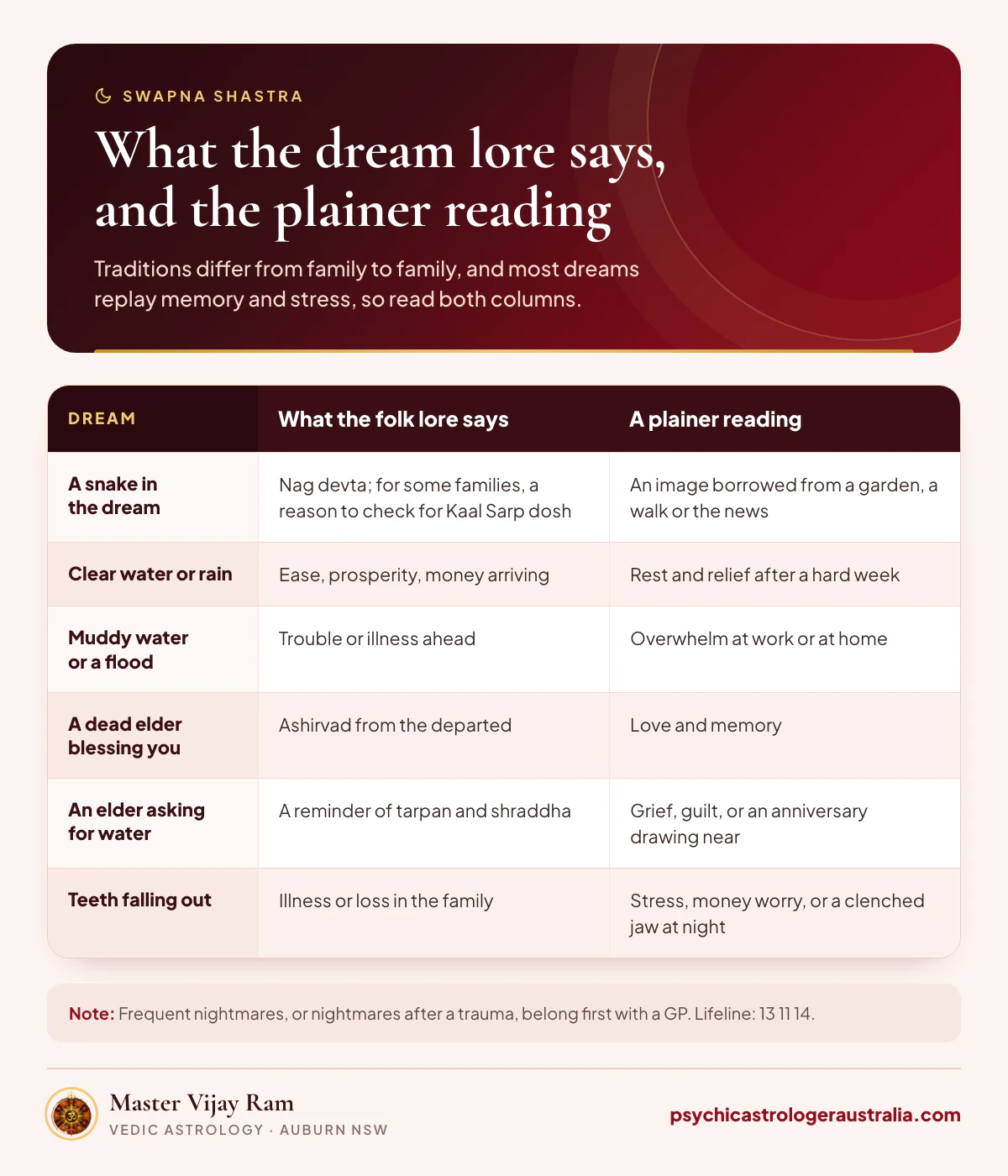
The table sets out the dreams families mention most. The second column is the folk reading, the third the plainer one, and the fourth a response that suits either.
| Dream | What the folk tradition says | The plainer reading | A calm response |
|---|---|---|---|
| A snake, coiled or following | Nag devta; in some families, a reason to check for Kaal Sarp dosh | An image borrowed from a garden, a walk or the news; a worry | Note it in the journal; milk at a temple on Nag Panchami if your family keeps it |
| A snake bite | Good fortune in some families, danger in others | Fear of being hurt or let down | No action needed beyond the journal |
| Clear water or gentle rain | Ease, prosperity, money arriving | Rest, relief after a hard week | Gratitude at the morning prayer |
| Muddy water or a flood | Trouble or illness ahead | Overwhelm at work or at home | Look at sleep, workload and worry |
| A dead elder smiling or blessing | Ashirvad from the departed | Love and memory | A lamp lit in their name |
| A dead relative asking for food or water | A reminder of shraddha or tarpan | Grief, guilt, an anniversary near | Tarpan by your panchang; a meal given in their name |
| Teeth falling out | Illness or loss in the family | Stress, money worry, a clenched jaw | A dentist if the jaw aches; otherwise rest |
Do dreams at dawn come true?
That is folk belief, and a widespread one. Many families say a dream in the last part of the night, around brahma muhurta before sunrise, is fulfilled sooner, while dreams early in the night fade; some almanacs give a timescale for each watch of the night. There is a plainer reason dawn dreams feel prophetic: they are the ones we wake from, so they are the ones we remember.
Related customs vary. Some families will not tell a bad dream before sunrise, or tell it to flowing water or a tulsi plant to let it go, and keep a good dream to themselves until it comes true. None of these is harmful, and none needs to frighten anyone.
Can bad dreams be a sign of black magic?
Families sometimes fear so, especially when a dream follows a quarrel or a visitor. Bad dreams on their own are not evidence of anything done to you; they are far more often stress, grief, illness or a film. Where frightening dreams come with waking up unable to move or a weight on the chest, recurring nightmares and sleep paralysis explains the medical side and the spiritual view of that particular experience.
Other household omens raise the same question, from a dog barking at nothing at night to things that break. The answer is the same each time: the ordinary explanation first, and a reading only for a pattern that holds.
How do you keep a dream journal, and why?
Keep a notebook by the bed, not the phone. On waking, write the date, the main image, the feeling it left, and one line about the day before; then, a week later, add a line about what actually happened. After a month you have something no dream book can give you: your own record of how often the omens came true.
Most people find the snakes and floods track their busiest, most anxious weeks rather than any later event, which is reassuring in itself. Where one dream keeps returning around a particular person or anniversary, the journal also shows the reading exactly what to look at.
What is the pitru link, and when is tarpan offered?
In the tradition the ancestors, the pitrs, are remembered with water and food: tarpan, water mixed with black sesame and poured out for them, and shraddha, the meal and rites on the tithi of a death. Pitru Paksha, the fortnight of the ancestors in the dark half of Bhadrapada, is the traditional season, and your temple panchang gives its days each year; many families also offer tarpan on amavasya.
A family dreaming repeatedly of an unhappy elder can begin at home, with a lamp in the person’s name, a meal given to someone in need on their behalf, and a phone call to whoever in the family keeps the dates. Where the dreams are part of a longer family pattern, repairing a family pattern with the ancestors sets out what fuller rites involve.
When should you see a GP about bad dreams?
When nightmares come most weeks, wake you in fear, or make you dread going to bed; when they follow an accident, an assault, a death you witnessed or any other trauma; or when a new medicine seems to have started them. Repeated nightmares after a frightening event can be part of post-traumatic stress, which is treatable, and healthdirect’s page on it is a sound place to start.
A GP can also look at sleep, alcohol, mood and medication together. If dreams leave you hopeless or thinking of harming yourself, call Lifeline on 13 11 14, or 000 in an emergency, before anything else.
What can you do before sleep tonight?
Wash your face, hands and feet before bed, as many households do, and light a small lamp at the evening prayer, never left burning once you are asleep. Say a short prayer or your family deity’s name, and leave the news and the phone out of the last hour. If you wake from a bad dream, sit up, drink some water, say the prayer again, and write the dream down rather than replaying it.
For dreams of a departed relative, remember them by name at the evening prayer. The point is relationship, not fear.
When does a reading help, and what does it cost?
A reading helps when a dream returns again and again around a person, an anniversary or a family story, and the ordinary causes have been looked at. Master Vijay Ram checks the chart in a full kundli reading, especially the Moon, the ninth house and the dasha running, and says plainly when the chart shows grief and stress rather than any dosha. A consultation is $50, in English, Hindi or Punjabi.
Where Kaal Sarp or Pitra shanti, a tarpan or a shraddha is warranted, the work begins at $250, and the price is fixed with you before he starts; he performs it personally at his Auburn altar with the family present by video if they wish. How a shraddha or puja is performed explains the day itself.
Grief at a distance: Brisbane, Perth, Adelaide and Hobart
Many of the dreams people describe begin with a phone call at an odd hour: a grandparent gone in Ludhiana or Chennai, a funeral watched on a screen in Perth at three in the morning, rites in India that fall while you are asleep in Adelaide. The dreams that follow are grief finding its way, and joining the family’s shraddha by video, even at an awkward hour, gives many families somewhere to put it.
The Brisbane and Gold Coast consultations work the same way as those for Canberra and Hobart, by phone or video; a face-to-face reading means a visit to Auburn by appointment.
What dream lore cannot tell you
No dream book, and no astrologer, can tell you that a dream will come true, that a snake means a dosha, or that a dead relative is angry with you. Dream lore is tradition and faith, not medical or psychological advice, and nothing in a reading can be guaranteed. Frequent nightmares belong first with a GP.
What the tradition offers is gentler and still worth having: a way to honour the people you have lost, a lamp and a prayer at the end of the day, and permission to wake from a bad dream and let it go.
Read next
- Kalava, Mauli and Black Thread: What Protection Threads MeanKalava, mauli and black thread explained: the raksha mantra, which wrist, when to change and retire a thread, nazar t…
- Broken Mirrors, Cracked Glass and Things That Keep Breaking at HomeA broken mirror or a run of breakages at home: the physical causes first, what Hindu folk belief and vastu say, safe …
- Ruqyah Healing in Australia: Sessions, Cost & What HappensWhat a ruqyah session in Australia really involves, how an honest fee is built up, what should never be charged for, …
Frequently asked questions
What does it mean to see a snake in a dream in Hinduism?
Readings vary by family and region. Many link a snake with Nag devta, the serpent deities honoured on Nag Panchami; others read a coiled or following snake as a reason to have the chart checked for Kaal Sarp dosh or for Rahu and Ketu. A shedding snake is often read as renewal. Plainly, snakes seen on walks, in gardens or on the news are images dreams borrow, so one snake dream proves nothing.
What does it mean when a dead relative appears in a dream?
The tradition reads the manner of the visit. A calm or smiling elder giving a blessing is taken as ashirvad; one asking for food or water, or looking unhappy, is read as a reminder of tarpan and shraddha. Grief explains many of these dreams, especially near an anniversary or after a death overseas. Lighting a lamp in their name and keeping the family’s rites is the gentle response either way.
Do dreams seen at dawn come true?
That is a widespread folk belief: dreams in the last part of the night, around brahma muhurta, are said to come true sooner than those early in the night. A plainer explanation is that dawn dreams are the ones we wake from and remember. Keeping a dream journal for a month, with a note a week later about what actually happened, is an honest way to see how often they do.
Is it bad to dream of muddy water or a flood?
In the folk reading, muddy water or a flood points to trouble or illness ahead, while clear water and gentle rain are auspicious. In practice these dreams cluster in weeks when work, money or family has become overwhelming, which is what the image describes. Look at sleep, workload and worry first. One flood dream is not a forecast, and traditions differ on what it signifies.
What does dreaming of teeth falling out mean?
Many Indian families read it as illness or loss in the family, and some as money slipping away; the image appears in the dream books of many cultures, usually during stressful months. If your teeth or jaw ache, see a dentist, since grinding or clenching at night can bring on exactly this dream. Otherwise treat it as a sign of strain and rest, not as a prediction.
Can bad dreams be caused by black magic?
A bad dream, however vivid, does not show that anyone has worked against you. They are far more often stress, grief, illness, alcohol, a new medicine or a frightening film. If nightmares come with being unable to move on waking, that is usually sleep paralysis, which a GP can help with. A reading only becomes useful when a pattern holds after the ordinary causes are dealt with, and nobody is ever named.
Should I do tarpan if I keep dreaming about my late father?
Many families would, and it is a gentle response. Tarpan is water with black sesame offered to the ancestors, traditionally during Pitru Paksha by your temple panchang and often on amavasya. You can also light a lamp in his name and give a meal to someone in need on his behalf. If the dreams are distressing or come with low mood, speak to a GP or a grief counsellor as well.
When should I see a doctor about bad dreams?
When nightmares come most weeks, wake you in fear or make you dread bedtime; when they began after an accident, assault or other trauma; or when a new medicine seems to have started them. Repeated nightmares after a frightening event can be part of post-traumatic stress, which is treatable. If dreams leave you hopeless or thinking of self-harm, call Lifeline on 13 11 14, or 000 in an emergency.
Should you tell anyone about a bad dream?
Customs differ. Some families will not tell a bad dream before sunrise, or tell it to flowing water or a tulsi plant to let it go, and keep a good dream private until it comes true. None of this is harmful. If a dream is troubling you, though, telling someone you trust, and writing it in a journal, usually takes much of its weight away.
People also ask
What is Swapna Shastra?
Swapna Shastra is the traditional Hindu lore of dream interpretation, passed down in families and panchang almanacs. It sorts dreams into auspicious and troubling ones, gives weight to the time of night a dream came, and suggests responses such as prayer, charity or offerings to the ancestors. Regions and families read the same dream differently, so it is tradition and faith rather than a fixed code.
Which dreams are considered auspicious in Hinduism?
Dreams of temples, deities, a lit lamp, a cow, flowers, fruit, clear water, gentle rain or bathing in the Ganga are traditionally counted as auspicious, as is an elder giving a blessing. Some traditions also read a few dreams upside down, saying that seeing your own death means a long life. Traditions differ, and an auspicious dream is a comfort rather than a promise.
Are dreams messages from ancestors?
Many families believe the departed can appear in dreams, and the tradition reads an elder asking for food or water as a reminder of tarpan and shraddha. Grief, anniversaries and unfinished conversations also bring the dead into our dreams. Honouring them with a lamp, a meal given in their name and the family’s rites suits both readings, and a reading checks the chart only if the dreams form a pattern.
Does seeing a snake in a dream mean Kaal Sarp dosh?
Not by itself. Some families take repeated snake dreams as a reason to have the chart checked, but Kaal Sarp dosh is a placement of Rahu and Ketu in the birth chart, not something a dream can diagnose, and many flagged charts carry cancellations. A reading of the actual chart answers the question; a dream can only prompt it.
What should you do after a bad dream in Hinduism?
Many families sit up, drink water, say a short prayer or the family deity’s name, and some wash their face or tell the dream to flowing water to let it go. Writing it down rather than replaying it helps. In the morning, a lamp at the prayer and an ordinary day usually settle it. Frequent or traumatic nightmares belong with a GP.
References & further reading
Serving clients across Australia
Confidential consultations by phone, video & WhatsApp — including: