
Quick answer
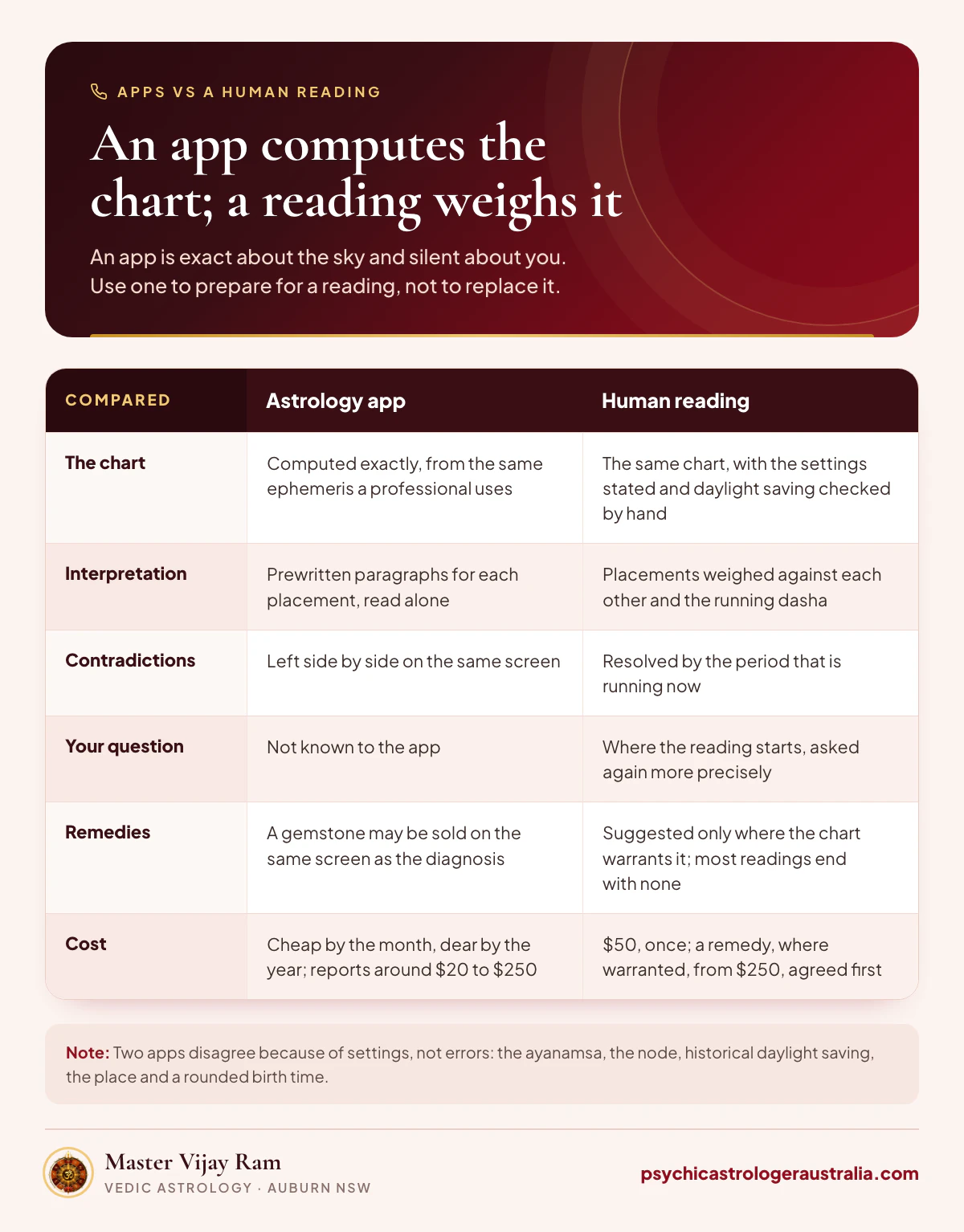
An astrology app computes the chart exactly and then assembles prewritten paragraphs for each placement; a human reading weighs those placements against your question and the running period, which the app cannot do. Apps disagree with each other because of settings such as ayanamsa and daylight saving, not errors. Use an app to prepare; a consultation with Master Vijay Ram is $50.
Why do an app and an astrologer give different answers?
An astrology app is software that computes a chart from birth data and then assembles prewritten paragraphs for each placement it finds; a human reading is a judgement about which of those placements matter for your question, how they weigh against each other, and when their effects are due. The two can look alike on the surface, because both begin with the same chart. They part company the moment interpretation starts, and the parting is the subject of this article.
The honest version of astrology app vs astrologer is not that one is right and one is wrong. The app is exact about the sky and silent about you; the astrologer is fallible about both but is the only one of the two who is actually reading your chart. A full kundli reading is what the second looks like in practice.
What an app gets exactly right
The computation. Planetary positions, the lagna, the nakshatra of the Moon, the dasha table and the panchang for any day come from the same ephemeris that a professional’s software uses, and a free kundli app will produce the same chart that Master Vijay Ram casts, provided the settings match. For learning the vocabulary, checking a tithi, or finding out which dasha you are in, an app is a fine tool and he recommends that callers use one before a reading.
Where apps disagree with each other
Enter the same birth into two apps and you will sometimes get two charts. The differences are settings, not errors, and five of them account for almost every disagreement a caller has ever brought to him.
| Setting | What it changes | How an astrologer handles it |
|---|---|---|
| Ayanamsa (Lahiri, Raman, KP and others) | Around a degree in every position; the Moon or lagna near a boundary moves a sign | States which value is used; recasts from the birth details |
| Mean or true lunar node | Rahu and Ketu by up to a couple of degrees | Uses one consistently and says so |
| Historical daylight saving | An hour, which can move the lagna a whole sign | Checks the rule in force on the birth date and place |
| Birth place coordinates and time zone | Minutes of lagna; a sign if the zone is wrong | Uses the actual town, not the nearest capital |
| Birth time rounded to the hour | Up to half a sign of lagna; the navamsa entirely | Reads with wider caveats; never pretends the time is exact |
The daylight-saving row catches more Australian-born charts than any other. Queensland ran daylight saving only in 1971–72 and from 1989 to 1992, Western Australia only in trials, the last from 2006 to 2009, and an app that applies today’s rule to a 1990 Brisbane birth or a 2008 Perth one puts the lagna out by an hour. He uses the Lahiri ayanamsa and the mean node, which are the settings behind the computed facts on this site, and checks the daylight-saving rule by hand.
What the templated paragraphs cannot do
An app reads each placement alone. Venus in the seventh house produces a paragraph about a happy marriage; Saturn aspecting the seventh produces a paragraph about delay; the two sit on the same screen, contradict each other, and nobody resolves them. The app does not know that the Venus dasha ended in 2019 and the Saturn dasha has just begun, which is the one fact that decides which paragraph applies now, and it does not know that you asked about a second marriage, not a first.
That is not a flaw to be fixed in a later version. Synthesis, weighting and the question are the reading, and an app has none of the three.
What a human reading does differently
It starts with the question, and asks it again more precisely. It weighs the placements against each other and against the running period, so that the one that matters now is the one that is discussed. It uses the divisional charts where they apply, the navamsa for marriage above all, which most apps display and few interpret. It reads the dasha and the transits together, which is how timing is actually done; how the dasha system works shows why the two cannot be separated. And it listens, which lets a reading be corrected by the one person who knows the life it describes.
It is also fallible, and an honest astrologer says so. How Master Vijay Ram works sets out his method and his limits in his own frame.
AI astrology chatbots: fluent, confident and sometimes invented
The newest apps add a conversational layer: you type a question and receive a paragraph that reads like an astrologer wrote it. The fluency is real; the chart underneath sometimes is not. These systems can misstate a planet’s sign, invent a dasha, or describe a yoga that is not in the chart, and they do it in the same assured voice they use when they are right. They also have no memory of the reading they gave last month and no accountability for it. Ask one which ayanamsa it used and watch what happens; AI astrology vs a Vedic astrologer is settled at that question more often than at any other.
Kundli app accuracy: a test you can run
Put the same birth details into two apps and compare the Moon sign, the lagna and the current mahadasha. If all three agree, the settings match and the computation is almost certainly right. If they differ, note which app uses Lahiri and which uses something else, and whether either has applied daylight saving. Then the article on the lagna explains why the rising sign is the one most worth getting right. A caller who arrives with this test done saves ten minutes of the reading.
A worked example: the same birth, two apps, one reading
A caller born in Brisbane in the summer of 1991 arrived with two charts. One app had given her a Cancer lagna and a Moon at the last degree of Scorpio; the other, a Leo lagna and the Moon in Sagittarius. Both apps had the birth time right. The first had applied Queensland’s daylight saving, which was in force that summer; the second had not, which put the moment an hour later and moved the lagna forward a sign. The Moon had moved for a different reason: the second app used a Raman ayanamsa, and the Moon sat close enough to the boundary for one degree to matter.
The reading took five minutes to settle which chart was hers and the rest of the hour to read it. No app could have done the first part, because neither knew it was wrong, and neither could have done the second, because the question she brought was about a second marriage and a job move in the same year, and the answer lay in weighing one against the other.
When an app is enough, and when it is not
Enough: curiosity about your chart, learning the terms, checking today’s tithi or a festival date, knowing which dasha you are in, keeping a daily practice. Not enough: a decision with money or a marriage attached, a compatibility question between two people, a prediction that has frightened you, or a remedy that the app itself is selling. The last is worth a sentence on its own: an app that diagnoses a weak Venus and then offers a gemstone in the same screen is a shop, and the diagnosis serves the shop.
Use the app to prepare for the reading
Screenshot the chart and the dasha table, confirm the birth time against a record rather than memory, note the questions the app raised and did not answer, and bring all of it. An online reading by phone, video or WhatsApp goes faster and deeper when the computation has already been checked and the question has been sharpened by a week of looking at the chart yourself.
Cost: the subscription and the fixed fee
Apps are inexpensive by the month and expensive by the year, and the written reports they sell run from around $20 to $250 for text no human has read. A consultation with Master Vijay Ram is $50, once, for a reading of your chart against your question. Where the chart warrants a remedy, spell or prayer work starts from $250 and is agreed before it is performed; what a puja or havan includes is written down, which is more than most apps say about their gemstones.
Privacy: what an app keeps
A birth date, time and place are personal information, and some apps keep them, link them to a profile and use them for marketing. Read the policy before you type a child’s birth into anything. Australian privacy law gives you rights over personal information held by businesses, and a human astrologer who keeps your details in a notebook and records nothing is, in this one respect, the older and safer technology.
The honest limit on both sides
Neither an app nor an astrologer can make astrology certain. The computed sky is exact; everything said about it is interpretation, and what accuracy means for a reading is discussed honestly elsewhere on this site. Vedic astrology, as practised here, is faith-based guidance, not medical, legal or financial advice, whether it arrives on a screen or down a phone line to Melbourne or anywhere else. The app will not tell you that; a good astrologer will, unasked, and the words he uses are explained for anyone who wants to follow the reading closely.
Read next
- IT and Tech Careers in the Birth ChartIT career astrology: how Mercury, Rahu and Saturn are read for software, data and tech work, which roles each suits, …
- How Much Does a Psychic or Astrology Reading Cost in Australia?What psychic lines, tarot readers and astrologers typically charge in Australia, what drives the price, what “free” m…
- Kundli Reading Explained: What Your Birth Chart RevealsWhat a Kundli reading reveals about your life, personality, career and destiny. Master Vijay Ram explains Vedic astro…
Frequently asked questions
Is a kundli app accurate?
The computation almost always is, because apps use the same ephemeris that professional software uses. What varies is the settings: which ayanamsa, mean or true node, and whether daylight saving has been applied correctly for the birth date and place. Compare the Moon sign, lagna and current mahadasha across two apps; if they agree, the chart is right. The interpretation is a separate matter and is templated, not reasoned.
Why does my app show a different Moon sign from my family’s astrologer?
Usually because of the ayanamsa, the correction that turns the Western sky into the sidereal one. Lahiri, Raman and KP values differ by around a degree, and if your Moon is near the end of a sign that is enough to move it into the next one. Neither is wrong in itself. Master Vijay Ram uses Lahiri, says so, and recasts from the birth details rather than trusting either printout.
Can an AI chatbot read my birth chart?
It can produce a paragraph that reads like a chart reading, and sometimes the chart underneath is correct. Sometimes it is not: these systems can misstate a planet’s sign, invent a dasha or describe a yoga that is not present, in the same confident voice either way. They have no memory of your situation and no accountability. Treat the output as a prompt for questions, not as a reading.
What can an astrologer tell me that an app cannot?
Which placements matter for your question and which do not, how they weigh against each other, and when their effects are due given the dasha that is running now. An app shows all placements with equal weight and lets contradictions stand. A human reading also uses the divisional charts, reads dasha and transits together, asks about your actual circumstances and corrects itself when you say the description does not fit.
Why does daylight saving matter for my chart?
Because an hour of clock time moves the rising sign by up to a whole sign, and the rising sign anchors the houses. Apps sometimes apply today’s daylight-saving rule to a birth that happened under a different one: Queensland had daylight saving only in 1971–72 and from 1989 to 1992, and Western Australia only in trials, the last from 2006 to 2009. A Brisbane birth in 1990 or a Perth birth in 2008 needs the rule checked by hand.
Should I use an app before booking a reading?
Yes. Cast the chart, screenshot it with the dasha table, confirm the birth time against a hospital record rather than memory, and write down the questions the app raised and did not answer. A reading goes faster and deeper when the computation has been checked and the question has been sharpened, and Master Vijay Ram would rather spend the consultation on your question than on finding your birth time.
Are the gemstone and remedy suggestions in apps reliable?
Treat them as advertising. An app that diagnoses a weak planet and sells the stone for it on the same screen has a reason to find weakness, and a gemstone chosen without a human reading of the whole chart can be the wrong one. A remedy with Master Vijay Ram is suggested only where the chart warrants it, is explained, starts from $250, and is agreed before it is performed; most readings end with none.
How much does a human reading cost compared with an app?
Apps are cheap by the month and dear by the year, and their written reports run from around $20 to $250 for text no human has read. A consultation with Master Vijay Ram is $50, once, for a reading of your chart against your question by phone, video or WhatsApp. If the chart warrants a remedy, spell or prayer work starts from $250 and is agreed before it is performed; if nothing is warranted, nothing further is charged.
People also ask
Are astrology apps accurate?
Their computation is: the positions, lagna, nakshatra and dasha come from the same ephemeris professionals use, provided the settings for ayanamsa, lunar node and daylight saving are right. Their interpretation is a set of prewritten paragraphs, one per placement, with no weighing and no question asked, which is where a human reading begins.
Which is better, an astrology app or an astrologer?
For learning the terms, checking a tithi or finding your dasha, an app. For a decision, a compatibility question, a frightening prediction or anything a remedy is being sold for, a human reading, because an app cannot weigh placements against each other or against your situation. Use the app to prepare and the astrologer to decide.
Why do different kundli software give different results?
Settings. The ayanamsa value, mean or true node, the time zone and historical daylight saving applied to the birth, the coordinates used for the birthplace and whether the birth time was rounded all shift the chart, sometimes by a whole sign at the lagna or Moon. Comparing the Moon sign, lagna and mahadasha across two apps shows whether the settings match.
Can AI predict my future with astrology?
No more than any other reading can, and often less reliably, because AI chatbots sometimes invent planetary positions or yogas while sounding certain. Vedic astrology describes tendencies and timing windows; it does not contain dates or outcomes. Any tool or person that promises a result has left the tradition behind.
What is the most accurate free kundli app?
Any app that lets you set the ayanamsa to Lahiri, uses the mean node, and handles the time zone and daylight saving of the birth correctly will compute an accurate chart; accuracy here is about settings, not brands. Check by comparing two apps. The interpretation layer is templated in all of them, which is why a human reading exists.
References & further reading
Serving clients across Australia
Confidential consultations by phone, video & WhatsApp — including: