
Quick answer
Pre-marriage counselling and kundli matching do different jobs. Matching reads both charts for temperament, compatibility and the dashas ahead; counselling, such as Relationships Australia's courses, builds the skills and forces the practical conversations. Used together they give a couple a map and a way of walking it, and neither should become a veto on the marriage.
What are pre-marriage counselling and kundli matching?
Pre-marriage counselling is a set of conversations with a trained counsellor or educator that helps an engaged couple talk through communication, money, family, intimacy and conflict before the wedding. Kundli matching is the Vedic comparison of two birth charts that reads temperament, compatibility and timing. They are often presented as alternatives, as if a modern couple chooses one and a traditional family the other.
They are better understood as two tools with different jobs. Matching looks at tendencies the couple brings with them and the periods they will move through; counselling builds the skills to handle whatever those periods bring. A couple who uses both gets a map and a way of walking it.
This post explains what each does well, what each cannot do, the questions worth discussing before marriage, and how to combine the two without either one becoming a veto.
Why would a couple use both?
Because each covers the other's blind spot. A chart cannot teach two people how to argue fairly, and a counsellor cannot say which years the tradition reads as heavy for a marriage or why one partner's family insists on a particular date. Many Indian couples in Australia find that both matter to someone they love.
| Question | Pre-marriage counselling | Kundli matching |
|---|---|---|
| What it looks at | How you communicate, resolve conflict and plan a life | Temperament, compatibility and timing in both charts |
| Who provides it | A counsellor or relationship educator | A Vedic astrologer |
| What you leave with | Skills, agreements, topics you have actually discussed | An understanding of tendencies and the periods ahead |
| What it cannot do | Speak to tradition, dashas or a family's faith | Teach skills or settle a practical disagreement |
| Best timing | In the months before the wedding | Before the engagement is formalised |
| Who it reassures | Often the couple themselves | Often parents and grandparents as well |
Neither column is complete without the other. That is the whole argument for kundli and counselling side by side.
What does pre-marriage counselling actually involve?
Usually a few sessions, as a couple, with a counsellor or a trained marriage educator. Many programs use a questionnaire that each partner fills in separately, then explore the places where answers differ; others are structured courses held with several couples. Relationships Australia runs courses and counselling for couples preparing to marry, and some faith communities offer their own marriage preparation.
It is not therapy for a troubled relationship, and booking it does not imply there is a problem. Couples who are very happy often find it most useful, because they have the goodwill to talk about difficult subjects calmly.
For couples in regional areas such as Cairns, Townsville or the Sunshine Coast, many providers offer sessions by video, which makes it easy to fit around shift work.
What does kundli matching add that counselling cannot?
Timing, mainly, and a language families share. A full matching looks beyond the guna score at the 7th house of each partner, the navamsa, Mangal dosha with its cancellations and, importantly, the dashas each person will run in the first years of marriage. Two people whose difficult periods coincide may need more support at that time, and knowing it in advance is useful.
The guide to dasha sync and compatibility beyond gun milan explains that part in detail. A love and marriage reading applies it to one couple.
Matching also gives many families a sense that the marriage has been considered properly. For parents and grandparents who grew up with it, that reassurance is real and worth respecting.
What does counselling add that a chart cannot?
Practice. A chart may describe one partner as quick to anger and the other as withdrawn under stress, but it is in a counsellor's room that the couple actually practises noticing that pattern and interrupting it. Skills come from rehearsal, not from description.
Counselling also forces the specific conversations that matching leaves general. A chart can suggest money will be a theme; a counsellor will ask how much each of you earns, owes and sends home, and what happens if one of you loses a job.
Which questions should a couple discuss before marriage?
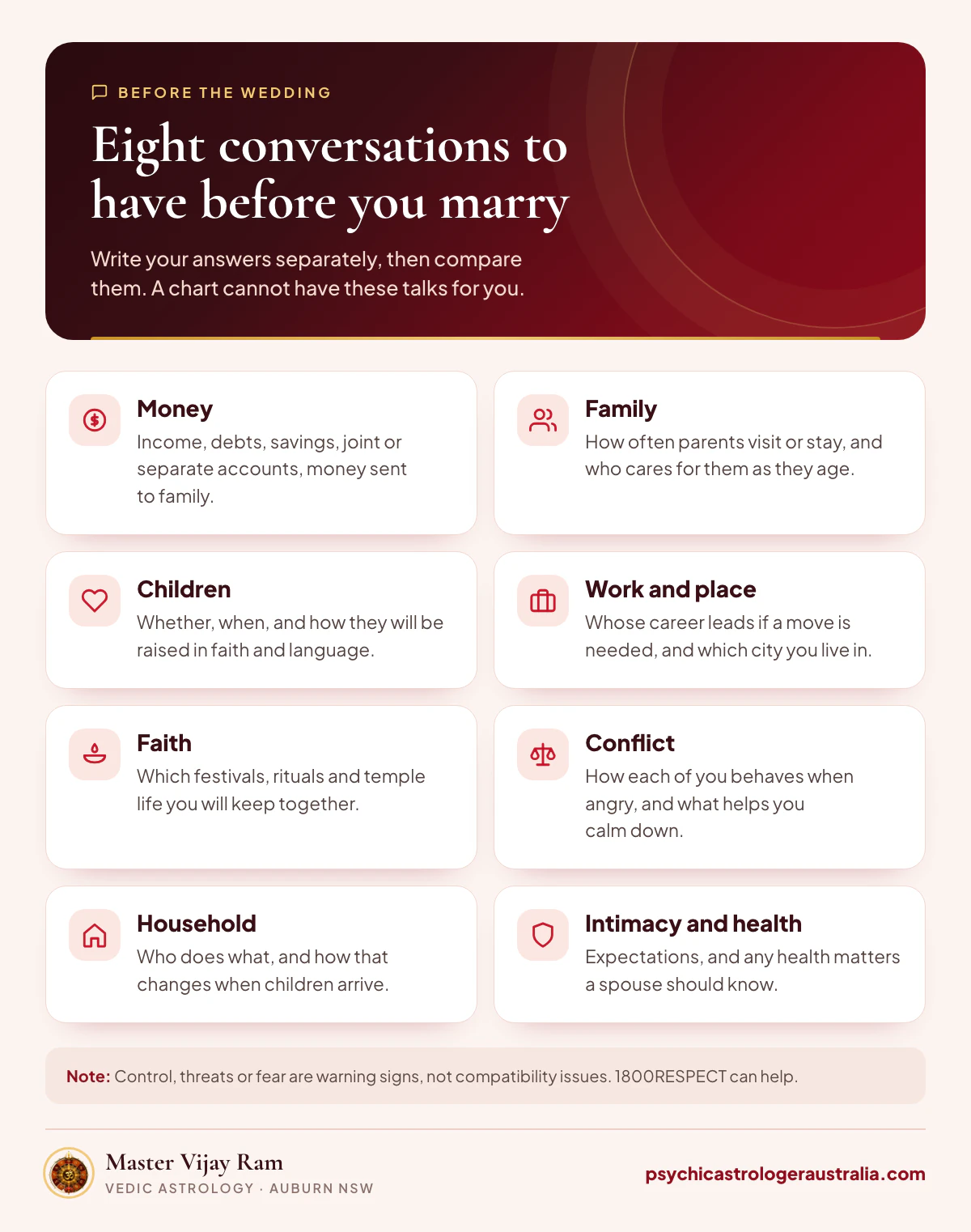
These before marriage questions come up in almost every preparation program, and they are worth discussing whether or not you see a counsellor:
- Money: income, debts, savings, joint or separate accounts, money sent to family.
- Family: how often parents visit or stay, whether they may live with you later, who cares for them as they age.
- Children: whether, when, how many, and how they will be raised in faith and language.
- Work and place: whose career leads if a move is needed, and which city you will live in.
- Faith: which festivals, rituals and temple life you will keep, and how much each of you expects of the other.
- Conflict: how each of you behaves when angry, and what you both need to calm down.
- Household: who does what, and how that changes when children arrive.
- Intimacy and health: expectations, past relationships where relevant, and any health matters a spouse should know.
Write your answers separately first, then compare them. The surprises are where the useful conversations begin, and preparing questions for a love reading shows how to bring the same list to an astrologer.
What if the chart and the counselling seem to disagree?
Trust the lived evidence and read the chart again. A high guna score with serious unresolved conflict about money or family in counselling means the couple has work to do, whatever the score; a low score with strong communication skills often reflects cancellations a full reading would find.
Neither tool should become a veto. A counsellor does not decide whether you marry, and a matching score should not either; both are information for two adults making a decision together.
Where they agree, take that seriously too. When both the chart and the counsellor point to the same theme, perhaps temper, perhaps a parent's influence, it is almost certainly the area to work on first.
In what order should a couple do them?
There is no single right order for marriage preparation. Many families match charts before the engagement is formalised, because that is when the tradition expects it, and the couple then books counselling in the months before the wedding. Others begin counselling while still deciding, and use matching as one more input.
What matters is time. Counselling squeezed into the fortnight before a wedding, when every evening is taken by sangeet rehearsals and relatives arriving from India, rarely gets the attention it deserves.
What if one partner does not believe in astrology?
Then counselling is the common ground, and matching can be offered rather than imposed. Some sceptical partners agree to it as a kindness to the other family; others prefer to skip it, and that choice deserves respect.
The post on couples who disagree about astrology covers how to handle that difference without it becoming the first big argument of the marriage.
Where do parents fit into marriage preparation?
Often at the matching stage rather than the counselling one. Parents may ask for the charts, consult the family astrologer and want the result before the engagement, while the counselling sessions stay private to the couple. That division works well for many families, provided the couple, not the parents, hears the full matching and decides what it means.
Some parents are wary of counselling, seeing it as something for marriages in trouble. It can help to explain it in their terms: a structured version of the long talks elders once had with a couple before the wedding, with someone neutral asking the awkward questions. Choosing between prayer, counselling and other help sets out where each kind of help belongs.
When families want more than a guna score, a full relationship compatibility reading gives them a fuller picture to discuss with the couple.
What warning signs can preparation bring to light?
Sometimes the conversations reveal more than ordinary differences. Controlling behaviour over money or friends, jealousy that checks phones, threats, pressure about dowry or gifts, or one partner being afraid of the other are not compatibility issues to be balanced against a good score.
If any of these appear, speak to a counsellor on your own as well as together, and to 1800RESPECT. Forced marriage is a crime in Australia, and nobody should feel they cannot step back from an engagement.
What can a reading not do here?
It cannot replace a counsellor's work, teach communication skills or resolve a practical disagreement about money or family. It cannot guarantee a happy marriage, and a good score is no substitute for the conversations listed above.
What it can do is describe each partner's tendencies, show the periods the marriage will move through, suggest a muhurat for the wedding and give families a shared, respectful framework. Where a puja is wanted before the wedding, Master Vijay Ram performs it personally at Auburn from $250, agreed before anything is performed, as puja and havan on request explains.
How does a matching consultation fit alongside counselling?
Couples often book a matching consultation early and bring what they learn to their counsellor. Master Vijay Ram reads both charts in full, explains the strengths first, names the periods that may need extra care and suggests what to discuss, which gives the counselling sessions a starting point.
A consultation is $50 by phone, video or WhatsApp, in English, Hindi or Punjabi. Couples in Newcastle and the Hunter, Wollongong or Geelong usually consult by video; in person he sees people only at Auburn, by appointment.
Read next
- Living Together Before Marriage: What Families and the Chart SayLiving together before marriage: what the Vedic tradition and a birth chart say, de facto relationships in general te…
- Kundli Matching for Marriage: Gun Milan Explained and What a Low Score MeansKundli matching for marriage: how Gun Milan scores 36 points, what each koota measures, why a low score is not a verd…
- Black Magic on Marriage: Signs Your Relationship Is TargetedSigns that black magic may be affecting a marriage, how the drift unfolds week by week, and the ordinary causes to ru…
Frequently asked questions
Is pre-marriage counselling necessary if our kundli matches well?
A good match is pleasant information, but it does not teach two people how to talk about money, family or conflict, and it cannot settle a practical disagreement. Counselling does those things. Many couples with high guna scores still find preparation useful, because the conversations it prompts are ones a chart cannot have for them.
What happens in pre-marriage counselling?
Usually a few sessions as a couple with a counsellor or trained marriage educator, sometimes using a questionnaire each partner completes separately, then discussing where answers differ. Topics include communication, conflict, money, family, children, faith and intimacy. Relationships Australia runs courses and counselling for couples preparing to marry, often by video for regional couples.
What questions should we ask each other before marriage?
Discuss money including debts and what is sent to family, how often parents visit or may live with you, whether and when to have children and how to raise them, whose career leads if a move is needed, which faith practices you will keep, how each of you behaves when angry, who does what at home, and expectations about intimacy and health.
What if our kundli match is low but counselling went well?
A low guna score often reflects factors that a full reading cancels, and a couple with strong communication skills has already answered many of the questions the points try to predict. Ask for a full matching that reads the 7th houses, navamsa, Mangal dosha cancellations and dashas rather than relying on the score. Neither tool should be a veto.
Should matching or counselling come first?
Either order works. Many families match before the engagement is formalised because tradition expects it, then book counselling in the months before the wedding. Others start counselling while deciding. What matters is leaving enough time, since sessions squeezed into the last fortnight before a wedding rarely get proper attention.
My fiance does not believe in astrology. Should we still do matching?
Offer it rather than impose it. Some sceptical partners agree as a kindness to the other family, and some prefer not to, which deserves respect. Pre-marriage counselling is common ground both can accept, and it covers the practical conversations that matter most whatever anyone believes about charts.
What warning signs can come up during marriage preparation?
Controlling behaviour over money or friends, jealousy that checks phones, threats, pressure about dowry or gifts, or one partner being afraid of the other. These are not compatibility issues to balance against a good score. Speak to a counsellor on your own as well as together and contact 1800RESPECT; nobody is obliged to go ahead with an engagement.
How much does kundli matching cost with Master Vijay Ram?
A consultation is $50 by phone, video or WhatsApp, in English, Hindi or Punjabi, or in person at Auburn by appointment. He reads both charts in full and suggests topics to take to counselling. A puja before the wedding, if wanted, starts from $250 and the figure is agreed before anything is performed.
People also ask
What is the difference between kundli matching and pre-marriage counselling?
Kundli matching compares two birth charts for temperament, compatibility and the timing of the periods ahead. Pre-marriage counselling is a series of guided conversations that builds communication and conflict skills and covers practical topics such as money and family. One describes tendencies; the other teaches the couple how to handle them.
Does Relationships Australia offer pre-marriage courses?
Yes. Relationships Australia runs courses and counselling for couples preparing to marry, as well as for couples at every other stage. Services and formats vary between states, and many are available by video, which suits couples in regional areas or on shift work. Their website lists what is offered near you.
Is kundli matching enough before marriage?
It is valuable but not complete. Matching describes temperament and timing; it does not teach communication skills or settle practical disagreements about money, family, children or where to live. Pairing it with honest conversations, ideally guided by a counsellor or educator, gives a couple a much fuller preparation.
When should pre-marriage counselling start?
Ideally several months before the wedding, when there is time and calm to discuss difficult subjects properly. Starting during the final weeks, when rehearsals and visiting relatives fill every evening, tends to rush the conversations. Some couples begin while still deciding whether to marry, which can also be helpful.
References & further reading
Serving clients across Australia
Confidential consultations by phone, video & WhatsApp — including: