

Quick answer
Living together before marriage is a choice adults make, and a birth chart describes it without judging it: the 5th, 7th and 12th houses, Venus and Rahu show tendencies and timing. Australian family law recognises de facto relationships in general terms, so take legal questions to a family lawyer or Legal Aid. With parents, answer the worry beneath the objection.
What does living together before marriage mean for an Indian family?
Living together before marriage is a relationship in which a couple shares a home as partners without having married, which Australian law may treat as a de facto relationship and which many Indian families still find difficult to accept. Among the couple's Australian friends it is ordinary; at the dinner table in Harris Park or Mill Park it can be the subject nobody mentions.
This post does not tell anyone what to do. Some couples live together and marry happily, some marry without ever living together, and both are choices adults make. Master Vijay Ram reads charts for people in every kind of relationship and does not lecture any of them.
What follows covers what the tradition and a birth chart actually say, the general legal position in Australia, and how couples handle the conversation with their parents, which is usually the hardest part.
Why is it so hard to raise at home?
Because it touches several things at once: religion, family reputation, what relatives in India will say, and a generation gap that migration has widened. Parents who arrived as adults often carry the norms of the town they left, while their children have grown up with a different idea of what a serious relationship looks like.
Many parents are less worried about morality than about security. Their unspoken questions are often practical: is this person committed, will my daughter be protected if it ends, will my son be pressured into something, what happens to a home they bought together.
Seeing the fear underneath the objection makes the conversation easier, because a fear can be answered in a way that a moral judgment cannot.
What does the Vedic tradition actually say?
The tradition treats marriage, vivaha, as a samskara, one of the sacred rites of a life, and the wedding fire as its witness. It has no rite for living together, and most families who follow it closely will hope a couple marries.
The old law books are also more varied than people assume. They list eight forms of marriage, one of which, the gandharva form, is a union by mutual choice between the two people, without arrangement by families. Traditions differ greatly on how they regard it, and it is not the same as a modern live in relationship, but it shows that love-led unions are not new to Indian thought.
Jyotish itself does not moralise. A chart describes tendencies in relationships and their timing; it does not issue permission or disapproval, and an astrologer who uses it to shame clients is going beyond what it can say.
What does a birth chart show about living together?
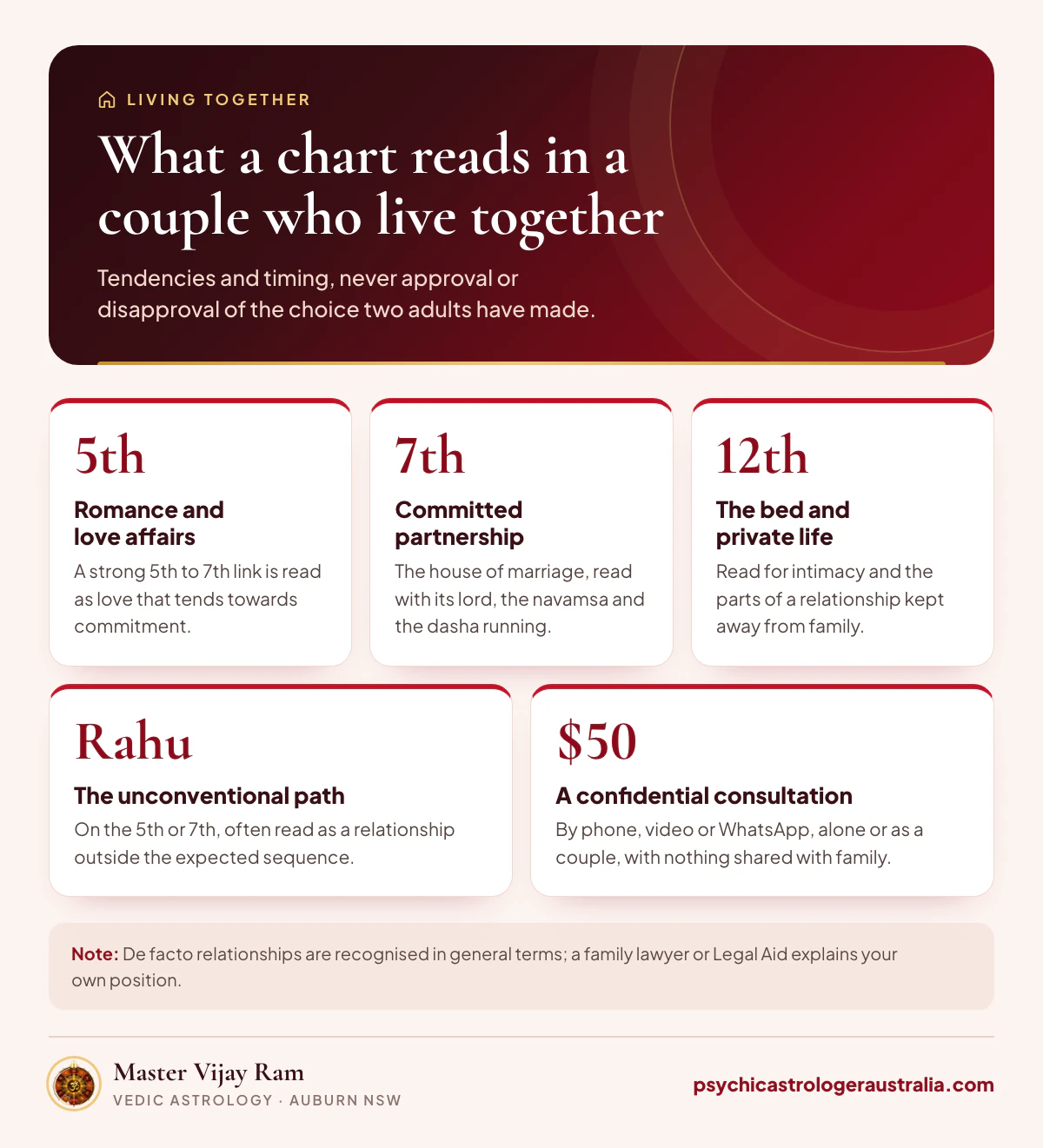
In cohabitation astrology the 5th house is read for romance and love affairs, the 7th for committed partnership and marriage, as the seventh house of marriage explains, the 12th for the bed and private life, and Venus for love and attraction. A strong link between the 5th and 7th houses or their lords is traditionally read as love that tends towards commitment.
Rahu connected with the 5th or 7th house is often read as a preference for unconventional arrangements, a partner from outside the family's expectations, or a relationship that does not follow the expected sequence. The running dasha usually explains why the question has become urgent now, for example when a period of the 7th lord begins.
These are tendencies, not verdicts. A love and marriage timing reading can say when the chart's marriage indicators are active, which many couples who already live together find useful.
Is kundli matching still worth doing if you already live together?
Many couples do it, for themselves or to reassure their parents. By the time two people share a home they know each other's habits well, so the matching is less a test and more a way of understanding the relationship's strengths and the periods ahead.
A low score at this stage is not a reason to separate. A couple who already live together well have answered many of the questions the koota points try to predict, and a full reading looks at the 7th houses, the navamsa and the dashas rather than the score alone. A compatibility reading for both charts does exactly that.
What does Australian law say about living together?
In general terms, Australian family law recognises de facto relationships, and couples who live together as partners can have rights and obligations, including over property, if the relationship ends. Whether a particular relationship counts, and what follows from it, depends on the facts and is decided under the law, not by a family or an astrologer.
This is general information only. A family lawyer or Legal Aid can explain how the law applies to you, particularly before buying property together or if you are separating; Legal Aid NSW and its counterparts in other states give initial advice, and separation under one roof and the law touches on the same ground.
Visas are a separate matter again. If either partner's residency depends on the relationship, the Department of Home Affairs decides, and advice should come from a registered migration agent.
What are families usually worried about?
| What parents say | What often lies underneath | A way to respond |
|---|---|---|
| What will people say? | Fear of the community's judgment | Acknowledge it; explain who knows and who does not need to |
| He or she will not marry you | Fear their child will be left unprotected | Share your plans and timeline honestly, if you have them |
| It is against our religion | Genuine faith, or a worry about the next generation | Respect the belief; explain how faith still features in your life |
| What if it ends? | Worry about money, the home, being hurt | Mention legal advice and how property is held |
| You did not ask us | Feeling shut out of a child's life | Invite them to meet your partner properly |
Where the objection is really about caste or community, guidance for inter-caste couples whose families object goes further. The middle column is the one to listen for. Answering the worry, rather than the words, turns an argument into a conversation.
How do couples tell their parents?
Slowly, and usually one parent first. Many people begin with the parent who is more likely to listen, or with a sibling who can prepare the ground, and choose an ordinary day rather than a festival or a family wedding, when everyone is under pressure.
It helps to say what you are asking for. Some couples want acceptance of the relationship; some want help planning a wedding; some only want their parents to stop hearing it from cousins. Being clear about the aim stops the conversation drifting into every grievance at once.
Where marriage is the plan, help for love marriages facing family resistance describes the longer work. The honest approach to convincing parents about a love marriage covers the longer process of family acceptance, and many of its steps apply here.
What if the reaction is frightening?
Most families are upset for a while and then adjust. A few react with threats, confinement, attempts to take a child back to India, or violence, and no cultural explanation makes that acceptable.
If you are afraid of your family's reaction, talk to 1800RESPECT before the conversation, and call 000 if you are in danger. Forced marriage is a crime in Australia, including when it is arranged overseas, and the Australian Federal Police can help.
What if your parents do not know?
Many couples live with that for a time, for reasons that make sense to them, and no one is obliged to share every part of their life with their parents. The cost tends to grow, though: holidays planned around secrecy, a partner who feels hidden, and the risk of parents finding out in the worst way.
A reading can sometimes help a couple choose a calmer period to have the conversation, since some dashas and transits are traditionally read as better for family discussions than others. It cannot make the conversation easy, and it should not be used to put it off indefinitely.
Does living together change the wedding later?
No. If a couple decides to marry, the wedding is the same samskara with the same rituals, and the muhurat is chosen in the same way. Some families prefer a quick, simple ceremony once they accept the relationship; others hold a full wedding as if nothing had come before.
Couples marrying a partner from outside the community face their own set of questions, which marrying a non-Indian partner and what parents ask looks at in detail.
What can a reading not do here?
It cannot approve or disapprove of your relationship, give legal advice about property or separation, or decide anything about a visa. It cannot change how your parents feel, though it can sometimes help you understand why they feel it.
It can describe the relationship's tendencies, show when marriage indicators are active, and help a couple decide on timing for the conversations that matter.
How does a confidential consultation work?
You can consult alone or as a couple, and nothing is shared with your family. Master Vijay Ram reads both charts if both partners agree, or one chart if only one of you wants a reading, and talks about the relationship without judgment.
A consultation is $50 by phone, video or WhatsApp, in English, Hindi or Punjabi. Couples in Brisbane and South East Queensland, Perth or Hobart usually consult by video; in person he sees people only at Auburn, by appointment.
Read next
- Pre-Marriage Counselling and Kundli Matching, TogetherPre-marriage counselling and kundli matching do different jobs: what each offers, the questions to discuss before mar…
- Marrying a Non-Indian Partner: What Parents Ask, and the ChartMarrying a non-Indian partner: the questions Indian parents usually ask, what sits behind them, and how a chart is re…
- Vashikaran for Marriage Approval: Softening Family ResistanceHow family resistance to a marriage really softens: what vashikaran addresses, a stage-by-stage timeline, the honest …
Frequently asked questions
Is living together before marriage against Hindu tradition?
The tradition treats marriage as a samskara and has no rite for living together, so many observant families hope a couple will marry. The old law books also list eight forms of marriage, including the gandharva form of union by mutual choice, and traditions differ widely in how they regard it. A chart itself does not moralise about relationships.
What does astrology say about live-in relationships?
The 5th house is read for romance, the 7th for committed partnership, the 12th for private life and Venus for love. Rahu linked to the 5th or 7th house is often read as a preference for unconventional arrangements. The running dasha usually explains why the question feels urgent now. These are tendencies, not judgments or fixed outcomes.
Should we do kundli matching if we already live together?
Many couples do, either for their own understanding or to reassure parents. At this stage matching describes the relationship's strengths and the periods ahead rather than testing it. A low guna score is not a reason to separate, since a full reading weighs the 7th houses, navamsa and dashas, and the couple already know how they live together.
Is a de facto relationship legally the same as marriage in Australia?
Australian family law recognises de facto relationships in general terms, and partners can have rights and obligations, including over property, if the relationship ends. Whether a particular relationship qualifies and what follows depends on the facts. A family lawyer or Legal Aid can explain how the law applies to you; an astrologer cannot.
How do I tell my Indian parents I live with my partner?
Usually one parent or a sibling first, on an ordinary day rather than at a festival, and with a clear idea of what you are asking for: acceptance, help planning a wedding, or simply honesty. Listen for the fear beneath their objection, often about security or community talk, and answer that. If you fear their reaction, speak to 1800RESPECT first.
Can a reading tell us when to talk to our families?
Some dashas and transits are traditionally read as better for family discussions than others, and a reading can suggest calmer periods. It cannot make the conversation easy or predict your parents' response, and it should not become a reason to postpone the conversation indefinitely.
Does living together affect a later Hindu wedding?
No. If the couple marries, the wedding is the same samskara with the same rituals, and the muhurat is chosen in the usual way from both charts and the place of the ceremony. Some families prefer a quick, simple ceremony once they accept the relationship, and others hold a full traditional wedding.
Will Master Vijay Ram judge us for living together?
No. He reads charts for people in every kind of relationship and does not lecture clients about their choices. Consultations are confidential and nothing is shared with families. A consultation is $50 by phone, video or WhatsApp, in English, Hindi or Punjabi, or in person at Auburn by appointment.
People also ask
Which house in astrology indicates live-in relationships?
No single house names it. The 5th house shows romance, the 7th committed partnership, and the 12th the bed and private life. Connections between the 5th and 7th lords suggest love moving towards commitment, and Rahu on the 5th or 7th is often read as an unconventional arrangement. The dasha shows timing.
Why do Indian parents object to living together?
Often because of a mix of faith, community reputation and practical fear: that their child will be left unprotected, that the partner will not commit, or that a shared home will cause problems if the relationship ends. Many objections soften when the underlying worry is heard and answered rather than argued with.
What is gandharva marriage?
Gandharva marriage is one of the eight forms of marriage listed in the old Hindu law books, a union by the mutual choice of the two people without arrangement by their families. Traditions differ on how they regard it. It is not the same as a modern live-in relationship, but it shows love-led unions have a long history.
Do de facto couples have property rights in Australia?
In general terms, Australian family law recognises de facto relationships and can deal with property when they end. Whether your relationship counts and what you may be entitled to depends on the facts. Speak to a family lawyer or Legal Aid before buying property together or if you are separating.
References & further reading
Serving clients across Australia
Confidential consultations by phone, video & WhatsApp — including: