
Quick answer
When to retire is first a question for your super fund, a licensed financial adviser and your GP. A Vedic chart adds the season: a dasha that quietens the tenth house and wakes the twelfth, fourth or ninth often matches the years people step back well, and the tradition's vanaprastha stage frames retirement as a change of duty rather than an ending.
What does the chart say about retirement?
Retirement astrology is a reading of the years when the chart’s emphasis moves away from career and status towards home, faith, family and rest, so that a decision to stop or slow down can be timed with that shift rather than against it. It does not tell you how much money you need or when you are allowed to reach your super. It tells you about the season.
People ask Master Vijay Ram when to retire in their late fifties and sixties, often after a health scare, a redundancy offer or the birth of a grandchild. Some want to know whether to go now or work three more years. A career and business reading can cover the end of a career as carefully as the start of one.
Who should you talk to before you decide?
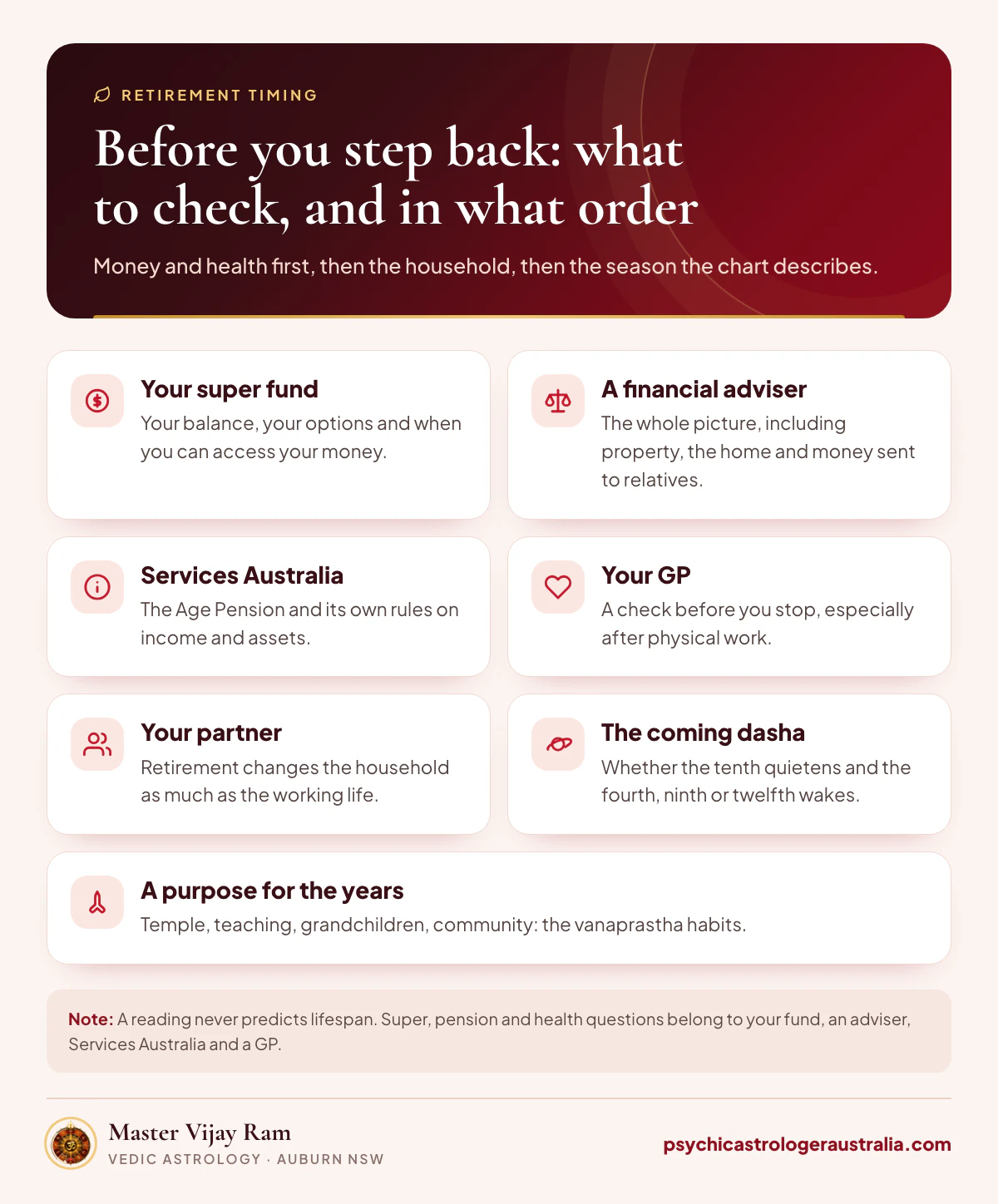
Your super fund first: most funds explain your balance, your options and when you can access your money, and many offer advice. A licensed financial adviser can look at the whole picture, including any investment property, the family home and what you send to relatives. Services Australia handles the Age Pension and has its own rules about income and assets.
Your GP second. A check before you stop work, particularly if your job is physical, is worth more than any chart. Then your partner, because retirement changes a household as much as it changes a working life.
| Question | Who answers it | What a chart can add |
|---|---|---|
| Can I afford to stop? | Super fund, licensed financial adviser | Nothing; this is arithmetic |
| Am I eligible for the Age Pension? | Services Australia | Nothing |
| Is my body telling me to slow down? | GP and specialists | The periods when rest is traditionally stressed |
| Is this the right season to step back? | You and your family | Which houses the coming dasha emphasises |
| What will give the years meaning? | You, your faith, your community | The ninth, fifth and twelfth: dharma, grandchildren, retreat |
Which houses describe stepping back from work?
The tenth house is the career and public role, and retirement is traditionally read when its lord’s period has passed and the dasha moves to planets connected with other houses. In twelfth house retirement readings, the twelfth is release, retreat, spiritual practice and also expense, so it often lights up when work ends and money starts going out rather than coming in. The twelfth house of release and expense covers that house fully.
The fourth is the home and inner peace, and a fourth-house period after a long working life is often when people renovate, downsize or move closer to children. The ninth is dharma, pilgrimage and teachers, and it is the house most people want to feed once there is time.
Is Saturn the planet of retirement?
Saturn is the natural significator of old age, of slowing down and of the long view. It is also a planet of work and duty, so a strong Saturn often shows someone who keeps working well past the usual age, by choice. Its period late in life can bring either a well-earned rest or a second, quieter career.
The second Saturn return falls around 58 to 60, which is why so many people ask about retirement then. In 2027 it is exact for people born between 13 May and 11 Oct 1967 and between 4 Feb 1968 and 13 Apr 1969. Traditions read it as a review of everything built since the first return, and many people use it to decide what the next twenty years are for.
Which dashas make a good time to retire?
For retirement timing by dasha, a reading looks for a period whose lord is connected with the fourth, ninth or twelfth house, with the tenth less active than before. Jupiter periods late in life are often read as years of teaching, advising and family, and a Ketu period as natural detachment from titles. A Moon period brings home and the emotional life forward.
The reading also checks for the opposite: a strong tenth-house period still running in your sixties, which often means work is not finished with you yet. That is not a reason to keep working if your body or family says otherwise, but it explains why some people feel restless when they stop. The timing ideas behind this are in the Saturn mahadasha and its rewards, which some people are running at this age.
What is vanaprastha, and does it still apply?
The old Vedic idea of life in four stages, the ashramas, gives student life, household life, vanaprastha and renunciation. Vanaprastha literally means going to the forest: handing the household to the next generation and turning towards study, pilgrimage and service. Hardly anyone moves to a forest now, but the idea that a working life hands over to a life of guidance and practice still shapes how many Indian families see their parents’ later years.
Families mark the turning point in their own ways. Some hold a shashtipurti at 60, which the 60th and 80th birthday rites describes. Others make a first long pilgrimage, or begin a daily practice they had postponed for forty years.
What about purpose after work?
Many retirees in Australia find the first year harder than they expected. The days lose their shape, a spouse who was used to an empty house now has company all day, and friendships that ran through work fade. It is common, and it is not a failure.
The chart can suggest where meaning is likely to come from: the fifth for grandchildren and creative work, the ninth for temple, teaching and pilgrimage, the eleventh for community groups and friends, the third for writing and hobbies. As illustrations, a retired engineer in Gosford with a strong ninth found his years in the temple committee and teaching Sanskrit to children; a nurse in Darwin with a busy fifth found hers in grandchildren and a choir.
If the change brings a low mood that does not lift, see a GP; Beyond Blue (1300 22 4636) and Lifeline (13 11 14) also help.
Should you retire back to India, or split the year?
Many couples who came to Australia in their thirties picture a retirement spent partly in Jalandhar, Pune or Chennai, near siblings and the old house. Then grandchildren arrive in Blacktown or Point Cook, and the plan changes. There is no right answer, and the practical side is detailed: tax, pensions paid overseas, health cover and property in two countries all need a financial adviser who knows both systems.
The chart reads this through the twelfth house, traditionally the house of living away from the birthplace, and the fourth, the home. For a migrant, these two often swap meaning in later life: the land you left becomes the foreign one. A reading can show which of the two the coming periods emphasise, which helps a couple talk it through, though it never settles it alone.
Is part-time work or consulting a good middle path?
For many people it is the most comfortable answer. A chart with the tenth lord still strong and Saturn well placed often suits a gradual step down: three days a week, a mentoring role, contract work in the field you know. Mercury and Jupiter periods are traditionally good for teaching and advisory work in later life.
Check how part-time income affects your super and any pension with your adviser first, since the rules can change what is worth doing.
Does retirement change a marriage?
Often, because two people who had separate days for decades now share the kitchen and the calendar. The seventh house and the period lords of both partners show how that adjustment is likely to go, and a joint reading can help a couple talk about what each wants.
The empty nest and a changing marriage covers the related shift when children leave.
Relationships Australia offers counselling for couples at any age, and many retirees find a few sessions useful in the first year.
What about health in the later years?
The sixth house and the lagna are read for health, and Saturn for long-term conditions, but a chart is never a diagnosis. Regular checks with a GP matter more after sixty, and any memory changes should be raised early; Dementia Australia supports families. Health and wellbeing readings look at the periods traditionally linked with rest and recovery, alongside medical care and never in place of it.
Are there rituals for the start of retirement?
Many families hold a small puja on the first morning of the new life, or on a birthday close to it: Ganesha first, then the family deity, then a Satyanarayana katha or a havan with the household together. A day chosen by muhurat is a gentle way to mark the change. If you want one performed for you, a puja or havan for a new stage of life starts from $250, agreed before it is performed, done personally at his place of practice in Auburn.
Daily practice matters more than a single event. A morning lamp, a set prayer, a walk at sunrise and service at a temple or community kitchen are the vanaprastha habits most people can keep.
What can a retirement reading not tell you?
It cannot tell you how much you need, whether your super will last, or how long you will live; Vijay Ram ji does not read longevity for anyone. It cannot decide eligibility for any payment. It describes which parts of life the coming years emphasise, so the decision you make with your adviser and family fits the season.
How does a retirement reading work?
Send your birth details and, if you like, your partner’s. Mention the options you are weighing: a date to stop, part-time work, consulting, or moving closer to children. A consultation is $50, by phone, video or WhatsApp in English, Hindi or Punjabi, or in person at Auburn by appointment.
Families on the Central Coast are about an hour from Auburn by road and many come in person; others book through readings for Central Coast clients by phone.
Read next
- Permanent Residency Timing: What a Chart Can and Cannot SayPR astrology, honestly: what the 12th, 9th and 4th houses and Rahu show about settling abroad, why Home Affairs decid…
- Promotion Timing: When the Chart Favours a Step UpPromotion timing in Vedic astrology: the dasha lords, Jupiter and Saturn transits and D10 signs read for a step up, a…
- Kundli Reading Explained: What Your Birth Chart RevealsWhat a Kundli reading reveals about your life, personality, career and destiny. Master Vijay Ram explains Vedic astro…
Frequently asked questions
Can astrology tell me the best year to retire?
It can describe which years emphasise home, family, faith and rest rather than career, by reading the coming dasha and the houses its lords govern. It cannot tell you whether you can afford to stop, which is a question for your super fund and a licensed financial adviser. The best decisions combine the two: an affordable date that also fits the chart's season.
Which house in the birth chart shows retirement?
No single house. The tenth shows the career that is ending, the twelfth shows release, retreat and the expenses that follow, the fourth shows home and peace, and the ninth shows faith and pilgrimage. Retirement is usually read when the tenth quietens in the dasha and one of the others becomes active.
Is the second Saturn return a time to retire?
It often coincides with the question, because it falls around 58 to 60. Tradition reads it as a review of the working life since the first return and a time to decide what the next years are for. It does not require anyone to stop working. People with a strong Saturn often keep working by choice well beyond it.
What is vanaprastha?
Vanaprastha is the third of the four traditional stages of life, after student and householder. It literally means going to the forest and describes handing household duties to the next generation while turning to study, pilgrimage and service. Today it is understood loosely, as a change of role in later life rather than a literal withdrawal.
Should I keep working if my chart shows a strong tenth house period?
Not necessarily. A strong tenth-house period in your sixties often explains why some people feel restless when they stop, and it can suggest consulting or part-time work suits them. But your health, your family and your finances come first. If they point to stopping, a chart is not a reason to keep going.
Can a reading predict how long I will live?
No. Master Vijay Ram does not read longevity for anyone, and no honest astrologer should. The eighth house is traditionally linked with lifespan, but readings about death frighten people and help no one. Health in later life belongs with a GP and specialists, and a reading talks about seasons and purpose instead.
Is there a puja for starting retirement?
Many families mark it with a small puja: Ganesha first, the family deity, and a Satyanarayana katha or havan with the household. A muhurat can be chosen for the day. If you want one performed for you, it starts from $250, agreed before it is performed, and is done personally at his place of practice in Auburn.
How much does a retirement reading cost?
A consultation with Master Vijay Ram is $50, by phone, video or WhatsApp, in English, Hindi or Punjabi, or in person at Auburn by appointment. A couple can share one reading. A puja or havan, if you want one to mark the change, starts from $250 and the figure is agreed before anything is performed.
People also ask
When is the right time to retire according to Vedic astrology?
Tradition looks for a period when the tenth house of career quietens and a period lord connected with the fourth, ninth or twelfth house begins, emphasising home, faith and release. That describes a season, not a date. It is read alongside the practical answer from your super fund, financial adviser and GP.
Which planet is responsible for old age?
Saturn is the natural significator of old age, patience and the long view. Its late periods can bring rest or a second, quieter career, depending on the houses it rules. Jupiter is read for wisdom and family in later life, and Ketu for detachment from titles and ambition.
What are the four ashramas of life?
The four ashramas are brahmacharya, the student stage; grihastha, the householder; vanaprastha, the stage of handing over and turning to study and service; and sannyasa, renunciation. Few people follow them literally today, but they still shape how many Indian families think about the later years.
Is retirement a twelfth house matter?
Partly. The twelfth covers retreat, spiritual practice, sleep and expenses, and it often becomes active when work stops and money starts going out rather than coming in. It is read together with the tenth, fourth and ninth houses, and with the running dasha.
References & further reading
Serving clients across Australia
Confidential consultations by phone, video & WhatsApp — including: