

Quick answer
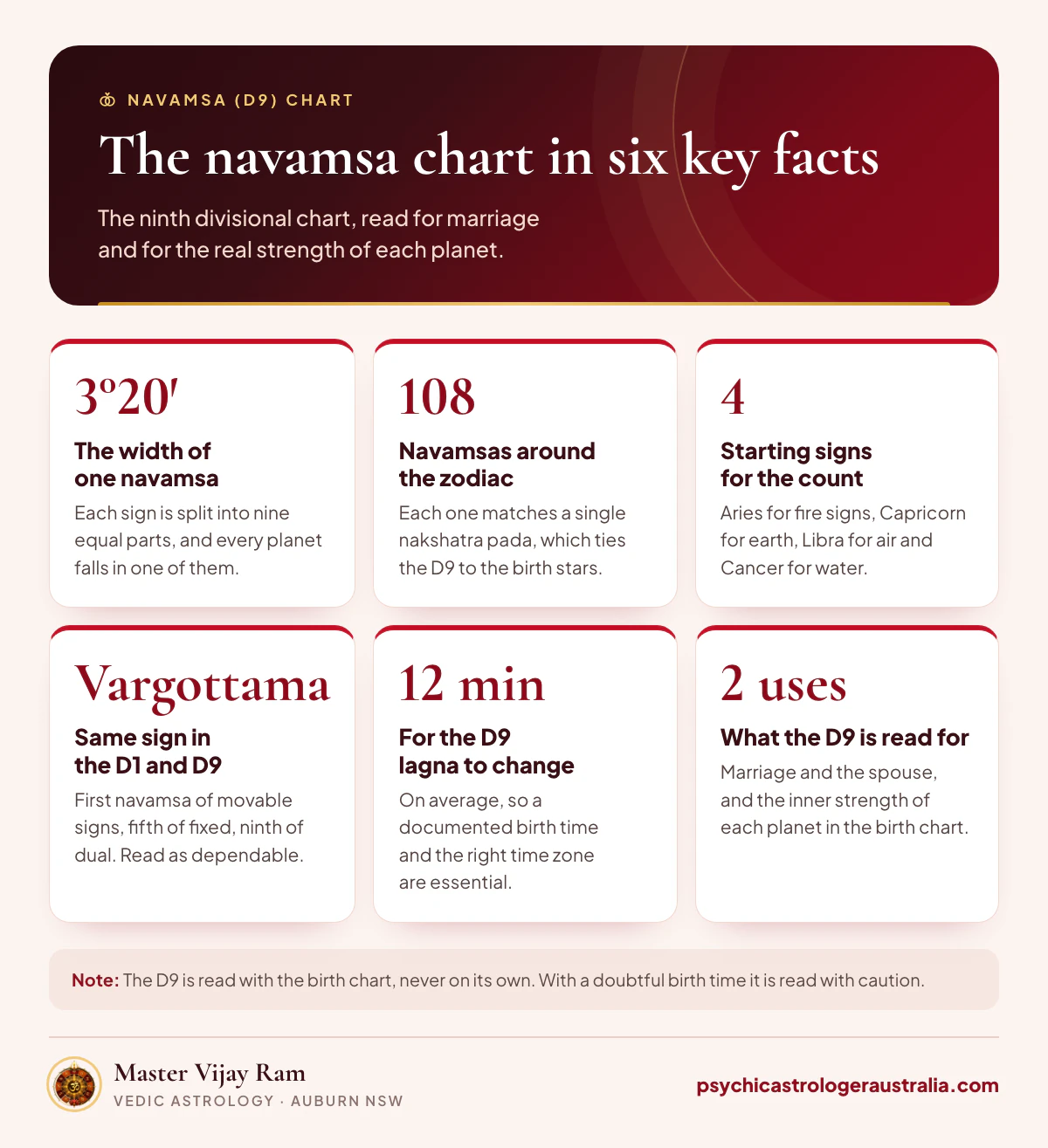
The navamsa, or D9, is the divisional chart made by splitting every sign into nine parts of 3°20′. It is read for marriage and the spouse and for the real strength of each planet, and a planet in the same sign in both charts is vargottama. Because the navamsa lagna changes about every 12 minutes, it needs an accurate birth time.
What is the navamsa (D9) chart?
The navamsa chart is a divisional chart that divides each of the twelve signs into nine equal parts and recasts the planets according to the part each one occupies. Its name joins nava, nine, and amsa, a portion, and astrologers write it as D9 because it is the ninth division of the birth chart. Where the ordinary birth chart, the D1, shows what a life promises, the tradition reads the navamsa as showing how that promise ripens.
It is read for two things above all: marriage and the spouse, and the real strength of each planet. That is why no careful compatibility reading skips it, and why a relationship compatibility reading with Master Vijay Ram always lays the two navamsas side by side as well as the two birth charts.
How is each sign divided into nine navamsas?
A sign is thirty degrees wide, so each navamsa spans 3°20′. Twelve signs of nine parts give 108 navamsas around the zodiac, and each one matches a single pada, or quarter, of a nakshatra, which ties the D9 directly to the birth stars. The count of nine parts starts from a different sign depending on the element of the sign being divided.
| Element | Signs | The first navamsa begins from |
|---|---|---|
| Fire | Aries, Leo, Sagittarius | Aries |
| Earth | Taurus, Virgo, Capricorn | Capricorn |
| Air | Gemini, Libra, Aquarius | Libra |
| Water | Cancer, Scorpio, Pisces | Cancer |
Followed around the zodiac, the rule produces one unbroken sequence: Aries runs from Aries to Sagittarius, Taurus picks up at Capricorn, Gemini at Libra, Cancer at Cancer, and Leo begins the cycle again at Aries. The four starting points are the four movable signs, and signs of the same element always share one.
How do you work out a planet's navamsa?
Take the planet's degree within its sign and see which of the nine parts it falls in: 0°–3°20′ is the first, 3°20′–6°40′ the second, and so on up to 26°40′–30°, the ninth. Then count that many signs from the starting sign for the element, counting the starting sign as one. The sign you land on is the planet's navamsa sign.
For example, Venus at 15° Taurus sits in the fifth part, between 13°20′ and 16°40′. Taurus is an earth sign, so the count starts at Capricorn: Capricorn, Aquarius, Pisces, Aries, Taurus. Venus falls in Taurus in the navamsa as well, which is the vargottama case explained further down.
What does a worked example look like?
The chart below is an illustration, not a client. Its lagna is 11° Libra, and the table places five points in the birth chart and the navamsa side by side.
| Point | Birth chart (D1) | Navamsa (D9) | What the tradition would note |
|---|---|---|---|
| Lagna | 11° Libra | Capricorn | The D9 seventh house is Cancer, ruled by the Moon |
| Venus | 15° Taurus, own sign | Taurus, D9 fifth house | Vargottama in its own sign: a steady signal for love |
| Jupiter | 21° Capricorn, debilitated | Cancer, exalted, D9 seventh house | Weak on the surface, strong underneath, and placed in the D9 house of marriage |
| Moon | 22° Gemini, ninth house | Aries, D9 fourth house | The D9 seventh lord sits in a kendra |
| Mars | 4° Aries, own sign, seventh house | Taurus, D9 fifth house | The birth chart's seventh lord in a neutral D9 sign |
Read together, the birth chart shows a seventh house holding its own lord, Mars: a direct, energetic partner and a marriage with some heat in it. The navamsa adds that the house of marriage there holds an exalted Jupiter, with its lord in a kendra and Venus vargottama. The tradition would read a marriage that begins with spark and matures into something wiser and kinder than its start.
Jupiter is the lesson of the example. Debilitated in the birth chart and exalted in the D9, it is the kind of planet a D1-only reading underrates, and the wider rules by which a fallen planet recovers are set out in how a debilitated planet recovers.
What is vargottama, and where does it fall in each sign?
A planet is vargottama when it occupies the same sign in the birth chart and the navamsa. The tradition reads it as consistent and dependable: the planet delivers what the birth chart promised, without the surprises a mismatch can bring. A vargottama lagna is read the same way, as a temperament that is the same in private as in public.
| Sign type | Signs | Vargottama span |
|---|---|---|
| Movable | Aries, Cancer, Libra, Capricorn | 0°–3°20′, the first navamsa |
| Fixed | Taurus, Leo, Scorpio, Aquarius | 13°20′–16°40′, the fifth navamsa |
| Dual | Gemini, Virgo, Sagittarius, Pisces | 26°40′–30°, the ninth navamsa |
Vargottama strengthens consistency, not necessarily comfort. A vargottama planet in its own or exaltation sign is a real asset; a debilitated one stays debilitated in both charts, and traditions differ on how much the repetition helps it.
Why does the birth time matter so much for the D9?
The lagna moves through all twelve signs in about a day, so on average it crosses a navamsa of 3°20′ in roughly twelve minutes. Change the birth time by a quarter of an hour and the navamsa lagna can change sign, which moves every D9 house at once. In the example above, a birth about twelve minutes earlier would put the lagna near 8° Libra and the navamsa lagna in Sagittarius instead of Capricorn.
The Moon and the planets move far more slowly through the navamsas, so their D9 signs are usually safe; it is the D9 lagna and its houses that depend on the minute. A time rounded to the nearest half hour is not good enough for this chart, so a hospital record or a baby health record book is worth finding.
Time zones catch people too. A January birth in Sydney, Melbourne or Adelaide is on daylight saving time, while a birth in Brisbane, on the Gold Coast or in Perth never is, and a birth recorded in India is in Indian Standard Time; one wrongly applied hour moves the navamsa lagna about five times over.
How is the navamsa chart read for marriage?
The navamsa chart for marriage is read through a handful of points. The D9 lagna and its lord describe how the person behaves inside a marriage, the D9 seventh house and its lord describe the partner and the partnership, and Venus's navamsa sign shows how love is given and received. For a woman, Jupiter's place in the D9 is traditionally read for the husband as well.
The birth chart's seventh lord is followed into the navamsa too. A seventh lord that looks modest in the D1 but rises in the D9 often belongs to a marriage that improves with the years, while a seventh lord that falls in the D9 asks for patience and a careful reading of the dasha. Many astrologers hold that the D9 grows more prominent as life goes on, especially after marriage.
How does the navamsa change kundli matching?
Gun Milan reads only the two Moons, so it cannot see the navamsa at all. A couple can score well in the 36 points and show strain between their D9 lagnas and seventh lords, or score modestly and show navamsas that fit like hands. The points system is explained in Gun Milan and what a low score means.
In a full match the two navamsas are compared the way the birth charts are: lagna to lagna, seventh lord to seventh lord, Venus to Venus and Moon to Moon. Because each navamsa is a nakshatra pada, the D9 also links naturally to the star-by-star comparison in the nakshatra layer of compatibility.
How does the D9 show the real strength of a planet?
A planet's dignity in the navamsa is read as its inner strength. A planet exalted or in its own sign in the D9 delivers more than its birth-chart sign suggests, and one debilitated in the D9 promises more than it gives. That is why D9 chart analysis is part of judging every major yoga, not just marriage.
The checks are simple to name. Is the planet in the same sign, a friend's sign, its own or exaltation sign, or its debilitation sign in the D9? Does the navamsa place it in a kendra or trikona from the D9 lagna, or in the sixth, eighth or twelfth?
What does the D9 add to the seventh house you already know?
The birth chart's seventh house, its lord and its planets remain the foundation of any marriage reading; the seventh house explained covers them in full. The navamsa adds a second opinion on each of them, and when the two charts agree the reading is firm.
When they disagree, the tradition gives the navamsa real weight. A seventh house that looks troubled in the D1 but strong in the D9 usually describes a difficult start and a sound marriage, and the reverse describes a promising start that needs tending.
What are the common mistakes with a navamsa kundli?
The first is reading the D9 on its own, as if it were a separate birth chart; it is a lens on the D1, not a replacement. The second is trusting a D9 lagna cast from a rounded or misremembered time. The third is mixing ayanamsas, since a planet near the edge of a navamsa can change sign between settings; this site uses Lahiri, the usual Vedic default.
A fourth mistake is treating every vargottama as good news, or every debilitation in the D9 as a disaster. A navamsa kundli is read with the birth chart, the dasha and the rest of the divisional charts, and its single positions only mean something in that company.
How does Master Vijay Ram use the navamsa in a reading?
Every marriage, compatibility and timing reading he gives includes the D9. He confirms the birth time first, checks whether the navamsa lagna is close to a boundary, and then reads the D9 lagna, seventh house, Venus, Jupiter and the dignity of the dasha lords alongside the birth chart. Each reading is $50, given by phone, video or WhatsApp, and a full kundli reading covers the other divisional charts as well.
A navamsa reading rarely ends in a ritual. Where a weak D9 seventh lord is part of a long delay and a shanti is genuinely warranted, it starts from $250, is agreed before it is performed and is done personally in Auburn, as the puja and havan service explains. Clients in Melbourne, Perth and the Gold Coast book the same way, and the Melbourne astrology readings page shows how calls run from Victoria.
What can the navamsa not tell you?
It cannot name a partner, set a wedding date or tell you whether a particular person is right for you. It refines the birth chart's picture of marriage and strength, and it depends entirely on an accurate birth time; with a doubtful time, it is read with caution or not at all.
None of this is medical, legal or financial advice; the navamsa is a tool of a faith tradition. For the practical side of marriage a counsellor helps, and Relationships Australia, listed below, is one place to start.
Read next
- The Seventh House: Your Marriage House ExplainedThe seventh house in Vedic astrology: how to find it, what its lord and planets mean for marriage and partnership, as…
- Love Marriage or Arranged Marriage: What Your Chart SaysLove marriage or arranged marriage: how the fifth and seventh houses, Venus, Rahu and Jupiter incline a chart, and wh…
- Kundli Reading Explained: What Your Birth Chart RevealsWhat a Kundli reading reveals about your life, personality, career and destiny. Master Vijay Ram explains Vedic astro…
Frequently asked questions
What is the D9 chart used for?
The D9, or navamsa, is used mainly for marriage and the spouse and for judging the real strength of each planet. The tradition reads the birth chart as the promise and the navamsa as how that promise ripens. It is also checked whenever a major yoga is assessed, because a planet's dignity in the D9 changes how much it can deliver.
How do I find my navamsa lagna?
Take the degree of your rising sign, find which ninth of the sign it falls in, and count from the starting sign for its element: Aries for fire, Capricorn for earth, Libra for air, Cancer for water. Any Vedic chart program does this instantly, but only if the birth time and time zone are right, since the navamsa lagna changes about every twelve minutes.
What does vargottama mean?
A planet is vargottama when it occupies the same sign in the birth chart and the navamsa. It happens in the first navamsa of movable signs, the fifth of fixed signs and the ninth of dual signs. The tradition reads it as consistent and reliable, delivering what the birth chart promised; a debilitated planet that is vargottama remains debilitated in both charts.
Is the navamsa more important than the birth chart?
No. The birth chart is the foundation and the navamsa is a lens on it. When the two agree the reading is firm, and when they disagree the navamsa carries real weight, especially for marriage and for a planet's inner strength. Reading the D9 on its own, as if it were a separate horoscope, is one of the commonest mistakes.
Can the navamsa show who I will marry?
It can describe the kind of partner and partnership the tradition associates with the chart, through the D9 seventh house, its lord, Venus and, in a woman's chart, Jupiter. It cannot name a person or confirm whether a particular partner is right for you. Those decisions stay with you and are made across a table, not from a chart.
What if my birth time is not exact?
The planets' navamsa signs are usually unaffected, because they move slowly, but the navamsa lagna and its houses may be wrong. A time rounded to the half hour is not enough for the D9. A hospital record or baby health record book is worth finding, and where the time is doubtful the astrologer should say how far the D9 can be trusted.
Does a debilitated planet in the birth chart improve if it is exalted in the navamsa?
The tradition reads such a planet as weaker on the surface than underneath: it may disappoint early and deliver more later. Some lineages also count navamsa exaltation among the conditions that soften a debility. The planet still has to be read with its house, aspects and dasha, so the D9 changes the picture without settling it alone.
How is the navamsa used in kundli matching?
The two navamsas are compared lagna to lagna, seventh lord to seventh lord, Venus to Venus and Moon to Moon. Gun Milan cannot see any of this, because it reads only the two Moons. A modest guna score with harmonious navamsas can be a sound match, and a high score with strained navamsas may need a closer look at timing.
Which ayanamsa should be used for the D9?
Use the same ayanamsa as the birth chart. This site uses Lahiri, the usual Vedic default, and the Moon-sign and nakshatra facts it quotes are calculated with it. A planet within a few minutes of arc of a navamsa boundary can change D9 sign between ayanamsas, so the setting should always be stated with the chart.
People also ask
What is navamsa chart in astrology?
The navamsa chart, or D9, is a divisional chart made by splitting each zodiac sign into nine parts of 3°20′ and placing every planet by the part it occupies. Vedic astrology reads it for marriage and the spouse and for the inner strength of each planet, and always alongside the main birth chart.
How to read navamsa chart for marriage?
Start with the D9 lagna and its lord for how the person behaves in marriage, then the D9 seventh house and its lord for the partner, then Venus's navamsa sign, and in a woman's chart Jupiter's. Follow the birth chart's seventh lord into the D9 as well. Read it all with an accurate birth time and alongside the birth chart.
What is vargottama planet?
A vargottama planet occupies the same sign in the birth chart and the navamsa. It falls in the first navamsa of Aries, Cancer, Libra and Capricorn, the fifth of Taurus, Leo, Scorpio and Aquarius, and the ninth of Gemini, Virgo, Sagittarius and Pisces. The tradition reads it as dependable, delivering what the birth chart promised.
Why is d9 chart important?
Because it refines two judgements the birth chart makes on its own: what marriage and the spouse will be like, and how strong each planet really is. A planet that looks strong in the birth chart but is debilitated in the D9 often promises more than it gives, and the reverse is also true. It needs an accurate birth time.
References & further reading
Serving clients across Australia
Confidential consultations by phone, video & WhatsApp — including: