

Quick answer
When you plan to marry a non-Indian partner, parents usually ask about culture, children, the wedding and the wider family rather than the person. Answer the worry behind each question. The chart can still be read: if your partner’s birth time is unknown, a Moon-sign comparison or a prashna chart helps, but no chart decides whether the marriage is right.
What changes when you marry a non-Indian partner?
An intercultural marriage is a marriage between partners raised in different cultures, and for an Indian family in Australia it usually means a partner whose parents are Anglo-Australian, Chinese, Lebanese, Filipino, Greek or from anywhere else. Marrying a non-Indian partner raises different questions from marrying across caste or religion inside the Indian community. The worry is less about which community and more about whether the family’s culture will continue at all.
Master Vijay Ram hears this from a pharmacist in Canberra whose partner of four years is from Hobart, and from parents in Wollongong who like their son’s fiancée but cannot picture the wedding. If the difference is mainly religion, inter-religion marriage and family acceptance goes deeper; for caste, inter-caste love marriage guidance does. This post is about culture and the chart, and a love and marriage prediction reading is where the chart side begins.
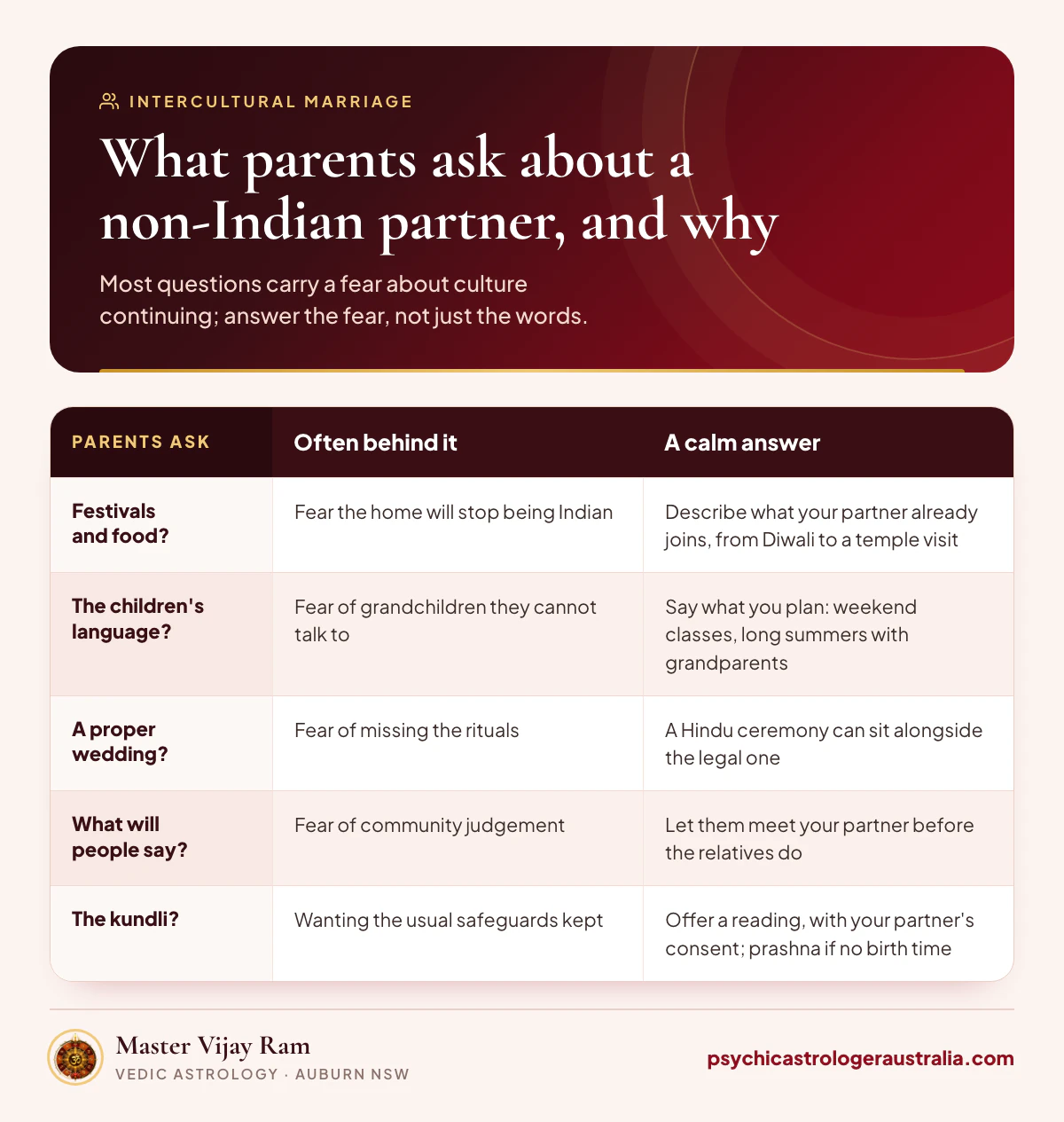
What do parents actually ask, and what is behind it?
Parents rarely object to the person directly. They ask practical-sounding questions that carry a deeper fear: of losing a child to another culture, of grandchildren who cannot speak to their grandparents, of the community’s judgement. Answering the fear rather than the surface question shortens most arguments.
| What parents ask | What is often behind it | A calm way to answer |
|---|---|---|
| Will they respect our festivals and food? | Fear the home will stop being Indian | Describe what your partner already joins: Diwali, a temple visit, a vegetarian kitchen |
| Will the children speak Hindi or Punjabi? | Fear of grandchildren they cannot talk to | Say what you plan, such as weekend classes and long summers with the grandparents |
| Will there be a proper wedding? | Fear of missing the rituals and the family gathering | Explain that a Hindu ceremony can sit alongside the legal one |
| What will people say? | Fear of community judgement | Acknowledge it, and let them meet the partner before relatives do |
| What about the kundli? | Wanting the usual safeguards to be kept | Offer a reading, with your partner’s consent |
| Will they stay when things get hard? | Fear of divorce in a culture they do not know | Show the length and steadiness of the relationship so far |
None of these is unreasonable. Most parents ask them because they love you and do not know the other culture well enough to imagine the future.
How do you introduce the idea to parents?
Gradually, and in the right order. Tell one parent or an older sibling first, the one most likely to listen, and let them help with the other. Introduce your partner as a person before you introduce them as a fiancé: a dinner, a festival, a visit when nothing is being decided.
Many of the same principles apply as in convincing parents about a love marriage, with one difference. Your partner may not know what a roka is, why the elders are touched first, or why turning down food offends; a short, kind briefing before the first meeting prevents many small hurts.
What should your partner know before meeting the family?
A little preparation spares everyone. Tell your partner who will be there, how to greet the elders (many families appreciate a namaste or touching an elder’s feet, though nobody expects perfection), and that food will be offered more than once and refusing everything can sound like refusing the family. Mention any topics your parents are sensitive about, such as previous relationships, alcohol or living together.
Brief your parents too. Tell them what your partner’s family is like, what they already know about Indian customs, and what might feel unfamiliar to them, such as how loud and crowded a family gathering can be. Convincing parents about a foreign partner is far easier when both sides walk in expecting to be a little out of their depth, and kind about it.
Language matters more than people think. If your parents are more comfortable in Hindi or Punjabi, a few words from your partner go a long way, and a sibling who can quietly translate keeps the evening from feeling like an interview.
Can you match kundlis with a non-Indian partner?
Yes, if your partner agrees. A kundli needs only a date, a place and, ideally, a time of birth, and none of those depends on culture.
The chart is read the same way for anyone. What matters first is consent: your partner’s birth details are theirs to share, and a reading should not be done behind their back.
Some partners are curious and enjoy it; some are sceptical. If yours is sceptical, when one partner believes and the other does not looks at how couples handle that with respect on both sides. A reading is for the family that values it, never a test the partner must pass.
What if your partner does not know their birth time?
Making a kundli with an unknown birth time is a common request, because many families outside South Asia never recorded it. The first step is to look: a parent may remember, a hospital record may hold the time, and each state’s Registry of Births, Deaths and Marriages explains what its records contain. Finding birth time records in Australia and India sets out where to ask.
If no time can be found, there are still options. The Moon moves about one sign every two and a half days, so the Moon sign is often certain from the date alone, and sometimes the nakshatra is too. Where the Moon changed sign or nakshatra that day, the astrologer says so plainly rather than guessing.
When is a prashna chart used instead?
A prashna chart is cast for the moment a sincere question is asked, and it is the traditional answer when a birth time cannot be found. For a couple, the question might be “Is this a good time for us to marry?” rather than a full comparison of two lives. Prashna kundli without a birth time explains how it works and what it can answer.
Prashna answers one question at a time and does not replace a natal chart for a lifetime’s themes. For many families, though, it satisfies the wish to have consulted the tradition before a wedding.
What can the chart say about an intercultural marriage?
Traditionally, a partner from a distant land or culture is read through Rahu’s link to the seventh house or its lord, the ninth and twelfth houses, and sometimes Venus in a foreign sign. These are tendencies, not verdicts; plenty of people with these placements marry within their community, and plenty without them marry across cultures. A reading looks at your own seventh house and the dasha you are running for timing.
What the chart can usefully show is when family resistance is likely to soften. A strained Saturn or Rahu period over the fourth house (home and parents) often coincides with the hardest conversations, and many families find the mood eases as it passes. A relationship compatibility reading compares temperaments, which matters more than any cultural label.
Does the wedding have to be a Hindu wedding?
No, but many couples choose to include one. In Australia the legal marriage is made under Australian law with an authorised celebrant, and a Hindu ceremony, a church service or a family ritual can be held alongside it. Some priests are authorised celebrants and some are not, so ask when you book.
Couples often combine customs: a mehndi evening and a pheras ceremony with a reception the partner’s family recognises. A muhurat can be chosen for the Hindu ceremony in the usual way, and the partner’s family is usually delighted to be included.
How do you handle the wider family and community?
Parents often accept a partner before grandparents, uncles and aunts do, and they then need support rather than more pressure. Let them decide how and when to tell relatives in India. Avoid making your parents defend you to everyone at once.
In smaller communities, such as those in Newcastle or Geelong, news travels quickly. A few months of quiet introductions before an engagement announcement gives your parents time to find their own words.
What if a parent will not accept the relationship at all?
Some parents need years, and a few never fully accept it. A chart can show timing, but no reading, puja or remedy can make another adult change their mind, and Master Vijay Ram will not offer one that claims to. What he can do is help you see whether a difficult period is passing and how to keep the door open without giving up your choice.
If disapproval turns into threats, pressure to leave the relationship, or talk of a trip to India you have not agreed to, that is a safety matter: 1800RESPECT helps, and forced marriage is a crime in Australia. Relationships Australia offers counselling for couples and families working through cultural difference.
What does a consultation cost, and what can it not do?
A consultation with Master Vijay Ram is $50, by phone, video or WhatsApp, in English, Hindi or Punjabi; partners who speak only English are welcome on the call. Where a family wants a prayer for harmony, a puja is performed personally at his place of practice in Auburn from $250, agreed before it is done, but it is never needed to read a chart. Families in the capital can read how consultations are arranged on the astrologer in Canberra page.
A reading is faith-based guidance. It cannot judge a person’s character by their culture, decide whether your family will accept them, or replace the conversations only you can have.
Read next
- Living Together Before Marriage: What Families and the Chart SayLiving together before marriage: what the Vedic tradition and a birth chart say, de facto relationships in general te…
- Second Marriage: What Your Birth Chart Says About RemarriageSecond marriage astrology: the houses and planets that show remarriage, what a second marriage yoga means, marriage a…
- Kundli Reading Explained: What Your Birth Chart RevealsWhat a Kundli reading reveals about your life, personality, career and destiny. Master Vijay Ram explains Vedic astro…
Frequently asked questions
Can Indian parents accept a non-Indian son-in-law or daughter-in-law?
Many do, often more readily once they have met the person a few times without any decision on the table. Acceptance usually follows when parents see their culture continuing: festivals kept, grandparents involved, a wedding they recognise. Some need months or years. A chart can show when resistance is likely to soften, but it cannot change anyone’s mind for them.
Can we do kundli matching if my partner is not Indian?
Yes. A kundli needs only a birth date, place and ideally time, and the chart is read the same way for anyone. The essential step is your partner’s consent, because their birth details belong to them. If they are sceptical, a reading can be done for the family’s peace of mind without being treated as a test they must pass.
My partner does not know their birth time. Is a chart still possible?
Often, yes. Ask parents, check hospital records, and see what the state Registry of Births, Deaths and Marriages holds. Without a time, the Moon sign is usually certain from the date alone, and sometimes the nakshatra too. Where the Moon changed sign that day, the astrologer says so. A prashna chart can also answer a specific question without any birth time.
What is a prashna reading and when is it used?
A prashna chart is cast for the moment a sincere question is asked. It is the traditional method when a birth time cannot be found or when one question is urgent. For a couple it might answer whether this is a good period to marry. It answers one question at a time and does not replace a full natal chart reading.
Do we need a Hindu wedding if my partner is not Hindu?
No. In Australia the legal marriage is made with an authorised celebrant under Australian law, and a Hindu ceremony, a church service or another family ritual can be held alongside it. Many couples combine customs. Some priests are authorised celebrants and some are not, so ask before booking. A muhurat can be chosen for the Hindu ceremony in the usual way.
Is there a chart sign of marrying someone from another culture?
Traditionally a partner from a distant culture is read through Rahu’s link to the seventh house or its lord, the ninth and twelfth houses, and sometimes Venus. These are tendencies only. Many people with these placements marry within their community, and many without them marry across cultures. The placements describe themes, not a fixed outcome.
What if my parents refuse to meet my partner?
Keep the door open without giving up your choice. Tell the most receptive parent first, suggest a low-stakes meeting such as a festival, and give them time. Relationships Australia counsels families through cultural difference. If refusal turns into threats or pressure to travel to India for a marriage you do not want, contact 1800RESPECT; forced marriage is a crime in Australia.
Can a puja make my family accept my partner?
No. No puja or remedy can make another adult change their mind, and Master Vijay Ram does not offer one that claims to. A family may choose a prayer for harmony, performed personally in Auburn from $250 and agreed before it is done, but it is optional. A $50 consultation can show timing and help you plan the conversations.
People also ask
How do I tell my Indian parents I am dating a non-Indian?
Start with the parent or older sibling most likely to listen, and let them help with the other parent. Introduce your partner as a person first, at a dinner or festival where nothing is being decided. Expect questions about culture, children and the wedding, and answer the worry behind each one calmly rather than defending yourself.
Why do Indian parents object to non-Indian partners?
Usually from fear rather than dislike: fear that the family’s language, festivals and food will not continue, that grandchildren will not speak to their grandparents, or that the community will judge them. Many parents also do not know the other culture well. Time, meetings and seeing their traditions respected usually soften the objection.
Can a kundli be made without a birth time?
A partial one can. From the birth date and place alone the Moon sign is usually certain, and sometimes the Moon’s nakshatra, which is enough for a basic compatibility comparison. The ascendant and houses need a time. Where no time can be found, a prashna chart cast for the moment of a question is the traditional alternative.
Is an interracial marriage accepted in Hindu tradition?
Views differ between families and communities. Many Hindu families in Australia welcome partners from other backgrounds, and priests perform Hindu ceremonies for intercultural couples. What families usually care about most is respect for their customs and the continuation of their culture in the next generation, which a couple can talk through openly.
References & further reading
Serving clients across Australia
Confidential consultations by phone, video & WhatsApp — including: