

Quick answer
The Ketu–Venus antardasha is Venus's sub-period inside the seven-year Ketu mahadasha, lasting 1 year and 2 months from about five months in. It tends to bring colour back after Ketu's flat opening: affection, beauty and comfort return, often in a simpler, more selective form. Old ties can resurface, and the sub-period asks what is still worth wanting.
What is the Ketu–Venus antardasha?
The Ketu mahadasha Venus antardasha is the sub-period of fourteen months in which Venus, the planet of love, beauty and comfort, takes its turn inside Ketu's seven-year period of detachment. In Hindi it is the Ketu Shukra antardasha, and South Indian almanacs list it as the Ketu–Venus bhukti. It is an odd pairing on purpose: the headless node that lets go meets the planet that holds on.
People often describe it as colour coming back into a grey picture, though not always the colour they expected. Master Vijay Ram's graha shanti guidance for Ketu periods treats it as a season for choosing what to keep.
How long does Ketu–Venus last, and when does it start?
It lasts 1 year and 2 months in 360-day years, Ketu's seven years multiplied by Venus's twenty and divided by 120. It is the second sub-period of the Ketu mahadasha and begins about five months in, once Ketu's own short sub-period ends. The Sun's sub-period comes next.
Because it comes so early, it is often the first real break from the flatness or confusion people associate with the start of Ketu's years. The guide to the Ketu mahadasha describes that wider period and why its opening months can feel disorienting.
What happens when detachment meets desire?
Ketu's own months tend to strip things back: interest fades from old goals, possessions feel heavy, and many people turn inward, towards prayer, study or simply quiet. Venus then arrives with appetite for beauty, affection and ease. The result can be a renewed pleasure in life, or a puzzling mix of wanting and not wanting at the same time.
A woman on the Gold Coast who stopped caring about her design work during the opening Ketu months might find the interest returning in this sub-period, but pointed at something simpler: handmade work, a smaller studio, devotional art. That is an invented example, yet it captures what the tradition expects, desire returning in a quieter, more selective form.
How is Ketu–Venus different from Venus–Ketu?
The same two planets, read in opposite settings. Venus–Ketu is the very last sub-period of Venus's twenty years: a long period of comfort and relationships is ending, and Ketu arrives to loosen what will not continue into the Sun mahadasha. It often feels like a farewell, and the overview of the Venus mahadasha places it at the close of that sequence.
Ketu–Venus is the reverse. The setting is detachment, and Venus arrives early, almost as a reminder that letting go does not mean living without love or beauty. Where Venus–Ketu asks what to release, Ketu–Venus asks what is still worth wanting.
What does the sub-period bring to relationships?
Several Ketu Venus marriage and relationship patterns come up in readings. Ketu is linked with the past, so an old friend or former partner sometimes reappears; whether that is a second chance or simply closure is a question for the people concerned, not the chart. Some meet a partner with a strong spiritual or unconventional side.
In existing marriages, one partner may want more closeness while the other feels oddly distant. That mismatch is common in Ketu periods and usually eases with honest talk rather than grand gestures. The post on Ketu in the seventh house covers the natal version of this theme.
Weddings do take place in Ketu–Venus, particularly when Venus is strong and connected with the 7th house. Families planning one can ask for the love and marriage timing reading, which reads both charts together. Where a relationship has become unhappy or unsafe, Relationships Australia and 1800RESPECT are the places to start.
What happens to comfort, money and possessions?
Venus rules vehicles, jewellery, clothes, furniture and the pleasures of home. In Ketu's setting, people often find themselves selling, giving away or simplifying these things, and then buying one or two good ones with care. Decluttering, downsizing and choosing quality over quantity fit the period well.
Money tends to follow the same pattern. Spending on comfort drops, then returns in a more considered way; a creative or artistic income sometimes appears. The tradition warns against spending to fill an inner emptiness, which is a Ketu feeling dressed in Venus's clothes.
How do the two pulls balance in daily life?
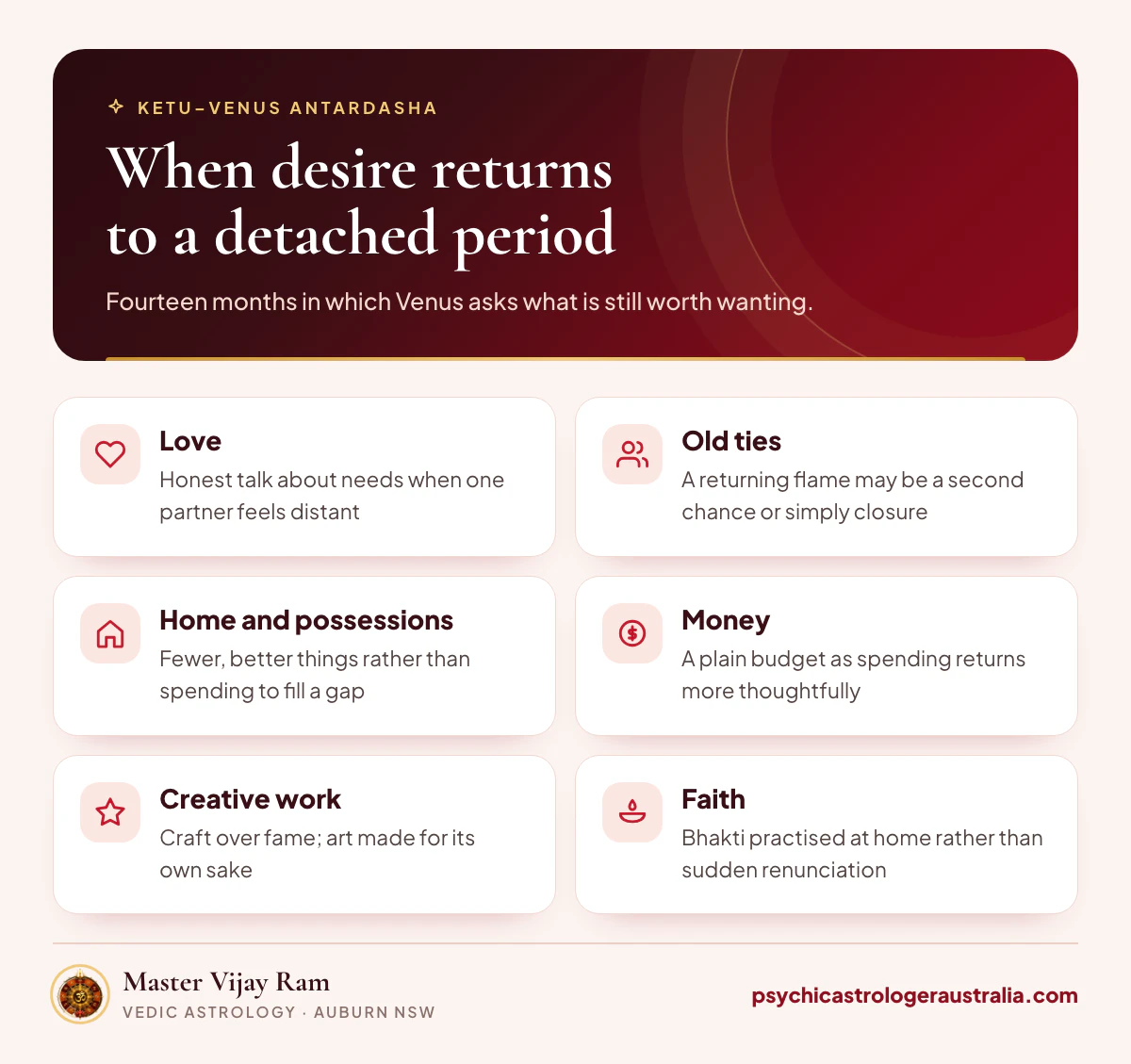
The table sets out the main areas, with Ketu's pull, Venus's pull and the balanced response the tradition tends to favour. It describes tendencies, and your own chart decides how strongly each applies.
| Area | Ketu's pull | Venus's pull | A balanced response |
|---|---|---|---|
| Love | Distance, old ties, inner focus | Affection, romance, partnership | Honest talk about needs |
| Home | Simplify, give away | Beautify, entertain | Fewer, better things |
| Money | Indifference to wealth | Spending on comfort | A plain budget |
| Creative work | Devotional, solitary | Artistic, social | Art made for its own sake |
| Faith | Renunciation, retreat | Devotion, celebration | Bhakti practised at home |
How do positions at birth change the reading?
Venus's dignity comes first. Venus is exalted in Pisces, debilitated in Virgo and at home in Taurus and Libra; a dignified Venus makes the sub-period warmer and steadier. Traditions differ on Ketu's own exaltation, with some placing it in Scorpio and others in Sagittarius.
Next is where Ketu sits from Venus. Ketu in a kendra or trikona from Venus usually lets the two cooperate; Ketu in the 6th, 8th or 12th from Venus can make pleasures feel hollow or relationships feel distant. If the two share a sign at birth, astrologers often read an artistic or spiritual turn in love, and this sub-period is when it shows most.
The houses Venus rules for your lagna decide where the colour returns. The guide to Venus in the twelve houses explains what each house adds.
Is it a good time for spiritual practice?
Very often. Ketu is the significator of moksha and Venus of devotion through beauty, so bhajans, kirtan, temple seva, devotional painting or a simple evening lamp before Lakshmi all sit naturally in this sub-period. Many people find their practice becomes warmer and less dutiful.
The caution is against extremes. Ketu can tempt someone to renounce a marriage or a job in a burst of feeling; Venus can tempt them to make a guru into an object of romantic devotion. Steady practice within ordinary life is the tradition's middle path.
What about work and creative careers?
For people whose work is Venusian, design, music, beauty, hospitality, fashion, the arts, the sub-period often revives a skill that Ketu's opening months had dulled. The revival tends to favour craft over fame: fewer clients, more care, work done because it is good rather than because it sells. Some people retrain in a creative field they had abandoned years earlier.
For everyone else, Venus brings the pleasant side of working life forward: a kinder team, a better workspace, an employer who notices small courtesies. Ketu keeps ambition modest. It is rarely the sub-period for a dramatic career leap, and often a good one for making ordinary work more bearable.
What do the first and last months feel like?
Entering Ketu–Venus, people often notice small appetites returning before anything outward changes: wanting to cook again, to dress with care, to ring a friend. Leaving it, the Sun's sub-period begins and the questions shift towards confidence, health and standing. The handover months can feel unsettled, as junctions between sub-periods usually do.
What about health?
Venus is traditionally linked with the kidneys, the reproductive system and skin, and Ketu with conditions that are hard to name. Any persistent symptom belongs with a GP, and a chart neither diagnoses nor treats anything. Restful sleep and regular meals matter more than any remedy.
Which remedies suit the Ketu–Venus months?
Friday prayers to Lakshmi are the usual Venus practice, with the Venus beej mantra in your family's version and a gift of rice, sugar or white cloth. For Ketu, many families pray to Ganesha and chant Om Sraam Sreem Sraum Sah Ketave Namah; the traditional Ketu gifts are mixed grains, blankets and help to dogs, best given through an animal shelter rather than by feeding strays.
The most suitable remedy is gratitude for simple pleasures: a meal shared, a song learned, a garden kept. Where a reading does find a shanti useful, Vijay Ram ji performs the Ketu or Shukra puja himself at his practice in Auburn, beginning at $250 and agreed beforehand; you can follow along by video, as the puja and havan service page describes. The reading that decides it is $50.
What can a Ketu–Venus reading not tell you?
It cannot tell you whether an old flame should be welcomed back, whether a marriage will last or what to give away. It can show when the pull between detachment and desire is strongest and help you see it as a season rather than a crisis. Those decisions stay with you and the people you love.
People on the Gold Coast talk to Vijay Ram ji by phone or video, in English, Hindi or Punjabi; the page for Gold Coast clients explains how, and in-person visits are only at Auburn.
Read next
- Venus Mahadasha, Rahu Antardasha: Desire and DistractionVenus mahadasha Rahu antardasha: three years of louder desire, relationship and money tendencies, the affair fear ans…
- Venus Mahadasha: Love, Comfort and Their LessonsVenus mahadasha explained: what the twenty-year Shukra period brings for love, money, comfort and work, its antardash…
- Online Istikhara Service in Australia for Marriage & DecisionsHow online istikhara for marriage and other decisions works in Australia, what a genuine practitioner asks for, and t…
Frequently asked questions
How long is Ketu mahadasha Venus antardasha?
Fourteen months, written as 1 year and 2 months, using the traditional 360-day year. Seven Ketu years times twenty Venus years, divided by 120, gives that figure. Venus's sub-period is second in the Ketu mahadasha, so it opens about five months in, and the Sun's sub-period follows when it closes.
Is Ketu–Venus antardasha good for marriage?
Weddings do happen in it, especially when Venus is strong and connected to the 7th house. The tradition also reads distance or a spiritual flavour in relationships, and sometimes the return of someone from the past. A reading of both partners' charts shows whether the window is supportive; the decision stays with the couple.
Why do old relationships come back in Ketu–Venus?
Ketu is linked with the past and with unfinished karma, and Venus with love, so the tradition expects old ties to resurface. Whether that is a second chance or simply closure depends on the people involved and what has changed. A chart cannot decide it for anyone.
What are the Ketu Venus effects on money?
Spending on comfort often drops in the opening months and then returns in a more considered way. Some people simplify their possessions or find a creative income. The tradition warns against spending to fill an inner emptiness, and a plain monthly budget is the most useful safeguard.
How is Ketu–Venus different from Venus–Ketu?
Venus–Ketu closes the twenty-year Venus mahadasha, so Ketu loosens what will not carry forward and it often feels like a farewell. Ketu–Venus comes early in Ketu's seven years, so Venus brings affection and beauty back into a detached period. One asks what to release; the other asks what is still worth wanting.
Is Ketu–Venus good for spiritual practice?
Often. Ketu signifies moksha and Venus devotion through beauty, so bhajans, kirtan, temple seva and devotional art suit the period. The caution is against extremes, such as renouncing a marriage or job in a burst of feeling. Steady practice within ordinary life is the traditional middle path.
What remedies help in Ketu Shukra antardasha?
Friday prayers to Lakshmi with a gift of rice, sugar or white cloth for Venus, and Ganesha worship with the Ketu beej mantra for Ketu, are traditional. Ketu's gifts of mixed grains and blankets, and help to dogs through an animal shelter, are also used. No stone is suggested from the dasha alone.
What does a Ketu–Venus reading cost?
The consultation is $50, held by phone, video or WhatsApp in English, Hindi or Punjabi. If a Ketu or Shukra puja is warranted, it begins at $250, the amount is agreed before anything is done, and Master Vijay Ram performs it personally at his practice in Auburn. Most readings need no puja.
People also ask
What happens in Venus antardasha of Ketu mahadasha?
The tradition reads the return of Venus's themes, love, comfort, beauty and art, into a period otherwise marked by detachment. Interest in life often revives in a simpler form, old relationships may resurface, and possessions are pared back. The detail depends on Venus's dignity and its position from Ketu at birth.
What comes after Ketu–Venus antardasha?
Ketu–Sun follows. The Ketu mahadasha runs its sub-periods in the order Ketu, Venus, Sun, Moon, Mars, Rahu, Jupiter, Saturn and Mercury. The Sun's sub-period is short and is often read as bringing questions of identity, health and authority forward after the softer Venus months.
Can Ketu–Venus cause separation?
It can bring distance or a sense of detachment within a relationship, but a chart does not cause a separation. Honest conversation, and counselling through Relationships Australia where needed, usually helps. If a relationship has become unsafe, 1800RESPECT is the national line, and 000 in an emergency.
Is Ketu friendly with Venus?
Traditions differ. Many astrologers treat Ketu as acting like Mars, which is neutral towards Venus, so the pairing is read through the chart rather than a fixed rule. Ketu's position from Venus at birth, Venus's dignity and the houses involved decide how well they work together.
References & further reading
Serving clients across Australia
Confidential consultations by phone, video & WhatsApp — including: