
Quick answer
The ishta devata is the personal form of the divine a person feels most drawn to worship. Astrologers look for pointers to it in the chart, most often from the 12th house counted from the karakamsa, or from the 5th and 9th houses and their lords. Methods differ, the family's kula devata comes first, and devotion matters more than any formula.
What is an ishta devata?
An ishta devata is the chosen deity, the particular form of the divine that a person feels closest to and returns to in prayer. Ishta means beloved or desired. For one person it is Krishna, for another Durga, Hanuman, Shiva or Ganesha, and Hindu tradition has long held that the divine is one while the forms through which people approach it are many.
Most people do not find their ishta devata in a chart. They find it at home, in a grandmother's prayer room, at a temple they visited as a child, or in a name that steadies them in a hard week. Astrology offers a second way of looking, and it is best used as a confirmation of what the heart already knows.
The question often comes up near the end of a full kundli reading, when someone asks which deity they should be praying to.
How is the ishta devata different from the kula devata?
The kula devata, or kuldevi or kuldevta, is the family deity, honoured by a lineage over generations, often at a particular temple in a particular village. The ishta devata is personal. A Punjabi family's kuldevi may be a form of the Goddess in a Himachal shrine, while one of its grandchildren finds her own ishta in Krishna.
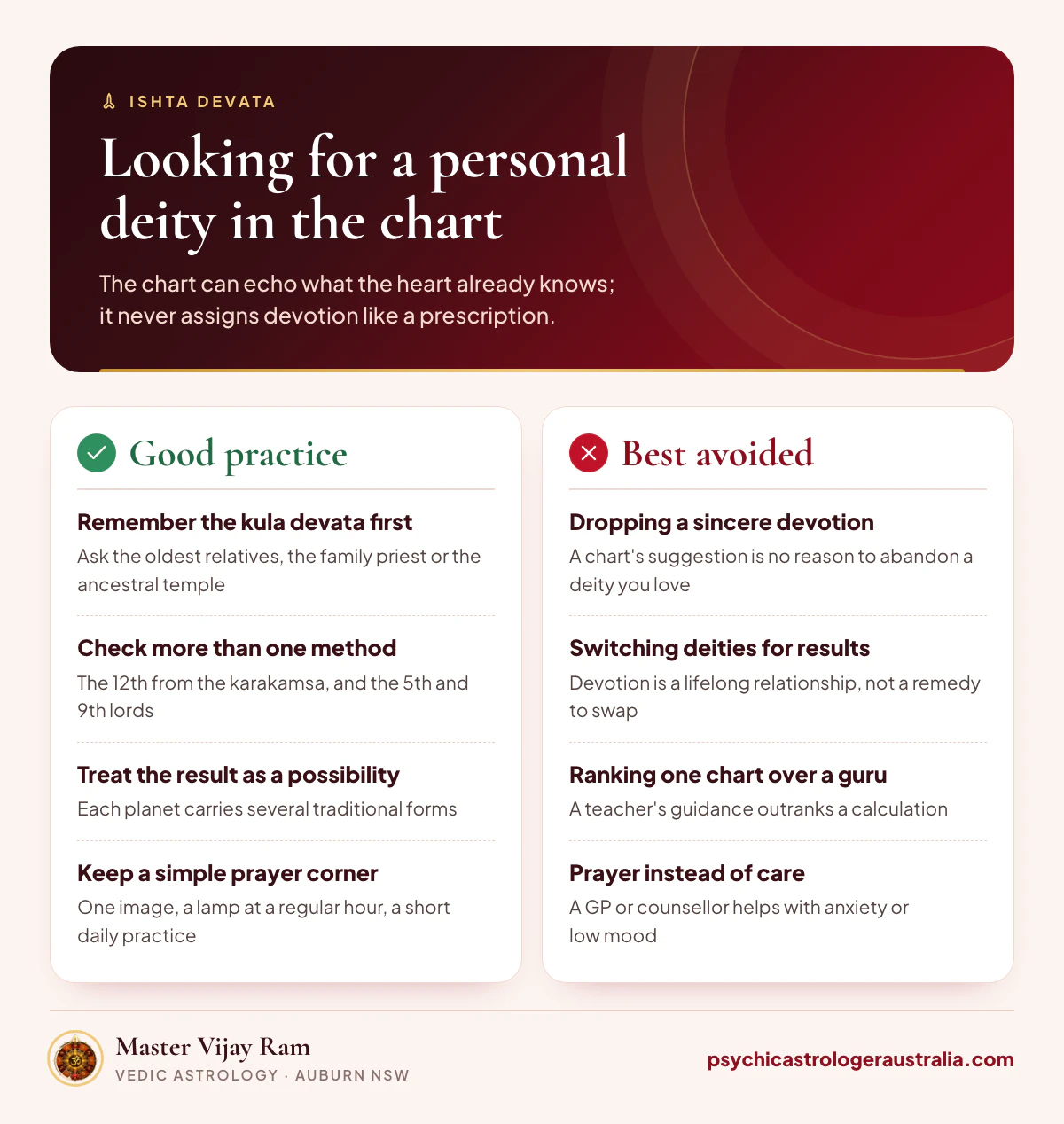
The traditional order is clear and Vijay Ram ji holds to it: the family deity is remembered first, at weddings, births and the beginning of new work, and the personal deity is worshipped alongside, not instead. Families who have lost track of their kula devata after migration can usually recover it by asking the oldest relatives, or the family priest or temple in the ancestral district.
Which methods do astrologers use to find the ishta devata?
There is no single agreed method, and a careful astrologer says so. Three approaches are common.
- The 12th from the karakamsa: in Jaimini practice, the house twelfth from the navamsa sign of the atmakaraka is read for the deity of liberation; the planet in it, or aspecting it, or its lord, suggests the form.
- The 5th house and its lord: the fifth is the house of mantra, devotion and merit from past lives, so the planet that rules or occupies it is read as a pointer to the form of worship that comes naturally.
- The 9th house and its lord: the ninth is dharma, the guru and faith; its lord is read for the deity and teacher who guide a person's path.
The first method needs the atmakaraka and the navamsa, which are explained in atmakaraka, the soul planet. The second and third use the ordinary birth chart.
How does the 12th from the karakamsa method work?
Find the atmakaraka, the planet with the highest degree in its sign. Find the sign it occupies in the navamsa; that is the karakamsa. Count twelve signs from it, which means the sign immediately before it. Then look at what is in that sign in the navamsa, what aspects it, and which planet rules it.
Take an invented example. The atmakaraka is Venus, in Aries in the navamsa, so Aries is the karakamsa. The twelfth from Aries is Pisces. If Jupiter sits in Pisces in the navamsa, Jupiter is the strongest pointer; if Pisces is empty, its lord, also Jupiter, is used. A reader would then look among the forms traditionally linked with Jupiter.
Different teachers prefer the planet in the house, the strongest aspect, or the lord, and some read the 6th from the amatyakaraka instead. These are real differences within the tradition, not errors.
Which deities are linked with which planets?
The pairings below are associations commonly given; texts, regions and families differ, and many planets carry more than one. They are a starting point for reflection, not a ruling.
| Planet | Forms often associated | Common practice |
|---|---|---|
| Sun | Shiva, Rama, Surya | Water offered at sunrise, the Aditya Hridayam |
| Moon | Parvati (Gauri), Krishna | Monday prayer, the Lalita names |
| Mars | Hanuman, Kartikeya (Murugan) | Tuesday prayer, the Hanuman Chalisa |
| Mercury | Vishnu, Narayana | The Vishnu Sahasranama |
| Jupiter | Vishnu, Dattatreya, Shiva as teacher | Thursday prayer, honouring the guru |
| Venus | Lakshmi, the Goddess | Friday prayer, the Shri Suktam |
| Saturn | Shiva, Hanuman, Bhairava | Saturday prayer, service to the poor |
| Rahu | Durga | The Durga Saptashati, Navratri |
| Ketu | Ganesha | Ganesha prayer before any undertaking |
The table explains why two astrologers can name different deities from the same chart: one reads Jupiter as Vishnu and another as Dattatreya, and both are within the tradition.
What do the 5th and 9th houses add?
The fifth house is where many astrologers look for the form of devotion that comes easily: the mantras a person can repeat without strain, the deity whose stories they remember from childhood. The fifth house of past merit and mantra covers its wider meanings.
The ninth house is read for the teacher, the tradition and the faith a person grows into. When the fifth and ninth lords point to the same planet, or to forms that belong together, such as Rama and Hanuman, the reading is felt to be firmer. When they point in different directions, the person's own experience settles it.
What if the chart points to a deity you do not feel drawn to?
Then the chart gives way. The tradition holds that devotion cannot be assigned like a prescription; a deity worshipped out of duty to a calculation rarely becomes beloved. Many people find that a form they had not considered grows on them over time, and many find the chart simply confirmed what they already loved.
It is also common for the chart to name a planet whose associated forms include the family's own deity, which is a gentle way of returning someone to the lineage. Either way, the person's sincere attraction is the final word, and a guru's guidance outranks a horoscope.
A worked illustration: a nurse in Cairns
Picture a nurse in Cairns, raised in a Gujarati family that visits its kuldevi's temple whenever it travels home, who has found herself drawn to Hanuman since a difficult year of night shifts. She asks whether that is the right deity for her or whether she should follow her mother's devotion to Krishna.
In this illustration her atmakaraka is the Moon, the karakamsa is Taurus, and Mars sits in Aries, the twelfth from it, in the navamsa. Mars is commonly linked with Hanuman, so the chart echoes what she already feels. Her fifth lord, Venus, points toward a gentler, Krishna-centred devotion as well.
A reader would not tell her to choose. Hanuman for strength in hard years, Krishna as the family's warmth and the kuldevi at every family occasion can all sit together in one prayer corner, and that is the advice she would hear.
Is worshipping the ishta devata a remedy?
It is better thought of as a practice than a remedy. Remedies in Vedic astrology are aimed at a planet under strain in a particular period; ishta devata worship is a lifelong relationship that steadies the person through every period. Many astrologers say that sincere worship of the ishta devata eases difficult dashas more than any single ritual, but that is a statement of faith, not a measurable effect.
The planetary mantras are a separate matter, set out in the nine planet mantras. Where a family wants a puja for the ishta devata, it is performed personally by Master Vijay Ram at his place of practice in Auburn, starting from $250 and agreed before it is performed, as described under how a puja is arranged.
How do families in Australia keep a personal deity?
Many keep a small shelf or cupboard as a prayer corner, with one image or murti of the ishta and one of the family deity, a lamp lit at a regular hour, and a simple daily practice that fits shift work and school runs. Regularity matters more than elaborate ritual.
Temples help too. Families on the Illawarra and southern Sydney side often visit the Sri Venkateswara Temple at Helensburgh, and every capital city has temples that hold festivals for the major forms of the divine. People in regional towns without a temple often gather in community halls for the big festival days. Clients in the Illawarra can arrange a reading through readings for Wollongong clients.
What can a chart not tell you about your deity?
A chart cannot tell you whom you love, and it cannot judge the worth of anyone's devotion. Its plainest limitation is that the methods disagree, the birth time affects the karakamsa, and a single planet carries several possible forms.
Nor is faith a substitute for care. Anyone who feels spiritually lost, anxious or low deserves practical support as well as prayer: a GP, a counsellor, Beyond Blue, or Lifeline on 13 11 14.
How does Master Vijay Ram approach the question?
He asks first about the family deity and the forms the person already prays to. He then checks the twelfth from the karakamsa, the fifth and ninth lords, and offers what the chart suggests as a possibility to sit with, never an instruction. If the chart and the person's heart agree, he says so; if they do not, he trusts the heart.
A $50 consultation by phone, video or WhatsApp, in English, Hindi or Punjabi, covers the reading. Those who want the wider spiritual picture of the chart may also find the graha shanti puja page useful, since planetary worship and the personal deity are often discussed together.
Read next
- How to Read Your Birth Chart: A Beginner’s Guide to the Vedic MethodHow to read your birth chart the Vedic way: find the lagna and Moon sign, learn the 12 houses and nine grahas, check …
- Maraka Planets and the Fear of Death in a ChartMaraka planets and houses 2 and 7 explained honestly: what the term means, why every chart has them, and why no readi…
- Kundli Reading Explained: What Your Birth Chart RevealsWhat a Kundli reading reveals about your life, personality, career and destiny. Master Vijay Ram explains Vedic astro…
Frequently asked questions
How can I find my ishta devata from my birth chart?
Astrologers commonly use the twelfth house counted from the karakamsa, the navamsa sign of the atmakaraka, reading the planet in it, aspecting it or ruling it. Others use the fifth and ninth houses and their lords. Each planet is then linked with traditional forms of the divine. The methods differ, so treat the result as a possibility to reflect on.
What is the difference between ishta devata and kula devata?
The kula devata is the family deity, honoured by a lineage over generations, often at a temple in the ancestral region. The ishta devata is the personal deity an individual feels most drawn to. Tradition remembers the family deity first at important occasions and worships the personal deity alongside it.
How do I find my kula devata if my family has lost track?
Ask the oldest relatives on the father's side first, since the family deity often follows the paternal line, then the family priest or the temple in the ancestral village or district. Wedding and mundan customs often preserve clues, such as where a first haircut was traditionally offered. A chart is a poor substitute for family memory here.
Which deity is linked with Jupiter?
Jupiter is commonly associated with Vishnu, with Dattatreya and with Shiva as the supreme teacher, and is honoured on Thursdays and through respect for the guru. Associations vary between texts, regions and families, which is why astrologers sometimes name different deities for the same planet. Your own attraction and family tradition help decide among them.
Can my ishta devata change over time?
The chart's pointers do not change, but people's devotion often deepens or shifts across a lifetime, sometimes after a pilgrimage, a teacher or a hard period. The tradition generally encourages steadiness with one form once it is truly found, while accepting that the divine is one and that the forms people approach it through may grow.
Should I stop praying to my current deity if the chart suggests another?
No. A chart's suggestion is not a reason to abandon a sincere devotion. Many people add a short prayer to the indicated form and see whether it grows on them; many find the chart simply confirmed what they already loved. Sincere attraction and a guru's guidance matter more than any calculation.
Is worshipping the ishta devata enough to fix a bad dasha?
Many devotees find that steady worship helps them carry a difficult period with more calm, and the tradition values it highly. That is a matter of faith rather than a promised effect. Practical problems in any period still need practical help, from a GP, a lawyer or a financial counsellor, alongside prayer.
Do I need a puja to establish my ishta devata at home?
No puja is required. A clean prayer corner, one image or murti, a lamp at a regular hour and a short daily practice are enough. Some families like a formal puja when they set up a new altar; if wanted, Master Vijay Ram performs it personally in Auburn from $250, agreed beforehand, after a $50 consultation.
People also ask
What does ishta devata mean?
Ishta devata means the beloved or chosen deity. It is the particular form of the divine, such as Krishna, Shiva, Durga or Ganesha, that a person feels closest to and returns to in prayer, alongside the family's own deity.
What is the 12th house from karakamsa?
It is the sign immediately before the karakamsa, the navamsa sign of the atmakaraka. In Jaimini practice the planet in it, aspecting it or ruling it is read as a pointer to the ishta devata, the deity linked with liberation.
Which god should I worship according to astrology?
Astrology can suggest forms linked with particular planets in your chart, but traditions differ and the suggestions are not commands. The family deity comes first, and your own sincere attraction and a guru's guidance matter more than any chart.
Can a chart show my kuldevi?
Not reliably. The kuldevi or kula devata is a matter of family lineage and memory rather than a planetary placement. Elders, the family priest and the ancestral temple are the best sources; a chart may at most echo what the family already knows.
References & further reading
Serving clients across Australia
Confidential consultations by phone, video & WhatsApp — including: