

Quick answer
Graha drishti is the Vedic idea that a planet casts its gaze on certain houses counted from its own. Every planet aspects the 7th house from itself; Mars also aspects the 4th and 8th, Jupiter the 5th and 9th, and Saturn the 3rd and 10th. Many traditions give Rahu and Ketu the 5th and 9th. Counting is inclusive, starting from the planet's own house.
What is graha drishti?
Graha drishti is a planet's aspect, a line of influence that the Vedic tradition says each planet casts from its own house onto certain other houses. Drishti means sight or gaze, and the picture is literal: a planet looks across the chart and colours whatever it looks at. A house with no planet in it can still be strongly shaped by the planets that aspect it.
Aspects are one of the first layers an astrologer reads after placements, and they explain why two charts with the same planet in the same house can read very differently. This guide covers the rules, the counting, a worked example and the main ways the Vedic method differs from Western aspects. A kundli reading by Master Vijay Ram applies all of it to a real chart.
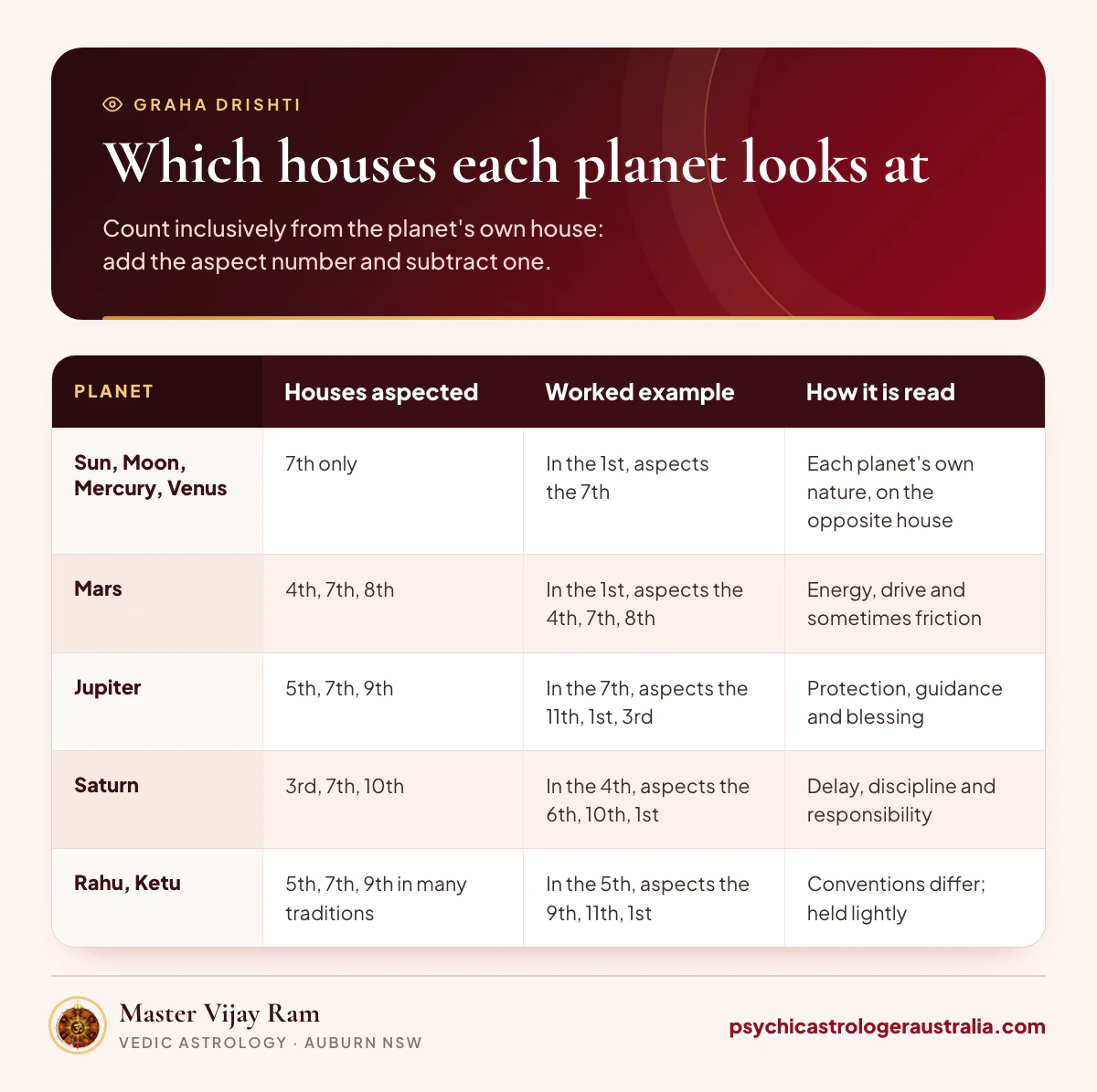
Which houses does each planet aspect?
Every planet aspects the 7th house from itself, the house directly opposite. Three planets have special aspects in addition, and many traditions add special aspects for the lunar nodes. These are full aspects, counted by house.
| Planet | Aspects (houses from itself) | Special aspects |
|---|---|---|
| Sun | 7th | None |
| Moon | 7th | None |
| Mercury | 7th | None |
| Venus | 7th | None |
| Mars | 4th, 7th, 8th | 4th and 8th |
| Jupiter | 5th, 7th, 9th | 5th and 9th |
| Saturn | 3rd, 7th, 10th | 3rd and 10th |
| Rahu, Ketu | 5th, 7th, 9th in many traditions | 5th and 9th (traditions differ) |
So the familiar search phrases, jupiter aspect 5 7 9, saturn aspect 3 7 10 and mars aspect 4 7 8, are simply this table written as numbers. Some practitioners give the nodes no special aspect at all, and a few give them the 2nd or 12th as well; a careful reading tells you which convention it follows.
How do you count an aspect correctly?
Counting is inclusive: the house the planet occupies is counted as the 1st. This is where most beginners slip by one. If Saturn sits in the 4th house, its 3rd aspect falls on the 6th house, because the 4th is one, the 5th is two and the 6th is three.
A simple way to avoid the mistake is to add the aspect number to the planet's house and subtract one. Saturn in the 4th: 4 plus 3 minus 1 is 6; 4 plus 10 minus 1 is 13, which wraps round to the 1st. If the answer is more than 12, take 12 away. The same arithmetic works for any planet in any house.
A worked example: one chart, four planets
Here is an imaginary chart, used only to show the counting. Mars sits in the 1st house, Saturn in the 4th, Rahu in the 5th and Jupiter in the 7th. The table works out each planet's aspects.
| Planet and house | Aspect counts | Houses aspected |
|---|---|---|
| Mars in the 1st | 4th, 7th, 8th | 4th, 7th, 8th |
| Saturn in the 4th | 3rd, 7th, 10th | 6th, 10th, 1st |
| Rahu in the 5th | 5th, 7th, 9th | 9th, 11th, 1st |
| Jupiter in the 7th | 5th, 7th, 9th | 11th, 1st, 3rd |
Look at the 1st house. It holds Mars and receives aspects from Saturn, Rahu and Jupiter. A reader would see energy and drive from Mars, pressure and seriousness from Saturn, restlessness from Rahu and Jupiter's steadying wisdom all meeting on the self. That mixture, rather than any single influence, is what the reading describes.
Notice also that Mars in the 1st and Jupiter in the 7th aspect each other, because each is 7th from the other. Mutual aspects like this are read as a two-way conversation between the planets and the houses they rule.
What about an empty house that receives aspects?
People often panic when they see an empty 7th or 10th house, as if nothing could happen there. An empty house is read through two things: its lord, wherever that planet sits, and the planets that aspect it. A 10th house with no occupant but a strong Jupiter aspecting it is far from empty in the reading.
An illustration: a nurse working night shifts on the Central Coast had nothing in her 10th house and assumed her career was unremarkable in the chart. Saturn aspected that house from the 1st by its 10th aspect, and the 10th lord sat well in the 11th. Long hours, steady responsibility and gradual seniority were all there; they simply came through aspect and lordship rather than occupation.
So before reading anything into an empty house, list who looks at it and where its lord has gone. The answer is usually more interesting than the blank square suggests.
Why do Mars, Jupiter and Saturn get special aspects?
The texts give the rules rather than reasons, but the tradition offers readings of each. Mars, the fighter, looks at the 4th and 8th, the home behind it and the hidden ground ahead, like a soldier watching both flanks. Jupiter, the teacher, looks at the 5th and 9th, the two houses of learning, children, merit and faith that sit in trine to it.
Saturn, the slow worker, looks at the 3rd, the house of effort, and the 10th, the house of duty and career, which suits a planet that rewards persistence. These are images to help memory, not explanations a physicist would accept, and they are presented that way.
Is an aspect always good or bad?
No. An aspect carries the nature of the planet and the houses it rules. A Jupiter aspect is traditionally welcomed as protective because Jupiter is the greatest natural benefic, and many astrologers say a house aspected by a strong Jupiter is never wholly without help. A Saturn aspect brings delay, discipline and responsibility, which can be hard in youth and useful later.
The lagna changes everything. For a Libra lagna, Saturn is the yogakaraka, ruling both the 4th and 5th houses, so its aspect carries the support of those houses as well as Saturn's sternness. For a Leo lagna, the same Saturn rules the 6th and 7th, and its aspect brings the matters of those houses instead. The natural friendships between planets add another layer, since an aspect between friends is read as easier than one between enemies.
How do aspects explain the Manglik houses?
The 7th house is the house of marriage, and Mars aspects it from three places: from the 1st by its 7th aspect, from the 4th by its 4th aspect and from the 12th by its 8th aspect. Add Mars sitting in the 7th itself, and four of the houses most commonly used to define Mangal dosha are explained by Mars's reach to the marriage house.
That is why a proper Manglik check looks at what Mars actually aspects and in what dignity, not just a house number; Manglik dosha checks and cancellations explains the cancellations. The guide to the seventh house and marriage covers the house itself.
Do aspects matter in transits?
Yes, and many people feel them more than they feel the transit sign. When Saturn moves through a sign, its 3rd, 7th and 10th aspects fall on three other signs at the same time, so a Saturn transit is really four areas of the chart under Saturn's gaze. Jupiter's 5th, 7th and 9th aspects do the same for blessing and expansion.
The method of reading transits from the Moon sign, and where those aspects land, is set out in gochar, reading transits from the Moon. A transit aspect confirms what the dasha already promises; it does not create an event the birth chart lacks.
How are Vedic aspects different from Western aspects?
Western astrology measures aspects by exact angles between planets, such as 90°, 120° and 180°, with an allowed margin called an orb. Its aspects work both ways and include angles the Vedic system does not use in the same way, such as the trine and the square. Vedic graha drishti is counted by whole houses or signs, and the special aspects are one-way: Saturn aspects the 10th from itself, but a planet in that 10th does not aspect Saturn back unless it has its own reason to.
Within the Vedic world there is a second system too. The Jaimini school uses sign-based aspects, where whole signs aspect other signs by fixed rules, and Parashara describes partial aspects of lesser strength on certain houses. Most everyday readings rely on the full aspects in the first table, and that is the method used here.
Can a difficult aspect be eased?
Rarely is anything needed. An aspect describes an influence, and influences in a chart are lived with rather than removed. When a demanding aspect is active during a hard period, the usual suggestions are the planet's weekday practice and mantra, and patience with the matters it touches.
A graha shanti is considered only when the whole chart points to it. Master Vijay Ram performs any such rite personally at his place of practice in Auburn, starting from $250 and agreed with you beforehand; puja and havan performed on request explains what it involves. Most questions about aspects are answered in a $50 consultation.
What aspects cannot tell you
An aspect is one thread. It cannot by itself predict an accident from a Mars aspect or a divorce from a Saturn aspect on the 7th, and anyone who reads it that way has stopped reading the rest of the chart. This is faith-based guidance, not medical, legal or relationship advice; a GP, lawyer or counsellor is the right first call for a real problem.
Clients in Queensland, where the clocks never change, ask by phone and video as easily as anyone; astrology readings for Brisbane covers how they book. Consultations are in English, Hindi or Punjabi.
Read next
- Graha Shanti Puja: Which Planet Needs Pacifying and HowGraha shanti puja: how the birth chart shows which planet needs pacifying, Shani and Rahu shanti, what the rite invol…
- Makara Rashi 2027: Rahu on the Moon and a Mid-Year DhaiyaMakara rashi 2027 for the Capricorn Moon: Rahu on the Moon all year, exalted Jupiter in the 7th to 25 June, and Kanta…
- Kundli Reading Explained: What Your Birth Chart RevealsWhat a Kundli reading reveals about your life, personality, career and destiny. Master Vijay Ram explains Vedic astro…
Frequently asked questions
Which planets have special aspects in Vedic astrology?
Mars, Jupiter and Saturn have special aspects in addition to the 7th-house aspect every planet casts. Mars also aspects the 4th and 8th houses from itself, Jupiter the 5th and 9th, and Saturn the 3rd and 10th. Many traditions give Rahu and Ketu the 5th and 9th as well, though conventions about the nodes differ.
How do I count Saturn's aspects?
Count inclusively from Saturn's own house as one. Add three, seven and ten in turn to Saturn's house number and subtract one each time; if the result passes twelve, take twelve away. Saturn in the 4th therefore aspects the 6th, the 10th and the 1st. The same method works for every planet.
Is Jupiter's aspect always good?
Jupiter is the great natural benefic, so its aspect is traditionally welcomed as protective. Its value still depends on the houses it rules for your lagna, its dignity and whether it is afflicted. A strong Jupiter aspecting a house is read as real help; a weak or badly placed Jupiter offers less, even though its nature remains kind.
Do Rahu and Ketu have aspects?
Many traditions give Rahu and Ketu the 5th, 7th and 9th aspects, borrowing the pattern of Jupiter. Others give them only the 7th, and some add the 2nd or 12th. Because the classical texts are not uniform, a careful astrologer states the convention being used and does not build a prediction on the nodes' aspects alone.
Are aspects in Vedic astrology mutual?
Only sometimes. Two planets opposite each other aspect each other by the 7th aspect, so that is mutual. The special aspects are one-way: Jupiter in the 1st aspects the 5th, but a planet in the 5th does not aspect Jupiter back unless its own rules give it an aspect onto the 1st.
What is the difference between graha drishti and rashi drishti?
Graha drishti is the planet-based aspect described here, counted from the planet's house, with special aspects for Mars, Jupiter and Saturn. Rashi drishti belongs to the Jaimini school and works sign to sign by fixed rules, regardless of which planet sits there. Most everyday readings use graha drishti, and some astrologers add rashi drishti for particular techniques.
Does a planet aspect the house it sits in?
Not by aspect. A planet occupies its own house and influences it directly by being there, which is usually stronger than an aspect. Its aspects are cast onto other houses. In a reading, occupation and aspect are both noted, and a house that has a planet in it and receives aspects as well carries a richer mix of influences.
Can a Saturn aspect on the 7th house delay marriage?
The tradition associates Saturn with delay and seriousness, so its aspect on the 7th is often read as marriage that comes later or is approached carefully. It is not a denial, and its weight depends on Saturn's dignity, the houses it rules for your lagna, other aspects on the 7th and the dasha running when marriage becomes a question.
People also ask
What is drishti in astrology?
Drishti means sight or gaze. In Vedic astrology it is the aspect a planet casts from its own house onto other houses, colouring them with its nature. Every planet aspects the 7th house from itself, and Mars, Jupiter and Saturn have extra special aspects counted by house.
Which house does Mars aspect?
Mars aspects the 4th, 7th and 8th houses counted from its own position, with the house it sits in counted as the first. Mars in the 1st aspects the 4th, 7th and 8th; Mars in the 5th aspects the 8th, 11th and 12th. Its aspect is read as energy, drive and sometimes friction.
What does Jupiter's 9th aspect mean?
Jupiter's 9th aspect falls on the house nine places from it, counted inclusively, and is read as blessing, guidance and protection for that house. With its 5th aspect it links Jupiter to the two other houses of its trine, so a well-placed Jupiter can support three areas of a chart at once.
Are Vedic and Western aspects the same?
No. Western aspects are measured in exact angles with orbs and work in both directions. Vedic graha drishti counts whole houses, gives special aspects only to Mars, Jupiter and Saturn, and those special aspects run one way. The two methods can describe the same chart quite differently.
References & further reading
Serving clients across Australia
Confidential consultations by phone, video & WhatsApp — including: