

Quick answer
The saptamsa, or D7, is the divisional chart Vedic astrologers read for children and the wider family line. Each sign is split into seven slices of about 4°17′, odd signs counting from themselves and even signs from the seventh. It is read beside the fifth house and Jupiter to describe tendencies and timing, never to promise or rule out a pregnancy.
What is the saptamsa chart?
The saptamsa chart is a divisional chart that divides each sign into seven equal parts and redraws the horoscope from the part each planet occupies. It is also written saptamsha, or simply the D7 chart, and the tradition reads it for children, grandchildren and the creative legacy a person leaves. Older writers sometimes call it the progeny chart.
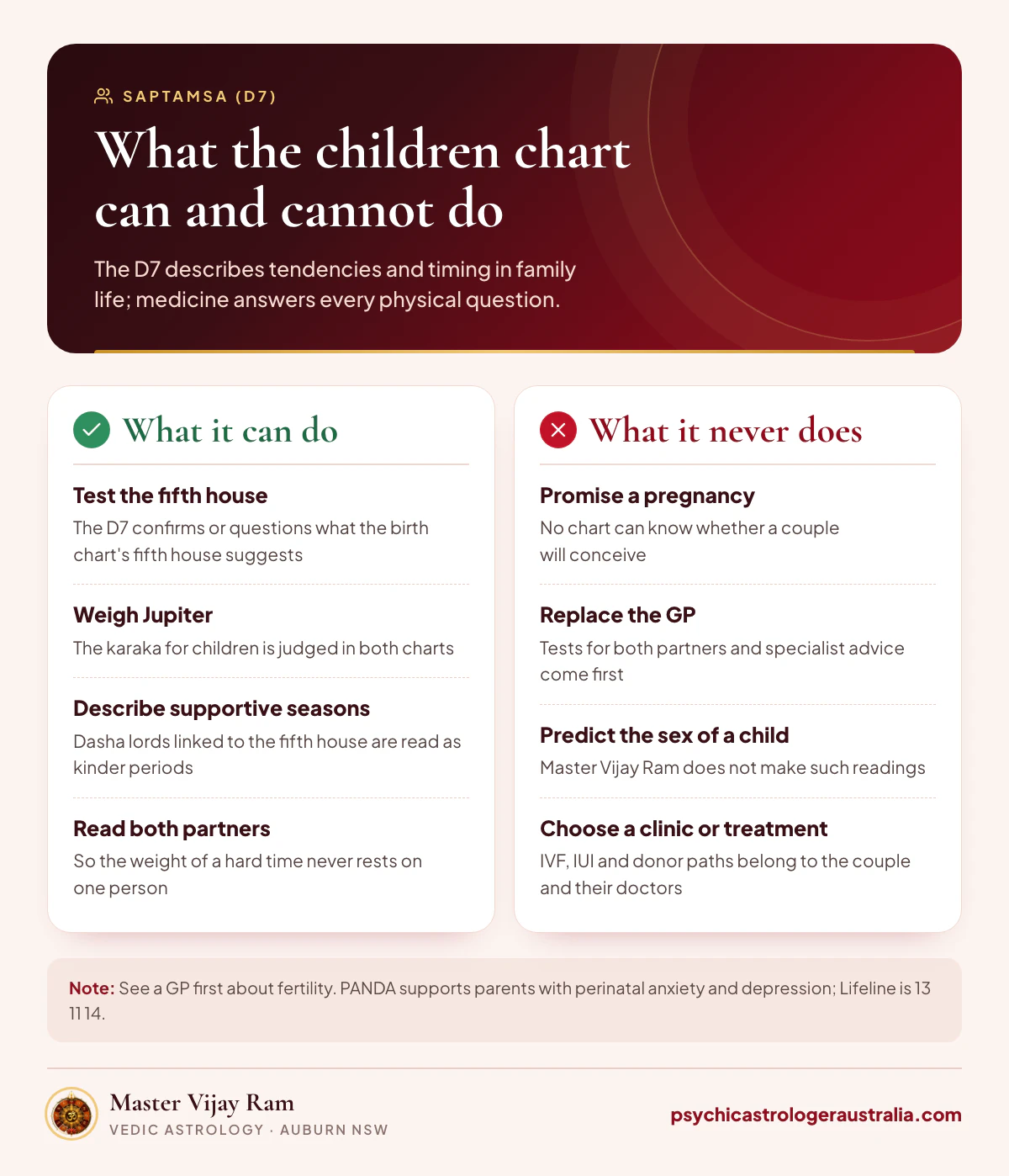
Before anything else, one plain statement. No chart, divisional or otherwise, can tell a couple whether they will conceive, and nothing on this page should delay a visit to a GP or a fertility specialist. The D7 describes tendencies and timing in the area of children; medicine is what investigates and treats.
It is one layer of a complete kundli reading, opened after the birth chart and only when the question is about family.
How are the seven slices counted?
Thirty degrees divided by seven gives slices of about 4°17′ each, so the boundaries fall at roughly 4°17′, 8°34′, 12°51′, 17°09′, 21°26′ and 25°43′. Which sign the first slice belongs to depends on whether the birth-chart sign is odd or even.
For an odd sign, the first slice belongs to the sign itself and the count runs forward. For an even sign, the first slice belongs to the seventh sign from it, the sign directly opposite. The table shows both patterns using Aries (odd) and Taurus (even).
| Slice | Degrees within the sign (approx.) | Planet in Aries goes to | Planet in Taurus goes to |
|---|---|---|---|
| 1 | 0° to 4°17′ | Aries | Scorpio |
| 2 | 4°17′ to 8°34′ | Taurus | Sagittarius |
| 3 | 8°34′ to 12°51′ | Gemini | Capricorn |
| 4 | 12°51′ to 17°09′ | Cancer | Aquarius |
| 5 | 17°09′ to 21°26′ | Leo | Pisces |
| 6 | 21°26′ to 25°43′ | Virgo | Aries |
| 7 | 25°43′ to 30° | Libra | Taurus |
Can you walk through an example?
Suppose Jupiter is at 10° Gemini. Gemini is odd, so the count starts at Gemini; 10° lies in the third slice, and the third sign from Gemini is Leo. Jupiter therefore sits in Leo in the saptamsa.
Now suppose the Moon is at 20° Scorpio. Scorpio is even, so the count starts at Taurus, the seventh sign from Scorpio. Twenty degrees falls in the fifth slice, and counting five from Taurus gives Taurus, Gemini, Cancer, Leo, Virgo: the Moon is in Virgo in the D7. Both positions are invented to show the arithmetic and belong to nobody.
The D7 lagna is found the same way from the rising degree, and the houses of the D7 are counted whole-sign from it. That last step is where the trouble with birth times begins.
How accurate does the birth time need to be?
A slice of a little over four degrees is crossed by the rising degree in well under twenty minutes on average, and faster when a sign of short ascension is rising. A time recorded as "about eight in the morning" may therefore give a D7 lagna one or two signs away from the true one.
The planets' D7 signs are steadier, because most planets move slowly, though the Moon can change slice within hours. When a time is uncertain the honest course is to say that the D7 houses are provisional, read the planets' D7 signs with care, and lean on the birth chart's fifth house instead. Families unsure of a time can start with finding birth time records.
What does an astrologer read in the D7?
The fifth house of the birth chart is the starting point, with its lord and Jupiter, the natural significator of children; the fifth house in Vedic astrology covers that ground in depth. The saptamsa then tests those findings.
- The D7 lagna and its lord: where the lord sits and whether it is dignified is read as the overall tone of this area of life.
- The fifth house of the D7: its sign, its lord and any planets in it are read as the main indicator for children within the divisional chart.
- The birth chart's fifth lord, placed in the D7: a lord strong in both charts is read as a firm promise of family happiness; a mixed result suggests timing matters more than usual.
- Jupiter in the D7: its sign and house are judged as the karaka's own condition.
Some older texts tried to read the sex of a future child from odd and even D7 signs. That is not something Vijay Ram ji reads, and no parent should plan around it.
Why do the birth chart and the D7 sometimes disagree?
It is common for the fifth house of the birth chart to look comfortable while the D7 looks strained, or the reverse. The tradition does not treat this as a contradiction. The birth chart is read as the broad promise, and the divisional chart as the detail of how that promise unfolds over time.
A strong fifth house with a troubled D7 is usually read as a promise that arrives with effort, waiting or worry along the way. A modest fifth house with a well-placed D7 is read as quiet support that becomes clearer in the right period. In both cases the running dasha decides which side of the picture is louder at a given time; the same relationship between a broad promise and its detail is described for work in the dasamsa career chart.
Where the two charts disagree sharply, the first suspect is the birth time rather than the family's future. A shift of a few minutes can move the D7 lagna, and with it every house, while leaving the birth chart almost untouched.
How does timing come into it?
Families most often ask when, not whether. The traditional method looks at the mahadasha and antardasha lords and asks whether they connect with the fifth house, its lord or Jupiter, in the birth chart and in the D7. A period that links strongly to these is read as a more supportive season for family life.
Transits add a layer: Jupiter moving over the fifth house or the fifth lord, counted from the lagna or the Moon, is traditionally welcomed. These are windows of tendency. They are never a forecast that a pregnancy will happen in a given year, and they have no bearing on what a clinic recommends.
Medicine first: how does the chart sit beside fertility care?
Couples who have been trying for some time without success are usually advised to see a doctor, and sooner where age or a known condition is a factor; a GP can begin tests for both partners and refer on. That advice comes from medical guidance, not from astrology, and it comes first.
The chart can sit alongside treatment as a source of patience and perspective, and some couples find that a reading lowers the pressure of each month. It does not choose between IVF, IUI or donor paths, and it does not judge whether a clinic's advice is right. Those choices belong to the couple and their specialists.
What about adoption, step-children and blended families?
The fifth house and the D7 are read in the tradition for children in a broad sense, not only biological ones. Many astrologers say a strong fifth house can show the joy of children who arrive through adoption, kinship or out-of-home care, marriage into a family, or the young people a teacher or mentor raises.
That matters for the many Australian families whose children came by more than one road. A D7 is not a test of whether a family is complete; it is one lens on the bonds and responsibilities around children.
Is there a remedy if the D7 looks weak?
A remedy cannot change the chart and is not a fertility treatment. What the tradition offers is prayer: the Santan Gopal mantra, a Jupiter shanti in a supportive period, and conduct such as respect for teachers and elders, which the texts link to Jupiter.
The practical detail of that approach, and when a puja is not suggested at all, is in santan prapti remedies for couples. Where a puja is warranted it is performed personally at Auburn, starting from $250 and agreed before it is performed; puja and havan arrangements sets out how that works.
What can the saptamsa never tell you?
It cannot diagnose infertility, predict a miscarriage, choose a clinic or forecast a pregnancy. A reading that says otherwise, or that sells a ritual as a cure, has gone well beyond what the tradition supports.
It also cannot carry grief for anyone. Couples living through loss or long treatment deserve care from people trained for it: PANDA supports parents with perinatal anxiety and depression, a GP can refer to a counsellor, and Lifeline answers on 13 11 14 at any hour.
How does Master Vijay Ram approach a children question?
He asks first what the medical picture is, and if the couple have not yet seen a doctor he says that is the first step. He then reads both partners' charts, the fifth house and Jupiter in each, and the D7 only where the birth times are reliable.
The answer is framed in seasons and steadiness, never in promises. A $50 consultation by phone, video or WhatsApp covers it, in English, Hindi or Punjabi; the santan prapti service explains how such readings are handled, and families in the Top End can book through readings for Darwin clients.
Read next
- Dasamsa (D10): The Career Chart ExplainedHow the dasamsa (D10) chart is built from 3° slices, what an astrologer reads in it for work and status, and why it d…
- Chaturthamsa (D4): Property, Home and Fixed AssetsHow the chaturthamsa (D4) chart is cut into four 7°30′ quarters, what it is read for about home and property, and why…
- Kundli Reading Explained: What Your Birth Chart RevealsWhat a Kundli reading reveals about your life, personality, career and destiny. Master Vijay Ram explains Vedic astro…
Frequently asked questions
What does the D7 chart show?
The D7 or saptamsa is traditionally read for children, grandchildren and the legacy a person leaves through them. Astrologers judge its lagna lord, its fifth house, Jupiter's placement and where the birth chart's fifth lord falls in it. It describes tendencies and the timing of family life. It cannot diagnose fertility, predict a pregnancy or replace medical tests and advice.
How is the saptamsa calculated?
Each 30° sign is divided into seven slices of about 4°17′. For odd signs the first slice belongs to the same sign; for even signs it belongs to the seventh sign from it. You count forward one sign per slice to find a planet's D7 sign. Chart software does this, but it needs an accurate birth time and the correct ayanamsa setting.
Can the D7 chart tell me if I will have children?
No. A chart can describe how the tradition reads the area of children and which periods it regards as supportive, but it cannot know whether a pregnancy will happen. Only medical tests and a doctor's advice can say anything about fertility. Any astrologer who promises a child, or tells a couple they will never have one, is claiming more than astrology can know.
Does a weak fifth house in the D7 mean no children?
No. A weak placement is read as a call for patience, care or attention to timing, not as a verdict. Many people with difficult fifth houses have children, and many with strong ones choose not to. The birth chart, Jupiter's condition and the running dasha all change the picture, and medicine has the final word on any physical question.
Can the D7 predict the sex of a baby?
Some older texts link odd and even signs in the saptamsa with sons and daughters, but Master Vijay Ram does not make such readings. They are unreliable, and in many families they add pressure that harms both parents and children. A healthy child and a settled family are the only aims a reading should serve.
When should we see a doctor rather than an astrologer?
First. Medical guidance sets out how long a couple might try before seeking help, and the advice is to go sooner where age or a known condition is a factor. A GP can arrange tests for both partners and refer to a specialist where needed. A reading can sit alongside that care, offering perspective and patience, but it should never delay it.
Is there a puja for children in the chart?
The tradition offers the Santan Gopal mantra and a Jupiter or santan puja in a supportive period. These are prayer, not treatment. Where a puja is warranted after a $50 consultation, Master Vijay Ram performs it personally at his place of practice in Auburn, starting from $250 and agreed before it is performed. Many readings suggest no ritual at all.
Should both partners' charts be read?
Yes, where both birth times are available. The tradition reads children from each partner's fifth house, Jupiter and D7, and a period that is supportive for one partner may be quieter for the other. Reading both gives a fuller picture of timing and avoids placing the weight of a hard time on one person, which is never fair or helpful.
People also ask
Which divisional chart is for children?
The saptamsa, or D7, is the divisional chart traditionally used for children and grandchildren. It is read together with the fifth house of the birth chart, the fifth lord and Jupiter. It describes tendencies and timing, and it never replaces medical advice about fertility or pregnancy.
What is the saptamsa lagna?
The saptamsa lagna is the D7 sign occupied by the rising degree of the birth chart. Because each D7 slice is only about 4°17′ wide, it can change within a quarter of an hour, so it is reliable only when the birth time is accurate. Its lord's placement sets the general tone of the D7.
Which planet is the karaka for children?
Jupiter is the natural significator, or karaka, for children in Vedic astrology. Astrologers judge its sign, house and strength in both the birth chart and the D7. A well-placed Jupiter is read as supportive, but no single planet decides anything about a family's future.
Can astrology help with IVF?
Astrology does not treat infertility and should not influence clinical decisions about IVF. Some couples find a reading gives them patience and perspective during treatment, and the tradition may describe periods it considers supportive. Every medical choice belongs to the couple and their fertility specialist.
References & further reading
Serving clients across Australia
Confidential consultations by phone, video & WhatsApp — including: