

Quick answer
Peepal worship on Saturdays is a folk practice in which families offer water, walk around the tree and pray to Shani and Vishnu. In Australia Ficus religiosa grows mainly in warm gardens and some temple grounds. Its roots damage pipes and foundations, so it is not planted near houses, and no lamp is ever lit at a public tree.
Why is the peepal tree worshipped?
The peepal, Ficus religiosa, is a sacred fig tree that Hindus, Buddhists and Jains have honoured for thousands of years, recognised by its heart-shaped leaves with a long, tapering tip. In the Bhagavad Gita, Krishna names himself as the ashvattha among trees, which is the peepal's Sanskrit name, and Buddhists know it as the bodhi tree under which the Buddha sat. For many Hindu families it is simply the tree you bow to on the way past.
Tradition reads the tree as home to the trinity: Brahma at the root, Vishnu in the trunk and Shiva in the crown, in the most common version of the verse. Women in many regions walk around it praying for a husband's long life or for children, and thread is wound around the trunk with each circuit. Peepal tree worship is therefore far older and wider than its Saturday link with Saturn.
Why Saturday, and what is the link with Shani?
A story told in several versions explains the link. The sage Pippalada, son of the rishi Dadhichi, grew up under a peepal tree after his father's death, and when he learned that Shani's influence had caused his family's suffering he struck Shani down. Shani was released only after promising not to trouble those who worship the peepal on Saturdays, or in some versions children under a certain age.
Another common belief holds that Lakshmi visits the peepal on Saturdays, which is why many families touch the tree on that day and avoid touching it on others, especially Sunday. Customs differ by region and family. What they share is the idea that a peepal tree on Saturday is a natural place to meet Saturn with patience and humility rather than fear. It is a small, personal step, quite different from a graha shanti puja for Saturn performed by a priest.
What do families actually do at a peepal on a Saturday?
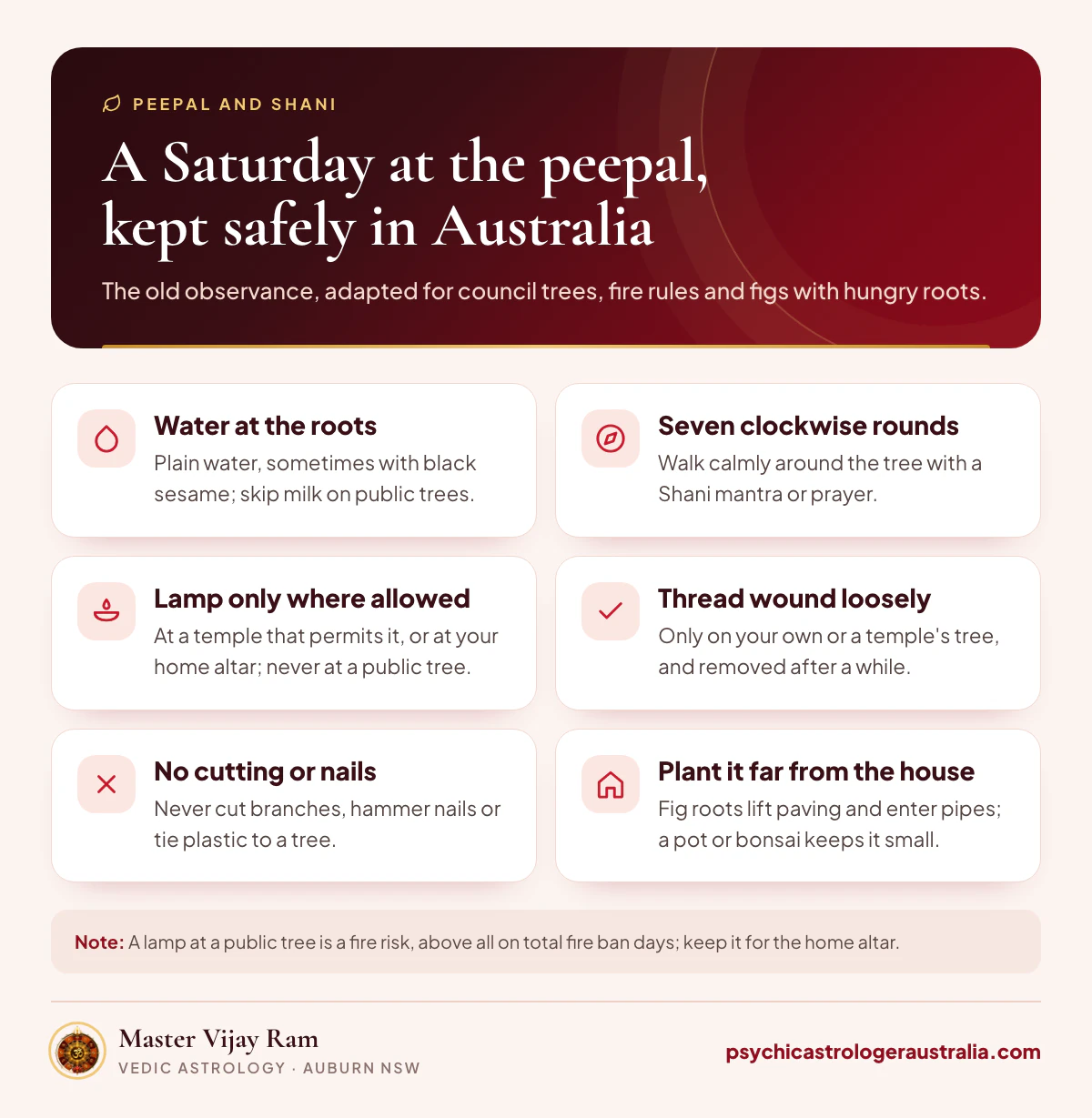
The observance is simple. Early on Saturday, or in some families at dusk, water is poured at the roots, sometimes with a little black sesame, raw milk or jaggery. The person walks around the tree clockwise, commonly seven times, saying a prayer or a Shani mantra, and bows before leaving.
In India a mustard-oil lamp is often placed at the base. In Australia that part belongs only where a temple allows it, which is explained further down. The beej mantra many families use for Saturn is Om Praam Preem Praum Sah Shanaye Namah; spellings vary, and a guru's or family's version is equally good.
| Element | Traditional meaning | How to keep it in Australia |
|---|---|---|
| Water at the roots | Nourishing the tree that shelters the gods | A small amount of plain water; skip milk on public trees, as it sours and draws ants |
| Circling the tree | Respect, usually seven clockwise rounds | Fine anywhere you have permission to walk |
| Cotton thread | A vow or a prayer bound to the tree | Only on your own or a temple's tree, wound loosely and removed later |
| Mustard-oil lamp | Light offered to Shani at dusk | Only at a temple that permits it, or at your home altar instead |
| Mantra or prayer | Remembering Saturn with patience | Anywhere, aloud or silently |
Is peepal worship a remedy for Sade Sati?
It is one of the Saturday practices most often suggested for a hard Saturn period, alongside the Hanuman Chalisa, chhaya daan and service to elderly or poor people. As a peepal Shani remedy it suits Saturn's nature: it is plain, regular and asks for humility rather than display.
Whether it fits you depends on your chart. Sade Sati is read from the Moon sign and the dasha running alongside it, and the same transit weighs very differently in different charts. Sade Sati and Shani remedies sets out how a period is judged before anything is suggested, and which Moon signs Sade Sati affects in 2027 covers who is in it this coming year.
Where can you find a peepal tree in Australia?
Ficus religiosa is a tropical and subtropical tree. It grows readily in the warm north, around Darwin and in north Queensland, and in sheltered gardens further south, but it is frost-tender and struggles in cold inland and southern winters. People in Melbourne or Hobart rarely see one outdoors.
Some Hindu and Buddhist temples have planted a peepal in their grounds, and some botanic gardens and private gardens in warm suburbs grow one. If you are not sure whether the tree you have found is a peepal, look for the long, thin "drip tip" on each heart-shaped leaf; many other figs in Australian parks look similar from a distance. Ask your temple whether its tree may be visited and what offerings it allows.
How do you visit a temple's peepal respectfully?
Ask first. Temples that keep a peepal usually have their own customs about when it may be approached, what may be offered and whether thread or lamps are allowed, and a Buddhist temple's bodhi tree may follow quite different etiquette from a Hindu temple's. A quiet word with the priest or the temple office avoids giving offence.
Leave shoes where others leave theirs, keep offerings small and take any wrappers, empty bottles or leftover flowers home with you. If others are already praying at the tree, wait your turn and keep your voice low. Many temples are busiest on Saturday mornings, so an early or late visit is often calmer.
Children can be taught the rounds and a short prayer without being told to fear Saturn. A family habit kept gently on a Saturday morning, followed by breakfast together, is a good way to hand the custom on.
Should you plant a peepal at home?
Think carefully first. Like most figs, the peepal has strong, spreading roots that can lift paving, crack foundations and find their way into drains and sewer pipes, and in India it is often seen growing out of walls and rooftops. Traditional Vastu advice also tends to keep it away from the house itself.
If you want one, a large pot on a patio or a bonsai keeps the tree small and the roots contained. A tree in the ground needs plenty of distance from the house, the neighbour's fence, pipes and the sewer line; a local nursery or your council can say whether it suits your area. Never plant one on council land, in a park or in bushland without permission.
Why is a lamp never lit at a public tree?
Because a naked flame at the base of a tree in a park, street or reserve is a fire risk, and in much of Australia it may break fire rules outright, especially on total fire ban days. Dry leaf litter catches easily, and a lamp left burning unattended is exactly how small fires start. Council trees are also public property, and oil, soot and wax marks are not welcome on them.
Keep the lamp for your home altar, on a metal tray and never left unattended, or for a temple that permits one at its own tree. The Saturday evening light can be offered at home while you think of the tree, and that keeps the intention without the risk.
What about threads, milk and nails?
Thread wound tightly and left on a living tree can cut into the bark as the trunk grows, so wind it loosely and remove it after a while, and only on a tree you own or where the temple allows it. Milk poured repeatedly at the roots sours, smells and draws ants; plain water does just as well. Never hammer nails, pin pictures or tie plastic to a tree.
Cutting branches or stripping leaves from a public tree for a puja is not acceptable, even for a sacred purpose. If you need peepal leaves for a ritual, ask the temple, a friend with a tree or a nursery.
What if there is no peepal near you?
Most people in southern Australia will not have one within reach, and the tradition does not require it. The Saturday practice can move entirely to the home: a lamp at the altar at dusk, the Hanuman Chalisa, a Shani mantra, and a gift of black sesame, mustard oil or a blanket to someone in need. Chhaya daan on Saturdays describes the mustard-oil offering in full.
Conduct counts as much as any ritual for Saturn: punctuality, respect for labourers and the elderly, honest work and patience. Daan by planet gives the Saturday gifts alongside the other days.
When is a puja suggested instead?
Where a chart shows Saturn under real strain, for example a difficult Saturn period overlapping Sade Sati, a Shani shanti puja or a jaap of the Saturn mantra is sometimes suggested. Master Vijay Ram performs it personally at his place of practice in Auburn, on a chosen muhurat, with you joining by video if you wish.
A puja or jaap starts from $250, and the figure is agreed before it is performed; how a puja is done on your behalf explains the steps. A consultation is $50, in English, Hindi or Punjabi, for clients from the Central Coast to Darwin, where the peepal grows well.
What can peepal worship not do?
It cannot end Sade Sati early, clear a debt or heal an illness. It is a devotional practice that the tradition links with patience under Saturn, offered as faith-based guidance, not medical, legal or financial advice. Money worries go to a financial counsellor and health worries to a GP, alongside any Saturday practice.
What many families describe is a calm weekly habit: a short walk to a temple tree, a few minutes of quiet, and a reminder that Saturn's lessons are about time and steadiness. That is what the practice was always meant to give.
Read next
- Chhaya Daan: The Saturday Shadow Offering in Mustard OilChhaya daan explained: seeing your face in mustard oil on a Saturday and giving it away, the story of Chhaya, who doe…
- Pradosh Vrat and Evening Shiva WorshipPradosh vrat explained: the Trayodashi evening fast for Shiva, how pradosh kaal is set by local sunset in Australia, …
- Diwali 2026 House & Aura Cleansing: Clear the Year's Heavy EnergyDiwali 2026 house and aura cleansing done honestly: clean first, use the Five-Lamp Check, and learn when heaviness is…
Frequently asked questions
Why do people worship the peepal tree on Saturday?
A story told in several versions says the sage Pippalada, who grew up under a peepal, overpowered Shani and released him only when Shani promised not to trouble those who worship the peepal on Saturdays. Another belief holds that Lakshmi visits the tree on Saturdays. Customs differ by region, but the Saturday link with Saturn is widely kept.
What is offered to the peepal tree on Saturday?
Usually water at the roots, sometimes with a little black sesame or jaggery, followed by seven clockwise rounds of the tree and a Shani mantra or prayer. In India a mustard-oil lamp is often lit at the base. In Australia the lamp is kept for a temple that allows it or for the home altar.
Can I light a diya under a peepal tree in a park?
No. A naked flame at the base of a public tree is a fire risk and may break fire rules, especially on total fire ban days, and council trees are public property. Light the Saturday lamp at your home altar on a metal tray, never left unattended, or at a temple that permits one at its own tree.
Does the peepal tree grow in Australia?
Yes, in the right climate. Ficus religiosa is tropical and subtropical, so it grows readily around Darwin and in north Queensland and in sheltered warm gardens further south, but it is frost-tender. Some temples and botanic gardens grow one. Check the long drip tip on each heart-shaped leaf, as other figs look similar.
Is it safe to plant a peepal tree near my house?
Not close to it. Peepal roots spread strongly and can lift paving, crack foundations and enter drains and sewer pipes. A large pot or a bonsai keeps the tree small. If planted in the ground it needs plenty of distance from buildings, fences and pipes, and a nursery or your council can say whether it suits your area.
Is peepal worship a remedy for Sade Sati?
It is one of the Saturday practices often suggested for a hard Saturn period, along with the Hanuman Chalisa, chhaya daan and service to elderly people. Whether it suits you depends on your Moon sign, the dasha running and the chart as a whole. It is a devotional practice, and it cannot shorten Sade Sati.
Can I tie a thread around a peepal tree?
Only on your own tree or a temple's tree where it is allowed. Wind it loosely and remove it after a while, because a tight thread left on a growing trunk can cut into the bark. Never tie plastic, hammer nails or pin pictures to a tree, and never cut branches from a public tree for a puja.
What if there is no peepal tree near me?
The practice can move to your home. Light a lamp at the altar at dusk on Saturday, recite the Hanuman Chalisa or a Shani mantra, and give black sesame, mustard oil or a blanket to someone in need. Conduct matters too: punctuality, honest work and respect for elderly people are traditional Saturn remedies.
People also ask
Which god lives in the peepal tree?
The most common verse places Brahma at the root, Vishnu in the trunk and Shiva in the crown, and Krishna names himself the ashvattha, the peepal, among trees in the Bhagavad Gita. Many families also associate the tree with Lakshmi on Saturdays and with Shani through the story of the sage Pippalada.
Should we touch the peepal tree on Sunday?
Many families avoid touching the peepal on Sundays and touch it on Saturdays, following the belief that Lakshmi visits it on Saturdays. This is a regional custom and families keep it differently. Nothing in the tradition threatens misfortune for touching the tree on another day.
How many times should you go around a peepal tree?
Seven clockwise rounds is the most common count for the Saturday observance, though some families use eleven or one hundred and eight on special days. The number matters less than walking calmly and keeping a prayer or mantra in mind as you go.
Is the peepal tree the same as the bodhi tree?
Yes. The bodhi tree under which the Buddha sat is a Ficus religiosa, the same species Hindus call the peepal or ashvattha. Some Buddhist temples plant one in their grounds, which is one of the places a peepal can sometimes be found in Australia.
References & further reading
Serving clients across Australia
Confidential consultations by phone, video & WhatsApp — including: