
Quick answer
Bhai Dooj 2027 falls on Sunday 31 October in every Australian city and in India. The Kartika Shukla Dwitiya runs from 11:22 pm AEDT Saturday to 10:44 pm Sunday, and the tilak is traditionally applied in the aparahna, the afternoon portion of the day, on the sister's own clock.
When is Bhai Dooj 2027?
Bhai Dooj is the siblings' festival on the second day after Diwali, when a sister applies a tilak to her brother's forehead, feeds him and prays for his long life, and he gives her a gift and a promise of care. In 2027 Bhai Dooj 2027 falls on Sunday 31 October in every Australian city and in India, the last day of the Diwali festival and, conveniently, a weekend.
The Dwitiya of Kartika's bright fortnight begins at 11:22 pm AEDT on Saturday 30 October and ends at 10:44 pm on Sunday, Sydney time. It is present through the whole of Sunday's daylight in every city.
| City | Date | Kartika Shukla Dwitiya (local time) | Rule applied |
|---|---|---|---|
| Sydney | Sun 31 Oct 2027 | Sat 30 Oct 2027, 11:22 PM AEDT – Sun 31 Oct 2027, 10:44 PM AEDT | tithi present in the afternoon (aparahna) |
| Melbourne | Sun 31 Oct 2027 | Sat 30 Oct 2027, 11:22 PM AEDT – Sun 31 Oct 2027, 10:44 PM AEDT | tithi present in the afternoon (aparahna) |
| Brisbane | Sun 31 Oct 2027 | Sat 30 Oct 2027, 10:22 PM AEST – Sun 31 Oct 2027, 9:44 PM AEST | tithi present in the afternoon (aparahna) |
| Perth | Sun 31 Oct 2027 | Sat 30 Oct 2027, 8:22 PM AWST – Sun 31 Oct 2027, 7:44 PM AWST | tithi present in the afternoon (aparahna) |
| Adelaide | Sun 31 Oct 2027 | Sat 30 Oct 2027, 10:52 PM ACDT – Sun 31 Oct 2027, 10:14 PM ACDT | tithi present in the afternoon (aparahna) |
| Canberra | Sun 31 Oct 2027 | Sat 30 Oct 2027, 11:22 PM AEDT – Sun 31 Oct 2027, 10:44 PM AEDT | tithi present in the afternoon (aparahna) |
| Hobart | Sun 31 Oct 2027 | Sat 30 Oct 2027, 11:22 PM AEDT – Sun 31 Oct 2027, 10:44 PM AEDT | tithi present in the afternoon (aparahna) |
| Darwin | Sun 31 Oct 2027 | Sat 30 Oct 2027, 9:52 PM ACST – Sun 31 Oct 2027, 9:14 PM ACST | tithi present in the afternoon (aparahna) |
| New Delhi (reference) | Sun 31 Oct 2027 | Sat 30 Oct 2027, 5:52 PM IST – Sun 31 Oct 2027, 5:14 PM IST | tithi present in the afternoon (aparahna) |
The tithi is one moment everywhere; only the clock and the sunrise differ, which is why a city can fall a day apart from India. Computed with the Swiss Ephemeris (Lahiri ayanamsa for Vedic positions) and checked against US Naval Observatory data. Times are rounded to the minute.
The table's moment checked is 3 pm local time, which is inside each city's afternoon; that is the test the festival uses, as the next section explains.
Why does Bhai Dooj follow the afternoon rule?
Most festivals in this series are fixed by the tithi present at sunrise. Bhai Dooj is one of the few fixed by aparahna, the fourth of the five equal parts into which the daylight is divided, roughly the middle and late afternoon. The day on which the Dwitiya is present during aparahna is Bhai Dooj, and the tilak is ideally applied within that window.
The reason lies in the story. Yama, the lord of death, is said to have visited his sister Yamuna on this day after a long absence; she welcomed him, applied a tilak, fed him a meal she had cooked herself, and in return he promised that any brother who visited his sister on this day and ate from her hand would be free of the fear of untimely death. A visit, a meal and a blessing take the afternoon, and the festival kept the hour.
In 2027 the Dwitiya covers every Australian afternoon on Sunday, so the rule and the calendar agree. Families wanting the aparahna window worked out to the minute for their suburb can ask for a muhurat for the Bhai Dooj tilak, though any time after lunch and before the late afternoon fits the custom.
What is the aparahna on the last day of October?
Aparahna is counted from local sunrise to local sunset, so it shifts with the season and the city. At the end of October the days in the south-east are long, with daylight saving in force, and the fourth fifth of the day falls from around two o'clock to the late afternoon in Sydney, a little later in Melbourne and Adelaide, and earlier on the clock in Brisbane, which stays on standard time.
Perth's afternoon falls inside the Dwitiya on its own clock, as does Darwin's. Nobody needs a stopwatch: the custom is that the tilak happens after the midday meal is prepared and before the evening, and that is the Bhai Dooj tilak time for every household in the country this year.
| City or zone | Day | Dwitiya on the local clock | Afternoon note |
|---|---|---|---|
| Sydney, Melbourne, Canberra, Hobart (AEDT) | Sunday 31 October | 11:22 pm Saturday to 10:44 pm Sunday | Whole afternoon inside the tithi |
| Brisbane, Gold Coast, Sunshine Coast (AEST) | Sunday 31 October | 10:22 pm Saturday to 9:44 pm Sunday | Whole afternoon inside the tithi |
| Adelaide (ACDT) | Sunday 31 October | 10:52 pm Saturday to 10:14 pm Sunday | Whole afternoon inside the tithi |
| Perth (AWST) | Sunday 31 October | 8:22 pm Saturday to 7:44 pm Sunday | Whole afternoon inside the tithi |
How is the tilak ceremony done?
The sister prepares a small plate, the thali, with roli or kumkum, a few grains of rice, a lamp, sweets and sometimes a coconut or a dry fruit. The brother sits facing north or east, often on a low seat; she applies the tilak, places the rice on it, performs a short aarti with the lamp and offers him a sweet.
In many families the brother then eats a meal his sister has cooked, which is the heart of the old story, and gives her a gift. North Indian families sometimes have the brother bring sweets and a coconut when he arrives, and in some homes the sister prays to Yama and Yamuna before the tilak for her brother's long life.
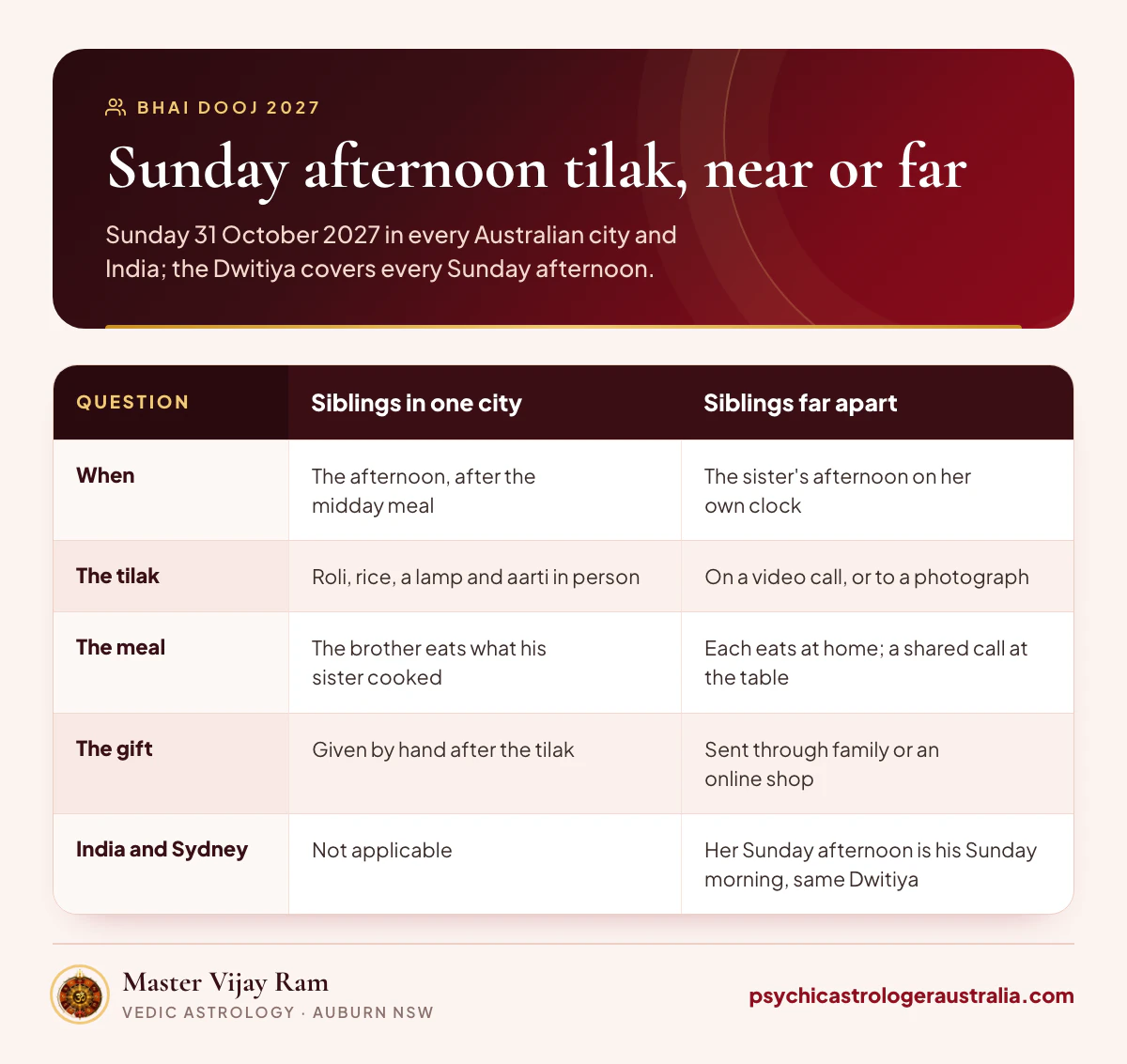
A brother and sister who live in the same city usually manage the afternoon visit easily on a Sunday. The ones who write to the Master are those for whom the visit is not possible.
What if your brother or sister lives far away?
For many Australian families the brother is in Delhi, the sister in Geelong, and a cousin in Toronto. The tradition has quietly adapted: sisters apply the tilak on a video call, to a photograph of the brother, or to the brother of a close friend standing in, and brothers send gifts through an online shop or a family member.
The timing question has a simple answer. The sister keeps the afternoon on her own clock, because she performs the rite; if her brother is in India and she is in Sydney, her Sunday afternoon is his Sunday morning, about five and a half hours behind, and the Dwitiya covers both. A sister in Perth and a brother in Hobart can both keep their afternoons and share a call in the gap.
Joining family in India across time zones sets out the clock differences through the year, and the same arithmetic serves a video tilak.
How do Bhai Phonta, Bhau Beej and Bhai Tika differ?
The festival goes by many names, and each region adds something. In Bengal, Bhai Phonta sees sisters apply a phonta of sandal paste, kajal and curd while reciting a verse that places a thorn at the door of Yama, and many fast until the ceremony is done.
In Maharashtra, Goa and Karnataka the day is Bhau Beej, with the sister performing aarti for her brother and serving a festive meal, often with basundi or shrikhand. In Nepal it is Bhai Tika, the climax of Tihar, when sisters lay a garland of marigold and globe amaranth and a seven-coloured tika, and Nepali families follow their own calendar for its date.
The festival is also called Yama Dwitiya after the story, and Bhatru Dwitiya in some panchangs. Whatever the name, a sister's prayer for her brother and a brother's promise to his sister are the same ritual at heart.
Is Bhai Dooj the same as Raksha Bandhan?
They are cousins rather than twins. On Raksha Bandhan, at the Shravana full moon in August, the sister ties a thread of protection on her brother's wrist and he promises to protect her; on Bhai Dooj she applies a tilak and feeds him, praying for his long life, and he gives her a gift in return.
One festival is about protection, the other about longevity and hospitality, and many families keep both. The Raksha Bandhan 2027 page explains why the rakhi that year also belongs to the afternoon, for a different reason.
What about sisters without brothers, or brothers without sisters?
Families find their own answers, and all of them are kind. A woman with only sisters may apply the tilak to a cousin, a brother-in-law, a close family friend, or to an image of Krishna or Ganesha; two sisters sometimes apply it to each other. A man with no sister may receive the tilak from a cousin, an aunt or a friend's sister who has adopted him in the old way of the rakhi-brother.
Some people dread the day because it reminds them of a sibling who has died. Lighting a lamp for that brother or sister in the afternoon is a gentle custom many families keep, and Griefline is there for anyone for whom the day is simply too hard.
What if the relationship is strained?
Festivals put pressure on difficult family ties, and Bhai Dooj is no exception. A tilak cannot mend a long quarrel on its own, and nobody is obliged to sit across from a sibling who has harmed them; the custom is an expression of love, not a duty to tolerate mistreatment.
Where the strain is ordinary, the third house of the chart, the house of younger siblings and of one's own effort, is where a reading looks, and sibling rivalry and the third house explains how tendencies are read. For family conflict that has become serious, Relationships Australia offers family dispute resolution, and where there is fear or violence, 1800RESPECT and 000 come first. A wider look at a household under strain is the work of a family problem consultation.
How do families in Hobart, Canberra and the regions keep it?
Sunday 31 October 2027 suits the smaller cities well. In Hobart, Canberra, Newcastle and Wollongong siblings who live nearby gather for lunch and the afternoon tilak, and those whose brothers are in Sydney or Melbourne often drive across for the day, since Govardhan Puja on the Saturday has already brought the family together.
On the Sunshine Coast and in Geelong many families combine Bhai Dooj with the weekend's community Diwali gathering. Hobart families seeking a reading consult by phone or video, in English, Hindi or Punjabi.
Is a puja on request ever part of Bhai Dooj?
Rarely. The tilak is a family rite and needs no priest. Occasionally a sister whose brother is very ill, or in a difficult period, asks for a prayer to be offered for his health and long life; the puja is then performed personally on request at Master Vijay Ram's place of practice in Auburn, with the family joining by video.
A consultation is $50; a puja starts from $250, and the figure is agreed before anything is performed. An illness belongs with the doctors first, and the prayer alongside.
What can a tilak not do?
It cannot guarantee a long life or settle a family dispute, and no honest reading pretends it can. Vedic astrology reads tendencies and timing, and the Bhai Dooj prayer is love made visible, which is powerful in its own way and limited in the ordinary way.
What it can do is put a brother and sister in the same room, or on the same call, for an hour in the afternoon once a year. For many families far from home, that hour is the festival.
Read next
- Maha Shivratri 2027 in Australia: Date and Night TimingMaha Shivratri 2027 is Saturday 6 March in Australia and India. Nishita kaal and four-prahar puja times for Sydney, M…
- Holi 2027 in Australia: Date and Holika Dahan TimingHolika Dahan is Monday 22 March 2027 in every Australian city and Rangwali Holi is Tuesday 23 March; India is a day e…
- How Long Does Black Magic Removal Take to Show Results?Black magic removal rarely runs to a fixed date. Here is the honest arc, what tends to shift first, what stretches it…
Frequently asked questions
What is the date of Bhai Dooj 2027 in Australia?
Sunday 31 October 2027 in every Australian city and in India. The Kartika Shukla Dwitiya begins at 11:22 pm AEDT on Saturday 30 October and ends at 10:44 pm on Sunday 31 October, Sydney time, and it is present through every Australian Sunday afternoon, which is the test the festival uses.
What is the best time for the Bhai Dooj tilak?
The aparahna, the fourth of five equal parts of the daylight, roughly the middle and late afternoon. On Sunday 31 October 2027 the Dwitiya covers the whole afternoon in every Australian city, so any time after the midday meal and before late afternoon fits the custom. A precise window for a suburb comes from local sunrise and sunset.
Why is Bhai Dooj in the afternoon and not the morning?
Because its rule is aparahna, not sunrise. The story behind it tells of Yama visiting his sister Yamuna, who welcomed him, applied a tilak and fed him a meal she had cooked; a visit and a meal belong to the afternoon. The day on which the Dwitiya is present in the afternoon is Bhai Dooj.
How do I do Bhai Dooj if my brother is in India?
Many sisters apply the tilak on a video call or to their brother's photograph, and brothers send gifts through family or an online shop. The sister keeps the afternoon on her own clock, since she performs the rite. With Sydney about five and a half hours ahead of India, her Sunday afternoon is his Sunday morning, inside the same Dwitiya.
Is Bhai Dooj the same as Raksha Bandhan?
No, though both honour siblings. On Raksha Bandhan the sister ties a protective thread on her brother's wrist and he promises to protect her. On Bhai Dooj she applies a tilak, feeds him and prays for his long life, and he gives her a gift. Many families keep both festivals.
What are Bhai Phonta and Bhau Beej?
Regional names for Bhai Dooj. Bhai Phonta is the Bengali form, with a phonta of sandal paste, kajal and curd and a verse that bars Yama's door. Bhau Beej is the Maharashtrian, Goan and Karnataka form, with aarti and a festive meal. In Nepal the festival is Bhai Tika, the last day of Tihar.
Can a sister with no brother celebrate Bhai Dooj?
Yes. Many women apply the tilak to a cousin, brother-in-law or close family friend, or to an image of Krishna or Ganesha, and sisters sometimes apply it to each other. The prayer for a sibling's long life and the shared meal are the heart of the day, and families shape the custom kindly around who is present.
Do I have to keep Bhai Dooj with a sibling who has hurt me?
No. The tilak is an expression of love, not a duty to tolerate mistreatment, and nobody is obliged to sit with a sibling who has harmed them. Relationships Australia offers family dispute resolution for ordinary conflict, and where there is fear or violence, 1800RESPECT and 000 come first. A lamp and a private prayer are enough.
Can Master Vijay Ram offer a prayer for my brother on Bhai Dooj?
Yes, on request, for example when a brother is ill or going through a hard period. He performs the puja personally at his place of practice in Auburn, and the family can join by video. A consultation is $50; a puja starts from $250, agreed before it is performed, and illness belongs with doctors first.
People also ask
Is Bhai Dooj on 31 October 2027?
Yes. Sunday 31 October 2027 is Bhai Dooj in every Australian city and in India. It is the last day of the Diwali festival, following Govardhan Puja on Saturday 30 October 2027 and Lakshmi Puja on Friday 29 October 2027.
Why is Bhai Dooj called Yama Dwitiya?
Because of the story of Yama, lord of death, visiting his sister Yamuna on this second lunar day. She applied a tilak and fed him, and he promised that brothers who visit their sisters on this day and eat from their hand would be free from the fear of untimely death.
What does a sister put on the Bhai Dooj thali?
Usually roli or kumkum for the tilak, a few grains of rice, a small lamp, sweets and sometimes a coconut or dry fruit. She applies the tilak, places rice on it, performs a short aarti and offers a sweet, often followed by a meal she has cooked.
Is Bhai Tika on the same day as Bhai Dooj?
Bhai Tika, the last day of Nepal's Tihar festival, usually coincides with Bhai Dooj, but Nepali families follow their own calendar and community notices for its date. Sisters apply a seven-coloured tika and a marigold and globe amaranth garland to their brothers.
References & further reading
Serving clients across Australia
Confidential consultations by phone, video & WhatsApp — including: