
Quick answer
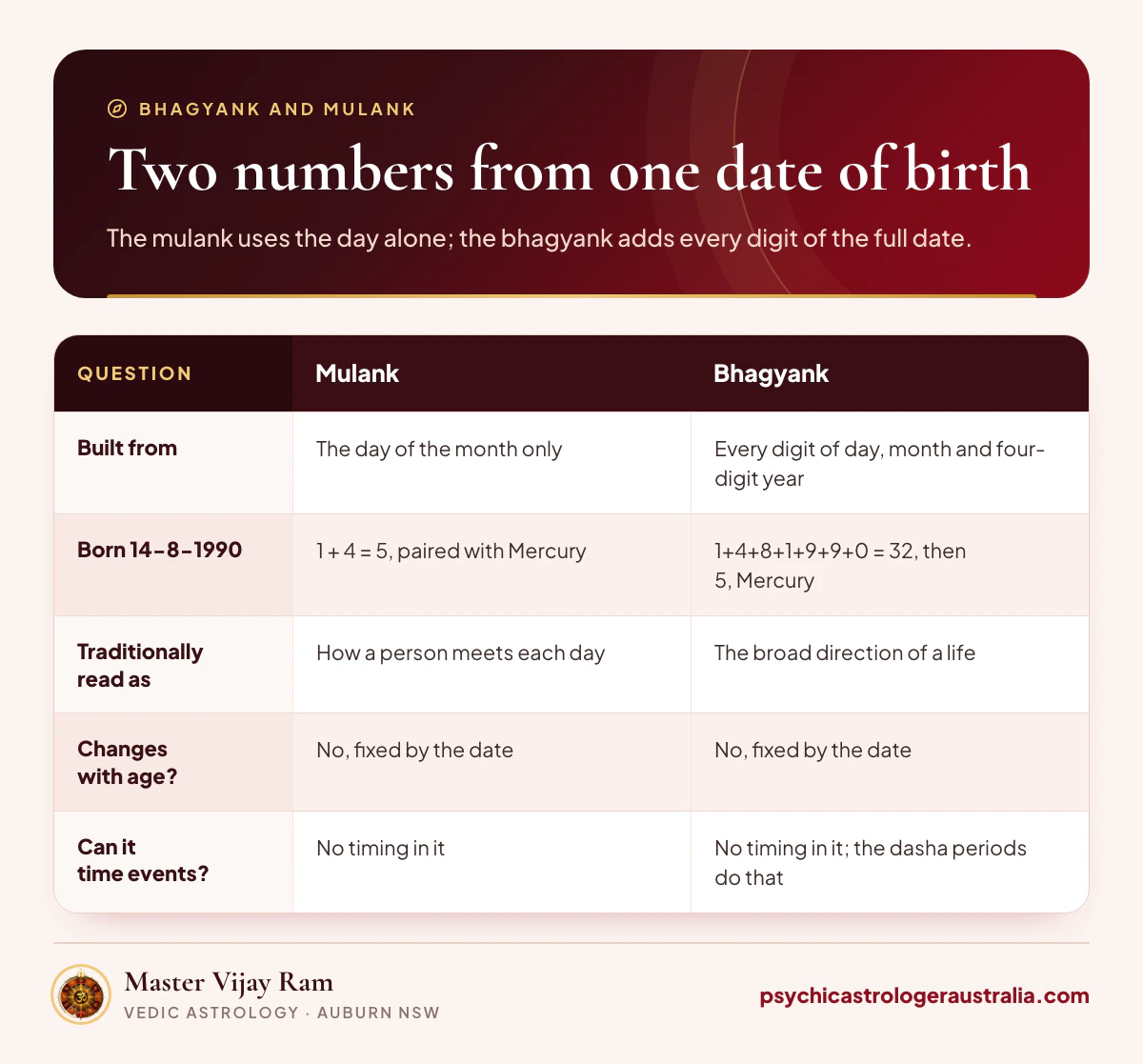
Bhagyank is the whole date of birth, day, month and year, added digit by digit and reduced to one number. Born 14-8-1990: 1 + 4 + 8 + 1 + 9 + 9 + 0 = 32, and 3 + 2 = 5, so the bhagyank is 5, paired with Mercury. Numerology reads it as life’s broad direction; the birth chart remains the detailed map.
What is a bhagyank?
Bhagyank is a single-digit number that Indian numerology takes from the complete date of birth, and that it reads as the broad direction or “fortune” of a life. The word joins bhagya, fortune, with ank, number. In English it is called the destiny number, and Western numerology computes the same figure under the name life path number.
Where the mulank looks only at the day you were born, the bhagyank uses every digit you were given. Master Vijay Ram treats both as talking points beside the birth chart, which is where the real reading happens; the numerology and gemstone consultation keeps them in that order.
How do you calculate a bhagyank, step by step?
Write the date of birth in full, with a four-digit year. Add every digit together, then keep adding the digits of the answer until one digit is left.
- Date of birth: 14-8-1990.
- Add every digit: 1 + 4 + 8 + 1 + 9 + 9 + 0 = 32.
- Reduce: 3 + 2 = 5.
- The bhagyank is 5, which numerology pairs with Mercury.
That is the whole bhagyank calculation. Leading zeros make no difference, so 05-03 and 5-3 give the same total, and the order of adding never matters.
Do you reduce each part first, or add everything at once?
Books teach both ways, and people worry that they give different answers. They do not. Reducing the day, month and year separately and then adding them always lands on the same final digit as adding all the digits at once.
Take 14-8-1990 again. The day reduces to 5, the month is 8, and the year 1 + 9 + 9 + 0 = 19 reduces to 1; then 5 + 8 + 1 = 14, and 1 + 4 = 5. The match is not a coincidence: repeatedly adding digits always gives the remainder after dividing by nine, with 9 standing for zero, so any route through the same digits ends in the same place.
What does change the answer is a mistake in the date itself. A month written as 18 instead of 8, or a year copied from the wrong document, will move the bhagyank, so check the birth certificate first.
Which mistakes give people the wrong bhagyank?
Most wrong numbers come from the date, not the sum. The commonest slip in Australia is reading an American-style date, month first, from an old visa form or a website profile, so 4-7 becomes the seventh of April instead of the fourth of July. The digits are the same, so the bhagyank happens to survive, but the mulank does not.
Other slips are a two-digit year, which drops the 1 and 9 of a twentieth-century birth and changes the total, and a birthday kept in the family by the Hindu lunar calendar rather than the Gregorian date. Many elders know their own birthday by tithi and month; numerology needs the civil date, so look at a passport or certificate rather than relying on memory.
Why do some families have two birthdays, and which one counts?
In many Indian families a grandparent’s birthday was celebrated by the lunar calendar, a tithi in a named month, and the civil date was written down later for school or a passport, sometimes approximately. A date chosen by a school clerk decades ago may not be the real day at all.
If a parent’s civil date is uncertain, any number built on it is uncertain too. That is no hardship for numerology, which is a light practice, but it matters greatly for a birth chart, and it is a good reason not to make decisions for an elderly parent on the strength of a number.
What is each bhagyank traditionally said to mean?
The readings below follow the planet pairing that Indian numerology uses, applied to the long arc of a life rather than to daily temperament. They are traditional descriptions, offered as such.
| Bhagyank | Planet | Traditionally read as a life that leans toward | The usual caution in the books |
|---|---|---|---|
| 1 | Sun | Responsibility, leadership, standing on one’s own feet | Pride and going it alone |
| 2 | Moon | Care, partnership, work with people and feelings | Changeable moods and dependence |
| 3 | Jupiter | Teaching, counsel, faith and principle | Preaching rather than listening |
| 4 | Rahu | Change, technology, the unconventional path, travel | Restlessness and sudden reversals |
| 5 | Mercury | Trade, communication, learning, many interests | Scattering energy across too much |
| 6 | Venus | Family, the arts, comfort and harmony | Indulgence and avoiding conflict |
| 7 | Ketu | Study, spirituality, research, independence | Withdrawal and detachment from people |
| 8 | Saturn | Endurance, duty, results that arrive late but last | Discouragement during slow years |
| 9 | Mars | Service, protection, courage, energy for causes | Impatience and conflict |
Notice that every number has both a gift and a caution. A reading that tells you only the flattering half, or only the frightening half, is selling something.
How are the mulank and bhagyank read together?
Numerology books describe the mulank as how a person meets each day and the bhagyank as the road the days add up to. When the two numbers are paired with friendly planets, the books call the combination harmonious; when the planets are enemies, they say the person feels pulled in two directions.
The friendships come from astrology. The Sun counts the Moon, Mars and Jupiter as friends and Venus and Saturn as enemies; Saturn counts Mercury and Venus as friends and the Sun, Moon and Mars as enemies. Planetary friendships and enmities sets out the full scheme, and numerology simply lays it over the two digits.
Rahu and Ketu, the planets behind 4 and 7, are not part of the classical friendship list, and numerology writers disagree about how to treat them. That is one more reason to hold any compatibility claim between numbers lightly.
Three worked examples of the pair
These are illustrations, chosen to show how the books reason, not readings of real people.
- Born 14-8-1990: mulank 1 + 4 = 5; bhagyank 5. Both numbers point to Mercury, which the books call a concentrated, single-minded pattern.
- Born 28-3-1985: mulank 2 + 8 = 10, then 1, the Sun; bhagyank 2 + 8 + 3 + 1 + 9 + 8 + 5 = 36, then 9, Mars. The Sun and Mars are natural friends, so the books call this pairing supportive.
- Born 17-11-2001: mulank 1 + 7 = 8, Saturn; bhagyank 1 + 7 + 1 + 1 + 2 + 0 + 0 + 1 = 13, then 4, Rahu. Many writers treat Rahu as Saturn-like and call the pair workable; others disagree, and traditions differ.
In every case the chart can overturn the number. A “supportive” pair means little if the Sun is weak and afflicted in the actual horoscope, and an “awkward” pair means little if both planets are well placed.
Is the bhagyank the same as the Western life path number?
For anyone searching for a life path number Indian style, the arithmetic is the same, and so is the single digit you end up with, unless the Western book keeps 11, 22 or 33 as master numbers. Indian usage usually reduces those to 2, 4 and 6.
The meanings diverge more than the sums. Western books describe the numbers without planets, while Indian books read them through the grahas, so a Western 4 is a builder and an Indian 4 carries Rahu’s restlessness. The same person can be told two different stories, which says something about how much weight either should carry; name numerology and its two systems shows the same disagreement with letters.
Does the bhagyank change with your age or the year?
No. It is fixed by the date of birth. Some numerologists add the day and month of birth to the current year to get a “personal year” number and read the coming twelve months from it, but that is a separate, later device and not the bhagyank.
Vedic astrology does its timing another way, through the planetary periods. How Vimshottari dasha timing works explains why a person can feel like two different people in their twenties and their forties, something no fixed number can show.
Can the bhagyank choose a career or a partner?
It should not. A bhagyank 5 is not destined for sales, and a bhagyank 3 is not obliged to teach. Career questions belong first to interests, skills, qualifications and the job market, and then, for those who want it, to the tenth house and the dasha in the chart, which a career and business astrology reading examines.
Marriage matching by numbers is the weakest use of all. Kundli matching compares Moon nakshatras, the seventh house and the navamsa; two people with “clashing” bhagyanks can be very well matched in their charts, and a family should never refuse a proposal on a digit.
What can a bhagyank honestly not tell you?
It cannot time events, predict illness, settle a visa question, judge an investment or tell you whether to leave a job. It is faith-based and cultural, not medical, financial, legal or psychological advice, and no study has shown that people sharing a bhagyank share a fate.
What it can do is start a reflective conversation. Asking “does the Saturn description fit my slow, hard-won progress?” is a fair use; deciding your future on the answer is not.
How does Master Vijay Ram use the bhagyank?
He works it out in a few seconds, mentions what it is traditionally said to mean, and then compares the paired planet with its place in your birth chart reading. If a bhagyank 8 client is in a Saturn period with Saturn well placed, the number and the chart tell one story and he says so; if not, he explains why the chart takes precedence.
Consultations are $50 by phone, video or WhatsApp, in English, Hindi or Punjabi. Clients in the Top End book through an astrologer for Darwin clients, keeping in mind that Darwin sits behind Sydney on the clock. The mulank, the birth-day number is covered in its own guide.
Read next
- Lucky Numbers and Mobile Number Numerology: What Counts and What Does NotMobile number numerology and lucky numbers: how digits are reduced, what the tradition says, what is custom rather th…
- Mulank: Your Birth Number and What It Is Said to MeanMulank, the birth number of Indian numerology: how to work it out from the day you were born, what each of 1 to 9 is …
- Kala Jadu Removal for Indians & Punjabis in AustraliaKala jadu removal explained for Indian and Punjabi families in Australia: the stage-by-stage process, what you are as…
Frequently asked questions
How do I calculate my bhagyank?
Write your full date of birth with a four-digit year and add every digit together. Keep adding the digits of the answer until one digit is left. For 14-8-1990, 1 + 4 + 8 + 1 + 9 + 9 + 0 makes 32, and 3 + 2 makes 5, so the bhagyank is 5. Use the date on your birth certificate to avoid copying errors.
Is bhagyank the same as destiny number?
Yes. Bhagyank is the Hindi name and destiny number is the usual English translation. Western numerology calls the same calculation the life path number. The arithmetic is identical; the interpretations differ, because Indian numerology reads each digit through a planet while Western numerology does not.
Which is more important, mulank or bhagyank?
Numerology books treat the mulank as everyday temperament and the bhagyank as the longer direction of life, so most give the bhagyank more weight for big questions. In Vedic astrology neither outweighs the birth chart, which is built from the exact time and place of birth and carries the dasha timing that numbers lack.
What if my mulank and bhagyank are enemies?
Then numerology books would call the pairing awkward, because the planets behind the two numbers are natural enemies in astrology. In practice it means very little on its own. The planets in your actual chart may be well placed and supportive, and many people with so-called clashing numbers live settled, successful lives.
Does the bhagyank change when I get older?
No. It comes from your date of birth and stays the same for life. Some numerologists also compute a personal year number that changes each year, but that is a different calculation. In Vedic astrology, change over time is read from the dasha periods and transits rather than from any number.
Can I use bhagyank for marriage matching?
Some numerologists do, but it is the weakest form of matching. Vedic matching compares the Moon nakshatras, the seventh house, the navamsa and the dasha periods of both people. A family should never reject a proposal because two destiny numbers are said to clash; the full charts and the people themselves matter far more.
Do master numbers 11 and 22 count in Indian numerology?
Usually not. Indian practice keeps reducing until one digit remains, so 11 becomes 2 and 22 becomes 4, with the Moon and Rahu as their planets. Western numerology sometimes stops at 11, 22 or 33 and gives them special meanings. Neither convention can be shown to be more correct.
How much does a bhagyank reading cost?
A consultation with Master Vijay Ram is $50, by phone, video or WhatsApp, in English, Hindi or Punjabi. He calculates your mulank and bhagyank and reads them against the birth chart rather than on their own. He does not sell number reports, name corrections or lucky items.
People also ask
What is the bhagyank of 14-8-1990?
Add the digits: 1 + 4 + 8 + 1 + 9 + 9 + 0 makes 32, and 3 + 2 makes 5. The bhagyank is 5, which Indian numerology pairs with Mercury and traditionally reads as a life leaning toward trade, learning and communication, with the caution of scattering energy.
Which bhagyank is lucky?
None is lucky or unlucky in itself. Each number in the tradition carries a gift and a caution. Whether a period of life goes well is read in Vedic astrology from the dasha and transits in the birth chart, not from a single digit computed from the date.
What is bhagyank 8?
Bhagyank 8 is paired with Saturn. Numerology books read it as a life of duty and endurance in which results come late but last, with the caution of discouragement during slow years. Saturn in the actual birth chart tells you far more about how that plays out.
Is life path number Indian or Western?
The term life path number is Western; the Indian equivalent is bhagyank. Both add every digit of the date of birth. Indian numerology then reads the result through one of the nine planets, while Western numerology uses its own meanings and sometimes keeps master numbers.
References & further reading
Serving clients across Australia
Confidential consultations by phone, video & WhatsApp — including: