

Quick answer
The badhaka is the house of obstruction in a chart, and its lord is the badhakesh. It depends on the lagna: the 11th house for movable signs, the 9th for fixed signs and the 7th for dual signs. It is read for delays and blocks, especially in the Kerala prashna tradition, but it is a technical marker, not a diagnosis of a curse.
What is the badhaka house?
The badhaka house is a house of the Vedic chart that the tradition reads as a source of obstruction, the place from which delays, blocks and frustrations tend to arise. Its lord is called the badhakesh, or badhaka lord. Badhaka means obstacle or hindrance, and the house is also called the badhaka sthana.
Few chart terms are more easily misused. In some circles the word is used to tell people they are under a spell or a divine curse, which is not what it means and not how this site reads it. This page explains how the house is found, what it is actually read for, and why it is a technical marker rather than a diagnosis. A kundli horoscope reading weighs it alongside everything else in the chart.
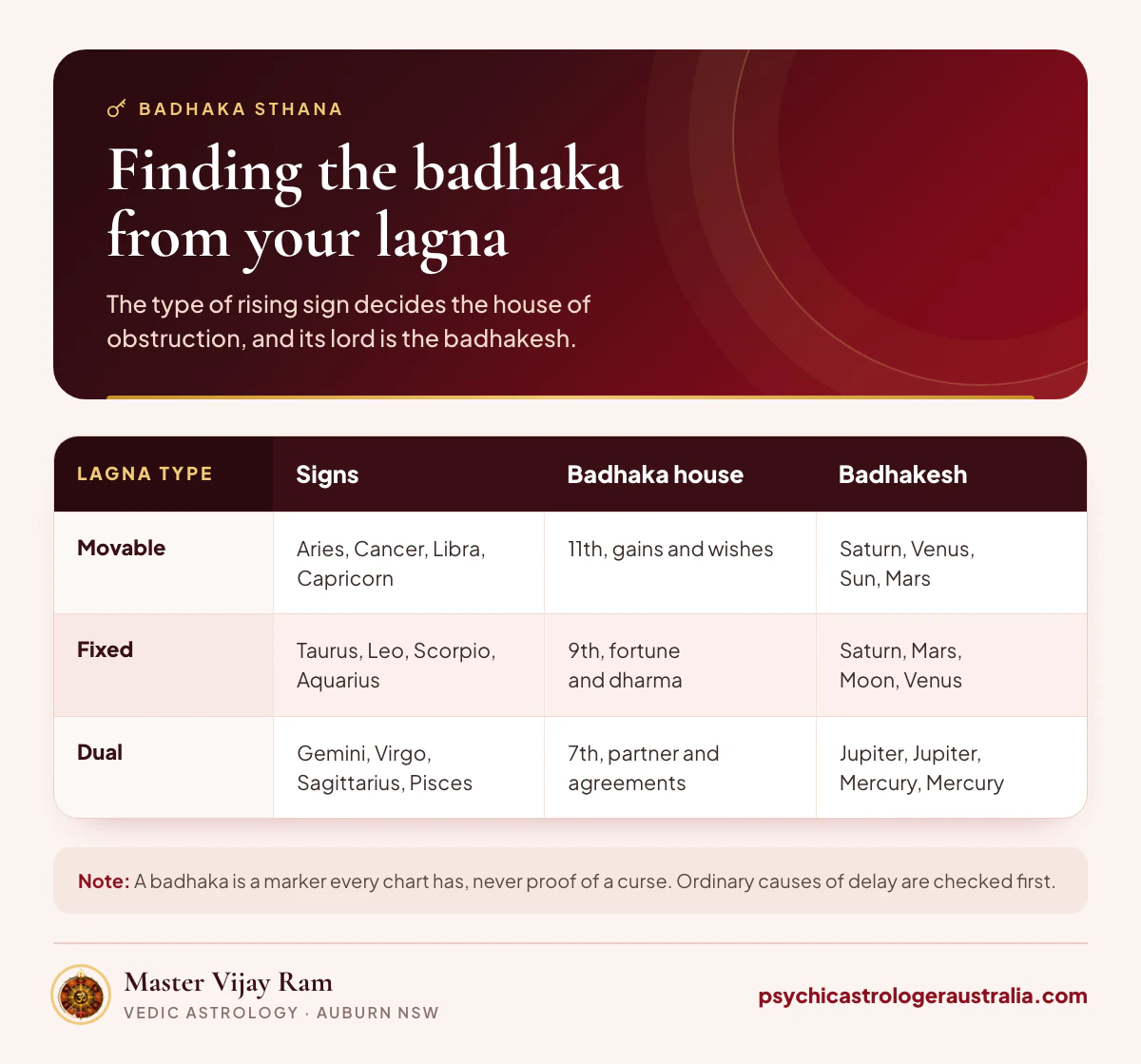
How is the badhaka house found?
It depends on the nature of the rising sign. The twelve signs fall into three groups of four. Movable signs, also called cardinal, are Aries, Cancer, Libra and Capricorn. Fixed signs are Taurus, Leo, Scorpio and Aquarius. Dual signs, also called mutable, are Gemini, Virgo, Sagittarius and Pisces.
The rule is short. For a movable lagna the badhaka is the 11th house. For a fixed lagna it is the 9th. For a dual lagna it is the 7th. The lord of that house is the badhakesh. If you know your lagna, the guide to finding your Vedic rising sign shows how it is worked out, and the table below does the rest.
What is the badhaka for each lagna?
| Lagna | Type | Badhaka house | Sign | Badhakesh |
|---|---|---|---|---|
| Mesha (Aries) | Movable | 11th | Aquarius | Saturn |
| Vrishabha (Taurus) | Fixed | 9th | Capricorn | Saturn |
| Mithuna (Gemini) | Dual | 7th | Sagittarius | Jupiter |
| Karka (Cancer) | Movable | 11th | Taurus | Venus |
| Simha (Leo) | Fixed | 9th | Aries | Mars |
| Kanya (Virgo) | Dual | 7th | Pisces | Jupiter |
| Tula (Libra) | Movable | 11th | Leo | Sun |
| Vrishchika (Scorpio) | Fixed | 9th | Cancer | Moon |
| Dhanu (Sagittarius) | Dual | 7th | Gemini | Mercury |
| Makara (Capricorn) | Movable | 11th | Scorpio | Mars |
| Kumbha (Aquarius) | Fixed | 9th | Libra | Venus |
| Meena (Pisces) | Dual | 7th | Virgo | Mercury |
Why is the obstruction found in good houses?
This is the most interesting thing about the badhaka. The 11th is the house of gains and fulfilled wishes, the 9th is the house of fortune and dharma, and the 7th is the house of the partner. None of them is a difficult house. The tradition is saying something subtle: our obstacles often come through the very things we want most.
For a movable lagna, restless and keen to act, the block comes through ambitions, networks and the wish for more; the eleventh house of gains and wishes shows that house's brighter side. For a fixed lagna, steady and set in its ways, it comes through beliefs, teachers, father figures and fixed ideas of fortune. For a dual lagna, which already lives between two choices, it comes through the partner and the agreements made with others.
Can the badhakesh also be a good planet?
Yes, and the table proves it. For a Taurus lagna, Saturn rules the 9th and is the badhakesh, yet Saturn also rules the 10th and is the chart's yogakaraka. For Leo, Mars is both badhakesh and yogakaraka. For Aquarius, Venus is both. The same planet that brings the greatest support can also bring the most characteristic delays.
The guide to kendra and trikona houses and the yogakaraka explains why those planets are so strong. Read together, the two ideas give a realistic picture: a powerful planet whose gifts come with conditions, often a period of waiting, a test of patience or a lesson that has to be learnt before the reward arrives.
For the dual lagnas there is a further overlap. The 7th lord is also a maraka lord and, for these four lagnas, a natural benefic ruling a kendra, so the badhakesh of a Gemini, Virgo, Sagittarius or Pisces chart carries several technical labels at once. None of them, alone or together, is a verdict.
Where does the badhaka idea come from?
The idea is most developed in the Kerala tradition of prashna, the reading of a chart cast for the moment a question is asked. Its best-known text, the Prashna Marga, uses the badhaka and its lord to look for hidden sources of obstruction in a question, and links them with matters such as neglected worship, unfulfilled vows and duties to the family deity. In that tradition the answer is usually a return to devotion, not a fear of enemies.
Many astrologers also apply the badhaka in birth charts to explain stubborn delays in a particular area of life. North Indian Parashari practice tends to give it less weight. Traditions differ, and a reading should say how much it is leaning on this technique.
What is the badhaka read for in practice?
It is read for the areas of life where effort seems to meet resistance for reasons that are hard to name. A badhaka house that is strongly occupied, or a badhakesh that is linked to the lagna lord, the 7th lord or the 10th lord, may be read as a reason why progress in those matters is slower than expected.
An illustration: a Brisbane couple with Gemini and Virgo lagnas, where Jupiter is the badhakesh for both, came with questions about repeated delays in buying a home together. The reading noted that the badhaka was the 7th for each, so their shared plans carried the obstruction, and that the delays coincided with Jupiter sub-periods. The practical advice came first: a mortgage broker and a clear budget. The chart's part was to suggest patience through a period, not to name a cause outside them.
Do planets sitting in the badhaka house matter?
Yes, though less than the lord. A planet occupying the badhaka house is read as taking on some of its obstructing colour in the matters it rules. Rahu placed there is often singled out, because many practitioners link Rahu with confusion and hidden causes, and some Kerala astrologers treat Rahu's link with the badhaka as especially telling in a question chart.
A benefic in the badhaka house, by contrast, is usually read as softening it: a strong Jupiter in the 11th for a movable lagna may still bring gains, with only a little delay along the way. As with every technique, the occupant's dignity and aspects decide the final reading.
How is badhaka used when someone asks a single question?
In a prashna, the question chart is cast for the moment the question is sincerely asked, and the badhaka is found from that chart's own lagna. If the badhakesh is strongly linked with the house of the question, the delay is read as having a cause that patience and prayer may ease. If it is not involved, the astrologer looks elsewhere. The question chart answers one matter at a time; prashna kundli for a single question explains why it is never used to read a whole life.
What happens in the dasha of the badhakesh?
The period of the badhaka lord is often described as a time when things take longer: approvals wait, plans need a second attempt, help arrives later than hoped. It is also a period when that planet gives the results of every house it rules, so a badhakesh that is also a yogakaraka can bring real progress alongside the delays.
The planet's dignity, its house, the aspects it receives and the antardashas within its period all change the picture. A strong, well-placed badhakesh in a supportive period may produce little obstruction at all.
Is the badhaka a sign of black magic or a curse?
No. A technical marker that every chart has cannot by itself show that anyone has done anything to you, and this site never tells a reader they are cursed. Delays usually have ordinary causes: workload, money, health, paperwork, other people's timetables. Those come first. The guide on black magic or a Rahu or Saturn period explains how a careful reading separates the two, and it never points to a person.
If anyone has used the word badhaka to tell you that you are under attack and must pay to remove it, be cautious. That kind of claim can be misleading conduct under Australian Consumer Law, and state fair trading agencies take complaints.
Is there a remedy for the badhaka?
In keeping with its prashna roots, the most traditional response is devotion: keeping a vow you have neglected, visiting or praying to the family deity, and regular prayer to the deity linked with the badhakesh. Steady effort through the delay matters as much as any rite.
Where a reading finds that a fuller rite would help, graha shanti for the planet concerned explains how it is chosen. Master Vijay Ram performs any puja personally at his place of practice in Auburn, starting from $250 and agreed before it is performed, as set out under puja and havan on request. A consultation is $50.
What the badhaka cannot tell you
It cannot tell you that a delay will end on a certain date, that a person is blocking you or that a rite will remove an obstacle. It describes where obstruction tends to come from and when it is more likely to be felt. This is faith-based guidance, not legal, financial or medical advice.
Consultations are by phone, video or WhatsApp in English, Hindi or Punjabi, or in person at Auburn by appointment. South Australian clients can read about astrology readings for Adelaide.
Read next
- Lagna Explained: Your Rising Sign the Vedic WayLagna, the Vedic rising sign: why it outranks the sun sign, how fast it changes, the twelve lagnas and their lords, a…
- Chaturthamsa (D4): Property, Home and Fixed AssetsHow the chaturthamsa (D4) chart is cut into four 7°30′ quarters, what it is read for about home and property, and why…
- Signs of Jinn Disturbance at Home and How Ruqyah HelpsJinn disturbance at home: which signs matter, which have ordinary causes, what ruqyah really is, and how a settled ho…
Frequently asked questions
How do I find the badhaka house in my chart?
Look at your lagna. If it is a movable sign, Aries, Cancer, Libra or Capricorn, the badhaka is the 11th house. If it is fixed, Taurus, Leo, Scorpio or Aquarius, it is the 9th. If it is dual, Gemini, Virgo, Sagittarius or Pisces, it is the 7th. The planet that rules that house is your badhakesh.
What is a badhakesh?
The badhakesh is the lord of the badhaka house, the planet traditionally read as a source of obstruction and delay in a chart. For an Aries lagna it is Saturn, for Cancer Venus, for Gemini and Virgo Jupiter, and so on through the table. Its dignity, house and dasha decide how much obstruction it actually brings.
Is the badhakesh always a bad planet?
No. For Taurus, Leo and Aquarius lagnas the badhakesh is also the yogakaraka, the planet that rules both a kendra and a trikona and brings strong support. Any badhakesh also gives the results of the houses it rules. It is read as a planet whose gifts may come with conditions or delays, not as an enemy.
Does badhaka mean someone has done black magic on me?
No. Every chart has a badhaka house and lord, so it cannot by itself show that anyone has done anything. Delays usually have ordinary causes such as workload, money, health or paperwork, and those are checked first. This site never tells a reader they are cursed and never points to a person.
Where does the badhaka concept come from?
It is most developed in the Kerala prashna tradition, which reads charts cast for the moment a question is asked. Its best-known text, the Prashna Marga, uses the badhaka to look for hidden sources of obstruction such as neglected worship or unfulfilled vows. Many astrologers also apply it to birth charts, and North Indian practice tends to give it less weight.
What happens during the badhakesh dasha?
It is often read as a period when things take longer: approvals wait, plans need a second attempt and help comes later than hoped. The planet still gives the results of every house it rules, so a strong badhakesh, especially one that is also a yogakaraka, can bring real progress along with the delays.
What is the remedy for badhaka dosha?
The most traditional response is devotion: keeping a neglected vow, praying to the family deity and regular prayer for the planet concerned, along with steady effort through the delay. A puja is considered only where a reading finds it would help; it starts from $250 and the amount is agreed before anything is performed.
Why is the 7th house the badhaka for dual signs?
The rule assigns the 7th to dual lagnas, the 9th to fixed and the 11th to movable, and the classical texts give the rule rather than a full explanation. One common reading is that a dual sign already lives between two choices, so its obstruction comes through the partner and through agreements made with others.
People also ask
What is badhaka sthana?
Badhaka sthana means the place of obstruction. It is the house traditionally read as a source of delays and blocks: the 11th for movable lagnas, the 9th for fixed lagnas and the 7th for dual lagnas. Its lord, the badhakesh, carries the same theme into whatever it touches.
Who is the badhaka lord for Leo lagna?
For a Leo lagna, a fixed sign, the badhaka is the 9th house, Aries, so Mars is the badhakesh. Mars also rules the 4th house for Leo, which makes it the yogakaraka as well, so it brings both strong support and characteristic delays.
Which signs are movable, fixed and dual?
Movable signs are Aries, Cancer, Libra and Capricorn. Fixed signs are Taurus, Leo, Scorpio and Aquarius. Dual signs are Gemini, Virgo, Sagittarius and Pisces. The type of your lagna decides which house is the badhaka.
Is badhaka the same as a dosha?
Not exactly. Badhaka is a house and its lord, present in every chart, rather than a special combination that only some charts have. People sometimes speak of badhaka dosha when the badhakesh is strongly involved with key houses, but that is a matter of degree, not a curse.
References & further reading
Serving clients across Australia
Confidential consultations by phone, video & WhatsApp — including: