

Quick answer
The chaturthamsa, or D4, is the divisional chart Vedic astrologers consult for home, land and fixed assets. Each sign is cut into four quarters of 7°30′, given in turn to the sign itself and then the fourth, seventh and tenth signs from it. It refines the fourth house for timing and tendency; a conveyancer and an inspector check the property.
What is the chaturthamsa chart?
The chaturthamsa chart is a divisional chart that splits each sign into four equal quarters and rebuilds the horoscope from the quarter each planet occupies. It is often shortened to the D4 chart, and some books call it turyamsa. Parashara links it with fortune in a broad sense; later practice narrows it to the home, land, vehicles and the possessions that stay put, and traditions differ on how wide to draw it.
Families in Australia usually meet it around one question: is this the right time to buy? The D4 can add a layer to that question. It cannot inspect a roof, read a contract or judge a suburb, and nobody should sign anything on the strength of a divisional chart.
It is opened as part of a detailed kundli consultation once the birth chart's fourth house has been judged.
How is the D4 built from the birth chart?
Each 30° sign is cut into four quarters of 7°30′. Unlike the dasamsa and the saptamsa, the chaturthamsa uses one rule for every sign: the first quarter belongs to the sign itself, the second to the fourth sign from it, the third to the seventh and the fourth to the tenth.
| Quarter | Degrees within the sign | D4 sign | Example: a planet in Cancer goes to |
|---|---|---|---|
| 1 | 0° to 7°30′ | The same sign | Cancer |
| 2 | 7°30′ to 15° | 4th sign from it | Libra |
| 3 | 15° to 22°30′ | 7th sign from it | Capricorn |
| 4 | 22°30′ to 30° | 10th sign from it | Aries |
A quiet consequence of that rule is worth noticing. Every planet's D4 sign is a kendra, the first, fourth, seventh or tenth, from the sign it occupies in the birth chart, which is one reason the D4 is associated with foundations and stable things.
What does a worked example look like?
Take Venus at 19° Cancer. Nineteen degrees lies in the third quarter, so Venus moves to the seventh sign from Cancer, which is Capricorn. Take Mars at 5° Libra: the first quarter, so Mars stays in Libra.
The D4 lagna is found the same way from the rising degree. A quarter of 7°30′ is wider than the slices of the D7 or the D10, so the D4 lagna is a little more forgiving of a birth time that is a few minutes out, but a rounded half hour can still move it. These positions are invented to show the counting and describe no real person.
What is read in the D4 for property and home?
The starting point is always the birth chart: the fourth house, its lord, the Moon for the home and peace of mind, Venus for vehicles and comfort and Mars for land. The fourth house in Vedic astrology sets out those significations. The D4 is then read as a second look.
- The D4 lagna and its lord: a dignified lord in a kendra or trikona of the D4 is traditionally read as steady ground under a person's feet.
- The fourth house of the D4: its lord and occupants are read for the home itself, whether it comes easily, late or after effort.
- The birth chart's fourth lord in the D4: strength in both charts is read as a firm promise of a settled home; a split result suggests the promise needs the right period.
- Mars and Saturn: Mars for land and building, Saturn for old buildings, long loans and patience, are judged for dignity in the D4.
How is the timing of a purchase read?
Most families ask when, not whether. The traditional approach looks at the running mahadasha and antardasha and asks whether their lords connect with the fourth house, its lord, or the D4's own fourth house and lagna. A period lord well placed in the D4 is read as a more supportive season to buy, build or settle.
Transits add a slower rhythm: Jupiter or Saturn moving across the fourth house from the lagna or the Moon is often discussed in property questions. Even so, a favourable period is a season of tendency, never a promise that a bid will win, a loan will be approved or a market will rise.
The day itself, settlement or the first night in a new home, is a separate matter of muhurat; how griha pravesh dates are chosen explains that method.
Who checks the property, and who reads the chart?
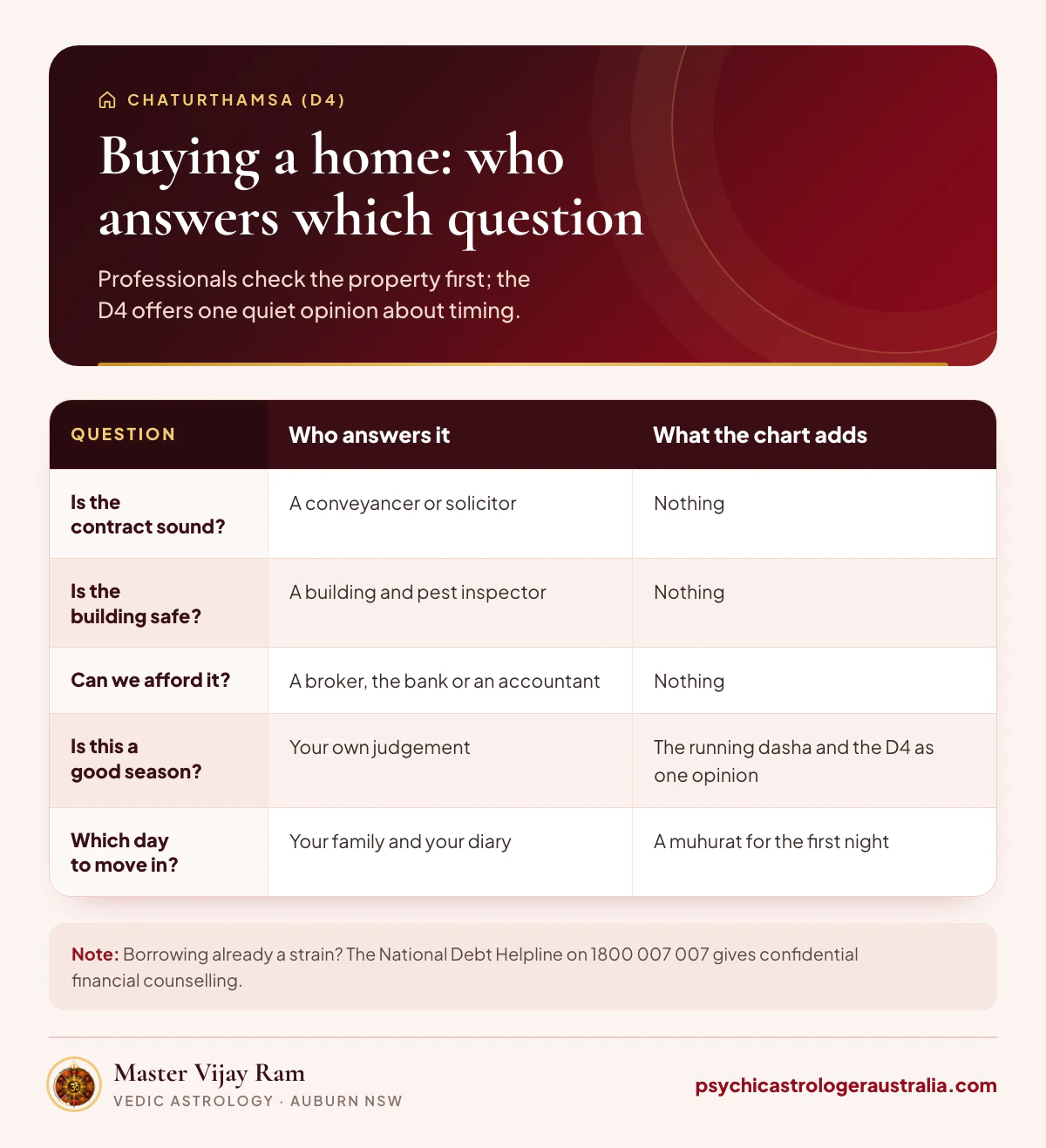
Practical help comes first, and in property it comes from licensed people. A conveyancer or solicitor reviews the contract and the title, a building and pest inspector looks at the structure, a mortgage broker or bank works through borrowing, and the state revenue office and the First Home Buyer website explain grants and duty. Strata reports matter for units and townhouses.
| Question | Who actually answers it | What a chart reading adds |
|---|---|---|
| Is the contract sound? | A conveyancer or solicitor | Nothing |
| Is the building safe and well built? | A building and pest inspector | Nothing |
| Can we afford it? | A broker, the bank, an accountant | Nothing |
| Is this a supportive period for us to settle? | Your own judgement | The dasha and the D4 as one opinion |
| Which day to move in? | Your family and your diary | A muhurat for the first night |
If borrowing is already a strain, the National Debt Helpline on 1800 007 007 gives confidential financial counselling before any new commitment.
Can the D4 say which house to buy?
No. A divisional chart describes a person, not a building, and it cannot compare two addresses. Vastu is sometimes asked to do that job instead; it can comment on layout and orientation, but it does not replace an inspection either.
Where a family is torn between two homes, the honest reading talks about timing, the family's own needs and the conversations still to have. The choice of street stays with the people who will live there.
What if you rent, or move often for work?
Plenty of people who ask about the D4 are not buying at all. Nurses on contract in Hobart, public servants posted between Canberra and the coast, and students who have shifted house four times in three years all want to know when life will feel settled. The chaturthamsa is read for that feeling of stable ground as much as for title deeds.
In that kind of reading the fourth house of the D4 and the Moon carry more weight than Mars, because the question is about rest and belonging rather than land. A period that lights up the fourth lord is often described as a time when a lease turns into something longer, a family joins a person from overseas, or a rented flat finally feels like home.
None of that changes tenancy law. A dispute about a bond, repairs or a lease belongs with the state's fair trading or tenancy body, not with an astrologer.
What about inherited land and family property?
The D4 is also opened when a family is weighing land in India against a home in Australia, or sorting out property after a parent's death. The tradition reads the eighth house for inheritance and the fourth for the ancestral home, and the D4 is checked for how settled the person's own ground is.
Any dispute over a will, a title or a transfer goes to a lawyer, in Australia or in India, and a chart reading never takes a side in it. What a reading can do is help a person see whether a season is better for patience or for decisions.
Is there a remedy for a weak fourth house in the D4?
A remedy does not move a planet, approve a loan or fix a crack in a slab. The tradition offers mantra for a strained fourth lord or Mars, steady conduct, care for one's mother and elders, and a griha pravesh puja when a family moves in.
Where a puja or havan is warranted it is performed personally by Master Vijay Ram at his place of practice in Auburn, starting from $250 and agreed before it is performed; booking a puja or havan describes the steps. The griha pravesh home blessing page covers the house-warming rite itself.
What can a chaturthamsa reading not do?
It cannot value a property, forecast interest rates, see a council zoning change or tell you whether a vendor is honest. It reads tendencies and timing in one person's life, and its plainest limitation is the birth time: a wrong lagna gives a confident reading of someone else's D4.
It also cannot replace the cooling-off period, the inspection or the legal advice that protect every buyer. Use those first, and treat the chart as a quiet second opinion about the season you are in.
How does Master Vijay Ram read a property question?
He reads the birth chart's fourth house and its lord, checks Mars, Saturn and the Moon, and only then looks at the D4 if the birth time can bear it. The period running now is laid over both, and he says plainly when the chart is quiet on the question.
A $50 consultation by phone, video or WhatsApp, in English, Hindi or Punjabi, covers the reading. Families in South Australia can arrange it through astrology readings for Adelaide, and first-time buyers may also find timing a first home purchase useful.
Read next
- The Fourth House in Vedic Astrology: Mother, Home, Property and PeaceThe fourth house in Vedic astrology (sukha bhava): mother, home, property and peace of mind, the fourth lord in each …
- Saptamsa (D7): The Chart of ChildrenWhat the saptamsa (D7) chart is, how its seven slices of each sign are counted, what astrologers read in it about chi…
- Signs of Jinn Disturbance at Home and How Ruqyah HelpsJinn disturbance at home: which signs matter, which have ordinary causes, what ruqyah really is, and how a settled ho…
Frequently asked questions
What does the D4 chart show in Vedic astrology?
The chaturthamsa or D4 is traditionally read for the home, land, vehicles and fixed assets, and in older texts for fortune more broadly. Astrologers judge its lagna lord, its fourth house and where the birth chart's fourth lord falls in it. It refines the fourth house of the birth chart and describes tendencies and timing rather than particular properties.
How is the chaturthamsa calculated?
Each sign is divided into four quarters of 7°30′. The first quarter belongs to the sign itself, the second to the fourth sign from it, the third to the seventh and the fourth to the tenth. The same rule applies to every sign, odd or even. Software computes it instantly, provided the birth time and the ayanamsa are correct.
Can astrology tell me when to buy a house?
It can describe periods the tradition reads as more or less supportive for settling a home, using the running dasha, the fourth house and the D4. It cannot see the market, interest rates, a vendor's position or your finances. The decision rests on your budget, legal advice and an inspection, with the chart as one quiet opinion about timing.
Is the D4 enough to judge property on its own?
No divisional chart is read alone. The birth chart's fourth house, its lord, the Moon, Mars and Venus come first, and the D4 confirms or questions what they show. When the two disagree, the running dasha usually decides which picture is louder, and an uncertain birth time is the first thing to check.
Does a weak D4 mean I will never own a home?
No. A weak placement is read as a home that may come later, with more effort or after a change of circumstance, not as a verdict. Many people with difficult fourth houses buy homes, and the running period changes the picture over time. Your savings, income and the market matter far more than any single placement.
Which planet is linked with land and property?
Mars is the traditional karaka for land and building, the Moon for the home and the peace felt in it, Venus for vehicles and comforts, and Saturn for old buildings, long loans and patient accumulation. Their dignity in the birth chart and the D4 is part of a property reading, alongside the fourth house and its lord.
Should I check vastu or the D4 before buying?
Neither replaces a conveyancer or a building and pest inspection, which come first. Vastu comments on the layout and orientation of a particular house, while the D4 describes the buyer's own chart and timing. Some families use both as personal guides, but the contract, the structure and the finances decide whether a property is sound.
Is there a puja for buying property?
Families often hold a griha pravesh puja when moving in, and some ask for a Mars or fourth-lord shanti during a strained period. These are prayer, not a way to secure a property. Where a puja is warranted after a $50 consultation, it is performed personally in Auburn, starting from $250 and agreed before it is performed.
People also ask
Which divisional chart is used for property?
The chaturthamsa, or D4, is the divisional chart traditionally used for property, home, land and fixed assets. It is read beside the fourth house of the birth chart and the running dasha. It describes tendencies and timing, not the merits of a particular building.
Which house is for property in the birth chart?
The fourth house is read for home, land, vehicles, the mother and peace of mind, with the Moon, Mars and Venus as supporting significators. The eighth house is also read for inherited property. The D4 is then used to refine what the fourth house shows.
What is the 4th lord in the D4?
It is the sign and house in the D4 occupied by the lord of the birth chart's fourth house. A fourth lord strong in both the birth chart and the D4 is traditionally read as a firm promise of a settled home; strength in only one suggests timing matters more.
Does astrology replace a conveyancer?
No. A conveyancer or solicitor reviews the contract and title, a building and pest inspector checks the structure, and a broker or bank works through finance. A chart reading is faith-based guidance about timing and cannot replace any of them.
References & further reading
Serving clients across Australia
Confidential consultations by phone, video & WhatsApp — including: