

Quick answer
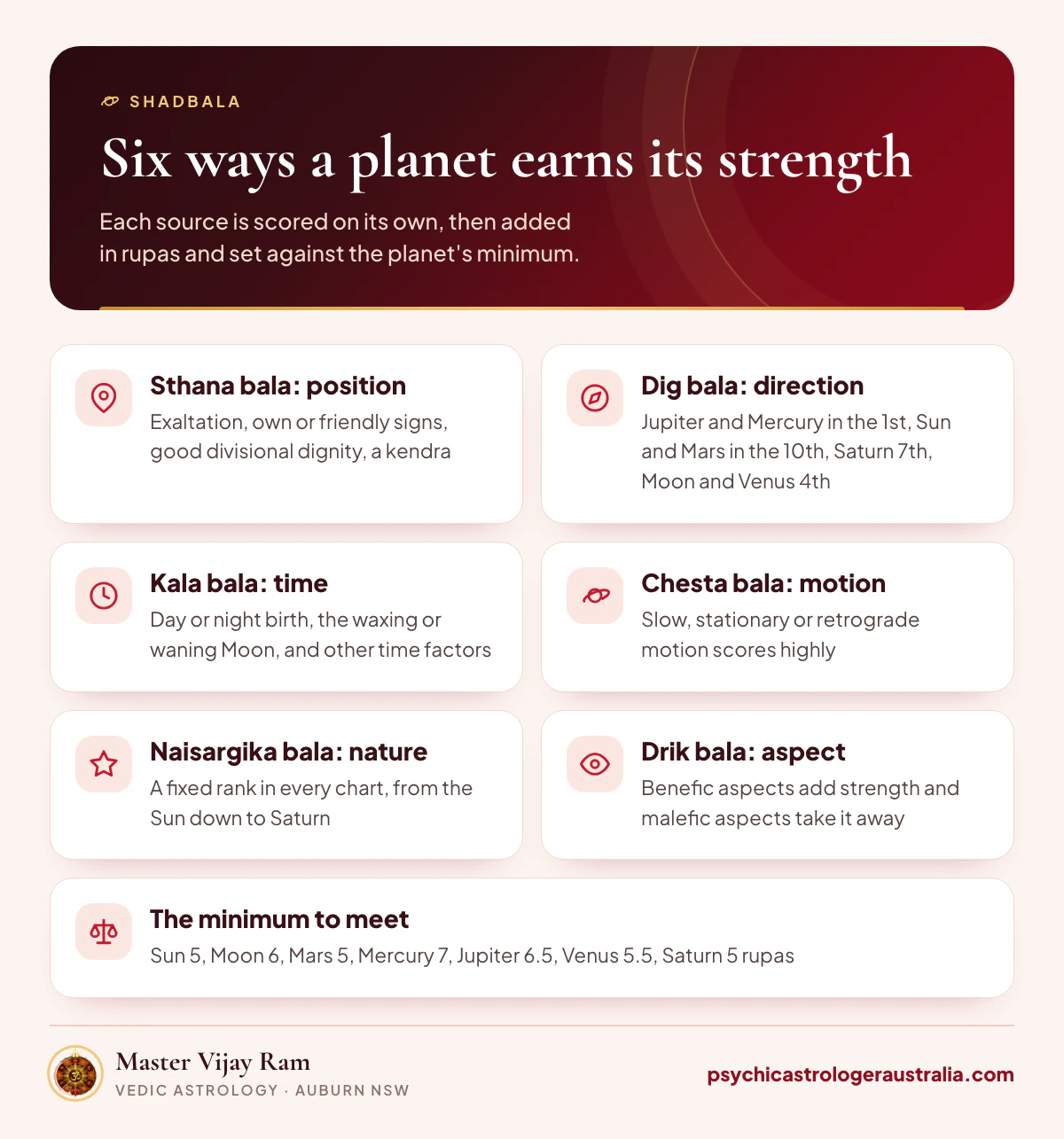
Shadbala is the Vedic method of measuring a planet's strength from six sources: position, direction, time, motion, natural rank and aspect. The results are added in rupas and compared with a minimum for each planet, from 5 rupas for the Sun, Mars and Saturn to 7 for Mercury. A planet above its minimum is read as able to deliver what it promises.
What is shadbala?
Shadbala is a scoring system that measures how much strength each of the seven visible planets has in a birth chart, by adding up six separate kinds of strength. The word simply means six strengths. It comes from the Brihat Parashara Hora Shastra and is the reason most kundli software prints a page of decimals that few people know how to read.
The idea is practical. Two charts can both have Jupiter in the tenth house, but if one Jupiter is strong and the other weak, the same placement will not deliver the same results. Shadbala is the tradition's attempt to put a number on that difference. Rahu and Ketu, which have no bodies of their own, are left out.
It is one of the tools behind a full kundli reading, used to decide which planets can carry their promises and which need the right period to do so.
What are the six sources of strength?
Each source answers a different question about the planet, and each is scored separately before the totals are combined. In plain words they are as follows.
| Component | Plain meaning | What it rewards |
|---|---|---|
| Sthana bala | Positional strength | Exaltation, own or friendly signs, good dignity in the divisional charts, and placement in angles |
| Dig bala | Directional strength | Being in the house that suits the planet's direction |
| Kala bala | Temporal strength | Day or night birth, the waxing or waning Moon, and other time factors that favour a planet |
| Chesta bala | Motional strength | The planet's speed and direction, with retrograde motion scored highly |
| Naisargika bala | Natural strength | A fixed rank, the same in every chart, from the Sun down to Saturn |
| Drik bala | Aspectual strength | Aspects received from benefics, reduced by aspects from malefics |
What does sthana bala measure?
Sthana bala is usually the largest single component and the one most people already understand. A planet in its exaltation sign earns the most, then its moolatrikona, own sign, a great friend's sign and so on downward to debilitation. It also earns points for good placement in several divisional charts and for sitting in a kendra.
This is why a planet that looks fine at a glance can score poorly: it may be in a friendly sign in the birth chart but debilitated in the navamsa. The meaning of exaltation and debilitation themselves is covered in exalted and debilitated planets.
How does dig bala work?
Each planet has a house where it is said to be most at home by direction. Jupiter and Mercury are strongest in the first house, in the east; the Sun and Mars in the tenth, at the top of the chart; Saturn in the seventh, in the west; the Moon and Venus in the fourth, at the bottom. A planet in its best house earns full directional strength, and the score falls away as it moves toward the opposite house.
Dig bala is one reason astrologers smile at Saturn in the seventh or Mars in the tenth: both are in their directional home, whatever else is going on.
What do kala bala and chesta bala add?
Kala bala looks at time. The Sun, Jupiter and Venus are reckoned stronger in a daytime birth, the Moon, Mars and Saturn at night, and Mercury at any hour; benefics gain while the Moon waxes and malefics while it wanes; further pieces come from the year, month, weekday and hour lords. It is the most technical component and the one software is most useful for.
Chesta bala looks at motion. A planet moving slowly, stationary or retrograde is scored high, because it is closest to the Earth and brightest; this is why the tradition does not treat a retrograde planet as weak, as retrograde planets in the birth chart explains. For the Sun and the Moon, which never go retrograde, other measures are used instead.
What are naisargika and drik bala?
Naisargika bala is a fixed natural rank, the same in every chart. Measured in virupas, the sixtieth part of a rupa, the Sun receives 60, the Moon about 51.4, Venus about 42.9, Jupiter about 34.3, Mercury about 25.7, Mars about 17.1 and Saturn about 8.6. It acts as a tie-breaker more than a deciding factor.
Drik bala adds strength for aspects from natural benefics and subtracts it for aspects from natural malefics. It is the one component that can be negative, and it explains why a planet under a heavy Saturn or Mars aspect can lose ground despite a good sign.
How many rupas does each planet need?
The six components are added and converted to rupas, where one rupa equals 60 virupas. Each planet is then compared with a minimum. The minimums commonly used are below; traditions differ slightly, and some software prints them as virupas instead.
| Planet | Required rupas | Required virupas |
|---|---|---|
| Sun | 5 | 300 |
| Moon | 6 | 360 |
| Mars | 5 | 300 |
| Mercury | 7 | 420 |
| Jupiter | 6.5 | 390 |
| Venus | 5.5 | 330 |
| Saturn | 5 | 300 |
Mercury's requirement is the highest of the seven, and Saturn, the Sun and Mars share the lowest. A planet that meets or beats its figure is read as able to give its results, and one that falls short as needing support from the dasha, the navamsa or a good transit before it does.
How do you read the shadbala page of a printout?
Software usually prints a column for each of the six components, a total in virupas, the same total in rupas, the required figure, and a ratio of actual to required. The ratio is the most useful single number: above 1 means the planet meets its minimum, and the higher it goes the more comfortably it does so. Many programs also print a rank from strongest to weakest.
Take an invented example. Jupiter totals 420 virupas, which is 7 rupas against a requirement of 6.5, a ratio of about 1.08. Mercury totals 380 virupas, about 6.3 rupas against 7, a ratio of 0.9. In this illustration Jupiter is read as able to deliver, and Mercury as capable but in need of the right season.
Which is the strongest planet in a chart, and does it matter?
People often ask which is the strongest planet in the chart, hoping it will name their gift. The highest ratio does show a planet that can act easily, and its dasha is often a productive time. But a strong planet that rules the sixth or eighth house delivers those houses' themes strongly too, so strength is not the same as kindness.
The weakest planet is equally misread. A low score does not mean the planet's significations are absent from life; it means they arrive with more effort, later, or through the help of other factors. Nobody should read a weak Venus as no marriage, or a weak Mercury as no career.
How does shadbala change the reading of a dasha?
The most practical use of the numbers is in timing. When a mahadasha begins, the astrologer wants to know whether its lord has the strength to carry what it promises. A Venus period for someone whose Venus rules the seventh and twelfth, with a ratio well above 1, is read as a time when relationships and spending both come forward clearly and with some ease.
The same Venus period with a ratio of 0.8 is read differently. The themes still arrive, because the dasha brings them forward, but they may take longer to settle, depend more on the antardasha lords, or show up as effort rather than reward. Neither reading says what will happen; both describe how readily it tends to happen.
Picture a pharmacist in Perth starting a Mercury mahadasha with Mercury ruling her tenth house but scoring below its 7 rupas. The reading would not tell her that her career is blocked. It would suggest that the seventeen Mercury years reward study, qualifications and patient networking more than quick moves, and that the antardashas of stronger planets inside it tend to be the easier stretches.
What are the limits of shadbala?
The system is traditional and arithmetical, and it has not been validated by controlled scientific testing. It also depends on the birth time, since dig bala, kala bala and parts of sthana bala change with the lagna and the hour, and on the software applying the rules correctly; different programs can disagree by a fraction of a rupa.
Most importantly, a number cannot tell you what a planet means for your life. That still comes from the houses it rules, the house it occupies, its company and the period running. Shadbala sharpens a reading; it never substitutes for one.
Does a weak planet need a gemstone or a puja?
Not automatically. A gemstone is considered only after a full reading and only for a planet that is both weak and helpful to the chart; strengthening a weak planet that rules difficult houses can do more harm than good, which is why gemstone advice by chart begins with the whole horoscope. Master Vijay Ram sells no stones.
The usual suggestions are mantra for the planet and conduct that matches its nature. Where a shanti is warranted it is performed personally at his place of practice in Auburn, starting from $250 and agreed before it is performed; the puja and havan service sets out how. A $50 consultation by phone, video or WhatsApp covers the reading itself, and clients in Western Australia can book through readings for Perth clients. The other great numerical method, used for transits, is covered in ashtakavarga and transit scoring.
Read next
- Maraka Planets and the Fear of Death in a ChartMaraka planets and houses 2 and 7 explained honestly: what the term means, why every chart has them, and why no readi…
- Graha Shanti Puja: Which Planet Needs Pacifying and HowGraha shanti puja: how the birth chart shows which planet needs pacifying, Shani and Rahu shanti, what the rite invol…
- Kundli Reading Explained: What Your Birth Chart RevealsWhat a Kundli reading reveals about your life, personality, career and destiny. Master Vijay Ram explains Vedic astro…
Frequently asked questions
What does shadbala mean?
Shadbala means six strengths. It is a Vedic method that measures each of the seven visible planets on six counts: position, direction, time, motion, natural rank and aspect. The scores are added, converted into rupas and compared with a minimum for each planet, to show which planets can deliver their results most easily in a given chart.
How many rupas does each planet need in shadbala?
The commonly used minimums are 5 rupas for the Sun, 6 for the Moon, 5 for Mars, 7 for Mercury, 6.5 for Jupiter, 5.5 for Venus and 5 for Saturn. One rupa is 60 virupas, so software may print these as 300, 360, 300, 420, 390, 330 and 300. Traditions differ slightly on the exact figures.
What is dig bala?
Dig bala is directional strength. Jupiter and Mercury are strongest in the first house, the Sun and Mars in the tenth, Saturn in the seventh, and the Moon and Venus in the fourth. A planet in its best house earns full directional strength, and the score falls steadily as it moves toward the opposite house.
Why is Rahu not included in shadbala?
Rahu and Ketu are the lunar nodes, points where the Moon's path crosses the Sun's, not physical bodies. Several components, such as motion, brightness and natural rank, cannot be measured for them, so classical shadbala covers only the seven visible planets. Their strength is judged instead from their sign, house, dispositor and the planets they join.
Does a retrograde planet have more shadbala?
Yes. Chesta bala, the strength of motion, scores a retrograde planet highly, because it is then closest to the Earth and brightest in the sky. This is one reason the classical texts do not treat retrograde planets as weak. The Sun and the Moon never go retrograde, and other measures replace chesta bala for them.
Is the planet with the highest shadbala the best one?
It is the planet most able to act, not necessarily the kindest. A strong planet ruling the sixth, eighth or twelfth house brings those houses' themes forward strongly as well. Strength tells you how loudly a planet speaks; the houses it rules and occupies tell you what it says.
Can I improve a weak planet's shadbala?
No remedy changes the numbers, which are fixed at birth. The tradition offers mantra and conduct suited to the planet, and the planet's period may still be productive if the dasha and transits support it. A gemstone is considered only after a full reading, and only for a planet that is weak and helpful to the chart.
Why do two apps show different shadbala figures?
Small differences in birth time, ayanamsa and the exact rules each program applies can change the totals by a fraction of a rupa. Kala bala and dig bala are especially sensitive to the time. Check that the birth details and settings match before comparing, and treat any figure close to the minimum as borderline either way.
People also ask
What are the six types of shadbala?
The six are sthana bala (positional), dig bala (directional), kala bala (temporal), chesta bala (motional), naisargika bala (natural) and drik bala (aspectual). Each is scored separately and the totals are added to give a planet's overall strength in rupas.
What is a good shadbala ratio?
A ratio of actual to required strength above 1 means the planet meets its minimum. Figures comfortably above 1 suggest a planet that can act easily; figures below 1 suggest results that arrive with more effort or need a supportive period. No ratio is a verdict on its own.
Which planet is naturally strongest in Vedic astrology?
In naisargika bala, the fixed natural ranking, the Sun is strongest, followed by the Moon, Venus, Jupiter, Mercury, Mars and Saturn. This ranking is the same in every chart and mainly acts as a tie-breaker between planets with similar totals.
Is shadbala accurate?
It is a traditional calculation rather than a scientific measurement, and it depends on an accurate birth time and correct software. Astrologers use it to sharpen a reading, never as the reading itself.
References & further reading
Serving clients across Australia
Confidential consultations by phone, video & WhatsApp — including: