
Quick answer
If you are unsure about an arranged proposal, you are allowed to take time, ask direct questions and say no. Consent is the whole foundation: a marriage you are pushed into is not arranged but forced, and that is a crime in Australia. A chart can show timing and temperament, but it cannot make the decision for you.
What does it mean to be unsure about an arranged proposal?
An arranged proposal is a suggested match that comes through parents, relatives or a matrimonial service rather than through the couple meeting on their own. Being unsure about an arranged marriage proposal usually means one of three things: you do not yet know the person, you know them and something feels off, or you are not ready to marry anyone at all. Each of those deserves a different answer, and none of them is a failing.
Master Vijay Ram hears this question often, from a graduate in Adelaide whose aunt has sent a biodata from Jalandhar, from a nurse in Wollongong whose parents have already met the boy’s family twice. The first thing he says is that the doubt is information. It is worth listening to before anyone looks at a chart, and a love and marriage prediction reading comes after that, never instead of it.
Is it normal to feel unsure, even about a good match?
Yes. A proposal can look excellent on paper, with matching education, a similar family background and a respectable guna score, and still leave you cold after two video calls. Arranged introductions compress a decision that love marriages spread over months, so hesitation is a natural response to speed rather than a verdict on the person.
What matters is what kind of doubt it is. Nerves about a big change tend to ease as you learn more; a sense that you are being steered, that your questions are brushed aside or that the other person avoids certain subjects tends to grow. Write down which one you feel, in your own words, before the next family conversation.
Why does consent come before everything else?
Consent in marriage means you agree freely, without threats, without being worn down and without being told that refusing will shame or break the family. An arranged marriage that both people choose is a long and honourable tradition. A marriage that one person cannot refuse is a different thing altogether, however it is dressed up.
Every Vedic wedding asks for the bride’s and groom’s agreement, and the saptapadi is meant to be walked willingly. No muhurat, no matching and no family promise overrides that. If you would say yes only because saying no feels impossible, you have not yet been given a real choice, and the right step is to make room for one.
What if the pressure has become force?
Forced marriage is a crime in Australia under Commonwealth law, whether the wedding is planned here or overseas. If you are being threatened, kept from friends, told you will be taken to India for a wedding you have refused, or having your passport held, that is no longer family pressure. 1800RESPECT and the Australian Federal Police help people in exactly this position, and in an emergency you call 000.
Master Vijay Ram will not read a chart to help anyone push a reluctant son or daughter into a match, and he says so plainly to parents who ask. He will, if you ask him, help you think through how to talk to your family safely, but your safety comes first and belongs with the services above.
How much time is it reasonable to ask for?
More than most families first offer. A few meetings, some of them without parents present, and a few weeks of ordinary conversation by phone or video is a modest request, not a delay tactic. Many families in Canberra and Newcastle now expect the couple to talk properly before anyone fixes a roka.
Put the request in a calm sentence your parents can repeat to the other family: “We would like to get to know each other properly before anything is decided.” If the other side refuses any time at all, that tells you something about how decisions will be made after the wedding too.
Which questions should you actually ask each other?
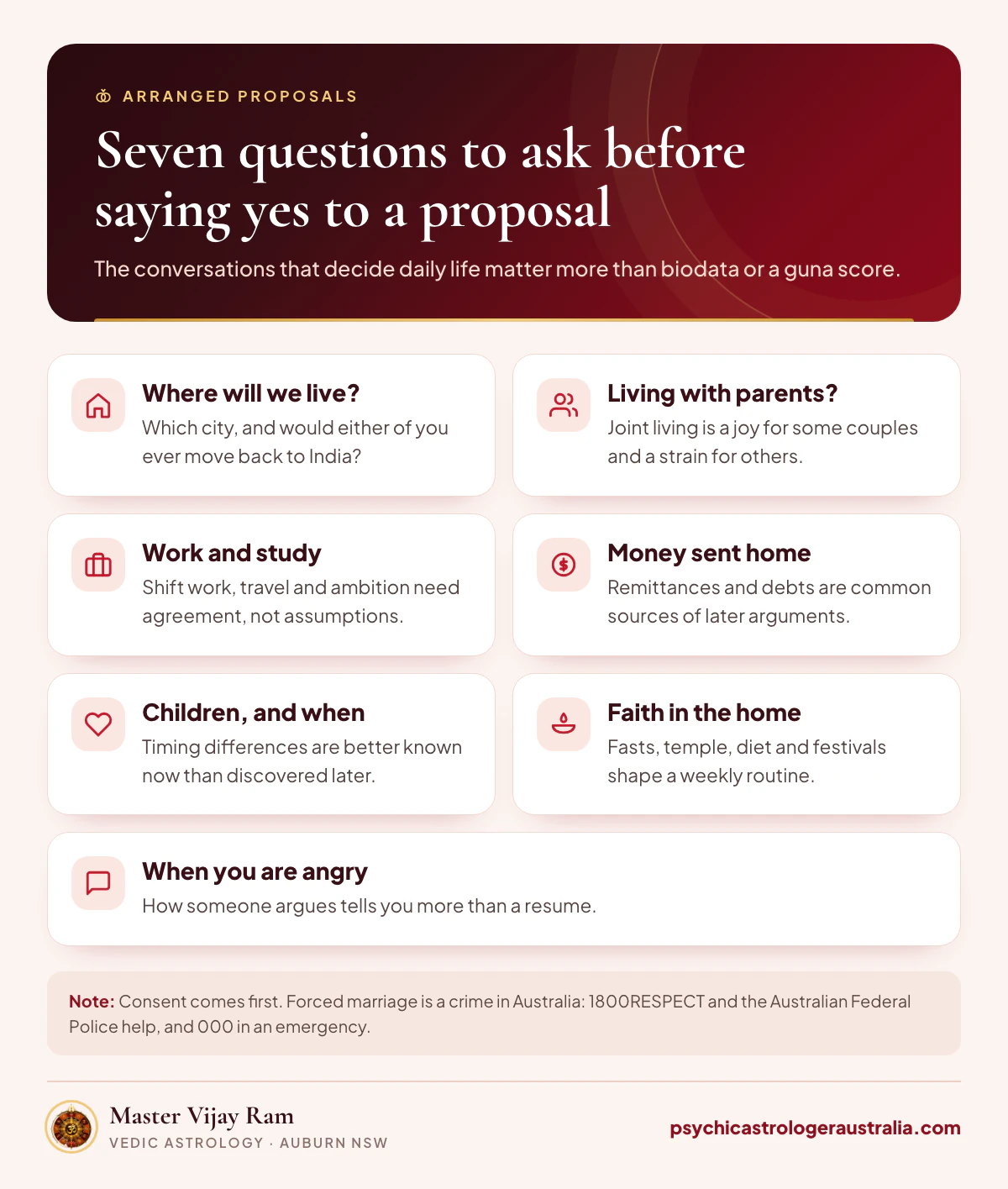
Families tend to exchange biodata, photos and kundlis; the couple often never ask the questions that decide daily life. The table below lists the conversations that matter most, and why each one is worth having before a yes. You do not need to raise them all on a first call.
| Area | A question to ask | Why it matters |
|---|---|---|
| Where you will live | Which city, and would you ever move back to India? | Visas, careers and family distance all follow from it |
| Family household | Will we live with your parents, now or later? | Joint living is a joy for some couples and a strain for others |
| Work | How do you feel about my career, hours and study? | Shift work, travel and ambition need agreement, not assumptions |
| Money | Do you send money home, and how would we share costs? | Remittances and debts are common sources of later arguments |
| Children | Do you want children, and when? | Timing differences are better known now than discovered later |
| Faith and practice | How much does religious practice matter in your home? | Fasts, temple, diet and festivals shape a weekly routine |
| Disagreement | What do you do when you are angry? | How someone argues tells you more than a résumé |
If you are meeting through a matrimonial site, what to check first on matrimonial sites covers the verification side. Sharing your own chart with the other family is a separate decision, and sharing your kundli with a proposal’s family sets out what to share and when.
What can the chart add to an arranged marriage decision?
A reading looks at your own seventh house, its lord, Venus and the dasha you are running, and asks whether this is a period in which a commitment is traditionally read as settling well. It can also compare two charts for temperament, which is more useful than a single number. A Saturn or Rahu period over the marriage houses, for example, is often read as a time to go slowly rather than a reason to refuse.
Gun milan is the part families know best, and its limits matter here. Gun milan and what a low score means explains why a high score does not make a doubtful match right, and why a low one is not a sentence. For a deeper comparison of two charts, a relationship compatibility reading looks beyond the points.
Can the chart tell me whether to say yes?
No, and anyone who says it can is overstating the tradition. A chart describes tendencies and timing: how two temperaments are likely to meet, which years carry pressure, where patience will be needed. It does not know whether the person in front of you is kind, honest or ready, and it cannot replace your own judgement or your consent.
What it can do is take some of the heat out of a family argument. When parents hear that the chart itself suggests waiting six months, the request for time stops sounding like rebellion.
How do you separate your own doubt from your parents’ hopes?
Try listing, on one page, what you want in a marriage and, on another, what your parents want for you. Usually the lists overlap more than either side expects: security, respect, a good family, someone steady. Where they differ, you can see exactly what the disagreement is about instead of arguing about the whole proposal.
Parents often push because they are anxious about age, community talk or their own health, not because they dismiss your view. Naming that worry gently (“I know you are worried I will leave it too late”) tends to soften the conversation more than defending yourself does.
How do you say no without breaking the family?
Saying no to a proposal is easier when the reason is about fit rather than fault. “We want different things about where to live” protects both families’ dignity; a list of the other person’s shortcomings does not. Let your parents carry the message to the other family in their own words, and thank them for the effort they made.
Expect some hurt and some silence afterwards. That is ordinary and usually passes. If a refusal is met with threats, isolation or talk of a trip you have not agreed to, go back to the section on force above and contact 1800RESPECT.
What if you want to say yes, but slowly?
Then say exactly that. A conditional yes (“I like him, and we want three more months of talking before a roka”) is a legitimate answer in most families today. A gradual engagement also gives time to look at muhurat properly rather than grabbing the first date in the wedding season.
If the families agree on a slower path, what the chart says about love or arranged marriage may help you understand how your own chart reads the way partnership arrives, which some couples find reassuring.
When does a reading help, and what does it cost?
A reading helps when the doubt is about timing, temperament or a family impasse, and when you want an outside voice that is not on anyone’s side. A consultation with Master Vijay Ram is $50, by phone, video or WhatsApp, in English, Hindi or Punjabi, and many people from Hobart or the Gold Coast take it with a parent listening. No puja is needed to make a decision, and he will not suggest one for that purpose.
Where a chart does show a strained period ahead, a prayer or shanti can be discussed afterwards, from $250 and agreed before it is performed, done personally at his place of practice in Auburn. That is always optional and never a condition of advice. Readers in South Australia can find how consultations work from there on the astrologer in Adelaide page.
What can a reading not do?
It cannot tell you whether a stranger is trustworthy, and it cannot give consent on your behalf. It is faith-based guidance, not legal, counselling or psychological advice. If the decision is affecting your sleep, eating or mood, a GP or Relationships Australia is the better first call, and Lifeline is on 13 11 14 at any hour.
The decision is yours. A good match will survive a request for time and a few honest questions; a match that cannot survive them was never as good as it looked.
Read next
- How to Convince Parents for Love Marriage: The Honest Vedic ApproachHow to convince parents for a love marriage, the honest Vedic way: hear the real objection, read the family houses fo…
- Love Marriage or Arranged Marriage: What Your Chart SaysLove marriage or arranged marriage: how the fifth and seventh houses, Venus, Rahu and Jupiter incline a chart, and wh…
- Vashikaran for Marriage Approval: Softening Family ResistanceHow family resistance to a marriage really softens: what vashikaran addresses, a stage-by-stage timeline, the honest …
Frequently asked questions
Is it wrong to say no to an arranged proposal my parents like?
No. An arranged marriage depends on both people agreeing freely, and parents introducing a match is not the same as you accepting it. Give a reason about fit rather than fault, let your parents pass it on in their own words, and thank them for their effort. Some hurt is normal and usually passes. If refusal is met with threats or isolation, contact 1800RESPECT.
How long should I take before deciding on a proposal?
There is no fixed rule, but a few weeks of regular conversation and several meetings, some without parents present, is a reasonable minimum for most couples. Ask for time in one calm sentence your parents can repeat to the other family. If the other side refuses any time at all, take that as useful information about how decisions may be made later.
What is the difference between an arranged and a forced marriage?
In an arranged marriage families introduce the couple, and both people can freely say yes or no. In a forced marriage one person cannot refuse because of threats, pressure, deception or control. Forced marriage is a crime in Australia under Commonwealth law, including weddings planned overseas. 1800RESPECT and the Australian Federal Police help, and 000 is for emergencies.
Can kundli matching tell me if I should accept the proposal?
Not on its own. Matching compares two charts for temperament and traditional compatibility, and a fuller reading adds the dasha each person is running. It can suggest whether a period favours going slowly. It cannot tell you whether the person is honest, kind or ready, and a high guna score never outweighs a real doubt.
What questions should I ask the other person before agreeing?
Ask where you would live and whether either of you might move back to India, whether you would live with parents, how each of you feels about the other’s career, whether money is sent home, whether and when you want children, how much religious practice matters, and what each of you does when angry. These shape daily life more than biodata does.
My parents say the stars are perfect, but I feel unsure. What now?
Tell them the stars and your feelings are both part of the decision. A chart describes tendencies; it does not replace your agreement. Ask for more time to get to know the person, and if your doubt continues, explain it in terms of fit. A neutral reading can help parents hear that waiting is reasonable, but the choice still rests with you.
Will Master Vijay Ram help my parents convince me?
No. He does not use a chart to push anyone into a marriage and tells parents so directly. He can read both charts honestly, describe the timing, and help a family talk more calmly, often with parent and child both on the call. A consultation is $50, in English, Hindi or Punjabi, by phone, video or WhatsApp.
Do I need a puja before deciding on a proposal?
No. A decision about marriage needs time, honest conversation and, if you wish, a reading. A puja is never a condition of advice. If a chart later shows a strained period that you want to pray about, a shanti can be discussed, starting from $250 and agreed before it is performed, done personally at his place of practice in Auburn.
People also ask
Is it normal to have doubts about an arranged marriage?
Yes. Arranged introductions ask for a big decision in a short time, so hesitation is common even with a good match. Nerves about change tend to ease as you learn more about the person. Doubts that grow, such as feeling steered or having questions brushed aside, deserve attention. Asking for time and more conversation is a reasonable response to either kind.
How do I politely reject a marriage proposal?
Give a reason about compatibility rather than criticism, for example that you want different things about where to live or how to raise a family. Ask your parents to pass the message on and thank them for their effort. Keep it short and kind. Avoid listing the other person’s faults, which hurts both families and makes the conversation harder.
Is forced marriage illegal in Australia?
Yes. Forced marriage is a crime in Australia under Commonwealth law, and that includes arranging for someone to be taken overseas to be married against their will. 1800RESPECT and the Australian Federal Police help people at risk, and anyone in immediate danger should call 000. A marriage both people freely choose is not affected.
Can astrology help decide on an arranged marriage?
It can add a view of temperament and timing, such as whether a running dasha favours patience or commitment, and it can compare two charts beyond a guna score. It cannot judge character or consent. Treat it as one input beside conversations with the person, your family and your own sense of the match.
References & further reading
Serving clients across Australia
Confidential consultations by phone, video & WhatsApp — including: