
Quick answer
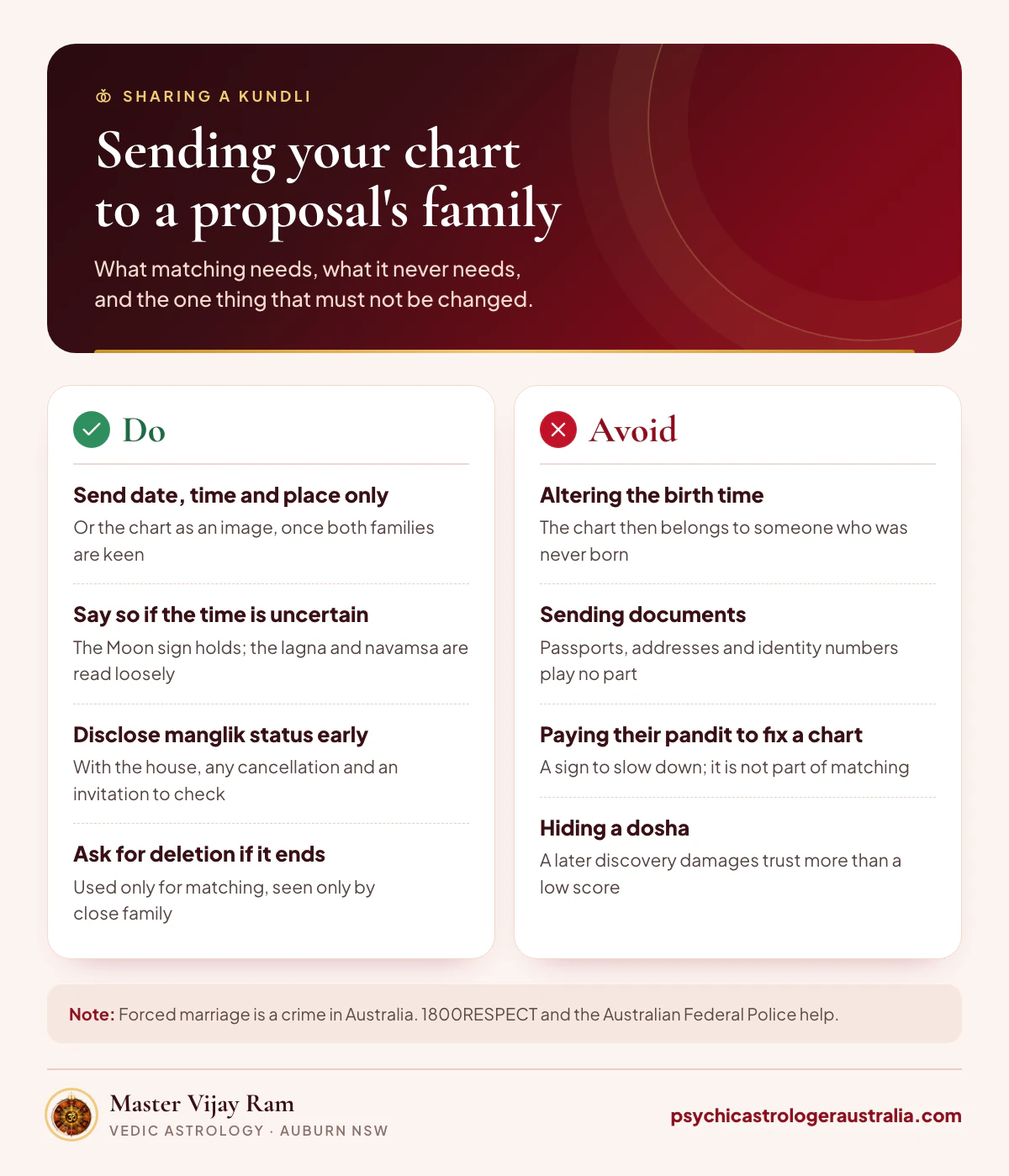
Share your kundli once both families are genuinely interested, send only the birth date, time and place or the chart itself, and never alter the birth time to improve a match or hide manglik status. State any dosha plainly with what the full chart says, and ask that your details be deleted if the proposal ends.
What does sharing a kundli with a proposal actually involve?
Sharing your kundli with a proposal is the step in an arranged or semi-arranged introduction where each family hands over birth details so that the two charts can be matched. It sits between the first phone call and the first serious meeting, and in many Australian Indian families it now happens over WhatsApp within days of a match on a matrimonial site. What used to travel in an envelope between two uncles now travels as a screenshot.
That speed is the reason this post exists. A kundli carries your exact date, time and place of birth, and in the matching itself it carries something more delicate: a reputation. Families who ring Master Vijay Ram for a love and marriage prediction often ask two questions together. What should we send, and is it all right to adjust anything?
The short answers are: less than you think, later than you think, and no.
Why must the birth time never be altered?
Because a chart cast from an altered birth time belongs to somebody who was never born. Shift a birth by forty minutes and the lagna can move to the next sign, the Moon can cross into another nakshatra, and the houses Mars falls in can change. The match the other family then reads is a match between their child and a stranger.
Families are sometimes advised to do exactly this, usually to move Mars out of the houses that count for manglik dosha or to lift a low guna score past eighteen. The request reaches him more often than people would guess. He refuses it, and the reason is practical as well as moral: every timing reading for the rest of that marriage, from the wedding muhurat to the first child's naming, will be built on a false foundation.
There is also the plain question of trust. Many couples later ask for their own charts to be read properly, the real time surfaces, and a marriage begins with the discovery that one side was not straight with the other. That costs far more than a low score ever would.
What if you genuinely do not know the exact time?
Say so. An approximate time stated honestly is far better than an exact-looking time that was invented. Hospital records, the state Registry of Births, Deaths and Marriages and a grandmother's diary are the usual places to look, and birth time rectification explains how an astrologer narrows a range from known life events.
When the time is uncertain, tell the other family what range you have and that the Moon sign and nakshatra are reliable while the lagna is not. Ashtakoot matching rests on the Moon, so a match can still be read; the manglik check and the navamsa need the time, so their verdict is held more loosely.
What should you send, and what should you hold back?
A kundli match needs three things: the date of birth, the time of birth and the place of birth. It does not need a birth certificate, a passport scan, a Medicare number, a residential address or a full legal name with middle names. Those belong to identity checks, not to astrology.
| Stage | Reasonable to share | Hold back for now |
|---|---|---|
| First enquiry or profile match | Moon sign or nakshatra if the family asks, city, broad background | Exact birth time, date of birth with full name |
| Both families keen to talk further | Date, time and place of birth, or the chart itself as an image | Documents, addresses, scans of anything official |
| Match read and families meeting | What your own astrologer found, including any dosha and its cancellations | Other people's charts, earlier proposals, private health history |
| Engagement agreed | Whatever the families decide together for the muhurat | Nothing needs to be hidden now; privacy is still a courtesy |
Sending the chart as an image rather than as typed details is a small help. The family can match it, and the full date of birth is not sitting in a group chat beside a full name and a photograph.
Is a kundli personal information under Australian privacy law?
Birth details privacy starts with a simple fact: they are personal information in the ordinary sense, and a date of birth combined with a name is one of the pieces identity thieves look for. The Office of the Australian Information Commissioner explains in general terms what the Privacy Act covers and what rights you have when an organisation holds your details. A matrimonial site or a business generally has obligations; a private family receiving a WhatsApp message usually does not.
That gap is why manners matter here more than law. A reasonable request, made at the start, does most of the work: please use this only for matching, please do not forward it beyond your astrologer and close family, and please delete it if we do not go ahead. Most families agree without a second thought, and the way they answer tells you something about them.
For the wider question of who should hold your chart at all, who should see your birth chart covers apps, astrologers and relatives. This post stays with the proposal.
How should manglik dosha be disclosed?
Plainly, early, and with the whole reading attached. Mangal dosha is common, and a large share of charts carry Mars in one of the houses that count. What a family needs is not the label but the context: from which house it is counted, whether a cancellation applies, and whether the other chart carries a matching Mars.
A sentence like "our daughter's chart has Mars in the seventh from the lagna; our astrologer found it cancelled by its sign and her running dasha, and we are happy for yours to check" is honest and calm. It answers the question before it becomes an accusation. Manglik dosha, its cancellations and remedies covers the rules themselves.
Families who hide it usually do so out of fear that the proposal will end. Sometimes it would have. But a proposal that would end over an honestly stated dosha was going to struggle with harder news later, and the manglik dosha check and remedy he offers exists so that the conversation can happen with facts rather than dread.
Who should read the match: your astrologer, theirs, or both?
Both, ideally, and separately. Each family having its own astrologer read the same two charts is an old and sensible custom; it catches arithmetic errors and stops either side from feeling the result was arranged. Where the readings differ, the difference is usually about whether a dosha is cancelled, and traditions genuinely do differ there.
What is not reasonable is a family insisting that only their astrologer may see your chart while refusing to share their own. Matching is mutual. A relationship compatibility reading with Master Vijay Ram reads both charts together, and he will tell either family the same thing.
What if the other family asks for something that makes you uneasy?
Some requests deserve a pause. A demand for every horoscope in your household, for scans of passports before a meeting, or for a payment to "their pandit" to fix a problem in your child's chart are all signs to slow down. None of them is part of matching.
Equally, a family who changes their story about the birth time once a dosha is mentioned, or who sends a chart that does not match the date and place they gave earlier, has told you something important. You can decline politely without accusing anyone. A simple "we don't think it is the right match for us" is enough.
Where pressure turns into control, threats or a push toward marriage against someone's will, the matter has left astrology behind. Forced marriage is a crime in Australia, and 1800RESPECT and the Australian Federal Police help. Relationships Australia supports families through the ordinary strain of introductions too.
How does honesty help the match itself?
Kundli honesty lets a reading do the useful part of its job. The guna score is only the beginning; the real work is in how the two dashas run side by side, where each partner's seventh house sits, and which years will need patience. All of that depends on accurate times.
Take an illustration of a kind of call he hears often: a family in Parramatta whose son's chart scored low on Bhakoot, and who were tempted to send a time that would lift it. Read honestly, the low score turned out to be cancelled because both Moon signs shared a lord, and the dashas suggested a steady first decade. Altered, the chart would have hidden the very thing that made the match good. The family is invented for this post; the pattern is not.
Read what a low gun milan score means before anyone panics over a number.
What can a reading not tell you about a proposal?
A chart does not tell you whether a person is kind, whether they drink, whether their family will respect your daughter's career, or whether they will move to Brisbane with her. Those come from meeting, talking and asking. A kundli match describes tendencies in temperament and timing; it never replaces getting to know someone.
He is also clear that a match is not a verdict on anyone's worth. A low score, a dosha or an unknown birth time says nothing about whether a person will make a good husband or wife.
How does a matching consultation work?
Both sets of birth details are sent before the call. Master Vijay Ram casts both charts, reads the ashtakoot score, the manglik position from the lagna, Moon and Venus, the seventh houses, the navamsa and the dashas, and then talks it through with the family in English, Hindi or Punjabi. Families across Australia consult by phone, video or WhatsApp, and Sydney families who prefer to come in can see him in Auburn by appointment.
A consultation is $50. Where a reading finds a dosha worth addressing, a puja or jaap starts from $250, is agreed before it is performed, and is done personally at his place of practice in Auburn. A consultation is $50, and spell or prayer work, where it is warranted, starts from $250.
The one thing he will not do, at any price, is cast a chart from a time he knows to be false.
Read next
- Kundli Matching for Marriage: Gun Milan Explained and What a Low Score MeansKundli matching for marriage: how Gun Milan scores 36 points, what each koota measures, why a low score is not a verd…
- Marriage Compatibility Beyond Gun Milan: Dasha Sync and Nodal ContactsMarriage compatibility beyond gun milan: dasha sync, nodal contacts, the seventh lords and the navamsa read together,…
- Kundli Reading Explained: What Your Birth Chart RevealsWhat a Kundli reading reveals about your life, personality, career and destiny. Master Vijay Ram explains Vedic astro…
Frequently asked questions
When should we share our daughter's kundli with a proposal's family?
Once both families are genuinely interested in talking further, usually after a first phone call or video chat. Sharing the exact birth time with every profile match on a site spreads personal details widely for little purpose. A Moon sign or nakshatra is enough for a first glance; the full details follow when a proper reading is worthwhile.
Is it wrong to change the birth time to avoid manglik dosha?
Yes. A changed time produces a chart that belongs to nobody, so the match the other family reads is meaningless and every later timing reading for the marriage rests on a false chart. Master Vijay Ram refuses to cast or match a chart from a time he knows has been altered, whatever the reason given.
What details does a kundli match actually need?
Only the date of birth, the time of birth as precisely as it is known, and the place of birth. A name helps keep charts apart but need not be the full legal name. Birth certificates, passports, addresses and Medicare numbers have nothing to do with astrology and should not be sent for matching.
How do we tell a family that our son is manglik?
State it early and calmly with the context: which house Mars occupies from the lagna, whether your astrologer found it cancelled, and an invitation for their astrologer to check. A plain sentence prevents the dosha being discovered later and treated as something hidden. Many charts carry it, and many cases are cancelled.
Can the other family share our kundli with other people?
There is usually no law stopping a private family from forwarding a message, which is why the request matters. Ask at the start that the chart be used only for matching, seen only by their astrologer and close family, and deleted if the proposal ends. Most families agree readily, and their response is telling.
What if we do not know the exact birth time?
Tell the other family what range you have. The Moon sign and nakshatra are usually reliable within a few hours, so ashtakoot matching can still be read, while the lagna, the manglik position from the lagna and the navamsa are held more loosely. Hospital and registry records sometimes hold the time, and rectification can narrow it.
Should both families use the same astrologer?
It is better for each family to have its own reading of the same two charts. That catches errors and means neither side feels the result was arranged. Where readings differ, the disagreement is usually over whether a dosha is cancelled, an area where traditions genuinely differ and a calm conversation helps.
What does a kundli matching consultation cost?
A consultation with Master Vijay Ram is $50 and covers reading both charts and talking the result through by phone, video or WhatsApp, or in person in Auburn. If a dosha warrants a remedy, a puja or jaap starts from $250 and is agreed before it is performed. Nothing is free and nothing is added without your agreement.
People also ask
Is it safe to share your horoscope with a stranger?
It is reasonably safe if you share only what matching needs: the date, time and place of birth, ideally as a chart image rather than beside your full name and photograph. Avoid sending identity documents or addresses. Ask that the details be used only for matching and deleted if the introduction goes no further.
Can a fake kundli be detected?
Often, though not always. An altered time can produce a chart that contradicts known life events, a manglik position that shifts between versions, or a chart that does not match the date and place given earlier. An astrologer reading both charts carefully may notice the inconsistency. Honesty from the start avoids the whole problem.
Do you have to disclose manglik dosha before marriage?
There is no law requiring it, but in a match where both families are reading charts, hiding it undermines the whole exercise and the trust between families. Disclosing it early with the full context, including any cancellation, is the honest course and usually leads to a calmer conversation than a later discovery.
What information is needed for kundli matching?
The date, time and place of birth for each person. With those an astrologer casts both charts and reads the ashtakoot score, the manglik position, the seventh houses, the navamsa and the dasha periods. Nothing else, such as documents or addresses, is needed for the astrology itself.
References & further reading
Serving clients across Australia
Confidential consultations by phone, video & WhatsApp — including: