
Quick answer
A combust or asta planet is one sitting within a set number of degrees of the Sun, commonly 14 for Mercury and 10 for Venus. You can check it yourself by subtracting longitudes, counting across sign lines. How much it matters depends on depth, dignity and the dasha; Mercury and Venus are combust so often that the tradition reads them lightly.
What is a combust planet, in one line?
A combust planet is a planet that sits close enough to the Sun in the sky that, by tradition, its own light is swallowed by the Sun's. The Sanskrit word asta means set, as the Sun sets, and an asta graha is read as a planet whose own agenda is pushed into the background. The earlier guide to what a combust planet means describes how each planet behaves in that state.
This page is the practical companion. It shows how to check combustion in your own chart with nothing more than subtraction, how to tell a deep combustion from a shallow one, why the same idea switches weddings on and off in the Hindu calendar, and how modest a sensible remedy is. Every point here is something Master Vijay Ram checks in a kundli reading by birth chart before he says a word about it.
What are the combustion degrees?
The combustion degrees vedic texts commonly give are a separate orb for each planet. A planet within that distance of the Sun is combust; outside it, it is not. Two planets get a narrower orb when they are retrograde, because a retrograde planet is closer to Earth and brighter.
| Planet | Orb when direct | Orb when retrograde | How often it happens |
|---|---|---|---|
| Moon | 12° | Never retrograde | Every month, around the new moon |
| Mars | 17° | Not usually narrowed | Occasional |
| Mercury | 14° | 12° | Very often |
| Jupiter | 11° | Not usually narrowed | Occasional, for some weeks each year |
| Venus | 10° | 8° | Fairly often |
| Saturn | 15° | Not usually narrowed | Occasional, for some weeks each year |
| Rahu, Ketu | Not combust | Not combust | Never; they are points, not bodies |
Rahu and Ketu are shadow points with no light of their own, so the idea of their light being lost does not apply. When Rahu or Ketu sits with the Sun, that is read as a different condition altogether.
How do you check combustion in your own chart?
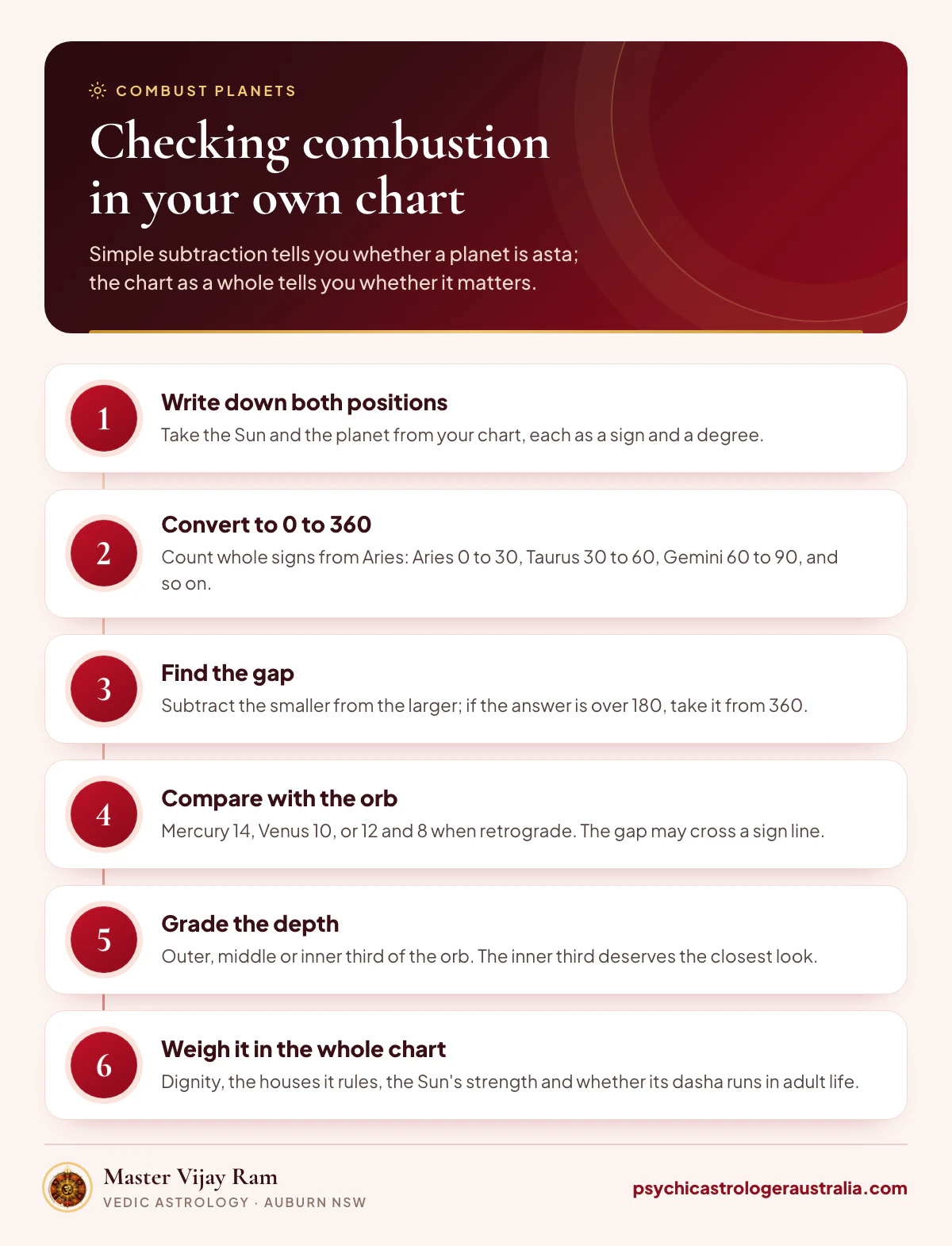
Take the Sun's position and the planet's position from your chart, both as sign and degree. Convert each into a single number from 0 to 360 by counting whole signs from Aries: Aries is 0 to 30, Taurus 30 to 60, Gemini 60 to 90, and so on. Subtract the smaller from the larger. If the answer is more than 180, subtract it from 360. What is left is the gap, and you compare it with the orb in the table.
The step people miss is crossing a sign line. An illustration: the Sun at 20° Taurus and Mercury at 1° Gemini look as if they sit in different houses, but the gap is only 11°, so Mercury is combust. Mercury at 7° Gemini would be 17° away and clear of the orb. Venus at 6° Taurus would be 14° from that same Sun and therefore not combust, even though it shares the Sun's sign.
Check also whether the planet was retrograde, because Mercury's orb drops to 12° and Venus's to 8°. The vakri or retrograde planet guide explains how to tell, and why the two conditions so often appear together for Mercury.
Why are Mercury and Venus combust so often?
They orbit inside Earth's path, so from where we stand they can never wander far from the Sun. Mercury never strays more than about 28° from it, which means it spends a large share of every year inside its 14° orb. A combust Mercury appears in so many charts that treating it as an affliction would make a large share of humanity afflicted.
Venus can travel further from the Sun than Mercury, but it still returns to the Sun's side regularly, so a combust Venus is common too. Mars, Jupiter and Saturn are different: they can stand anywhere in the sky relative to the Sun, and they are combust only for the weeks when the Sun passes them. Their combustion is less frequent and is usually given more weight.
This is also why the pairing of Sun and Mercury in one sign is so common that it has its own name; Budhaditya yoga and the Sun with Mercury explains why its value drops as Mercury moves deeper into the Sun's glare.
How deep is deep? Grading the condition
The orb is a threshold, but the condition behind it is gradual. A planet one degree from the Sun is far more lost in its light than one sitting at the very edge of the orb. Many practitioners therefore grade it, and a simple way to think about it is in thirds of the orb.
- Outer third: the planet is technically combust but still working; most readers mention it and move on.
- Middle third: the planet's matters are noticeably coloured by the Sun's themes of authority, father and self-image.
- Inner third: the planet is deeply set, and its houses and significations need the closest look.
This grading is a practical device, not a classical rule. Some schools also hold that a planet within a fraction of a degree of the Sun's centre behaves differently again; traditions differ, and the Vedic texts most astrologers rely on do not lean on that idea.
How much weight should combustion carry?
Less than an app suggests. After depth, five things decide its weight. First, the planet's dignity: a planet in its own sign or exaltation holds its ground better. Second, the houses it rules for your lagna, because those are the parts of life that feel it. Third, whether it shares the Sun's sign or sits across a sign line from it, the second usually read as milder.
Fourth, the Sun's own condition: a dignified Sun lends authority to whatever it absorbs, while a weak Sun gives little in return. Fifth, and most important, whether the planet's dasha runs in adult life. An illustration: a public servant in Canberra had a deeply combust Venus but would never run a Venus mahadasha in her likely lifespan, so the condition was noted and set aside.
When does a combust planet come into its own?
Traditionally, in its own dasha and antardasha, when its houses are activated and the person has the chance to act on them without the Sun's shadow. Many readings describe the early part of life, when parents and teachers dominate, as the time when a combust planet's themes feel most muffled, and the adult periods of that planet as the time they are reclaimed.
That is a tendency described by the tradition, not a schedule. The Vimshottari dasha timing method shows where those periods fall in a particular life.
Why do Venus and Jupiter combust affect weddings?
Combustion matters not only at birth. When transiting Venus or Jupiter is combust, many North Indian families, and many priests who serve them, avoid fixing a wedding, a griha pravesh or a mundan. The custom is often called shukra asta or guru asta, and in Hindi people say the star has set. Venus stands for marriage and comfort, Jupiter for blessing and wisdom, and the custom holds that neither can bless a new beginning while hidden in the Sun.
Traditions differ on how strictly this is applied, and South Indian practice often weighs it differently. Because the windows depend on the year's transits, they are never typed as a list here; a muhurat consultation for a wedding date checks them alongside every other factor.
Do combust planets need a remedy?
Rarely. A combust planet remedy is considered only when the planet is deeply set, rules houses that matter for your lagna, has no dignity to fall back on and is running its dasha now. Even then the first step is modest: the planet's mantra on its weekday, and practices that steady the Sun, such as offering water at sunrise and keeping a respectful relationship with parents and those in authority.
A formal shanti is for the uncommon chart where all of those conditions meet. When one is chosen, Master Vijay Ram performs it himself at his place of practice in Auburn, starting from $250 with the amount settled before anything begins; how a puja or havan is performed sets out what is included. A $50 consultation comes first, and most combustion questions end there.
What combustion cannot tell you
It cannot diagnose a health condition, a learning difficulty or a marriage problem. A combust Mercury does not cause a stammer, and a combust Venus does not decide whether a marriage lasts. Those questions belong with a GP, a specialist or a counsellor, and this is faith-based guidance, not medical, legal or financial advice.
It also cannot be judged from one line of an app report. Different software uses different orbs, which is why one program marks a planet asta and another does not.
Does where you were born in Australia change it?
Combustion is measured in degrees of longitude, so it is the same everywhere on Earth at the same instant. A planet combust for a baby born in Hobart is combust for one born at the same moment in Perth. What changes from city to city is the clock time on the birth record, and that moves the lagna, which decides the houses the combust planet rules.
That is why Master Vijay Ram asks for the hospital time and the city before checking anything. Readings are by phone, video or WhatsApp in English, Hindi or Punjabi, or in person at Auburn by appointment; Tasmanian clients can read about astrology readings for Hobart.
Read next
- Combust Planets: What a Planet Too Close to the Sun MeansCombust planets (asta graha): the degrees that count, why Mercury and Venus are combust so often, what combustion doe…
- Budhaditya Yoga: Why the Sun-Mercury Pairing Is So CommonBudhaditya yoga explained: why the Sun-Mercury pairing is so common, the combust Mercury paradox, how to check yours …
- 11 Signs of Negative Energy in Your Life (and How to Clear It)Eleven signs of negative energy, the ordinary causes to rule out first, and the three-doors test that tells you wheth…
Frequently asked questions
How many degrees from the Sun makes a planet combust?
The orbs commonly given are 12 degrees for the Moon, 17 for Mars, 14 for Mercury, 11 for Jupiter, 10 for Venus and 15 for Saturn. When Mercury is retrograde its orb narrows to 12 degrees, and Venus's narrows to 8. Schools differ by a degree or so, which is why two programs can disagree about the same chart.
Can a planet in a different sign from the Sun still be combust?
Yes. Combustion is measured in degrees, not signs. The Sun at 20 degrees of Taurus and Mercury at 1 degree of Gemini are only 11 degrees apart, so Mercury is combust even though it sits in the next sign. Many readers treat a combustion across a sign line as somewhat milder than one inside the same sign.
Is combust Mercury a serious problem?
Usually not. Mercury never moves far from the Sun, so it is combust in a large share of all charts. The tradition reads it gently, as thinking and speech that are shaped by the Sun's themes of authority and self-image. It deserves a closer look only when it is very deep, without dignity, ruling important houses and running its dasha.
Can Rahu or Ketu be combust?
No. Rahu and Ketu are the two points where the Moon's path crosses the Sun's, with no light of their own, so there is nothing for the Sun to outshine. When either node sits with the Sun, astrologers read it as a separate condition with its own name and its own considerations, not as combustion.
Why do some families avoid weddings when Venus is combust?
Venus stands for marriage and comfort, and many North Indian traditions hold that a planet hidden in the Sun's light cannot bless a new beginning. So while transiting Venus, or Jupiter, is combust, those families avoid fixing a wedding or a house-warming. Traditions differ on how strictly this applies, and a muhurat consultation checks it with the other factors.
Does a combust planet ever recover?
In the tradition's reading, yes. Its themes are often described as muffled in early life, when parents and teachers dominate, and as reclaimed during the planet's own dasha and antardasha in adult years. That is a tendency rather than a fixed schedule, and the planet's dignity and houses decide how clearly it shows in one particular life.
Should I wear a gemstone for a combust planet?
Not on the strength of combustion alone. A gemstone strengthens a planet and should only ever follow a full chart reading that shows the planet is worth strengthening, which is not always true of a combust planet that rules difficult houses. Master Vijay Ram does not sell stones, and buying advice belongs with a qualified gemmologist.
What does a combustion reading cost?
Checking combustion is part of an ordinary consultation, which is $50 and covers the whole chart rather than one condition. If, rarely, a shanti is suggested, it starts from $250 and the amount is agreed with you before anything is performed. Most people asking about a combust planet need nothing beyond the conversation.
People also ask
What does asta mean in astrology?
Asta means set, in the sense of the Sun setting. In Vedic astrology it describes a planet so close to the Sun that it cannot be seen in the sky, and the tradition reads its own themes as overshadowed by the Sun's. The same word is used when a transiting Venus or Jupiter is hidden in the Sun's glare for a period.
What is the combustion orb of Venus?
The orb commonly given for Venus is 10 degrees from the Sun when it is moving direct and 8 degrees when it is retrograde. Venus is narrower than most planets because it is very bright and can be seen closer to the Sun than fainter planets. Schools differ slightly on the exact figures.
Is a combust planet weak?
It is read as weakened in its own matters, because its light is lost in the Sun's. How weak depends on how deep it sits inside the orb, whether it is in its own or exaltation sign, the Sun's condition and whether its dasha runs in adult life. A shallow combustion of a dignified planet often makes little practical difference.
How do I know if a planet is combust in my chart?
Convert the Sun's and the planet's positions into degrees counted from the start of Aries, subtract one from the other and compare the gap with the planet's orb. Remember that the gap can cross a sign line. Many apps mark combustion automatically, but they use different orbs, so a hand check is worthwhile.
Is combustion the same as a planet being with the Sun?
Not exactly. Two planets can share a sign with the Sun and only one of them be combust, because combustion depends on the number of degrees between them, not on the sign. A planet across the sign line can also be combust if the gap is small enough.
References & further reading
Serving clients across Australia
Confidential consultations by phone, video & WhatsApp — including: