
Quick answer
Spell removal for someone else is shaped by consent. Anyone may pray for another person, and a sankalp can name them and ask for their wellbeing, but nothing is hidden on their body, in their home or in their food. The willing person consults Master Vijay Ram for $50; any puja starts from $250, agreed before it is performed.
What are you asking for when you want a spell removed from someone else?
Spell removal for someone else is a request made by one person on behalf of another: a wife about her husband, a mother about a grown son, a daughter about a father who no longer seems like himself. Master Vijay Ram hears it often, and it is among the most delicate requests in his work, because the person ringing is frightened and the person they are frightened for has asked for nothing.
That gap between the worried and the unwilling is what this page is about. Curse and hex removal describes the work itself; what follows is which parts of it can be done for a person who has not asked, which need that person to step forward, and which are never done at all.
Can you pray for someone who has not asked you to?
Yes, and nobody needs permission to do it. Prayer for another person's wellbeing is the oldest thing one human being does for another, and the tradition sets no condition on it: a grandmother in Harris Park lighting a lamp for a grandson who has gone quiet, a brother saying the Hanuman Chalisa for a sister in a hard marriage.
Inside a formal puja, that prayer is carried by the sankalp, the statement of intention spoken at the start. It names the person, their family line where it is known, and the purpose, and a sankalp for someone's wellbeing asks for their peace, health and protection. It asks for nothing that belongs to their own choosing, which is why it is the one part of this work that can be made in a person's name while they go about their week.
What is never done to another adult in secret?
Three things are refused, whoever asks and however lovingly it is meant. Nothing is placed on a person's body, in their bed, their car or their pockets without their knowledge; nothing is hidden in their home for them to live beside unawares; and nothing, ever, goes into their food or drink.
The last deserves a plain word, because it is the one families reach for in desperation. A powder stirred into a husband's tea or ash mixed into a son's dinner is precisely what households fear black magic to be, and calling it a cure does not change what it is. It can also make someone ill, which is a harm no intention excuses.
The hidden thread or taweez is gentler and still crosses the line. People find these things, and when they do the discovery becomes the story: suspicion, an argument, sometimes a whole household convinced that someone has done something to them.
Why does consent matter when the intention is good?
Because every hidden ritual is done with a good intention, or says it is. The aunt who tucks something under a bride's mattress believes she is protecting her, and the parent who circles a lemon over a sleeping adult son believes he is clearing him. The tradition's line does not turn on motive.
It turns on whose life it is. An adult's body, home and choices are their own, and the Vedic limits on binding and free will hold in both directions: a removal is no licence to reach into someone's life uninvited, any more than a binding is. What the tradition allows without consent is what it has always allowed, which is prayer.
There is a practical reason as well. A person who discovers they were treated in secret seldom concludes that they were loved; they conclude that they were not trusted, and the conversation that might actually have helped becomes much harder to have.
Can a spell be removed without them knowing?
Partly, and it is worth being exact about which part. A sankalp for the person's wellbeing can be made in their name without their knowledge, because it asks nothing of them and touches nothing of theirs. That prayer is the honest whole of what it means to remove a spell without them knowing, and a practitioner who offers more than that, secretly, is offering one of the three things refused above.
Everything else needs the person. Vijay Ram ji reads another adult's chart only with their knowledge, and a cleansing bath, a daily mantra or a period of fasting is something a person chooses for themselves. A protective kavach is prepared for one named person who will wear or keep it, after a consultation finds it will help, so it cannot be slipped to someone who has not agreed.
What if your husband or wife does not believe in any of this?
A common version of the question runs like this. A woman in Brisbane, say, whose husband has grown distant over a year, works late and drinks more than he used to; her mother is sure someone has done something, and he laughs at the idea. She wants to remove a spell from her husband, and he would be furious to learn that anything had been tried.
What she can do is consult about her own worry, which is hers to bring. Her chart is read, and her seventh house and the period she is running say a good deal about the marriage from her side; the ordinary explanations, his work, the drinking, a low mood, a third person, are put on the table plainly. A sankalp for his wellbeing can be added, and she can keep a lamp at the family altar each evening, which is her own worship in her own home.
What she should not do is anything done to him: a taweez in his pillow, water sprinkled over him while he sleeps, something in his food. If he will come to counselling, Relationships Australia sees couples, and if the drinking or the low mood is serious, his GP is the person to see. His disbelief is a view, not a symptom, and it deserves the same respect as her faith.
Who decides for a child?
For a young child, the parents do, and that is as it should be. A parent may consult about a son or daughter, give the child's birth details and ask for a prayer in the child's name. The child's doctor still comes first for anything that looks like illness, poor sleep or a sudden change, and nothing is put on a baby's face or eyes or burnt near a cot.
Spell removal for a child is gentler than the adult version, and mostly it is the parents' own practice that changes. The guide to protecting children from negative energy covers the practical side; what matters here is never telling a child they are under a spell, because a frightened child sleeps worse and the fear outlasts any remedy.
Teenagers sit in between and deserve a say. A fifteen-year-old who rolls their eyes can still be prayed for, but a ritual they have refused should not be done to them anyway, and if they are struggling, headspace and Kids Helpline are there for young people in a way a puja is not.
What about a grown son or daughter, or an ageing parent?
A son of thirty is an adult, however much he is still your child. A father in Adelaide whose son has stopped calling may pray for him every day and ask for a sankalp in his name; he may also send a message saying the door is open, which in many families does more than any ritual.
Ageing parents are often the reverse case, the believers while the children are not. Consultations run in Hindi and Punjabi as well as English, so a mother can speak for herself rather than through a son who is translating his own scepticism. Where illness means a parent can no longer decide, their doctors and whoever the family has agreed speaks for them come first, and the prayer is the part anyone can add.
How do you raise it with the person you are worried about?
Start with what you have noticed, not with what you suspect. "You have not been sleeping, and you seem far away" opens a conversation; "someone has done something to you" usually closes it, and leaves the other person feeling accused of being bewitched.
Offer, do not arrange. A consultation the person books for themselves, at a time they choose and in the language they prefer, is worth more than one they are taken to, and many people who would never agree to a puja will agree to talk to someone for half an hour. If the answer is no, the prayer is still yours to make.
Who is asking, and what can be done?
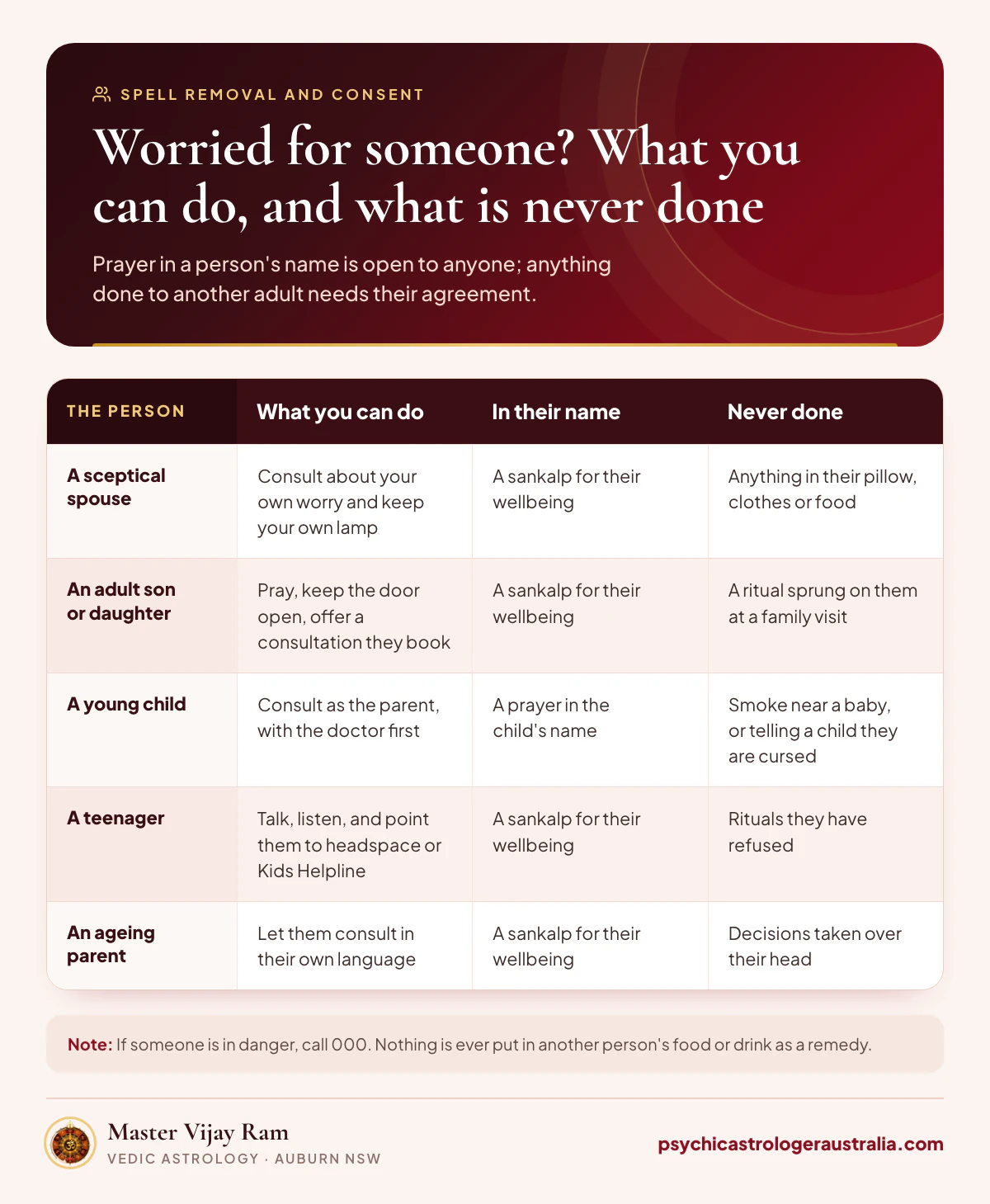
The table sets out the situations that reach him most often. The middle column is open to anyone; the last is closed to everyone.
| Situation | What you can do yourself | In their name, without them | Never done |
|---|---|---|---|
| A spouse who does not believe | Consult about your own worry; have your chart read; keep your own lamp and mantra | A sankalp for their wellbeing | Objects in their pillow, car or clothes; anything in their food |
| An adult son or daughter | Pray daily; keep the door open; offer a consultation they book themselves | A sankalp for their wellbeing | A ritual sprung on them during a family visit |
| A young child | Consult as the parent; see the doctor first; keep routines calm | A prayer in the child's name at the parent's request | Smoke or camphor near a baby; telling the child they are cursed |
| A teenager | Talk and listen; headspace or Kids Helpline if they are struggling | A sankalp for their wellbeing | Rituals they have refused |
| An ageing parent | Let them consult in their own language | A sankalp for their wellbeing | Decisions taken over their head while they can still make them |
| A friend or sibling | Listen, suggest help, respect a no | A prayer in their name | Reading their chart without their knowledge |
How does a consultation handle a request about another person?
The willing person consults, and the consultation is about them. Master Vijay Ram asks for the caller's own birth details and a plain account of what changed in the other person and when; the other person's details are used only if that person has agreed, or, for a young child, at the parent's request.
The reading then says what it can from the caller's side, which is often a great deal: the period they are running, what it shows about the relationship and the household, and whether the change they describe fits an ordinary pattern. Where a prayer for the other person is worth adding, he says so; where it is not, the consultation ends with that advice and nothing more.
A consultation is $50, by phone, video or WhatsApp. Where a puja with the other person named in the sankalp is chosen, he performs it personally at his place of practice in Auburn on a suitable muhurat, from $250 and agreed before it is performed, with the caller joining by video if they wish; a puja or havan performed on request explains what that involves. Callers in Western Australia book on their own clock, and readings for Perth families shows how the time difference is handled.
Does a prayer work if the person does not believe in it?
The tradition has never made prayer depend on the belief of the person prayed for; a grandmother's prayer for an infant asks nothing of the infant. Nobody honest, though, can tell you what a prayer will change in another adult, and Vijay Ram ji will not pretend to.
What it often changes first is the person praying. A wife who has handed her fear to a daily practice argues less, sleeps better and is easier to come home to, and a sceptical husband notices that in a way he would never notice a ritual.
When is the worry really about safety?
Sometimes the change in the other person is not spiritual at all and cannot wait. If someone talks of ending their life, stops eating, hears voices or becomes violent, call 000 or get them to a doctor; Lifeline is on 13 11 14 for the hours in between.
If you are the one being frightened, controlled or hurt, the worry about a spell may be sitting on top of something that needs different help. 1800RESPECT supports people living with family violence, and no remedy should keep anyone in a house where they are not safe.
Sometimes the roles are the other way round: it is the person you love who is sure they are cursed, and you who are not. Helping someone who is sure they are cursed is written for that situation.
Why will he not send it back at whoever cast it?
Some callers want two things at once: the spell lifted from a husband or son, and the person they suspect paid back. The second is refused, plainly, and no culprit is named either, because a reading that pointed at a sister-in-law would wreck the family it was meant to help. Why harm is never sent back sets out the reasoning in full.
What can a reading not do for someone else?
It cannot make another adult change their mind, come home, stop drinking, see a doctor or believe what you believe. Nothing about it can be guaranteed, and it is faith-based guidance in the Vedic tradition, not medical, legal or psychological advice; the GP, the counsellor and, where needed, the police keep their own roles.
What it can do is take a worried person seriously, read their own situation honestly, add a prayer in a loved one's name where that fits, and keep the work on the right side of a line that protects everyone in the family. That is less than some practitioners promise, and it is the version that leaves a family intact.
Read next
- Voodoo Removal in Sydney and Melbourne: How Remote Reversal WorksVoodoo removal in Sydney and Melbourne: what people mean by the word, the signs they describe, ordinary causes first,…
- Witchcraft Removal in Australia: Signs, Safe Reversal and CostsWitchcraft removal in Australia: what the word means here, the signs people report and their ordinary explanations, w…
- Family Curse Removal in Australia: Breaking the Generational CycleA grounded guide to family curse removal in Australia: what a generational curse means, the myths worth dropping, and…
Frequently asked questions
Can I have a spell removed from my husband without telling him?
You can ask for a sankalp in his name, a prayer for his wellbeing made at the start of a puja, and that needs nothing from him. Anything done to him is another matter: nothing in his pillow, nothing sprinkled on him while he sleeps, nothing in his food. Your own consultation, about your own worry and your own chart, is where the rest of the help begins.
Is it wrong to hide a protective thread or taweez in someone's room?
For an adult, in this practice, yes. A protective object is meant to be worn or kept by someone who has chosen it, and a hidden one tends to be found, at which point it frightens or angers the person it was meant to help. Offer it openly instead. If they say no, keep the protection in your own prayer and let the no stand.
Will Master Vijay Ram read my husband's chart if I send his birth details?
Only if your husband knows and agrees. He reads another adult's chart with their knowledge, because a chart is private and reading it behind someone's back is the start of the hidden work this page argues against. Your own chart, though, says a great deal about the marriage from your side, and it is where the reading starts.
My adult son will not talk about it. What can I do?
Pray for him, keep the door open, and talk about what you have noticed rather than what you fear. Many grown children will refuse a puja but accept a half-hour conversation they book themselves, in English, at a time that suits them. A sankalp in his name can be added to a puja at your request; anything arranged behind his back cannot.
Can a parent arrange spell removal for a young child?
Yes, parents decide for young children. A parent can consult, give the child's birth details and ask for a prayer in the child's name, and the family's own calm practice at home is usually the larger part of it. The doctor comes first for illness, poor sleep or a sudden change, nothing goes on a baby's face or eyes, and the child is never told they are under a spell.
Does a prayer work if the person does not believe in it?
The tradition never made prayer depend on the belief of the person prayed for, and a prayer for an infant asks nothing of the infant. No honest practitioner can tell you what a prayer will change in another adult, though. What it often changes first is the person praying, who becomes calmer and easier to talk to, and that is frequently where things start to move.
What does a puja in a loved one's name cost?
The consultation comes first and is $50, by phone, video or WhatsApp. Where a puja with your loved one named in the sankalp is chosen, it starts from $250 and the figure is agreed before anything is performed. Master Vijay Ram performs it personally at his place of practice in Auburn, you may join by video, and the figure does not rise for urgency.
A relative wants to put something in my husband's food to clear a spell. What should I say?
No, clearly and kindly. Nothing goes into anyone's food or drink as a remedy: it can make a person ill, it is exactly what families fear black magic to be, and no genuine tradition asks for it. Thank the relative for caring and suggest a prayer in his name instead. If something has already been added and he feels unwell, ring the Poisons Information Centre on 13 11 26.
Will you tell me who put the spell on my husband?
No. No reading names a person, and a name given on the strength of a chart has broken more families than any spell. The work is to ease what the household is carrying, from your side, with a prayer in his name where it fits. Nothing is sent back at anyone either, because harm returned is still harm, whoever it lands on.
People also ask
Can you remove a spell from someone else?
You can pray for them, and a sankalp in their name can ask for their wellbeing; that much needs no permission. Anything fuller involves the person themselves: their chart, read with their knowledge, and practices they choose. Nothing is hidden on them, in their home or in their food. The worried person consults about their own situation first, and that reading is often where the real help lies.
Do you need someone's permission to pray for them?
No. Prayer for another person's wellbeing is open to anyone, and in a puja it is carried by the sankalp, which names the person and asks for their peace, health and protection. It asks nothing of their will. What does need permission is anything done to them: reading their chart, giving them a kavach, or any ritual involving their body, belongings or food.
How can I help a family member I think is under a spell?
Start with what you have noticed, such as sleep, mood, drinking or withdrawal, and let a doctor look at anything physical. Talk to them without accusing anyone, offer a consultation they can book themselves, and pray for them in the meantime. Do not hide objects or put anything in their food. If they are in danger, call 000; Lifeline is on 13 11 14.
Can a husband or wife remove a spell from their partner?
Not by doing something to them in secret. A believing partner can consult about their own worry, have their own chart read, keep their own daily practice and ask for a sankalp for the other's wellbeing. A partner who does not believe deserves the same respect as one who does, and counselling, a GP or Relationships Australia often help more than any ritual.
References & further reading
Serving clients across Australia
Confidential consultations by phone, video & WhatsApp — including: