

Quick answer
A love-binding spell, as sold online, promises to hold one person to another whatever they want. The Vedic tradition allows nothing of the kind: vashikaran and mantra sadhana can lift what obstructs affection that genuinely existed, but cannot override another adult's will. Master Vijay Ram restores warmth where it was and declines the rest. A consultation is $50; sadhana, where warranted, starts from $250.
What a love-binding spell is, in the market and in the tradition
A love binding spell is a service sold on the promise that one person can be held to another: made to return, made to stay, made to stop looking elsewhere, regardless of what they themselves want. It is advertised with the words bind, tie, lock and forever, usually with a fixed menu price and a fixed number of days. In the Vedic tradition Master Vijay Ram practises, there is no such thing, and the first honest statement on this page is that no genuine practitioner of jyotish offers one.
What the tradition does have is older, narrower and more honest: vashikaran and mantra sadhana, practices with a classical meaning that the market has stretched past recognition. Understanding the difference is the whole of knowing what can be asked for, and what will be declined.
What vashikaran and mantra sadhana are in the classical sense
Vashikaran, in the texts, is one of a group of practices concerned with influence and attraction, and mantra sadhana is the disciplined repetition of a mantra, with fasting and purity of place, until it carries weight. In their classical use they are directed at obstruction: at what is blocking affection, respect or harmony that existed and has been interfered with, whether by a transit, by a third party or by something deliberately done.
They are not, in that use, a lever on another person's mind. The texts are plain that a person's will is theirs, and a practitioner who turns the practices against it is working outside the tradition, whatever words they use. Vashikaran as Master Vijay Ram practises it sits inside that limit; the rest of this page explains where the limit falls.
The line Master Vijay Ram draws
He draws it in the first consultation, before anything else is discussed. Restoring warmth that existed between two people and has been blocked is legitimate work, and he will read both charts to see whether that is the situation. Attempting to override another adult's choice, to make a person who has decided against you decide otherwise, is not work he will undertake at any price. That boundary is not negotiable and not for sale, and it is stated in those words on his vashikaran page.
In practice the line is easy to see. A wife whose husband has gone cold after a relative's interference, with a marriage both still want, is on one side of it. A man whose former partner has told him clearly that it is over, and who wants her made to return, is on the other. The first is read and, where the chart confirms obstruction, worked on. The second is declined, and told why.
Why binding is the wrong word for what the tradition allows
Binding describes holding something that would otherwise leave. The tradition's work is the opposite: removing what is holding affection back so that it can move as it would. A bond that needs binding is a bond one person has already left, and the texts have nothing to offer there except the counsel to let go.
This is why the honest answer to whether love spells work on this site distinguishes an obstructed door from a closed one. Sadhana can open an obstructed door. No practice opens a door the other person is holding shut, and the attempt usually makes it worse.
Karma and consequences, as the tradition teaches them
The tradition does not forbid will-overriding work because it is ineffective. It forbids it because it is a wrong act with a cost, and the cost falls on the person who commissions it as much as on the one who performs it. Work aimed at another person's will is understood to return to its source, which is why a love spell that backfires is such a familiar story: the warmth obtained by force curdles, the relationship obtained by pressure becomes the thing that has to be escaped.
Master Vijay Ram speaks about this plainly because people in pain do not want to hear it and need to. Karma, in the sense the tradition uses, is not punishment. It is the observation that what is taken by force has to be held by force, and nobody can hold another person forever.
Request, accepted or declined, and why
The table is drawn from the requests that reach him most often. The column that matters is the last one.
| Request | Accepted or declined | Why |
|---|---|---|
| My marriage has gone cold since a relative interfered; we both want it back | Read, and accepted if the charts confirm obstruction | Affection that existed and has been blocked is the tradition's proper subject |
| Make my ex come back; she has told me it is over | Declined | Overriding a decided will is outside the tradition and does not hold |
| Stop my husband seeing another woman | Read; accepted only as work on the marriage, never on the third person | A third person's will is also theirs |
| Make a specific person fall in love with me | Declined | There is no affection to restore; the request is for control |
| Help my parents accept the person I have chosen | Read; accepted as work on resistance, not on consent | Softening fear in a family is different from forcing a decision |
| Bind my partner so they can never leave | Declined | Binding is the market's word; the tradition has no such practice |
| Reverse a binding someone did to me | Accepted after reading | Lifting interference is protective work |
What an ethical consultation involves
An ethical love remedy begins with both charts where both are available, and with the plain question of what happened and when. The seventh house, Venus and Mars, the running dasha and any signs of interference are read before a word is said about remedy. Where the charts show an ordinary separation, a mismatch, or a decision the other person has made, the consultation ends with that reading and nothing is sold.
Where they show obstruction in a bond both people still want, the sadhana is chosen for that chart rather than from a menu, performed personally at his place of practice in Auburn on an appropriate muhurat, and followed by an honest review of what changed and what did not. What separates a genuine practitioner from a scam is, in the end, that order of events: reading first, remedy only where warranted, and a willingness to say no.
What it costs
A consultation is $50, by phone, video or WhatsApp, in English, Hindi or Punjabi, and covers the reading of both charts and the plain answer. Where sadhana is warranted it starts from $250, the figure is stated and agreed before anything is performed, and it is never raised partway through. The fees are fixed, but the work is never sold by type: it is chosen for a chart, and a menu of named spells, each with its own price, is one of the surest signs that it is not.
People in Western Sydney and Melbourne's south-east bring these questions to a love spell specialist most often; the pages for a love spell specialist in Parramatta and a love spell specialist in Dandenong describe how the work runs for families in those areas, under exactly the limits set out here.
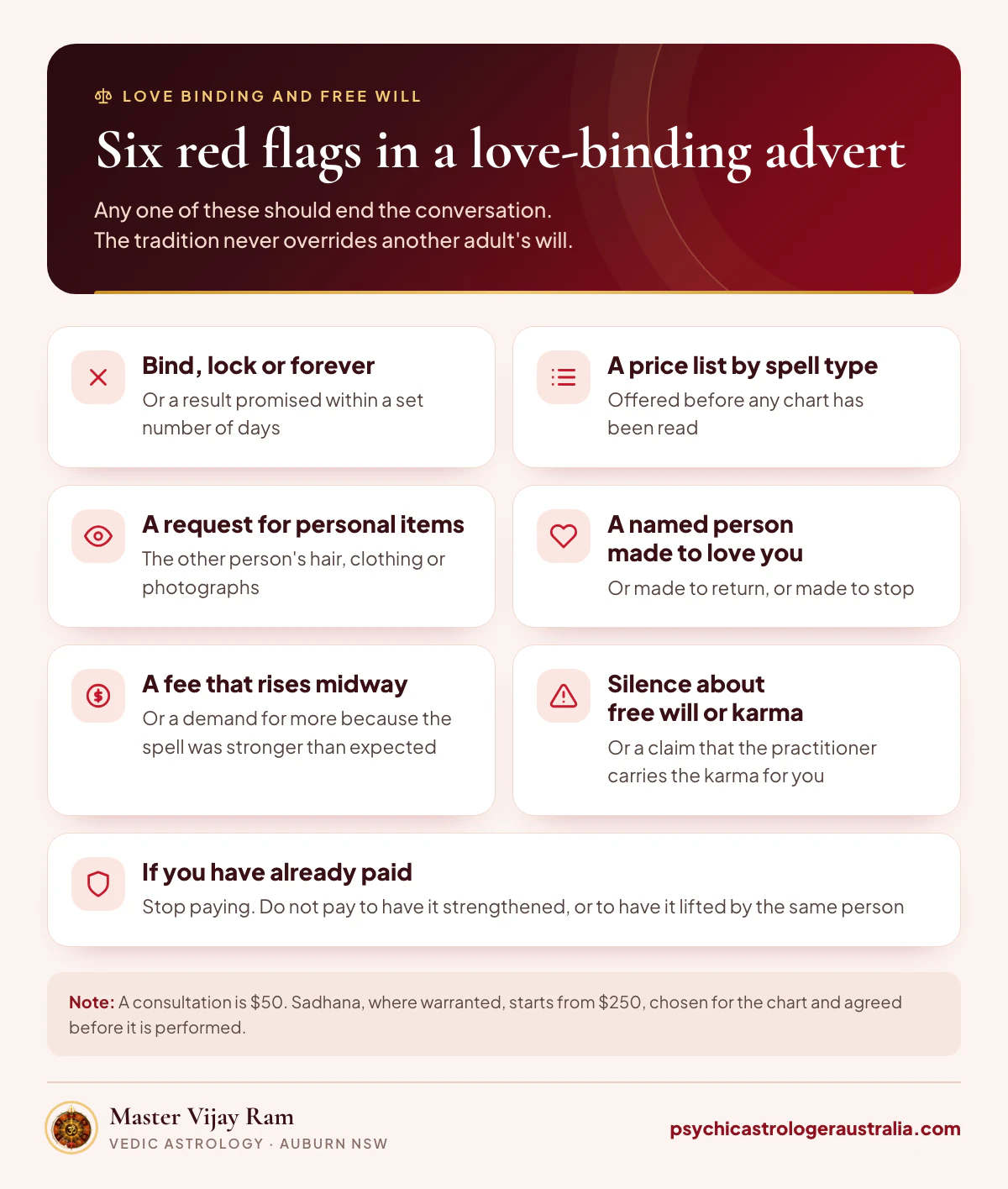
Red flags in love-spell advertising
- The words bind, lock, forever, or a result within a set number of days.
- A price list by spell type, before any chart has been read.
- A request for the other person's hair, clothing or photographs.
- An offer to make a specific, named person love you, or return, or stop.
- A fee that rises once the work has started, or a demand for more because the spell was stronger than expected.
- Silence about free will, karma or consequences, or a claim that the practitioner carries the karma for you.
Any one of these should end the conversation. Consumer protection in Australia applies to these services as to any other, and a practitioner who takes money for a promised result they cannot deliver is making a misleading claim, whatever tradition they say they follow.
If you have already paid someone for a binding
Stop paying. Do not send more money to have it strengthened, and do not send money to have it lifted by the same person. If the relationship it was aimed at has gone worse since, that is the usual course and not a reason to go back. Reversing a love spell safely is covered separately on this site; the short version is that lifting a binding is protective work, done for the person it was aimed at or for the one who commissioned it, and it is one of the few requests in this area Master Vijay Ram accepts without hesitation.
If you commissioned it, the honest reading will also ask what you wanted underneath the request, because that question is still there and the binding did not answer it.
Free will in the texts and in practice
The classical view of vashikaran and free will is simple: a person's choices are their own, and the chart describes tendencies and timing, never compulsion. Jyotish reads what a person is inclined towards and when, and it leaves the choosing to them. A practice that claimed to remove the choosing would contradict the whole basis of the chart it was supposed to rest on.
In practice this means the work Master Vijay Ram does for couples, under the get ex love back heading and elsewhere, is always aimed at obstruction and never at a person. It is slower than what the advertisements promise, it sometimes ends with no, and it is the only version of this work that the tradition recognises.
The question underneath the request
Almost everyone who asks for a binding is asking something else: whether they are still loved, whether the loss was their fault, whether the pain will end. A binding answers none of those and a reading can answer two. The chart says what kind of separation this is and what the coming months favour; the pain ends the way it always has, with time, company and the practices the tradition keeps for grief.
That is less than the advertisements offer and more than they deliver. It is what the tradition allows, and it is enough.
Read next
- Is Vashikaran Safe? Ethics, Karma and Free Will ExplainedIs vashikaran safe? Intention, karma and free will in the Vedic tradition, the side effects people report and what th…
- Love Spell Specialist in Sydney and Melbourne: What a Consultation InvolvesLove spell specialist in Sydney and Melbourne: what a consultation with Master Vijay Ram involves, which requests he …
- Ex Love Spell vs Vashikaran: What Actually WorksEx love spell or vashikaran: what each word really means, what a Vedic reading can honestly do about an ex, and the p…
Frequently asked questions
Does Vedic astrology have a love-binding spell?
No. The tradition has vashikaran and mantra sadhana, practices directed at obstruction, at what is blocking affection, respect or harmony that existed. It has no practice for holding a person to you regardless of their will, and the texts are plain that a person's choices are their own. Binding is the market's word, and a genuine practitioner of jyotish does not use it.
What is the difference between vashikaran and a binding spell?
Vashikaran in its classical sense lifts what is blocking warmth between two people who both still want the bond; a binding spell, as advertised, promises to force one person to stay or return whatever they want. The first works on obstruction and the second on will, and only the first is inside the tradition Master Vijay Ram practises.
Will Master Vijay Ram make my ex come back if they have said it is over?
No. A decided will is outside the work, and he says so in the first consultation rather than taking the money. What he will do is read both charts, say whether the bond was obstructed, closed or wrong, and, where it was obstructed and both people still want it, perform the sadhana that lifts what is blocking it.
Is vashikaran safe, or does it have consequences?
Used as the tradition uses it, on obstruction and with both people's wellbeing in view, it is protective work. Turned against another person's will it is understood to return to its source: affection taken by force curdles and the relationship becomes something to escape. That consequence is the tradition's reason for the limit, not a technicality.
How much does ethical vashikaran cost?
A consultation is $50 and covers the reading of both charts and a plain answer on whether any work applies. Where sadhana is warranted it starts from $250, the figure is agreed before anything is performed, and it is never raised partway through. The fees are fixed, but the work itself is chosen for a chart rather than sold by type from a menu of named spells.
What will he ask for before agreeing to any work?
The birth details of both people where available, the plain history of what happened and when, and a clear statement of what you want. He reads the seventh house, Venus and Mars, the running dasha and any signs of interference before a word is said about remedy. If the reading shows an ordinary separation or a decided will, the consultation ends there.
Can a love spell be used to stop a partner from leaving?
Not in this tradition. A partner who is leaving has made a choice, and work aimed at that choice is declined. Where the charts show that something is obstructing a marriage both people still want, interference or a hard transit, work on the obstruction is possible. The difference is whether the other person still wants the bond, and only they can say.
Someone did a binding on my partner or on me. Can it be lifted?
Yes, and lifting interference is one of the few requests in this area accepted without hesitation, after a reading confirms something is there. It is protective work, done for the person it was aimed at or for the one who commissioned it and regrets it. Do not pay the original practitioner to lift what they sold you.
What are the signs of a love-spell scam?
The words bind, lock or forever; a result promised within a set number of days; a price list by spell type before any chart is read; a request for the other person's hair, clothing or photographs; a fee that rises once the work has started; and silence about free will or consequences. Any one of them should end the conversation.
Why would a practitioner refuse paid work?
Because the tradition forbids it and because it does not hold. Work aimed at a person's will fails more often than it succeeds and causes harm when it seems to succeed. A practitioner who declines it, and explains why, is showing you the order of events that separates genuine work from a sale: reading first, remedy only where warranted, and a willingness to say no.
People also ask
What is a love-binding spell?
A service sold on the promise that one person can be held to another, made to return, stay or stop looking elsewhere, regardless of their own wishes. It is advertised with the words bind, tie and forever, usually at a fixed price and with a fixed number of days. The Vedic tradition has no such practice.
Is vashikaran against free will?
In its classical sense, no: it is directed at what is obstructing affection that already existed, not at a person's choice. Turned against a decided will it is outside the tradition, and Master Vijay Ram declines that use. The texts hold that a person's choices are their own and that the chart describes tendencies, never compulsion.
Do love spells have consequences?
The tradition teaches that work aimed at another person's will returns to its source, which is why forced affection curdles and relationships obtained by pressure become the thing to escape. That consequence falls on the person who commissions the work as much as on the one who performs it, and it is the reason for the limit.
How do I know if a love spell practitioner is genuine?
By the order of events. A genuine practitioner reads both charts first, says plainly when the separation is ordinary or the other person has decided, performs work only where obstruction is confirmed, agrees the fee before anything is done and never raises it, and declines requests to override a will. A price list by spell type is the surest sign of the opposite.
Can a love spell be reversed?
Interference can be lifted, after a reading confirms it is there, and that protective work is one of the few requests in this area accepted without hesitation. It is done for the person the work was aimed at or for the one who commissioned it, and never by paying the original practitioner to undo what they sold.
References & further reading
Serving clients across Australia
Confidential consultations by phone, video & WhatsApp — including: