

Quick answer
Ketu in the houses marks the area of life a person seems to have finished with before they began: skill comes easily there, interest fades and detachment is both gift and cost. Rahu always sits six houses away. Ketu does well in the 3rd, 6th, 10th and 11th, and in the 12th it is the classic moksha placement.
What is Ketu, and what does its house hold?
Ketu is the south node of the Moon, a shadow planet that the myth describes as the body of the demon whose head became Rahu: a body without a head, acting on instinct rather than plan. Ketu in houses vedic astrology marks the area of life a person seems to have finished with before they began, where skill comes without effort, interest comes and goes, and detachment is both the gift and the cost.
That makes Ketu the most misunderstood of the nine. Its house is not empty; it is full of something the person does not value because it came too easily. A kundli reading with Master Vijay Ram reads Ketu with its sign lord and the planets beside it, which is how its gifts are found.
How does Ketu relate to Rahu?
Ketu sits six houses from Rahu, always, so the two form one axis. The companion post, Rahu in the twelve houses, reads the axis from the hungry end; this page reads it from the quiet end. Where Rahu reaches, Ketu lets go, and a reading is only complete when both houses are named.
A traditional shorthand helps: Rahu acts like Saturn, and Ketu acts like Mars. Ketu's results are sudden, sharp and cutting, which is why it is linked with surgery, sudden insight, abrupt endings and the clean break.
What changes a Ketu placement?
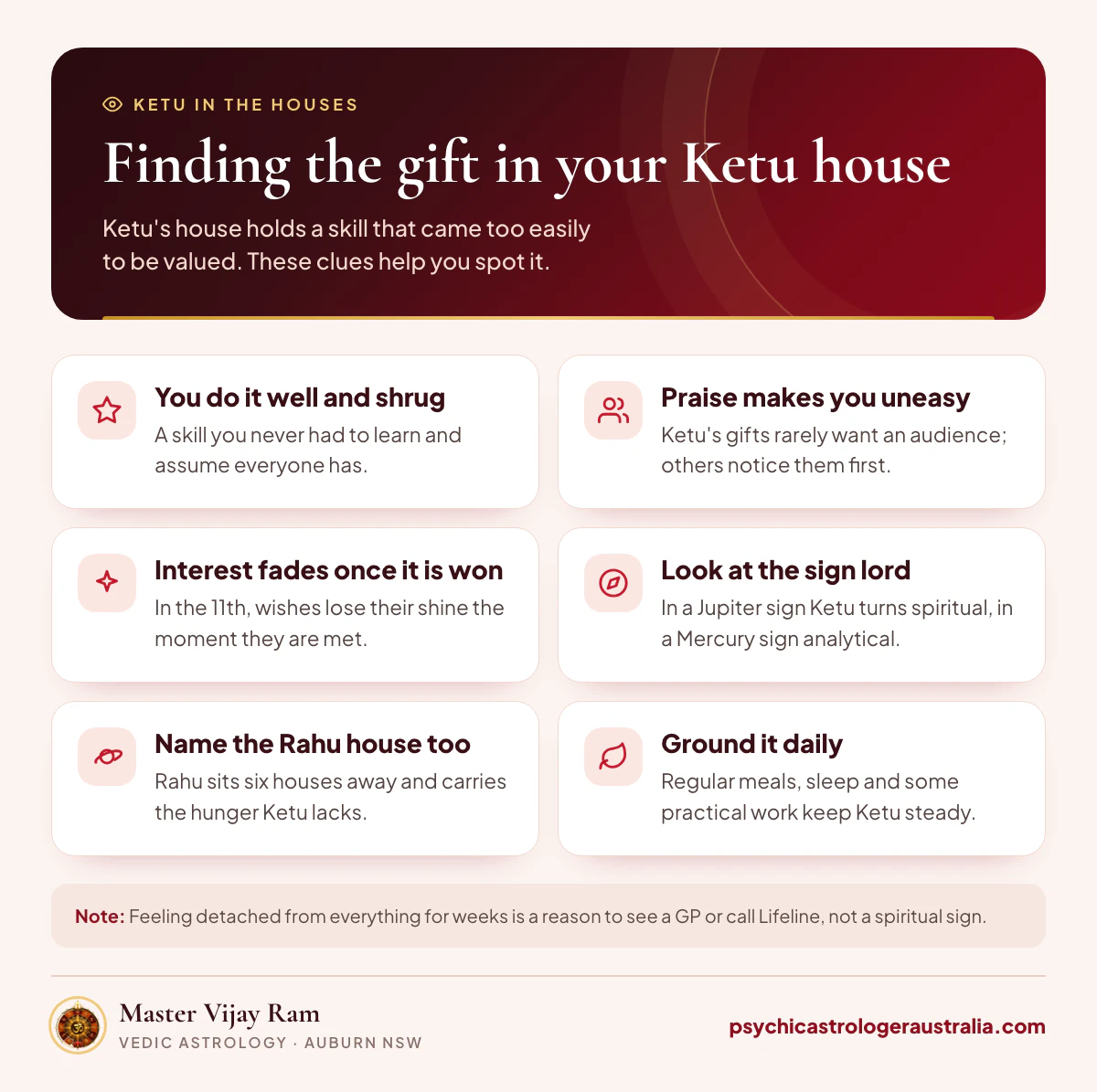
Traditions differ on Ketu's dignity; many give it exaltation in Scorpio or Sagittarius and debilitation in Taurus or Gemini, opposite to Rahu's. It is never combust. Many traditions give it the 5th and 9th aspects as well as the 7th. Its sign lord matters most: Ketu in a sign of Jupiter turns spiritual, in a sign of Mercury analytical, in a sign of Mars surgical.
Ketu is the significator of moksha, liberation, and is happiest in the houses where letting go is the point, the 12th above all. It shows most in its seven-year mahadasha, covered in the Ketu mahadasha post.
Ketu house by house: the table
| Ketu in | The hidden gift | Where detachment shows | What changes it |
|---|---|---|---|
| 1st | Intuition, a healer's presence | Unsure of identity; neglects the body | The lagna lord's strength |
| 2nd | Mantra, a few true words, old languages | Family ties loose; erratic savings | Speech kept honest |
| 3rd | Fearless effort without needing praise | Distance from siblings | Upachaya: strong |
| 4th | An inner home that travels well | Detached from house, land or mother | The Moon's condition |
| 5th | Mantra memory, past-life learning | Romance cool; children an unusual theme | Jupiter's aspect |
| 6th | Rivals fade, healing work, odd cures | Unexplained symptoms worry the person | Upachaya: very strong |
| 7th | A spiritual or unusual partner | Distance inside marriage | Has its own post |
| 8th | Research, astrology, crisis skill | Sudden changes, secretive health | Sign lord decides much |
| 9th | Inner faith beyond ritual | Doubts inherited religion; the father | The 9th lord's strength |
| 10th | Technical mastery, quiet competence | Indifference to titles | Upachaya: good results |
| 11th | Gains that arrive unasked | Few close friends; desires fade once met | Upachaya: often the best Ketu |
| 12th | Meditation, deep sleep, liberation | Little interest in luxury | The classic moksha placement |
Where does Ketu's detachment help?
In the growth houses, the 3rd, 6th, 10th and 11th, Ketu's indifference becomes an advantage. In the 3rd it gives effort that does not need applause. In the 6th, rivals lose interest and disputes simply fade; nurses, surgeons, alternative-health practitioners and people who solve problems others cannot see often have it.
In the 10th Ketu gives a technician's mastery and an odd indifference to titles: the engineer who will not take the management job, the researcher who refuses the spotlight. In the 11th, gains arrive without being chased, and wishes tend to lose their shine the moment they are met, which is a kind of contentment.
Why is Ketu in the 12th house called the moksha placement?
Ketu in the twelfth house puts the significator of liberation in the house of liberation. Tradition reads it as one of the most spiritual placements in Jyotish: a natural pull toward meditation, retreat, pilgrimage and service, sound sleep once the mind is quiet, and little appetite for luxury. Rahu then sits in the 6th, giving the drive to beat whatever obstacle stands in the way.
It is not a placement that requires renunciation. Most people with it hold jobs, raise families and pay mortgages; they simply find their deepest rest somewhere quiet. An ashram visit or a long silence is often more restoring to them than a holiday.
What does Ketu do in the 1st and 7th houses?
Ketu in the first house gives a person who is hard to read and sometimes unsure of themselves, intuitive, unworldly, often thin or careless about the body. People sense a healer or a monk in them. Rahu sits in the 7th, so partners tend to be vivid, foreign or ambitious, and the marriage carries the hunger the self does not.
Ketu in the 7th reverses that: the partner seems distant, spiritual or elsewhere, and the person may feel alone inside the marriage. The full treatment is in Ketu in the seventh house.
What does Ketu in the 4th house mean for home?
Ketu in the fourth house loosens the ties to land, house and sometimes mother. People with it move often, rent happily, sell the family property without much grief, or live far from where they grew up. Many migrants carry it, and they say the same thing: home is wherever the shrine is set up.
Rahu then sits in the 10th, so ambition at work runs high while home stays simple. The gift is an inner home that travels well; the care needed is for the mother, who may feel the distance more than the person does. The Moon's strength decides how settled the mind feels.
What about Ketu in the 2nd, 5th and 8th?
In the 2nd, Ketu loosens family ties and savings habits but gives a voice that says little and means it, a feel for mantra and old languages, and a simple diet. Honest speech matters more here than anywhere.
In the 5th, Ketu gives memory for mantra and an uncanny grasp of subjects the person never studied, which tradition reads as learning carried from a past life. Romance may run cool and children may be a quieter or unusual theme; questions about fertility always belong with a GP first.
In the 8th, Ketu turns toward research, astrology, the occult, insurance and crisis work, and gives a calm in emergencies that others find strange. Health matters can be hard to diagnose; a GP who persists with tests is worth more than any theory.
Ketu in the 9th: faith beyond ritual
Ketu in the 9th often makes a person doubt the religion they were raised in, or keep its core while dropping its forms. They may argue with priests and still pray every night. The father may be distant, spiritual or simply absent from the important years, and Rahu in the 3rd drives the person to carve their own path.
The tenth-wave sibling on finding an ishta devata in the chart is often the right next read for this placement, because a personal deity can hold faith when inherited ritual does not.
How do you recognise a Ketu gift?
Look for what you do well and dismiss. A Ketu gift is usually a skill the person never had to learn, does not enjoy being praised for, and assumes everyone else has: reading people, fixing machines, sensing illness, calculating quickly, sitting in silence.
An illustration, not a client: a radiographer in Cairns with Ketu in Scorpio in the 6th noticed that she spotted problems on scans before senior colleagues did and thought nothing of it. Ketu's gifts often need someone else to point them out.
Which practices are traditional for Ketu?
Ketu is steadied by grounding: regular meals, sleep and exercise, and some contact with the practical world each day. The traditional practices are Ganesha worship, the beej mantra Om Sraam Sreem Sraum Sah Ketave Namah, and mixed grains or blankets given as daan, along with help for dogs through an animal shelter. Cat's eye is discussed only after a full chart reading, and he sells no stones.
Where a Ketu shanti is chosen, the graha shanti page explains how the planet is chosen. Master Vijay Ram performs it personally at his place of practice in Auburn, and the online puja arrangement describes how families join by video. A consultation costs $50; a puja starts from $250 and the figure is agreed beforehand.
What can Ketu's house not tell you?
It cannot explain away a real symptom, decide whether to leave a marriage or tell you to renounce anything. Feeling detached from everything for weeks is a reason to see a GP or call Lifeline on 13 11 14, not a spiritual sign. A reading offers faith-based guidance on tendencies and timing; it is not medical or legal advice. Clients in Far North Queensland usually consult by video or phone; readings for Cairns clients explains how.
Read next
- Rahu in the Twelve Houses: Obsession and the ForeignRahu in each of the twelve houses with its Ketu partner opposite: obsession, ambition and foreign settlement, and wha…
- The Sun in the Twelve Houses: Authority, Father and VitalityThe Sun in each of the twelve houses in Vedic astrology: authority, the father and vitality, with dignity, aspects, t…
- Signs of Jinn Disturbance at Home and How Ruqyah HelpsJinn disturbance at home: which signs matter, which have ordinary causes, what ruqyah really is, and how a settled ho…
Frequently asked questions
Which house is best for Ketu?
The 12th is traditionally the most spiritual placement, because Ketu is the significator of moksha. For worldly results, the upachaya houses, 3, 6, 10 and 11, are strongest: rivals fade, effort needs no applause and gains come unasked. The sign lord and the planets with Ketu decide how a particular placement behaves.
What does Ketu in the 4th house mean?
Tradition reads loose ties to land, house and sometimes mother: frequent moves, contented renting or living far from the place of birth. Many migrants carry it. Rahu then sits in the 10th, pushing ambition at work. The gift is an inner sense of home that travels well.
Is Ketu in the 1st house bad?
No, though it can make a person hard to read and unsure of their identity. It often gives strong intuition and a healer's presence, with some neglect of the body. Rahu sits in the 7th, so partners tend to be vivid, ambitious or foreign, carrying the drive the person does not.
Does Ketu in the 5th house affect children?
Tradition sometimes reads children as a quieter or unusual theme, and romance as cool, alongside an uncanny memory for mantra and learning. It is a tendency, not a verdict; Jupiter's aspect softens it, and fertility questions always belong with a GP first.
What is a Ketu gift?
It is a skill a person never had to learn and tends to dismiss: reading people, fixing machines, sensing illness, calculating fast, sitting in silence. Tradition reads it as learning carried from a past life. Ketu's house shows where to look, and others often notice the gift before its owner does.
Is Ketu exalted in Scorpio or Sagittarius?
Traditions differ. Many give Ketu exaltation in Scorpio and debilitation in Taurus, the reverse of Rahu; others use Sagittarius and Gemini. Because of the disagreement, practical readings lean on Ketu's sign lord and company more than on its own dignity.
What remedies are used for Ketu?
Grounding routines, Ganesha worship, the Ketu beej mantra and mixed grains or blankets given as daan are traditional, with help for dogs through a shelter. A Ketu shanti puja, where a reading suggests one, starts from $250 with the figure agreed beforehand; a consultation costs $50.
How long is the Ketu mahadasha?
Seven years. It tends to bring forward the matters of Ketu's house and sign, often through endings, sudden insight or a turn inward. Its sub-periods change the tone, and a reading looks at which house Ketu occupies before describing what the period may bring.
People also ask
What does Ketu represent in astrology?
Ketu, the Moon's south node, represents detachment, liberation, intuition, past-life skill, sudden events, surgery, research and spiritual insight. It has no body, so it acts through its sign lord and the planets beside it. Its house shows where a person has natural skill and little attachment.
Why is Ketu called a headless planet?
In the myth of the churning of the ocean, a demon drank the nectar of immortality and was beheaded; the head became Rahu and the body became Ketu. A body without a head acts on instinct, which is why Ketu is linked with intuition, sudden action and detachment from plans.
Is Ketu in the 12th house good?
Traditionally it is one of the best spiritual placements, putting the significator of liberation in the house of liberation. It tends to give a pull toward meditation and retreat, sound sleep once the mind is quiet and little interest in luxury. It does not require anyone to renounce ordinary life.
Does Ketu act like Mars?
A traditional shorthand says Rahu acts like Saturn and Ketu like Mars. Ketu's results tend to be sudden, sharp and decisive, which is why it is linked with surgery, abrupt endings and flashes of insight. The shorthand is a guide; Ketu's sign lord still matters most.
References & further reading
Serving clients across Australia
Confidential consultations by phone, video & WhatsApp — including: