
Quick answer
Dhanishta nakshatra is the twenty-third lunar mansion, from 23°20′ Capricorn to 6°40′ Aquarius, ruled by Mars, with the eight Vasus as its deities and a drum for its symbol; the name means the wealthiest. Births in it open with Mars's seven-year mahadasha, its second half begins the monthly panchak, and the tradition reads it as rhythmic, generous and driven.
What is Dhanishta nakshatra?
Dhanishta nakshatra is the twenty-third lunar mansion, stretching from 23°20′ of sidereal Capricorn across the sign boundary to 6°40′ of Aquarius. Its name means the wealthiest, older texts call it Shravishtha, the most famous, and its symbol is a drum, so the tradition reads it through two ideas at once: abundance, and the rhythm that keeps a group moving together. Mars is its lord and the eight Vasus are its deities.
This guide follows the Vasus and their famous curse, the drum, the Mars period that opens a Dhanishta life, the padas and their sounds, the panchak that begins halfway through the star, and what the tradition reads from it for temperament, work, love and the body. The Moon's star is established from the birth time in a horoscope reading by Master Vijay Ram, and like every star it describes a leaning, never a fixed outcome.
Who are the eight Vasus, and what is their story?
The Vasus are the gods of the elements and the bright things of the world, named in the Brihadaranyaka Upanishad as fire, earth, wind, the atmosphere, the Sun, the sky, the Moon and the stars, though other texts give other names. Vasu itself means good, bright and wealthy, which is where the star's reputation for prosperity begins.
Their best-known story is in the Mahabharata. The eight stole the sage Vashishtha's cow and were cursed to be born as mortals, so they begged the river goddess Ganga to be their mother and to release them at birth; she drowned seven of her sons as they were born, until King Shantanu stopped her at the eighth. That child lived a long life on earth as Bhishma, the grandsire of the Kurus, keeping his vow of service for decades.
The tradition draws two lessons from the story for Dhanishta: abundance belongs to the group, and the one who stays behind to do the work needs great patience. Both appear again and again in the lives astrologers associate with this star.
Why is the symbol a drum?
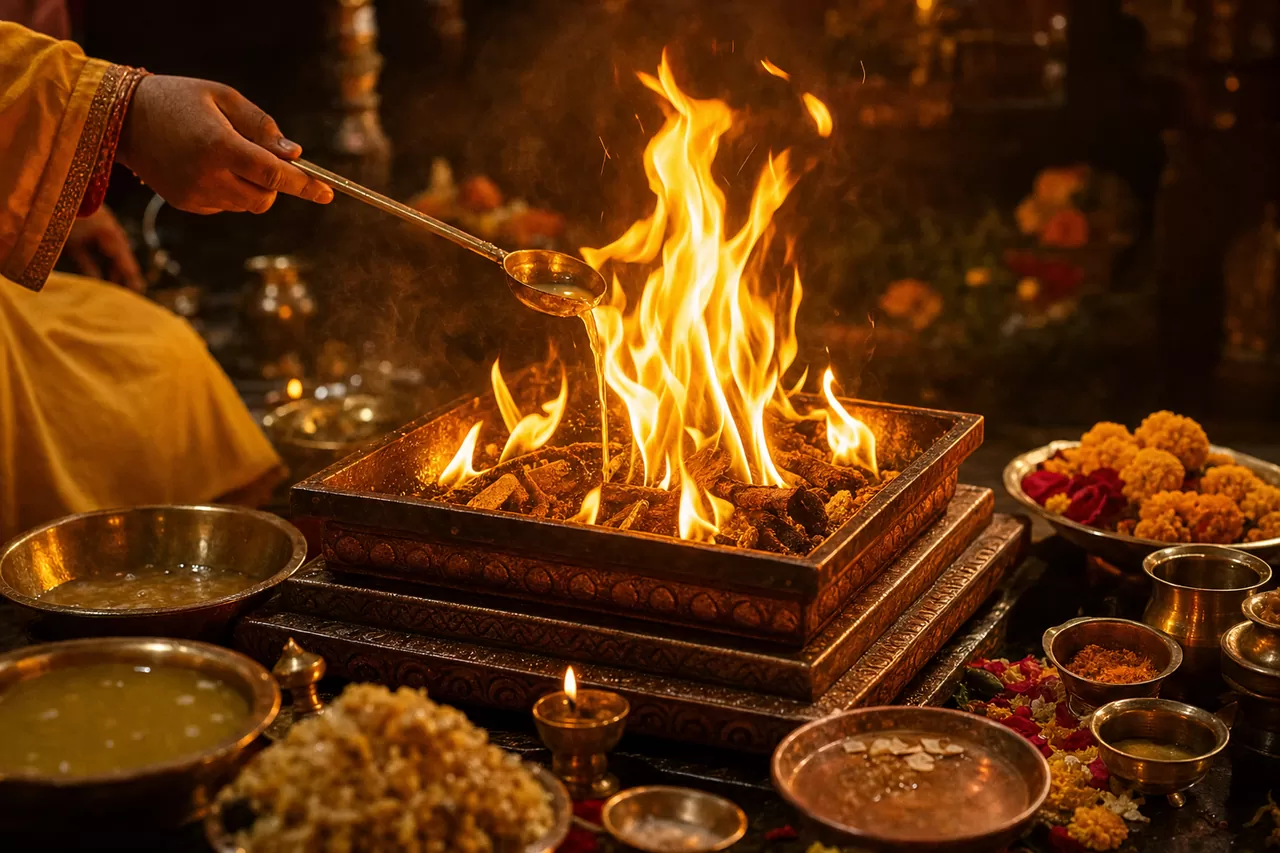
A drum is hollow, and it sounds only when struck; it keeps time for everyone else and is at its best inside an ensemble. The tradition reads Dhanishta people the same way: rhythmic, social, quick to set the pace for a group and happiest when there is something to answer to. Some picture the drum as the mridangam and some as Shiva's damaru, but the musical reading is old and persistent.
The hollowness has a second meaning that astrologers mention more quietly. A drum full of plans and noise can still be empty inside, and a life that chases wealth and recognition with nothing to carry may sound impressive and feel hollow. The tradition's answer is simple: give the rhythm a purpose worth keeping time for.
What does Mars as lord set in motion?
Mars rules Dhanishta, and so a Dhanishta birth opens in Mars's seven-year mahadasha, part of it already spent according to how deep into the star the Moon has gone. A Moon at the star's midpoint, which is the very start of Aquarius, leaves three and a half years.
After that comes the unusual part. Rahu's eighteen years follow at once, which for a midpoint Moon means from about three and a half to twenty-one and a half, so the whole of childhood and adolescence falls under Rahu; Jupiter's sixteen years then cover the twenties and thirties, to about thirty-seven and a half, and Saturn's nineteen carry the person into the late fifties. The seven-year Mars mahadasha explains what the opening period is traditionally said to bring.
Mars is also exalted in Capricorn, the sign that holds the first half of the star, and owns Scorpio, the navamsa of its last pada. Few stars are so thoroughly coloured by their own lord, which is why the tradition reads drive and competitiveness so strongly here.
How are Dhanishta's padas divided?
Dhanishta's padas take the navamsas from Leo to Scorpio in turn. The first two lie in Capricorn and give a Capricorn Moon sign, the last two lie in Aquarius and give an Aquarius Moon sign, and since Saturn rules both signs every Dhanishta Moon answers to Saturn as its sign lord, whichever half it falls in.
The name sounds are Ga, Gi, Gu and Ge, a run of one consonant that makes the choice unusually simple, and nakshatra naming for a newborn turns the pada into a list of real names. The Leo-navamsa first pada is read as the showman, the Virgo second as the craftsman, the Libra third as the diplomat, and the Scorpio fourth, Mars in its own navamsa, as the fiercest competitor.
What is panchak, and why does it start in Dhanishta?
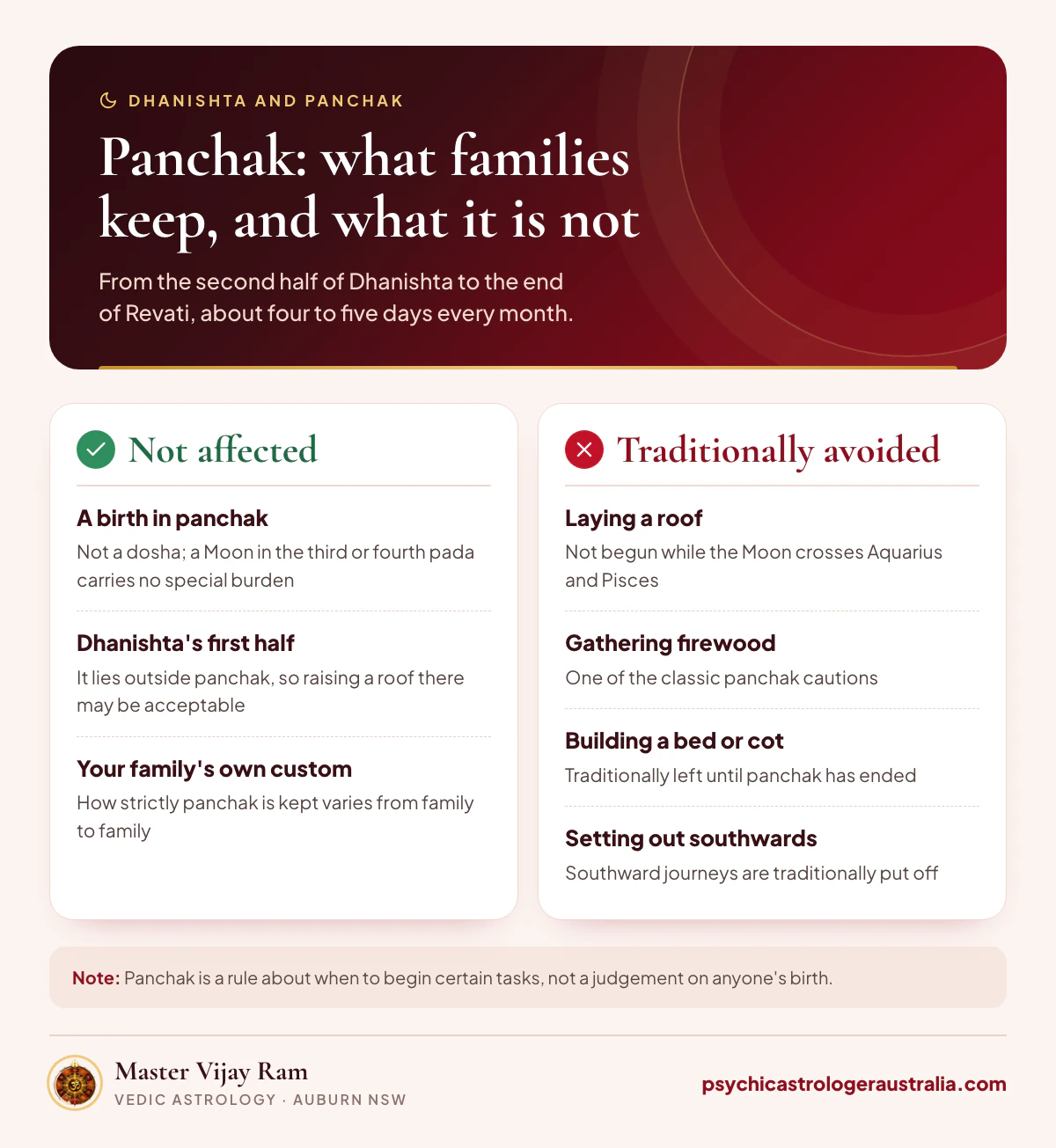
Panchak is a five-star stretch of the Moon's monthly path, from the second half of Dhanishta to the end of Revati, the time the Moon spends crossing Aquarius and Pisces, about four to five days each month. Many families, North Indian families in particular, traditionally avoid starting certain things while it lasts: laying a roof, gathering firewood, building a bed or cot and setting out southwards, and extra rites are traditionally added when a death falls in panchak. How strictly it is kept varies from family to family.
| Star | Span | Moon sign | Part in panchak |
|---|---|---|---|
| Dhanishta | 0°–6°40′ Aquarius (padas 3 and 4) | Aquarius | Second half only |
| Shatabhisha | 6°40′–20° Aquarius | Aquarius | The whole star |
| Purva Bhadrapada | 20° Aquarius – 3°20′ Pisces | Aquarius, then Pisces | The whole star |
| Uttara Bhadrapada | 3°20′–16°40′ Pisces | Pisces | The whole star |
| Revati | 16°40′–30° Pisces | Pisces | The whole star |
Being born in panchak is not a dosha, and a Dhanishta Moon in its third or fourth pada carries no special burden for the person. Panchak is a rule about when to begin certain tasks, not a judgement on anyone's birth.
What kind of person does a Dhanishta Moon describe?
The Dhanishta nakshatra traits the tradition names are energy, generosity, a strong sense of timing and an appetite for achievement. These are the people who organise the fundraiser, keep the band together, notice when a room has lost its rhythm and know how to restart it; Mars supplies the drive and Saturn, as sign lord, the stamina to keep going.
The shadow is impatience with anyone who cannot keep the tempo, and a habit of measuring life by what it has gathered. A Dhanishta Moon can grow restless in a quiet season, push a partner or colleague too hard, and confuse being busy with being fulfilled.
Which careers suit the star of rhythm and wealth?
Questions about a Dhanishta nakshatra career usually land on music and performance, percussion above all, sport, coaching and fitness, the defence forces and emergency services, real estate and property, engineering and surveying, banking and finance, and the running of events and teams. The common thread is work with a beat to it, a team to lead and a result that can be counted.
Think of a session drummer in Newcastle, a property manager on the Gold Coast, or a public servant in Canberra who coaches a junior cricket side every weekend. A business and career reading looks at the tenth house and the dashas for the actual timing, because the star alone cannot say when a promotion or a sale will come, and money decisions belong with a licensed financial adviser.
How is Dhanishta read in marriage and matching?
Dhanishta brings Rakshasa gana, Madhya nadi and the lion (female) to matching. A Rakshasa temperament is traditionally scored poorly against Deva and Manushya partners; a partner whose star is also Madhya, Purva Ashadha or Uttara Bhadrapada among them, produces Nadi dosha, which has its recognised exceptions; and the lioness pairs naturally with the lion of Purva Bhadrapada, while the elephants of Bharani and Revati are the lion's traditional enemies. The deeper layer of kundli matching explains how those points interact.
Where Dhanishta nakshatra marriage is concerned, astrologers expect an energetic, generous partner who brings resources and momentum to a household and expects a spouse to keep pace. Friction comes when ambition outruns attention: the anniversary missed for a work trip, the holiday planned like a project. A marriage with a Dhanishta partner tends to work when both agree on the tempo.
What health habits does the tradition associate with Dhanishta?
Mars rules energy, heat and injury, and Aquarius is traditionally linked with the calves and ankles, so the tradition's advice for this star reads like a coach's. Warm up before sport, rest between seasons, look after the lower legs if running is the habit, and do not mistake exhaustion for weakness; a temperament that loves rhythm also does well on a regular routine, with the same waking hour and the same training days.
These are tendencies read for care. A persistent injury, a racing heart or any other symptom goes first to a GP or a physiotherapist, never to a chart.
What does muhurta use Dhanishta for?
Like Shravana before it, Dhanishta is a chara, or movable, star, traditionally favoured for journeys, vehicles and starting things that should keep moving, and its musical character makes it a traditional choice for beginning lessons in music or dance. Its first half lies outside panchak and its second half inside, so the same star can be acceptable for raising a roof at one end and avoided by panchak-keeping families at the other.
That detail is exactly why a muhurat is never read from a star name on a calendar. The pada, the lunar day, the day of the week and the rising sign all count, and traditions differ on how much weight each receives.
What will a Dhanishta reading tell you, and what will it not?
It will describe the temperament, the early run of Mars and Rahu and the long Jupiter years that usually follow, the pada and its sound, the Moon sign and what the star contributes to a marriage match. It will not say whether an investment, a property purchase or a business will succeed, whether a court will rule for you or whether a visa will be granted; those questions go first to a licensed financial adviser, a solicitor, the Department of Home Affairs or a registered migration agent, and anything about health to a GP. It is a faith-based reading of tendencies and timing, never a promise of wealth.
When Mars is afflicted and its period pressing, the tradition starts with Hanuman's worship and Mars's mantra on Tuesdays, explained in a $50 consultation. A Mangal shanti or another puja is performed only where it is warranted, by Master Vijay Ram himself in Auburn, starting from $250 agreed beforehand, and online puja and havan sets out how families join remotely. He does not sell coral or any other stone.
How does Vijay Ram ji read a Dhanishta Moon?
The first question is which half of the star the Moon occupies, because that decides the Moon sign and whether the birth fell in panchak. Then come Mars's sign and house, Saturn as the sign lord, the navamsa, and the dasha now running, which for most adults is Jupiter, Saturn or Mercury.
People ring for astrology readings in Adelaide and from Canberra, Hobart, Newcastle, Wollongong and the Gold Coast, and talk with him by phone or video, or on WhatsApp, in English, Hindi or Punjabi; the only place he sees anyone in person is Auburn, by appointment. Before Dhanishta comes Shravana, the listening star, and after it Shatabhisha, the star of a hundred healers.
Read next
- Mrigashira Nakshatra: The Searching Star of the DeerMrigashira nakshatra: the deer, Soma and Rudra’s arrow, Mars as lord, its Taurus and Gemini halves, padas and name so…
- Anuradha Nakshatra: The Star of Friendship and DevotionAnuradha nakshatra, 3°20′ to 16°40′ Scorpio: Mitra and the lotus, Saturn as lord, padas and name sounds, friendship a…
- Online Istikhara Service in Australia for Marriage & DecisionsHow online istikhara for marriage and other decisions works in Australia, what a genuine practitioner asks for, and t…
Frequently asked questions
Which planet rules Dhanishta nakshatra?
Mars rules Dhanishta, and Mars is also exalted in Capricorn, where the first half of the star lies, so its influence is unusually strong here. A Dhanishta birth opens with Mars's seven-year mahadasha. Saturn rules both Capricorn and Aquarius, the two signs the star occupies, so every Dhanishta Moon is read with Mars as star lord and Saturn as sign lord.
What are the name letters for Dhanishta nakshatra?
The traditional first sounds are Ga, Gi, Gu and Ge for the four padas, one consonant with four vowels, which makes the choice simpler than for most stars. Which of the four applies is decided by the Moon's degree, so the time on the hospital record is worth finding. Where a family prefers another name, the syllable can live on in the name used at the temple.
Is it a problem to be born in Dhanishta during panchak?
No. Panchak covers the last two padas of Dhanishta and the four stars after it, and the tradition uses it as a rule about when to begin certain tasks, such as laying a roof or building a bed, not as a judgement on a birth. A Moon in Dhanishta's third or fourth pada carries no special burden and needs no special rite.
Which nakshatras match well with Dhanishta?
No single list decides it. Purva Bhadrapada carries the male lion and so completes Dhanishta's yoni pair, while the elephant stars Bharani and Revati are traditionally opposed; a second Madhya star in the couple brings Nadi dosha, though the usual exceptions can lift it; and Rakshasa gana scores badly beside Deva and Manushya. The two rashis and full kundlis then settle how much any point weighs.
Is Dhanishta a lucky star for money?
Its name means the wealthiest and the tradition reads resourcefulness, generosity and a talent for gathering people and means. That is a tendency of temperament, not a forecast of riches, and it can be spent as easily as it is earned. Whether money comes, and when, is read from the second and eleventh houses and the dashas, and real financial decisions belong with a licensed adviser.
Is Dhanishta in Capricorn or Aquarius?
Both. The star runs from 23°20′ of Capricorn to 6°40′ of Aquarius, so its first two padas give a Makara rashi Moon and its last two a Kumbha rashi Moon. Saturn rules both signs, so the sign lord does not change, but the transits that matter, such as Sade Sati, are counted from whichever sign the Moon occupies.
What careers suit people born in Dhanishta?
The tradition favours work with rhythm, teams and measurable results: music and percussion, sport and coaching, the defence forces and emergency services, property and real estate, engineering and surveying, banking and finance, and event or team management. These are tendencies of temperament; the tenth house and the planetary periods decide what a career actually becomes and when it moves.
Who are the Vasus in Dhanishta nakshatra?
The eight Vasus are the gods of the elements and the bright things of the world, named in one Upanishad as fire, earth, wind, atmosphere, Sun, sky, Moon and stars, though texts vary. In the Mahabharata they were cursed to be born as mortals; Ganga released seven at birth, and the eighth lived on as Bhishma. The tradition reads the story as shared abundance and patient service.
What does Rahu's early period mean for a Dhanishta child?
Because Mars's opening period is short, a child with the Moon near the middle of Dhanishta usually enters Rahu's eighteen years before school age, and Rahu then covers childhood and adolescence. The tradition reads that as a restless, curious, sometimes unsettled stretch, coloured by Rahu's house in the chart. It describes tendencies for parents to understand, not problems to fear.
People also ask
What does Dhanishta nakshatra mean?
Dhanishta means the wealthiest, and older texts call the star Shravishtha, the most famous. It is the twenty-third nakshatra, from 23°20′ Capricorn to 6°40′ Aquarius, ruled by Mars with the eight Vasus as its deities. In the tradition it stands for abundance and rhythm, and for people who set the pace for a group.
What is the symbol of Dhanishta nakshatra?
A drum. It keeps time for everyone else, sounds only when struck and does its best work in an ensemble, which is how the tradition reads Dhanishta people: rhythmic, social and quick to lead a group. Its hollowness carries a quieter warning, that a busy life chasing wealth can still feel empty without a purpose.
Who is the deity of Dhanishta?
The eight Vasus, the gods of the elements and of light, whose name means good, bright and wealthy. Their best-known story is the Mahabharata curse that brought them to earth as Ganga's sons; seven were released at birth and the eighth lived a long life as Bhishma, which the tradition reads as patience and service.
Is Dhanishta part of panchak?
Its second half is. Panchak begins when the Moon enters Aquarius, which is the third pada of Dhanishta, and runs through Shatabhisha, the two Bhadrapadas and Revati to the end of Pisces. Families who keep panchak traditionally avoid laying a roof, gathering firewood, making a bed or setting out southwards during those four or five days.
Which mahadasha does Dhanishta start with?
Mars's seven-year mahadasha, with the balance at birth set by the Moon's position inside the star. Rahu's eighteen years follow, so a Moon near the middle of Dhanishta usually reaches Rahu in early childhood, and Jupiter's sixteen years then fall across the twenties and thirties, often the steadiest stretch of the early adult life.
References & further reading
Serving clients across Australia
Confidential consultations by phone, video & WhatsApp — including: