
Quick answer
The Pancha Mahapurusha yogas form when Mars, Mercury, Jupiter, Venus or Saturn sits in its own or exaltation sign in a kendra from the lagna, giving Ruchaka, Bhadra, Hamsa, Malavya and Sasa. Your rising sign decides which of them are even possible, and each shows mainly in its own planet's dasha.
What are the Pancha Mahapurusha yogas?
A Pancha Mahapurusha yoga is a combination that forms when Mars, Mercury, Jupiter, Venus or Saturn stands in its own sign or its sign of exaltation and, at the same time, in a kendra from the lagna: the first, fourth, seventh or tenth house. Pancha means five and mahapurusha a great person, and each of the five takes its name and character from its planet: Ruchaka for Mars, Bhadra for Mercury, Hamsa for Jupiter, Malavya for Venus and Sasa for Saturn. The Sun, the Moon, Rahu and Ketu form none of them.
These yogas describe character more than circumstance, which is why they are prized. This page looks at which ones your rising sign can hold, what each describes, what spoils them and when they show, and a kundli reading checks them in your own chart.
Why does your lagna decide which ones are possible?
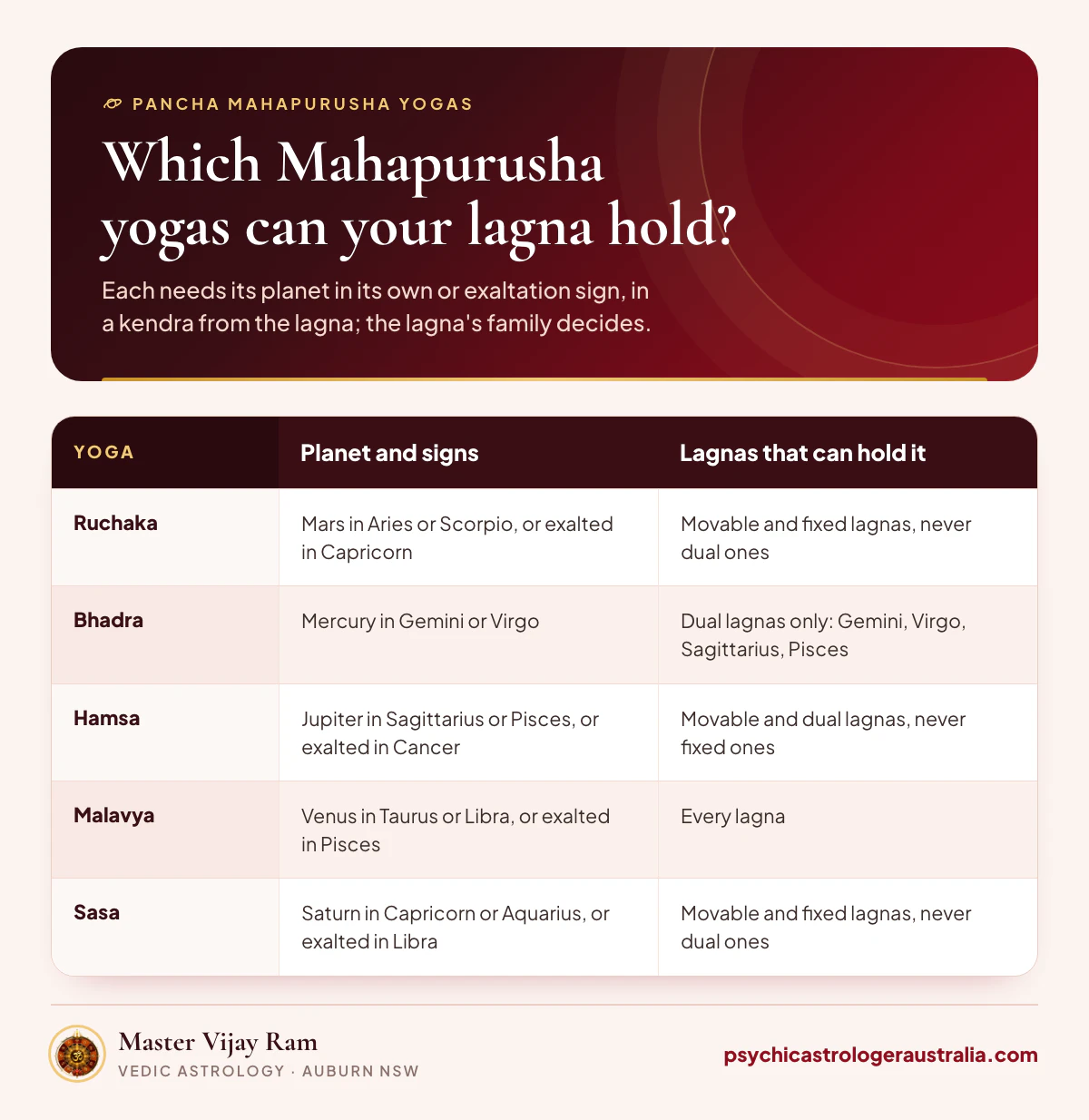
The kendras from any rising sign are the four signs of its own family. A movable lagna, Aries, Cancer, Libra or Capricorn, has the four movable signs as its kendras; a fixed lagna, Taurus, Leo, Scorpio or Aquarius, has the fixed signs; and a dual lagna, Gemini, Virgo, Sagittarius or Pisces, has the dual signs. A yoga is only possible if its planet's own or exaltation sign belongs to that family.
That simple fact rules a great deal out. Mercury's signs of strength, Gemini and Virgo, are both dual, so Bhadra yoga can form only for the four dual lagnas; Jupiter has no fixed sign of strength, so Hamsa is impossible for a fixed lagna; Mars and Saturn have no dual sign of strength, so neither forms for a dual lagna; and Venus, with Taurus, Libra and Pisces, is the only planet that can form its yoga for every rising sign. Lagna explained covers how the rising sign is found.
| Lagna | Ruchaka (Mars) | Bhadra (Mercury) | Hamsa (Jupiter) | Malavya (Venus) | Sasa (Saturn) |
|---|---|---|---|---|---|
| Mesha (Aries) | Aries (1st) or Capricorn (10th) | Not possible | Cancer (4th) | Libra (7th) | Libra (7th) or Capricorn (10th) |
| Vrishabha (Taurus) | Scorpio (7th) | Not possible | Not possible | Taurus (1st) | Aquarius (10th) |
| Mithuna (Gemini) | Not possible | Gemini (1st) or Virgo (4th) | Sagittarius (7th) or Pisces (10th) | Pisces (10th) | Not possible |
| Karka (Cancer) | Capricorn (7th) or Aries (10th) | Not possible | Cancer (1st) | Libra (4th) | Libra (4th) or Capricorn (7th) |
| Simha (Leo) | Scorpio (4th) | Not possible | Not possible | Taurus (10th) | Aquarius (7th) |
| Kanya (Virgo) | Not possible | Virgo (1st) or Gemini (10th) | Sagittarius (4th) or Pisces (7th) | Pisces (7th) | Not possible |
| Tula (Libra) | Capricorn (4th) or Aries (7th) | Not possible | Cancer (10th) | Libra (1st) | Libra (1st) or Capricorn (4th) |
| Vrishchika (Scorpio) | Scorpio (1st) | Not possible | Not possible | Taurus (7th) | Aquarius (4th) |
| Dhanu (Sagittarius) | Not possible | Gemini (7th) or Virgo (10th) | Sagittarius (1st) or Pisces (4th) | Pisces (4th) | Not possible |
| Makara (Capricorn) | Capricorn (1st) or Aries (4th) | Not possible | Cancer (7th) | Libra (10th) | Capricorn (1st) or Libra (10th) |
| Kumbha (Aquarius) | Scorpio (10th) | Not possible | Not possible | Taurus (4th) | Aquarius (1st) |
| Meena (Pisces) | Not possible | Gemini (4th) or Virgo (7th) | Pisces (1st) or Sagittarius (10th) | Pisces (1st) | Not possible |
What does each yoga describe?
The classical texts give each yoga a portrait, written for a world of kings and armies. Read in modern terms, they describe five recognisable kinds of strength.
Ruchaka: Mars
Ruchaka yoga forms when Mars sits in Aries or Scorpio, or exalted in Capricorn, in a kendra. The texts describe a strong frame, a bold temper and a name won by action. Today it looks like the person who runs the worksite, the paramedic first through the door, the athlete, or the founder who built a business from the slab up.
Bhadra: Mercury
Bhadra forms when Mercury sits in Gemini or Virgo in a kendra, Virgo being both its own sign and its exaltation. The texts describe a fine intellect, eloquence and a long life given to learning. It shows as the analyst, the lawyer who drafts what others sign, the mathematics teacher or the trader with a head for margins.
Hamsa: Jupiter
Hamsa yoga forms when Jupiter sits in Sagittarius or Pisces, or exalted in Cancer, in a kendra. Hamsa is the swan, which tradition says can separate milk from water, and the yoga is read as that kind of discernment joined to virtue and the respect of good people. It shows as the trusted teacher, the fair-minded magistrate, the priest, or the GP whose patients actually follow the advice.
Malavya: Venus
Malavya yoga forms when Venus sits in Taurus or Libra, or exalted in Pisces, in a kendra. The texts describe comfort, beauty, refinement, a good marriage and fine possessions. It shows as an eye for design and pleasure, in the stylist, the musician, the restaurateur, or simply the person whose home everyone wants to visit.
Sasa: Saturn
Sasa yoga, also written Shasha, forms when Saturn sits in Capricorn or Aquarius, or exalted in Libra, in a kendra. The texts describe authority over many people, endurance and a capacity for hard, patient work, along with a streak of severity. It shows as the operations manager, the senior public servant, the mine supervisor or the person who keeps a large organisation running.
How common are they?
Less common than the yogas counted from the Moon. Each needs one particular planet in one of two or three signs and, at the same time, in a kendra from the lagna, so many charts have none at all, and that is not a deficit. Two in one chart is unusual, and a chart without any can still be strong through its raja yogas, its lagna lord or its dasha sequence.
The reverse mistake also happens: a planet in its own sign outside the kendras is strong and useful, but it does not form a Mahapurusha yoga. The overview of yogas in a kundli sets these five beside the other families of yoga.
What can hollow out a Mahapurusha yoga?
Combustion is the commonest spoiler for Bhadra and Malavya, because Mercury and Venus never stray far from the Sun; a Mercury in Virgo three degrees from the Sun forms Bhadra on paper while sitting deep in the Sun's light, and combust planets and their orbs explains how close is too close. Conjunction with Rahu, Ketu or a hostile planet, and heavy aspects, also dilute a yoga.
House lordship matters as well. For Leo rising, Saturn in Aquarius forms Sasa in the seventh but also rules the sixth, and for Gemini or Virgo rising Jupiter rules two kendras and no trikona, which some traditions read as tempering a Hamsa; the same caution applies to Mercury forming Bhadra for Sagittarius or Pisces rising. The navamsa then confirms or weakens what the main chart shows.
Why does an accurate birth time matter so much here?
Because all five yogas are counted from the rising sign, which changes about every two hours. Venus in Libra forms Malavya for a Libra lagna and nothing at all for a Virgo lagna, where Libra is the second house, so a birth time wrong by thirty minutes near a sign boundary can create or erase the yoga.
Australian clocks add their own trap. A summer birth in Victoria, New South Wales, the ACT, Tasmania or South Australia carries daylight-saving time on the record wherever it applied that year, an hour ahead of standard time, while Queensland, Western Australia and the Northern Territory do not use it today; the clock rules of the year and place of birth are the ones that count. A family on the Sunshine Coast whose child was born in Sydney needs the Sydney rules, not Queensland's.
Worked example: Malavya and Sasa in one house
This chart is invented for illustration and belongs to no one. Libra is rising, with Venus at 18° Libra and Saturn at 5° Libra, both in the first house, and the Sun at 10° Virgo in the twelfth. Venus in its own sign in a kendra forms Malavya, and Saturn exalted in a kendra forms Sasa, so one house holds two Mahapurusha yogas.
The checks are encouraging. Neither planet is close enough to the Sun to be combust; Saturn is the yogakaraka for a Libra lagna, ruling the fourth and fifth; and Venus at 18° of an air sign falls in the Pisces navamsa, where it is exalted. Venus also rules the eighth for this lagna, which adds depth and some upheaval to its comforts, and the Libra lagna in full explains how those lordships play out.
The Moon sits at 13°20′ Pisces, three-quarters of the way through Uttara Bhadrapada, the star Saturn rules. Saturn's own period is therefore over by the age of about four and three-quarters, Mercury's seventeen years follow, and the Mercury–Saturn sub-period at their close, two years, eight months and nine days long, runs from about nineteen. Ketu's seven years then lead into Venus's twenty, from about twenty-nine to forty-nine, the stretch in which the tradition would expect Malavya to show most fully.
In which years do these yogas show?
Each delivers most plainly in its own planet's period: Mars runs seven years, Mercury seventeen, Jupiter sixteen, Venus twenty and Saturn nineteen. Where that mahadasha falls in childhood, as Saturn's does in the example, the tradition reads the yoga through the upbringing and later through the planet's sub-periods, so the Sasa in that chart would surface in the Saturn sub-periods of other planets' years.
A yoga whose planet runs in the working decades is the one people notice. The character it describes is present all along; the period decides when the world sees it.
Can a ritual install a Mahapurusha yoga?
No. A yoga is written into the chart at birth and no rite installs one; an offer to install one for money is an offer to sell something that does not exist. When a planet that forms one of these yogas is afflicted, for instance a combust Venus in a Malavya, the tradition offers that planet's own mantra and weekday practice, and a graha shanti puja if the chart truly calls for one.
Master Vijay Ram performs such a puja personally in Auburn, from $250, with the amount settled before the day, and online puja and havan explains how families join by video. No gemstone is sold or prescribed on the strength of a yoga alone.
Do these yogas make a great person?
They cannot promise fame, wealth or a particular career, and they cannot replace effort: a Ruchaka gives the engine, and training decides whether it ever races. They describe character and its season, and the rest of the chart can amplify or mute them. This is faith-based guidance, not career, financial or psychological advice.
What does a reading of these yogas involve?
He confirms your lagna from the birth time, allowing for daylight saving and the clock rules of your birth year, lists every planet in its own or exalted sign, checks which fall in kendras, and tests each candidate for combustion, company, lordship and navamsa. Then he dates the periods, so you know which yogas you genuinely hold and when each is due.
The fee for a consultation is $50, and sessions run over the phone, on video or through WhatsApp. Clients on the Sunshine Coast keep Queensland time, and anyone who wants to meet in person comes to Auburn.
Read next
- Kendra and Trikona Houses: The Pillars and the Fortunes of a ChartKendra houses 1, 4, 7, 10 and trikona houses 1, 5, 9: why they are a chart's pillars and fortunes, the yogakaraka for…
- Adhi Yoga: Benefics Around the MoonAdhi yoga explained: Jupiter, Venus and Mercury in the 6th, 7th and 8th from the Moon, full and partial forms, why it…
- 11 Signs of Negative Energy in Your Life (and How to Clear It)Eleven signs of negative energy, the ordinary causes to rule out first, and the three-doors test that tells you wheth…
Frequently asked questions
What are the five Pancha Mahapurusha yogas?
Ruchaka for Mars, Bhadra for Mercury, Hamsa for Jupiter, Malavya for Venus and Sasa for Saturn. Each forms when its planet is in its own sign or its sign of exaltation and in the first, fourth, seventh or tenth house from the lagna. The Sun, the Moon and the nodes form none of them, and each yoga is traditionally read as a distinct kind of character.
Can my lagna have Bhadra yoga?
Only if you have a dual lagna: Gemini, Virgo, Sagittarius or Pisces. Mercury's signs of strength, Gemini and Virgo, are both dual, and the kendras of a dual lagna are the dual signs. For Gemini or Virgo rising it can form in the first, fourth or tenth house; for Sagittarius or Pisces rising, in the fourth, seventh or tenth.
Which Mahapurusha yoga is the most powerful?
The texts do not rank them; each describes a different kind of strength. In practice the strongest is whichever is intact in your chart: its planet clear of combustion, away from difficult company, well placed in the navamsa, ruling helpful houses for your lagna, and running its period while it can still be used. An intact Sasa outweighs a combust Bhadra.
Is Malavya yoga good for marriage?
Venus governs partnership and comfort, and the tradition reads Malavya as refinement, pleasure and a good spouse, so it is welcome in a marriage reading. Its effect still depends on the seventh house, its lord, the navamsa and the periods running. For Libra rising Venus also rules the eighth, which adds depth and some upheaval to its gifts.
What is the difference between Hamsa yoga and Gajakesari yoga?
Hamsa is counted from the lagna and needs Jupiter in its own sign or exalted, in Sagittarius, Pisces or Cancer, in a kendra. Gajakesari is counted from the Moon and needs only Jupiter in a kendra from the Moon, in any sign. A chart can have both, either or neither; Gajakesari is far more common, and Hamsa is the stricter test of Jupiter's strength.
Does a retrograde planet form a Mahapurusha yoga?
By the definition, yes, because the yoga depends on sign and house rather than on direction of motion. Traditions differ on how retrogression changes the result, and many astrologers read a retrograde planet as strong but inward, delivering its yoga in an unusual or delayed way. The combustion, company and navamsa checks matter more than the direction.
How exact must my birth time be for these yogas?
Very exact, more so than for most yogas, because all five are counted from the lagna, which moves on to the next sign in roughly two hours. Near a sign boundary half an hour can create or erase a yoga. In Australia, check whether the birth fell during daylight saving, which moved the clock by an hour, and use the clock rules of the year and state of birth.
When will my Mahapurusha yoga give results?
Mainly in its planet's mahadasha or antardasha: Mars runs seven years, Mercury seventeen, Jupiter sixteen, Venus twenty and Saturn nineteen. If the mahadasha falls in childhood, the yoga tends to show through upbringing and later through the planet's sub-periods. The character it describes is present throughout, while the period decides when it becomes visible.
Can a puja give me a Mahapurusha yoga?
No rite can put a planet into its own sign or move it into a kendra, so no puja can give you one of these yogas. What the tradition offers is help for an afflicted planet that already forms one, such as a combust Venus in Malavya: its mantra, its weekday observance and, where the chart calls for it, a graha shanti in Auburn from $250, with the price settled beforehand.
People also ask
What is Pancha Mahapurusha yoga?
It is a set of five combinations formed when Mars, Mercury, Jupiter, Venus or Saturn sits in its own sign or exaltation sign in a kendra from the lagna. They are Ruchaka, Bhadra, Hamsa, Malavya and Sasa, and the tradition reads each as a distinct kind of greatness of character, shown most clearly in the planet's own period.
Which is the rarest Mahapurusha yoga?
Bhadra is the most restricted by lagna, since only the four dual rising signs can hold it, and Hamsa is impossible for the four fixed rising signs. Ruchaka and Sasa cannot form for dual lagnas, while Malavya can form for any rising sign. Rarity on paper matters less than whether the yoga in your chart is intact.
What is Sasa yoga?
Saturn in Capricorn or Aquarius, or exalted in Libra, in the first, fourth, seventh or tenth house from the lagna. The texts describe authority over many people, endurance and patient hard work, with some severity. It can form for movable and fixed lagnas but not for dual ones, and it shows mainly in Saturn's periods.
What is Ruchaka yoga?
Mars in Aries or Scorpio, or exalted in Capricorn, in a kendra from the lagna. The tradition reads it as a strong body, courage and a name made through action, and today it often shows in physical, technical or command roles. It can form for movable and fixed lagnas but never for the dual ones.
Can there be more than one Mahapurusha yoga in a chart?
Yes. Two or more can form when several planets sit in their own or exaltation signs in kendras, and they can even share a house, as Venus and Saturn can in Libra for a Libra lagna. It is uncommon, and each yoga is still checked for combustion, company, lordship and navamsa before it is counted.
References & further reading
Serving clients across Australia
Confidential consultations by phone, video & WhatsApp — including: