

Quick answer
A chart is read for job or business by weighing the tenth house of work against the seventh of trade and partners and the eleventh of gains, then checking the second house and Moon for how well a person carries irregular income. Most charts lean both ways at different times; an accountant and a savings buffer come before any leap the chart seems to support.
Job or business: what is the chart actually being asked?
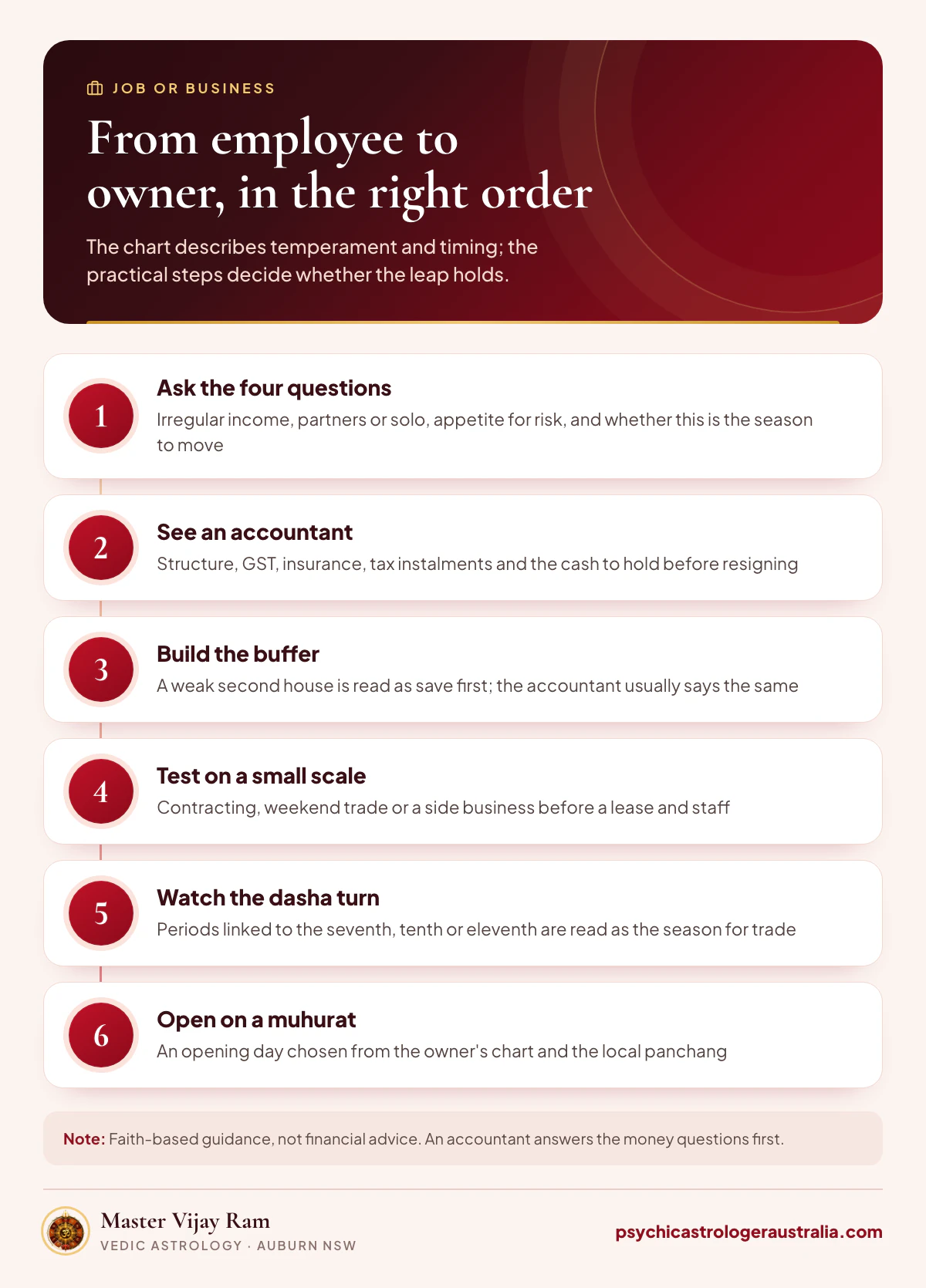
Job or business astrology is the part of a career reading that weighs whether a person is better suited to employment or to running something of their own, and when a move between the two is best timed. The question sounds like a yes or no. In practice it is four smaller questions, and a chart answers each one differently.
Can you carry an irregular income, the first test for anyone who asks should I start a business, without losing sleep? Do you work better alone or beside a partner? How much risk does your temperament enjoy, and how much can your household absorb? And is this the season to move, or the season to prepare? A business and career reading with Master Vijay Ram takes them in that order.
The houses involved are covered in business astrology for launches and partners, which also deals with choosing a partner and a launch date. This post is about the decision before any of that.
Which houses weigh employment against enterprise?
The tenth house is work itself, whoever pays for it. The sixth is service, rosters and the daily round of an employee. The seventh is trade, clients, contracts and partners: the house of dealing with others as equals rather than as a boss. The eleventh is gains and networks, the flow of income from many sources.
A tenth house job signature, such as Saturn aspecting the tenth from a strong sixth, is read as comfort inside a structure. A seventh house business signature, such as the tenth lord placed in the seventh or Mercury strong there, is read as a pull toward trade. Most charts have threads of both, and which one leads at a given time often depends on the dasha running.
| Question | Leans toward a job | Leans toward a business | Suggests a middle path |
|---|---|---|---|
| Where is the tenth lord? | In the sixth or tenth; aspected by Saturn | In the seventh or eleventh; joined with Mercury or Mars | In the third: self-effort inside someone else's structure |
| How strong is the seventh? | Quiet or afflicted; partners a strain | Benefics or a strong lord; clients and deals come easily | Strong but with Saturn: slow, contract-based trade |
| What does the eleventh show? | One steady stream; lord in the sixth or tenth | Several planets or a strong lord; income from many hands | A strong eleventh with a weak seventh: side income |
| How well is irregular income carried? | Afflicted Moon or a weak second lord | Steady Moon and a second lord well placed | A mixed second house: build savings first |
| Appetite for risk | A cautious third house; Saturn dominant | Mars or Rahu strong in the third, tenth or eleventh | Rahu strong but the Moon unsettled: test small first |
Why does the Moon matter so much here?
Because a business is lived through the mind before it shows in the books. The Moon is read for emotional steadiness, and a self-employed person spends years with uneven months, late invoices and nobody to hand the problem to. A well-placed Moon is read as the capacity to ride that out; an afflicted Moon, especially with Saturn or in the eighth, is read as needing more scaffolding.
That is not a reason to stay employed forever. It is a reason to build a larger buffer, find a mentor, or start as a contractor before taking on staff and a lease. The chart describes where the strain will fall so that it can be planned for.
What about the second house and capital?
The second house is savings, family money and what a person accumulates. A business chart with a weak second lord is the classic case of strong ideas and thin reserves. The tradition's advice and an accountant's advice tend to agree here: keep the job, save, and wait for a period that strengthens the second or eleventh before signing anything.
The eleventh house tells the other half, the flow of income once it starts. The eleventh house of gains explains why almost every planet is welcome there, and why it is still read alongside the second rather than on its own.
Who should you speak to before the chart?
An accountant, first. The questions that make or break a new business in Australia are practical: whether to trade as a sole trader, a partnership or a company; whether you need to register for GST; what insurance the trade needs; how tax instalments will work in the first year; and how much cash to hold before giving notice. A good accountant or a registered tax agent answers those in an hour.
The state fair trading office explains leases, franchise agreements and consumer law obligations, and the National Debt Helpline offers financial counselling if an earlier business left debts behind. A reading sits beside that advice. It never replaces it, and Master Vijay Ram will ask whether you have had it.
Is there a middle path between a job and a business?
Often, and many charts point to one. Contracting on an ABN while keeping one main client, a part-time job beside a small trade, a franchise that supplies the structure, or joining a family business with clear roles are all ways of testing the seventh house without betting the household on it.
A chart with a strong eleventh but a cautious seventh is often read this way: income from several sources rather than one enterprise. A second income or side business covers that path in more detail.
How does the dasha change the answer?
The same chart can favour employment for a decade and enterprise for the next. A Saturn period running through the sixth house is read as a time to learn the trade under someone else; a Mercury or Rahu period activating the seventh or eleventh is read as the time the pull toward trade grows strong. The common Australian story, years as an employee then a business in the same field, is often the dasha turning.
Houses three, six, ten and eleven are the upachaya houses, the ones that improve with time and effort, which is why tradition is patient with a weak early business signature. The upachaya houses and growth with time explains the idea.
What does a reading sound like in practice?
An illustration. A chef in Cairns, employed for nine years, wants to open her own place in Edge Hill. Her tenth lord sits in the seventh with Mercury, which leans toward trade, and her eleventh is strong. Her Moon is with Saturn and her second lord is weak, and she is in the last year of a Saturn sub-period.
The reading does not say yes or no. It says the chart leans toward enterprise, that her strain will be emotional and financial rather than a lack of customers, and that the coming Mercury period is the traditional season for trade. The practical counsel beside it: see an accountant now, build a cash buffer, run weekend pop-ups for a year, and look at leases when the period turns.
Does the chart show a business partner?
The seventh house shows partners in business as well as in marriage, and a strong seventh with benefics is read as working well alongside others. An afflicted seventh, or its lord in the sixth, eighth or twelfth, is read as preferring sole control. The seventh house explained covers the house in depth.
Where a partnership is planned, both charts are read together, and a written partnership agreement drafted by a lawyer is the practical half of the same caution.
Which remedies are offered before starting out?
A Ganesh puja before opening a business is the most widely kept custom, offered for the removal of obstacles at a beginning. Many families also time the opening with an auspicious muhurat for the opening, chosen from the owner's chart and the local panchang.
Where a puja is wanted, a puja for a new business starts from $250, is agreed before it is performed, and is done personally at his place of practice in Auburn, with the owner joining by video if they wish. No puja replaces a business plan, and no puja protects a business that started without capital.
What can the chart not decide about a business?
It cannot judge your market, your rent, your competitors or your prices. It cannot tell you whether a franchise agreement is fair or whether a lease has a hidden clause. It describes temperament, strain and timing; the numbers come from the accountant and the decision is yours. A chart that leans strongly toward business is never a reason to skip that advice.
How is a job-or-business reading booked?
Send the date, time and place of birth, and a few lines about the work you do and the business you are considering. The reading is by phone, video or WhatsApp in English, Hindi or Punjabi; owners in the far north often book a reading from Cairns by video. A consultation is $50. The consultation is $50, and if no remedy is called for, nothing further is charged.
Read next
- Government Job Yoga: Public Service Careers in the ChartGovernment job yoga explained: the Sun, the tenth house and Saturn as tradition reads them, and how public service se…
- Promotion Timing: When the Chart Favours a Step UpPromotion timing in Vedic astrology: the dasha lords, Jupiter and Saturn transits and D10 signs read for a step up, a…
- Kundli Reading Explained: What Your Birth Chart RevealsWhat a Kundli reading reveals about your life, personality, career and destiny. Master Vijay Ram explains Vedic astro…
Frequently asked questions
How do I know if my kundli supports business?
An astrologer looks at the seventh house of trade and clients, the eleventh of gains, the tenth lord's placement and the strength of Mercury, Mars or Rahu in those houses. The second house and the Moon are then checked for capital and steadiness. Several signatures together suggest a lean toward business; the dasha shows when it is strongest.
Which house is for business in astrology?
The seventh house is the main house of trade, contracts, clients and partners. The tenth is work in general, the eleventh is gains and income streams, and the second is capital and savings. A business question is read across all four, never from the seventh alone.
Should I quit my job to start a business if my chart is good for business?
Not on the chart alone. Speak to an accountant about structure, tax and insurance, build a cash buffer, and test the idea on a small scale first. A chart can say whether the period supports trade and where the strain is likely to fall; it cannot judge your market or your figures.
What if my chart favours a job but I want a business?
A chart leaning toward employment does not forbid enterprise. It suggests you may prefer structure, so a franchise, a partnership with clear roles, contracting for one main client or a small side business may suit better than a large solo venture. The upachaya houses also improve with effort and time.
Does the Moon affect business success in astrology?
Tradition reads the Moon for emotional steadiness, which matters because self-employment brings uneven months and pressure with nobody to pass it to. A strong Moon is read as resilience; an afflicted Moon suggests more support, a larger buffer and a gentler start. It shapes how a business is lived rather than whether it can succeed.
When is a good time to start a business according to astrology?
Tradition favours a dasha or antardasha of a planet linked to the seventh, tenth or eleventh house, a supportive Jupiter transit from the Moon, and an opening day chosen by muhurat. In practice the right time is also when the accountant's checklist is done and the savings are in place.
Can astrology tell me which business to start?
It can suggest fields in broad terms: Mercury for trade and communication, Venus for hospitality and beauty, Mars for trades and engineering, Saturn for property and labour-heavy work. It cannot pick a product, a location or a price. Market research and an accountant do that part.
How much does a job-or-business reading cost?
A consultation with Master Vijay Ram is $50, by phone, video or WhatsApp, or in person in Auburn by appointment. A puja for an opening, if wanted, starts from $250 and is agreed before it is performed. The consultation is $50, and if no remedy is called for, nothing further is charged.
People also ask
Is my kundli good for job or business?
Most charts carry signatures of both. A strong sixth house and Saturn aspecting the tenth lean toward employment; a strong seventh and eleventh with Mercury, Mars or Rahu lean toward trade. The Moon and second house show how well irregular income is carried, and the running dasha shows which lean is strongest now.
Which planet is good for business?
Mercury is the natural significator of trade and commerce. Mars supports trades and bold ventures, Rahu is read for unconventional or large-scale enterprise, and Jupiter for advisory and finance-related work. Their value depends on the houses they rule and occupy for your rising sign.
What is the business yoga in kundli?
There is no single business yoga. Tradition reads the tenth lord in the seventh or eleventh, a strong seventh lord, Mercury well placed in a kendra, and connections between the second and eleventh lords as leaning toward trade and income from enterprise.
Can an online kundli app answer job or business?
Online calculators can show where planets sit, but the job-or-business question depends on weighing several houses, the Moon and the running dasha together. A consultation with Master Vijay Ram is $50 and reads those in one conversation, alongside the practical advice to see an accountant first.
References & further reading
Serving clients across Australia
Confidential consultations by phone, video & WhatsApp — including: