

Quick answer
Family business succession is planned with an accountant and a lawyer first: ownership, tax, wills and a written agreement among siblings. A Vedic reading comes after, describing which child’s chart leans towards running the business, which seasons suit the handover, and a muhurat for the day it happens. It never decides who deserves what; that is a family and legal decision.
What is family business succession, and why does it go wrong?
Family business succession is the process that moves ownership and control of a business from one generation to the next, and it goes wrong most often because nobody plans it. A father who started a grocery in Harris Park, a mother who built a travel agency in Dandenong, a couple who run three restaurants in Perth: each meant to hand over one day, and one day kept moving. Then an illness, a death or a family argument forces the question, and it is answered in a hurry.
Master Vijay Ram sees these questions come in through business and career readings, usually from the founder or from a son or daughter who is not sure whether they are meant to take over. He begins by asking whether an accountant and a lawyer have been involved yet. If not, that is the first step, and the reading can wait.
Who should be involved before the chart?
An accountant, for the structure of the business, tax on the transfer, superannuation and the founder’s retirement income. A lawyer, for wills, a shareholders’ or partnership agreement, powers of attorney and what happens if a sibling wants out. Often a business adviser or mediator too, when the family cannot agree among itself.
These people are not optional extras. A succession done on trust and goodwill alone can leave a business exposed to tax it did not expect, siblings who own shares but have no say, and a widowed parent without income. The chart can add a great deal of perspective, but it cannot draft a contract.
| Question | Who answers it first | Where a reading can help |
|---|---|---|
| How should ownership pass? | Accountant and lawyer | Not at all |
| What tax will the transfer trigger? | Accountant | Not at all |
| Which child wants to run it? | The children, asked honestly | Whether each chart leans towards the trade, a profession or something else |
| When should the founder step back? | The founder, with advisers | The seasons in the founder’s and successor’s dashas |
| What day is the handover? | Practical deadlines first | A muhurat for the signing or the first day under new control |
How do you treat siblings fairly?
Fair is not the same as equal. A daughter who has worked in the shop for fifteen years and a son who became a doctor in Brisbane have given the business very different things. Many families settle on giving control to the child who runs it and balancing the others through property, savings or a buy-out over time.
The worst outcome is the one many families drift into: equal shares for everyone, one sibling doing all the work, and resentment that lasts decades. A written agreement, explained to every sibling before the founder’s death and not read out for the first time at the funeral, prevents most of it. Inheritance and property disputes looks at what happens when that agreement is missing.
Which houses describe a family business?
The tenth house is read for career and public work, the seventh for partners and contracts, the eleventh for income and gains, and the second for family wealth and the family itself. A family business touches all four, which is why it is one of the more complex questions a chart can be asked. The tenth house and career explains the main one.
Siblings are read from the third house (younger) and the eleventh (elder) in the tradition. When a business passes among brothers and sisters, those houses are looked at for cooperation and competition, always as tendencies and never as a reason to favour one child.
Can a chart show which child should take over?
It can show leanings, and only leanings. A child whose tenth lord is linked with the second or the fourth, or whose chart is strong in Mercury for trade, is traditionally read as more comfortable inside an established family enterprise. A child with a strong Sun or a busy twelfth may lean towards independent work, a profession or work overseas.
These readings are useful as a starting point for a conversation, not as a ruling. The child who wants the business, has the skills and has earned the trust of staff and customers is the obvious candidate, whatever the chart says. A chart should never be used to override a capable daughter in favour of a son, or the other way round.
When should the founder step back?
Founders tend to stay too long. A reading can show which seasons in the founder’s chart favour withdrawal, a Saturn or Ketu period is traditionally read as a time of release, and which seasons in the successor’s chart favour taking responsibility, often a period of the tenth lord or a strong Jupiter stretch.
The practical signs matter more. When the founder is tired, the successor is ready, the staff look to the successor for decisions, and the advisers have the paperwork in place, the time has usually come. A gradual handover over a year or two, with clear stages, tends to work better than a sudden one.
How is a muhurat chosen for the handover?
Once the decision and the documents are ready, a day and hour can be chosen for the signing or the first day under new control. The tradition avoids Rahu kaal and the weaker choghadiya periods, prefers a fixed lagna for an arrangement meant to last, and checks the day’s nakshatra against both the founder’s and the successor’s birth stars. Choosing an auspicious date and hour explains how it is done.
Practical deadlines come first. If the bank, the lease or the end of the financial year sets the date, that date stands, and a short puja at the start of the day is enough. Business opening muhurat covers the related question of launching a new venture.
Is Diwali a traditional time for handing over?
In many Gujarati, Marwari and Sindhi business families, the new account books are blessed at Lakshmi Puja on Diwali, and some families like to mark a change of leadership then, with the successor seated beside the founder for the chopda pujan. In 2027 Lakshmi Puja falls on Fri 29 Oct 2027 in every Australian city. It is a lovely custom and a reasonable moment; it is not a requirement, and it does not replace the legal handover date.
What about the founder’s own feelings?
A business is often a founder’s identity. Handing it over can feel like losing a role, a purpose and a place in the community. Fathers in particular can become difficult in the year of handover, interfering, criticising, or quietly undoing decisions, and that is usually grief rather than malice.
Giving the founder a defined role after the handover, a chairman’s seat, a mentoring role, the supplier relationships he built, helps a great deal. Father and son conflict and the Sun looks at the strain that often runs underneath a business handover between a father and son.
What if siblings are already in dispute?
Then the chart is the least important tool in the room. A family business mediator, an independent accountant and separate lawyers for each sibling where interests conflict are the proper route. Legal Aid can explain options where money is tight. Courts are expensive and slow, and most families regret how far a dispute went.
A reading can still help one person: understanding that their brother is in a restless Rahu stretch, or that their own Saturn period has made them rigid, sometimes makes compromise possible. It never names a villain.
Is there a puja for a business handover?
Many families hold a Ganesh puja or a Lakshmi puja when a business passes to the next generation, sometimes a havan at the premises. If a family wants Master Vijay Ram to perform one, it is done personally at his place of practice in Auburn on the chosen muhurat, with the family joining by video if they wish; a puja or havan performed for you explains how. A consultation is $50; a puja starts from $250, agreed before it is performed.
What can a reading not do?
It cannot value the business, structure a trust, write a will or settle who is entitled to what. It cannot promise that the successor will grow the business. Succession planning for Indian families is first legal, financial and personal, and the chart adds timing and understanding on top. Consultations are by phone or video in English, Hindi or Punjabi; readings for Perth business families explains how sessions work across the time difference, and he sees people in person only in Auburn, by appointment.
A short checklist before the handover
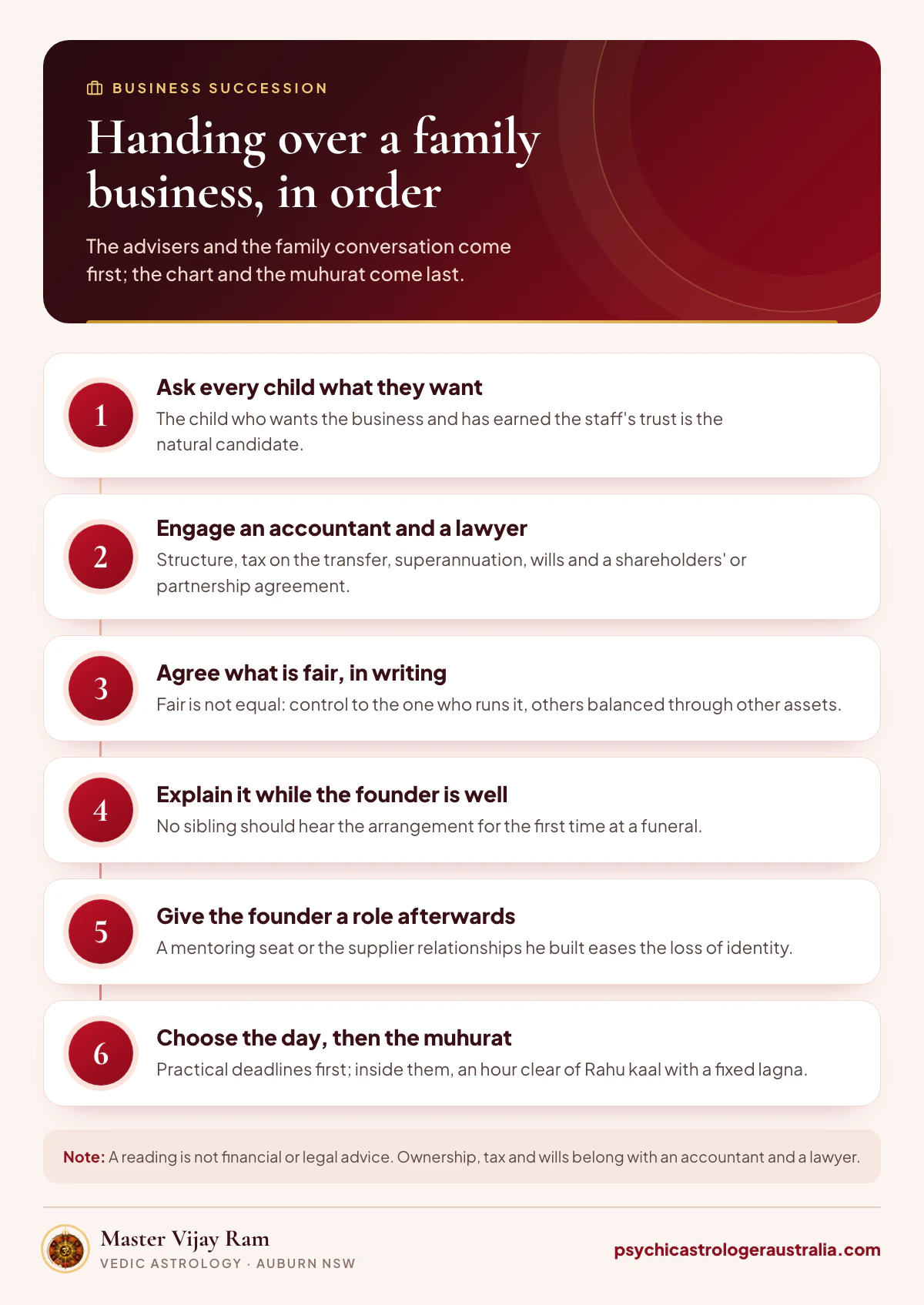
Talk to every child about what they want. Engage an accountant and a lawyer early. Write the agreement and explain it to everyone while the founder is well. Give the founder a role after handing over. Choose a day that works practically, and if the family wishes, a muhurat inside it. Most family business disputes grow in the gaps this list leaves.
Read next
- Inheritance and Family Property Disputes, and the ChartInheritance and family property disputes: lawyers and Legal Aid in Australia and India first, then the eighth and fou…
- Father and Son Conflict: The Sun and the Ninth HouseFather and son conflict in migrant families: expectations, career, the family business, what the Sun, Saturn and the …
- Win Your Ex Girlfriend or Boyfriend Back: Vedic RemediesVedic remedies to win back an ex girlfriend or boyfriend, explained plainly: what an honest quote covers, what nobody…
Frequently asked questions
Can astrology tell me which child should take over the business?
A chart can show leanings, such as whether a child’s chart sits comfortably with an established family trade or leans towards independent work. It cannot weigh skills, effort, trust or what the child actually wants. The child who wants the business and has earned the confidence of staff and customers is the natural candidate, and the chart is only a starting point for the conversation.
Who should I talk to first about succession?
An accountant and a lawyer. The accountant handles the structure of the business, tax on the transfer, superannuation and the founder’s retirement income. The lawyer handles wills, shareholder or partnership agreements and what happens if a sibling wants out. A mediator helps if the family cannot agree. A reading comes after these, not before.
How do we keep the handover fair to siblings who are not in the business?
Many families give control to the child who runs the business and balance the others through property, savings or a buy-out paid over time. Equal shares with unequal work tends to breed resentment. A written agreement, explained to every sibling while the founder is alive and well, prevents most disputes.
Is there an auspicious day to hand over a business?
A muhurat can be chosen for the signing or the first day under new control, avoiding Rahu kaal and weaker choghadiya periods and favouring a fixed lagna for an arrangement meant to last. It is chosen through a consultation, never from a printed list. If the bank, the lease or the financial year sets the date, that date stands.
Why do some families hand over at Diwali?
Many Gujarati, Marwari and Sindhi business families bless the new account books at Lakshmi Puja on Diwali, and some like the successor to sit beside the founder for that puja. In 2027 Lakshmi Puja falls on Friday 29 October in every Australian city. It is a meaningful custom but not a requirement, and it does not replace the legal handover.
Which houses in the chart describe a family business?
The tenth house is read for career and public work, the seventh for partners and contracts, the eleventh for income and gains, and the second for family wealth. Siblings are read from the third and eleventh houses. A family business touches all of these, so the reading looks at how they work together across the charts involved.
My siblings and I are already in dispute over the business. Can a reading help?
The first help is a business mediator, an independent accountant and, where interests conflict, separate lawyers; Legal Aid can explain options if money is tight. A reading can help one person understand the season they or a sibling are in, which sometimes makes compromise easier. It never names a culprit or takes a side.
Does Master Vijay Ram perform a puja for a business handover?
Yes, if the family wants one. A Ganesh or Lakshmi puja, or a havan, is performed personally at his place of practice in Auburn on the chosen muhurat, with the family joining by video if they wish. It starts from $250, agreed before it is performed. A consultation is $50.
People also ask
What is a family business succession plan?
It is a written plan for passing ownership and control of a business to the next generation. It usually covers who will run the business, how ownership and value pass to each family member, tax and superannuation, the founder’s role and income afterwards, and what happens if someone wants to leave. An accountant and a lawyer help draft it.
Why do family businesses fail at succession?
Most often because the handover is never planned and is forced by illness, death or a dispute. Unequal work with equal shares, a founder who will not let go, and siblings who learn the arrangements only at a funeral are common causes. Early planning with advisers prevents much of it.
Which house is business in a kundli?
The tenth house is the main house for career and business, with the seventh for partnerships, the eleventh for gains and the second for accumulated family wealth. Mercury is the traditional significator of trade. A business reading looks at these together with the dasha running at the time.
Can a muhurat help a business handover succeed?
A muhurat chooses a considered day and hour for the handover and gives the family a meaningful start. It cannot promise success. The plan, the advisers, the successor’s skill and the family’s goodwill do the real work, and practical deadlines always take priority over the chosen hour.
References & further reading
Serving clients across Australia
Confidential consultations by phone, video & WhatsApp — including: