
Quick answer
Blue sapphire (neelam) belongs to Saturn in Vedic astrology and suits Taurus and Libra lagnas most, where Saturn is yogakaraka, and usually Capricorn and Aquarius, while Cancer, Leo, Scorpio, Sagittarius and Pisces lagnas are generally advised against it. Because the tradition says it acts quickly, it is trialled for a few nights before it is ever set.
What is a blue sapphire in Vedic astrology?
A blue sapphire, neelam in Hindi and indraneela in Sanskrit, is the gem Jyotisha reserves for Saturn, the planet of work, discipline, delay, endurance and the long view. It has the most dramatic reputation of the nine: in blue sapphire astrology it is said to show its effect faster than any other stone, lifting some wearers quickly and unsettling others just as fast. That reputation is the reason for the custom this page spends most time on, the trial period.
Alongside the trial, it covers why Saturn has a blue stone, what a sapphire is, the lagnas it suits and those it does not, the fear-driven sales around Sade Sati, wearing, substitutes and treatments. Gemstone guidance taken from your kundli is where a neelam question should start.
Why is neelam linked with Saturn?
Saturn is Shani, the slow, dark planet, son of the Sun and Chhaya, painted in the texts in a deep blue verging on black. Saturday is his day, iron his metal, and sesame oil, black sesame and black cloth his traditional offerings, with Hanuman's worship kept by many families on the same day. A stone the colour of a night sky suits a planet that rules patience, labour and the hours after dark.
Ask what neelam stone benefits people are hoping for and the answer is Saturn's portfolio: steady work and promotion earned over time, discipline, endurance, property and long-term security, and fairness from employers and courts. Those are read as a strong Saturn's gifts to charts that want them, and the same stone on the wrong chart as isolation, delay and loss.
What gives a sapphire its blue, and where does it come from?
Blue sapphire is corundum, aluminium oxide, coloured blue by traces of iron and titanium, and like ruby it rates 9 on the Mohs scale. Kashmir, Myanmar and Sri Lanka are the famous names, with Madagascar and Thailand among today's major sources. Australia is a sapphire country too: stones have long been mined in the central Queensland gemfields around Anakie, Sapphire and Rubyvale, and in northern New South Wales around Inverell and Glen Innes, many of them a deep, inky blue.
The trade names on a certificate describe colour and origin, not astrological worth. What the tradition wants is a clean, well-coloured stone without cracks or cloudy patches, and how a particular stone measures up is a gemmologist's judgement.
Which lagnas is Saturn's stone meant for?
Saturn owns Capricorn and Aquarius, and the two houses those signs occupy in your chart decide whether a neelam helps or harms. Working out who should wear neelam starts here:
- Strongest case, when Saturn is weak: Taurus, where Saturn rules the ninth and tenth, and Libra, for which it rules the fourth and fifth; for both it is the yogakaraka.
- Usually suitable: Capricorn, where Saturn rules the first and second, and Aquarius, where it rules the twelfth and first, since it is their lagna lord.
- Mixed, read case by case: Aries (tenth and eleventh), Gemini (eighth and ninth) and Virgo (fifth and sixth).
- Usually avoided: Cancer (seventh and eighth), Leo (sixth and seventh), Scorpio (third and fourth), Sagittarius (second and third) and Pisces (eleventh and twelfth).
Saturn is exalted in Libra and debilitated in Aries, and a Saturn fallen in Aries for a Taurus or Libra lagna is exactly the planet a neelam is meant for, unless the fall is cancelled. The Libra ascendant and its Saturn yogakaraka shows how much Saturn carries in that chart, and selecting a gemstone from the whole kundli sets out how Saturn's strength and the running period come into it.
Who should not be sold a neelam in a hurry?
First come Cancer, Leo, Scorpio, Sagittarius and Pisces lagnas, because for them Saturn rules houses that are better left unstrengthened, and a person whose Saturn is already strong needs no more of its weight. The stone is also kept off a hand carrying ruby, pearl or red coral, since the tradition sets Saturn against the Sun, Moon and Mars; the stones and pairings that backfire gives the full reasoning.
The commonest wrong sale is driven by fear. In 2027 Saturn moves from Pisces into Aries, its sign of debilitation, on 3 June 2027, returns to Pisces on 20 October 2027 and re-enters Aries on 24 February 2028, Sydney dates, while Sade Sati touches the Aquarius, Pisces and Aries Moon signs and, from June, Taurus. Those transits are shared by everyone born with those Moon signs and say nothing about whether Saturn rules good houses in your chart, so they are never a reason on their own to buy a neelam.
Why does neelam come with a trial period?
The tradition holds that a blue sapphire shows its nature quickly, for good or for ill, more quickly than any other stone. A trial is the old answer to that belief: rather than setting an expensive stone and hoping, the wearer lives with it loosely for a few nights and watches what happens. The custom is best known for neelam, and many lineages apply it to hessonite and cat's eye, the stones of Rahu and Ketu, as well.
How does the trial actually run?
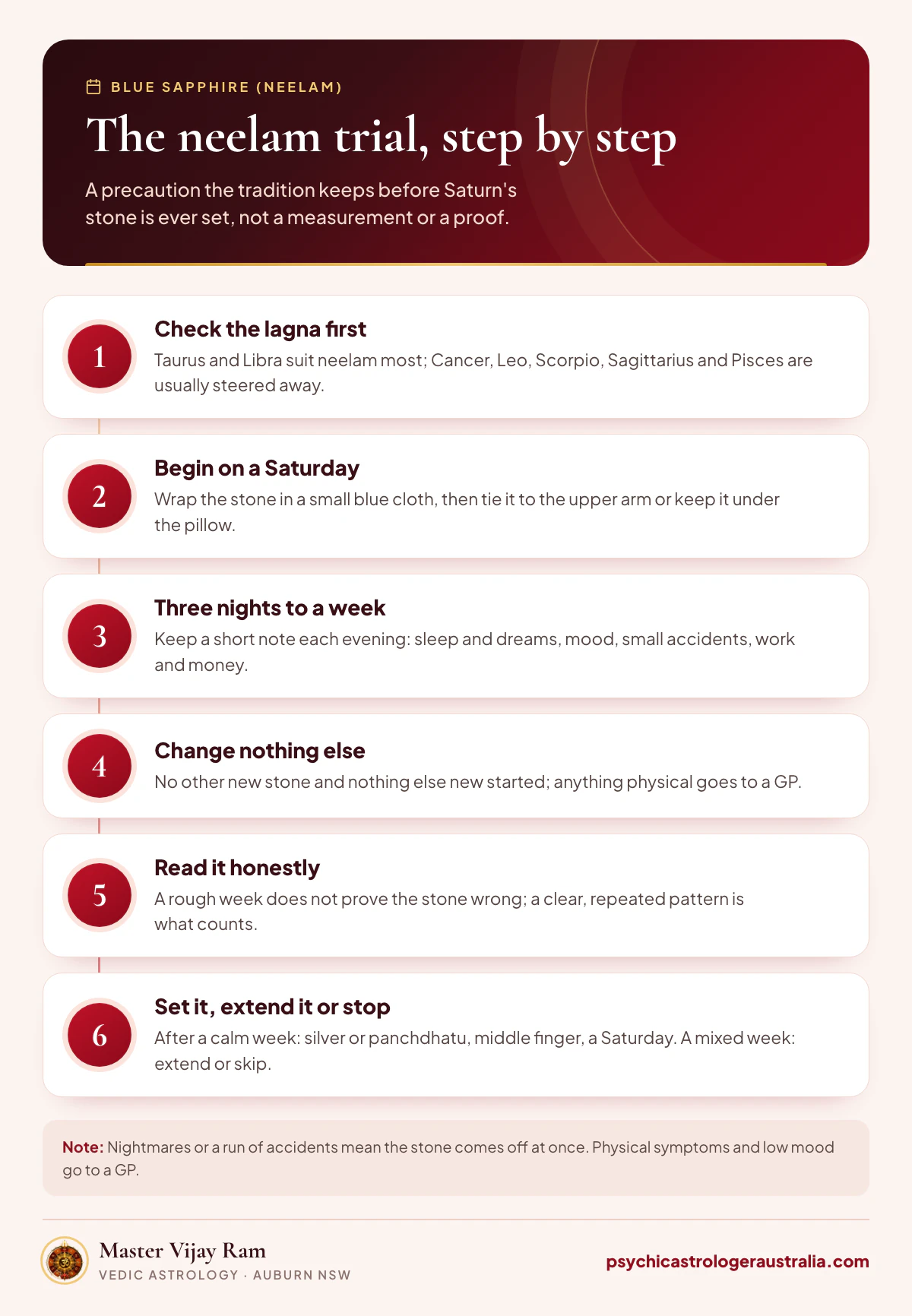
Practice varies by lineage, but a common form begins on a Saturday. The stone, wrapped in a small piece of blue cloth, is tied to the upper arm or kept under the pillow, and stays there for three nights at the least, often a full week, while the person keeps a short written note each evening. Nothing else new is started that week, no other new stone is added, and anything physical that arises is taken to a GP rather than to the diary.
| What to note each day | Read as a good sign | Read as a warning |
|---|---|---|
| Sleep and dreams | Settled sleep, ordinary dreams | Broken sleep, repeated nightmares |
| Mood and temper | Steadier, more patient | Heavy, low or unusually irritable |
| Small accidents and near misses | Nothing out of the ordinary | A cluster of knocks, falls or close calls |
| Work and money | Moving at the usual pace | Sudden losses, disputes or setbacks |
| How others treat you | Ordinary or warmer | A run of coldness or conflict |
How is the trial read honestly?
A trial is a precaution, not a measurement. A week is short, life brings bad nights and small knocks anyway, and someone who expects a famous stone to cause trouble tends to notice trouble, so a rough week does not prove the stone is wrong and a calm one does not prove it is right. What the trial does well is catch a clear, repeated pattern early, before a stone is set and worn for months.
Where the week is mixed, the usual advice is to extend the trial or simply not to wear the stone. No one should push on through nightmares or a string of accidents to see whether things settle.
What side effects are blamed on a blue sapphire?
Most of the blue sapphire side effects people describe show Saturn's harder face: disturbed sleep and dark dreams, a heavy or low mood, withdrawal from family, sudden reversals at work, money slipping away, and a run of minor accidents. In the tradition's reading, that is a Saturn the chart did not want strengthened, and the remedy is to remove the stone at once. A low mood that lingers after the stone is off, or anything physical, belongs with a GP, who can also point you to support for the heavier weeks.
After a good trial, how is neelam worn?
The common practice sets neelam in silver or panchdhatu, the five-metal alloy, on the middle finger, which palmistry links with Saturn, with Saturday as the first day of wearing, after the Saturn beej mantra, Om Praam Preem Praum Sah Shanaye Namah. Lineages disagree about the hour, morning or evening, about the hand and about the preparation, and the version your family follows is a sound one. Jewellers are usually asked to leave the back open, so the sapphire sits against the finger.
Amethyst or iolite instead?
The tradition's uparatnas for Saturn are amethyst, a purple quartz, and iolite, a violet-blue gem that changes colour as it is turned and was once called water sapphire. Both are far gentler in the tradition's reading, which makes them a sensible first step where the lagna welcomes Saturn but the person is wary of neelam's reputation. For the five lagnas that avoid neelam they are no workaround, since they serve the same Saturn.
What has been done to the stone, and who should tell you?
Heating is the routine treatment for blue sapphire, used to deepen the colour and clear silky inclusions, and the trade accepts it as long as the buyer is told. Some are diffusion-treated, with colour driven in from the surface and sometimes only skin-deep, and synthetic sapphire grown by flame fusion, glass imitations and assembled doublets also circulate. The seller should tell you in writing, and an independent laboratory should confirm anything costly.
Traditions differ on whether a heated stone serves Saturn, and many practitioners ask for an unheated natural neelam ratna, while a diffused or assembled stone is widely refused. Buying advice is a qualified gemmologist's work, and a stone that does not match its description is covered by the Australian Consumer Law. Master Vijay Ram sells no sapphires or any other stones.
Does Sade Sati or Saturn's mahadasha call for a neelam?
Neither does by itself. Sade Sati is a transit read from the Moon sign, and the Shani mahadasha, nineteen years long, is a period read from the birth chart; both raise the question of Saturn, but whether a neelam belongs on your hand still depends on Saturn's houses from your lagna and its strength. Children born with the Moon in Pushya, Anuradha or Uttara Bhadrapada begin life in Saturn's period.
For many people in either situation the better support is Saturn's own discipline, a Saturday sesame-oil lamp, the Hanuman Chalisa, help given to elderly and poor people, and patient work, which Sade Sati and Shani remedies describes; the Shani mahadasha years covers the long period itself.
How does Vijay Ram ji handle a neelam enquiry?
Master Vijay Ram first establishes the lagna from an exact birth time, then reads Saturn's two houses, its sign and company, and the period running, before saying whether a neelam is worth a trial, whether amethyst or iolite is the better start, or whether no stone suits. If a trial is warranted he explains how to run and read it. His fee for the consultation is $50; it can be done on the phone, over video or on WhatsApp, in the family's choice of Hindi, Punjabi or English, or at his place of practice in Auburn, by appointment.
Picture, for example, a forklift driver in Sunnybank with a Pisces Moon, worried by Sade Sati, might be told by a relative to buy a neelam at once. If his lagna is Leo, Saturn rules his sixth and seventh and neelam is the wrong answer; the reading would put its weight on Saturday practice and on the work and health questions the year raises; Brisbane astrology readings run on Queensland time, without daylight saving. If a Shani shanti suits the chart, a puja or havan for Saturn is performed by him in person in Auburn, from $250, after the cost has been agreed.
Read next
- Yellow Sapphire (Pukhraj): Jupiter’s Stone, Marriage and WisdomYellow sapphire (pukhraj) in Vedic astrology: Jupiter’s stone, the lagnas it suits, who should avoid it, the marriage…
- Hessonite (Gomed): Rahu’s Stone and When It Is SuggestedHessonite (gomed) in Vedic astrology: Rahu’s stone, how it is judged without a sign, when it is suggested or avoided,…
- Love Spell Backfire: What Goes Wrong and How to Repair ItA love spell backfire rarely looks dramatic. Learn the three ways it goes wrong, when it tends to surface, and how ho…
Frequently asked questions
Who should wear a blue sapphire (neelam)?
Taurus and Libra lagnas first, because Saturn is their yogakaraka, then Capricorn and Aquarius, where Saturn is the lagna lord, in each case when Saturn lacks strength and the current dasha gives its help some point. Aries, Gemini and Virgo lagnas are mixed. Even a well-suited chart trials the stone before it is set, and fixing the lagna takes a birth time you can trust.
Which lagnas are usually told not to wear neelam?
Cancer, Leo, Scorpio, Sagittarius and Pisces. For them Saturn rules the seventh and eighth, the sixth and seventh, the third and fourth, the second and third, or the eleventh and twelfth, houses the tradition prefers not to strengthen. A Saturn that is already strong is also left alone, and neelam is never combined with ruby, pearl or red coral.
How long is the blue sapphire trial period?
Traditions differ, but three nights is the usual minimum and a full week, Saturday to Saturday, is common. The stone is kept close, wrapped in blue cloth on the upper arm or under the pillow, while sleep, mood, small accidents, work and relationships are noted each evening. A mixed week means extending the trial or not wearing the stone; a bad one means removing it at once.
What if the neelam trial goes badly?
Take the stone off and stop there. Nightmares, a heavy mood, a cluster of small accidents or sudden setbacks during the trial are read by the tradition as Saturn refusing the arrangement, and nobody needs to test the point further. Note what happened, return to the chart with the dates, and take anything physical, or a low mood that persists, to a GP.
Should I wear neelam during Sade Sati?
Not because of Sade Sati. The transit is read from the Moon sign and is shared by everyone with that Moon, while the stone depends on Saturn's houses from your lagna. For a Taurus or Libra lagna a neelam may suit, Sade Sati or not; for a Leo or Cancer lagna it is usually wrong even at the worst of the transit. Saturday practices suit every chart.
Can a blue sapphire be worn with ruby or pearl?
No. The tradition sets Saturn against the Sun, Moon and Mars, so neelam never shares a hand with ruby, pearl or red coral. Emerald or diamond may join it where those planets also need support, Mercury and Venus being Saturn's friends in the tradition. Most charts that suit neelam are well served by it alone, and a crowded hand is rarely a better one.
Why is neelam worn on the middle finger?
Palmistry assigns the middle finger to Saturn, so the tradition places Saturn's stone there, set in silver or panchdhatu and first worn on a Saturday after the Saturn mantra. Which hand and what hour are matters of lineage, and a family's own custom is acceptable. The setting usually leaves the back of the stone uncovered.
Does it matter if my neelam has been heated?
Traditions differ. Heat treatment is routine in the sapphire trade; a good number of practitioners are content with a heated stone that is declared, and some want only unheated ones. Diffusion-treated stones, whose colour may be only skin-deep, and assembled doublets are widely refused. Whatever you buy, the treatment belongs in writing on the invoice, and an independent laboratory report is worth having for anything costly.
Does Saturn moving into Aries in 2027 mean I need neelam?
No. Saturn enters Aries, its sign of debilitation, on 3 June 2027 and returns to Pisces on 20 October 2027, Sydney dates, but a transit is shared by everyone and cannot by itself tell you anything about your natal Saturn. A reading can show which of your houses the transit touches; whether a stone helps depends on Saturn's houses from your lagna and its strength at birth.
People also ask
What are the benefits of neelam stone?
When Saturn is both a friend to the lagna and short of strength, neelam is traditionally worn to support steady work, promotion earned over time, discipline, endurance, property and fairness from employers. The tradition describes these as leanings a stronger Saturn favours, not as outcomes. On the wrong chart it is linked with delay, isolation and loss instead, which is why it is trialled first.
Does neelam act faster than other stones?
That is its reputation in the tradition, for good or ill, and the reason a trial is customary. Nothing measures it, and a fast change after a new ring is just as often coincidence or expectation. Treat the reputation as a reason for caution and a trial, not as a promise, and judge any benefit slowly over the months that follow.
Why is blue sapphire called a dangerous stone?
Because Saturn rules difficult houses for five of the twelve lagnas, because the tradition says the stone acts quickly, and because it is sold hardest to people frightened by Sade Sati. Chosen from the chart and trialled first, it is treated like any other stone, and for a Taurus or Libra lagna with a weak Saturn it may be among the most useful.
Can I trial neelam with a cheaper stone?
Most lineages trial the very stone that will be set, because the point is to see how that particular stone sits with you, and a cheaper sample tells you about a different stone. If cost is the concern, amethyst or iolite, the accepted substitutes, can be worn instead for a milder version of the same planet, and only where Saturn suits the lagna.
References & further reading
Serving clients across Australia
Confidential consultations by phone, video & WhatsApp — including: