

Quick answer
Spirit disturbance at work is the reading of a presence in a shop, office or warehouse: staff who avoid a room, sounds on the night shift, a cold corner customers walk away from. Master Vijay Ram checks the building's ordinary causes first, then reads the owner's chart, the opening date and the premises, and clears what remains from Auburn without anyone visiting the site.
When the back room empties
A restaurant owner whose kitchen hands will not go into the cool room alone, a warehouse supervisor whose night shift hears a forklift that is not running, an office manager whose staff have renamed the third-floor meeting room: each rings about something at work that nobody will put in an email. Spirit disturbance at work is the reading of a presence in a commercial premises, a shop, an office, a factory floor, and the clearing that follows if the reading finds one. It is also, more often than not, the discovery that a building and a rumour have done the whole thing between them.
Master Vijay Ram approaches spirit disturbance at work as he approaches a home: the ordinary causes first, then the owner's chart, the opening of the business and the premises themselves, and only then a remedy. Nobody visits the site, trading is never interrupted, and no member of staff is ever named as the cause.
What do staff and customers actually report?
The reports are remarkably consistent across trades. A room or a corner that staff avoid without quite saying why. Sounds after close: doors, footsteps, a trolley, a voice from the stock room. Lights that flicker in one bay only, a cold spot in a warm shop, and customers who come in, look around and walk out, with a till that has been quiet since a date everyone remembers.
Alongside those come the human ones: a staff member who has become withdrawn, two who argue in the same corner, a manager who cannot keep anyone past three months. Those belong to a different conversation, and the consultation separates them early.
What does a building do on its own?
Commercial buildings are louder and stranger than homes. Fluorescent tubes flicker and hum as their ballasts age, and old wiring warms one wall. Air-conditioning plant, extraction fans and refrigeration motors produce a low hum that people feel rather than hear, and that is known to cause unease and a sense of being watched in those who sit near it all day.
Roller doors tick as they cool, racking settles under load, and a cool room's compressor cycles at the same minute every hour. Rodents cross a ceiling with a footstep's weight, motion sensors trip alarms on a moth, and the cleaner comes at eleven and leaves a door ajar. If one of these fits, the consultation says so, and the fix is an electrician, not an astrologer.
Rumour travels faster than any spirit
A workplace is a story-telling machine. One worker's bad night becomes the room's history by the end of the week, and new staff are told it on their first day, before they have formed any impression of their own. From then on, every creak confirms it.
That is not a reason to dismiss the staff, who are describing something real to them; it is a reason to take separate accounts, in private, and to ask when each person first heard the story. Vijay Ram ji does this before reading anything, and he will not entertain the suggestion that one employee, or a competitor down the road, is behind it. A negative presence at work is never pinned on a person.
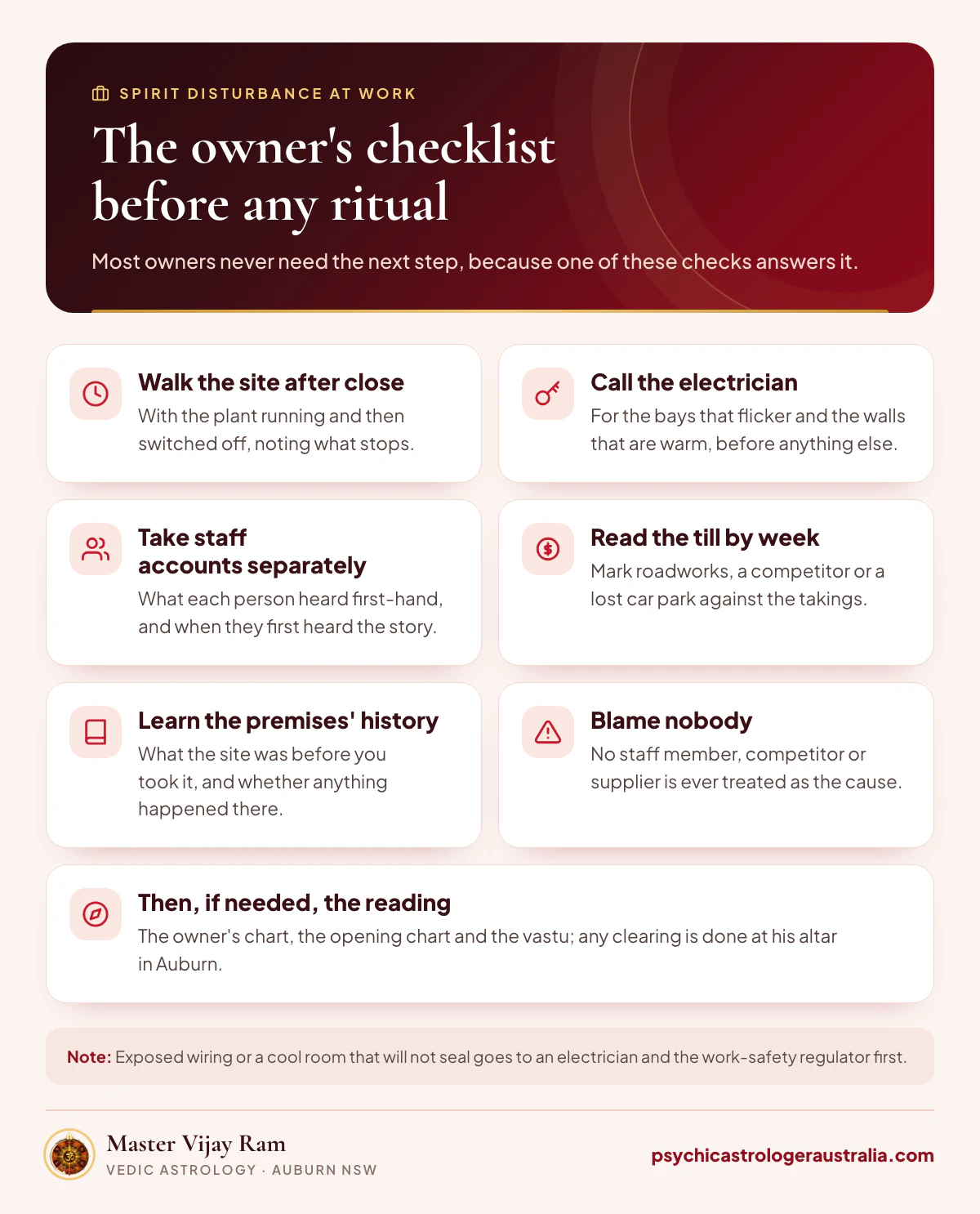
The owner's checklist before any ritual
- Walk the premises after close with the plant running and then with it off, and note what stops.
- Have the electrician check the bays that flicker and the walls that are warm.
- Ask each staff member separately when it began and what they heard first-hand, not second-hand.
- Look at the till by week, not by feeling, and mark the dates of any change in the street: roadworks, a competitor, a lost car park.
- Find out what the premises was before you took it, and whether anything happened there.
Most owners never need the next step, because one of these answers it. The ones who do have, at least, a clean account to bring.
Signs, ordinary causes and checks
The table lists what workplaces report most often, the ordinary cause that usually explains it, and what to check before any reading.
| What is reported | Ordinary cause in a commercial building | What to check |
|---|---|---|
| Sounds after close: footsteps, doors, a trolley | Plant cooling, racking settling, rodents, the cleaner's round | Walk the site with plant on and off; ask the cleaner's hours |
| Flicker in one bay, a warm wall | Ageing ballasts and wiring | Electrician, before anything else |
| Unease near a particular machine or wall | Low-frequency hum from fans, compressors or plant | Move the desk; have the plant serviced |
| Customers walk in and out; the till is quiet since a date | Street change, parking, a competitor, the fit-out, a staff change | Weekly takings against the calendar of what changed |
| Several staff, separately, describe the same room and hour | A shared cause not yet found, or a presence worth reading | Separate accounts, the checklist, then a consultation |
What does the Vedic reading look at?
Three charts, where they exist. The owner's birth chart, for the dasha running when the trouble began and the houses of work and gain. The business's own chart, drawn for the day and hour it opened, if that is known, which is why the guide to business astrology and launch timing asks owners to keep that record. And the premises, read by vastu: the entrance, the direction the counter faces, where the stock and the water sit, what occupies the north-east.
A premises with a history, a previous trade that failed in the same room, a death on the site, is read with that in mind, without anyone being told the place is cursed. A vastu consultation covers the premises on its own where that is the whole question; a haunted business in the owner's words is usually a vastu question with a story attached.
What does a clearing for a business involve?
Where the reading finds a presence, the release and a shanti for the premises are performed at Master Vijay Ram's altar in Auburn on a muhurat, with the hour given to the owner, as spirit and ghost removal describes. Nothing is done on the shop floor during trading, and nothing is done that staff could find alarming.
The owner then keeps a short opening practice, a lamp or incense within the building's fire rules, a Ganesh or Lakshmi prayer at the counter, the entrance kept clean, for a few weeks. The remedy is puja or havan performed personally on request, agreed before it is done. Staff are told, if they are told anything, that the owner has had the place blessed, which is true and is usually welcome.
Keeping a workplace steady afterwards
A premises stays steady for the same reasons a home does: it is clean, lit, aired and used with respect. Honest dealing with staff and customers does more for a shop's atmosphere than any yantra, and an owner who pays on time and keeps the back room tidy rarely rings twice. The car, shop and rental cleansing guide sets out the simple weekly practices that owners actually keep.
Where the business itself is struggling, the chart is read for that too, and business and career guidance looks at the periods ahead rather than at the corner everyone avoids.
When is this not the answer?
An unsafe workplace, exposed wiring, a cool room that will not seal, a mezzanine without a rail, is a matter for an electrician and the state's work-safety regulator, not for a reading. Bullying, a withdrawn staff member or a manager under strain are human matters, and Beyond Blue and a GP come before anything spiritual. A shop in a street that has lost its foot traffic has a commercial problem, and Vijay Ram ji will say so rather than sell a clearing to a business that needs a new lease.
This is faith-based guidance, beside the electrician, the accountant and the doctor, never instead of them.
What does it cost?
A consultation is $50, by phone, video or WhatsApp, and it covers the checklist, the staff accounts and the charts. Most end with a tradesperson's number and a change of habit. Where a clearing is warranted it starts from $250, agreed before anything is performed and not raised afterwards, and the figure does not change with the size of the premises or the size of the fear.
Restaurants, salons and warehouses: who rings
The calls come from the restaurants and grocers along Wigram Street, which the Harris Park page describes, from the warehouses and workshops of the south-east, covered on the Dandenong page, and from family shops in every capital; the Adelaide page explains how a reading reaches an owner there. A spirit in a shop is rung about most often by the person who locks up alone.
What to do next
Do the walk-through, book the electrician, and take the staff accounts separately. Then ring or message with your own birth details, the opening date of the business if you have it, and the checklist in front of you, in English, Hindi or Punjabi. By the end of the conversation you will know whether the building, the street or the premises is the question, and exactly what would be done and for how much if anything is to be done at all.
Read next
- Evil Spirit Removal for a Rented or Shared HomeEvil spirit removal for a rental or share house: what a tenant can do without the landlord, the ordinary causes to ch…
- Black Magic at Work: Signs Your Career Is Being BlockedCareer stuck for no clear reason? Learn which signs point to something spiritual, what is safe to do at home, and whe…
- Hex Removal Specialist in Australia: What the Work Involves and CostsHex removal specialist in Australia: how a hex is diagnosed, what removal involves, realistic arcs, what it costs and…
Frequently asked questions
My staff refuse to work in one room. Is that a spirit?
Usually it is a story with a draught behind it. Take each account separately and ask what each person heard first-hand and when they first heard the room's history; then walk the room with the plant on and off and have the electrician look at the lighting and the wall. If several people independently describe the same hour and sensation after that, the room is worth a reading, and the chart and the premises are looked at together.
Can a business be cleared without closing for a day?
Yes. Nothing is done on the premises at all. The release and a shanti for the site are performed at Master Vijay Ram's own altar in Auburn on a muhurat, and the owner is told the hour. Trading continues, staff are not asked to take part, and the only change on the floor is a short opening practice the owner keeps afterwards, within the building's fire rules.
Should I tell my staff I had the premises blessed?
Tell them the truth, which is that the place has been blessed, and leave it there. Most staff find that reassuring, whatever their own faith, and it closes the story rather than feeding it. Do not announce a spirit, a removal or a cause, and never suggest a person was behind it. A workplace steadies fastest when the owner is calm and the room is lit, clean and in use.
Does the previous tenant's failure affect my shop?
A premises carries its history in practical ways, a fit-out that suited a different trade, a reputation in the street, a corner that never worked, and the reading takes that into account. It does not mean the site is cursed, and nobody is told that. Vastu looks at the entrance, the counter and what sits in each direction, and the owner's own chart and the opening chart carry more weight than the last tenant's luck.
Could a competitor have done something to my business?
Owners ask this often, and the honest answer is that a competitor's price, parking and opening hours do far more to a till than any ritual could. Master Vijay Ram will not name a rival, a supplier or a staff member as the cause of anything, and a practitioner who does is to be avoided. The chart is read for the period the business is in, and the remedy, if any, protects the premises rather than pointing at anyone.
What is a business opening chart and why does it matter?
It is the chart drawn for the day and hour the business opened its doors, read as a birth chart for the enterprise. Where the date and time are known, it shows the periods the business is passing through and the houses of trade, staff and gain, which is why owners are asked to keep that record. Without it the owner's own chart carries the reading, which is still a full picture.
What does a workplace clearing cost?
A consultation is $50 and covers the checklist, the separate staff accounts and the charts; most end with a tradesperson's number and a change of habit. Where a clearing of the premises is warranted it starts from $250, agreed before anything is performed and not raised afterwards. The figure does not rise with the size of the warehouse or the strength of the story.
Our warehouse night shift hears a forklift that is not running. What is that?
Almost always plant. Refrigeration compressors, extraction fans and charging equipment cycle on and off through the night, racking settles as the building cools, and a roller door ticks for an hour after close. Walk the floor at the same hour with each system switched off in turn and the sound usually finds its source. If it does not, and more than one worker describes it the same way, bring the log to a consultation.
Can vastu fix a shop that customers leave quickly?
Vastu looks at the things a customer feels without noticing: the entrance and what faces it, the direction of the counter, where stock and water sit, whether the north-east is clear. Those are corrected cheaply, by moving things rather than building. It cannot fix a lost car park, a competitor's prices or a street that has emptied, and an honest consultation will say which of those is doing the damage.
People also ask
What are the signs of negative energy in a workplace?
Owners describe a room staff avoid, sounds after close, flicker in one bay, a cold corner and customers who walk out, with a till quiet since a remembered date. Each has an ordinary cause, ballasts, plant hum, rodents, a street change, which is checked first. A reading looks at what remains after that, in the owner's chart and the premises, and never at a person.
How do you remove negative energy from a business?
Begin with the building: the electrician, the plant, the cleaner's hours and the street. Then, where a reading finds a presence or heaviness, a shanti and protection for the premises are performed at the practitioner's altar on a muhurat, and the owner keeps a short opening practice, a lamp or incense within fire rules, a prayer at the counter and a clean entrance. Honest dealing with staff and customers does the rest.
Can a shop be haunted?
In the Vedic frame a pret-atma can attach to a place with a history, and a few premises are read that way. Far more often a shop is loud plant, a bad corner and a story told to every new employee on their first day. The useful question is not whether a place can be haunted but what explains this place, and that is answered by a walk-through, separate accounts and a reading of the owner's chart.
What does vastu say about a shop entrance?
That it should be clear, lit and easy to see into, facing a direction that suits the trade and the owner's chart, with nothing heavy or broken beside it and no water or rubbish in front. The counter should let the owner face the door, and the north-east should not be the storeroom. Most corrections are a matter of moving furniture, which costs far less than a fit-out.
Who do I call about an unsafe workplace instead of a healer?
The electrician first for anything that flickers, warms or sparks, and the state work-safety regulator for anything that could hurt someone: exposed wiring, a cool room that traps, a mezzanine without a rail. A withdrawn or frightened staff member needs a GP and Beyond Blue before anything spiritual. A reading comes after those, never in their place.
References & further reading
Serving clients across Australia
Confidential consultations by phone, video & WhatsApp — including: